Property Acquisition Due Diligence Checklist: 2026 Guide
22 September 2026Most investment teams treat property vetting as a defensive formality, but institutional due diligence actively dictates your entire capital structure. You already know the high-stakes friction of compressed closing windows. Overlooking an unrecorded utility easement, miscalculating immediate structural repairs, or discovering zoning encumbrances can stall project momentum and compromise debt underwriting before site work even begins. Adopting an institutional-grade due diligence checklist for property acquisition ensures your acquisitions team uncovers every operational vulnerability well before earnest money goes hard.
By establishing rigorous oversight across legal, physical, and environmental disciplines, you protect your baseline yield and preserve long-term asset value. In this 2026 guide, you’ll learn how to standardize complex multi-track workflows, align physical asset assessments with lender parameters, and structure an airtight risk mitigation framework before waiving contractual contingencies. We examine the critical benchmarks across title, environmental reviews, and engineering audits so you can deploy acquisition capital with complete confidence.
Key Takeaways
- Deploying an institutional-grade due diligence checklist for property acquisition across five core operational tracks protects equity before contractual contingencies expire.
- Executing updated Property Condition Assessments and Phase I Environmental Site Assessments uncovers urgent structural liabilities and emerging hazardous substance exposures early.
- Synchronizing physical and financial audit findings directly with lender underwriting criteria creates a seamless pathway from acquisition bridging facilities to development finance.
- Translating operational discrepancies into tailored escrow holdbacks and enforceable seller covenants ensures complete risk remediation before title transfer and closing.
Institutional Framework: Foundations of Commercial Property Due Diligence
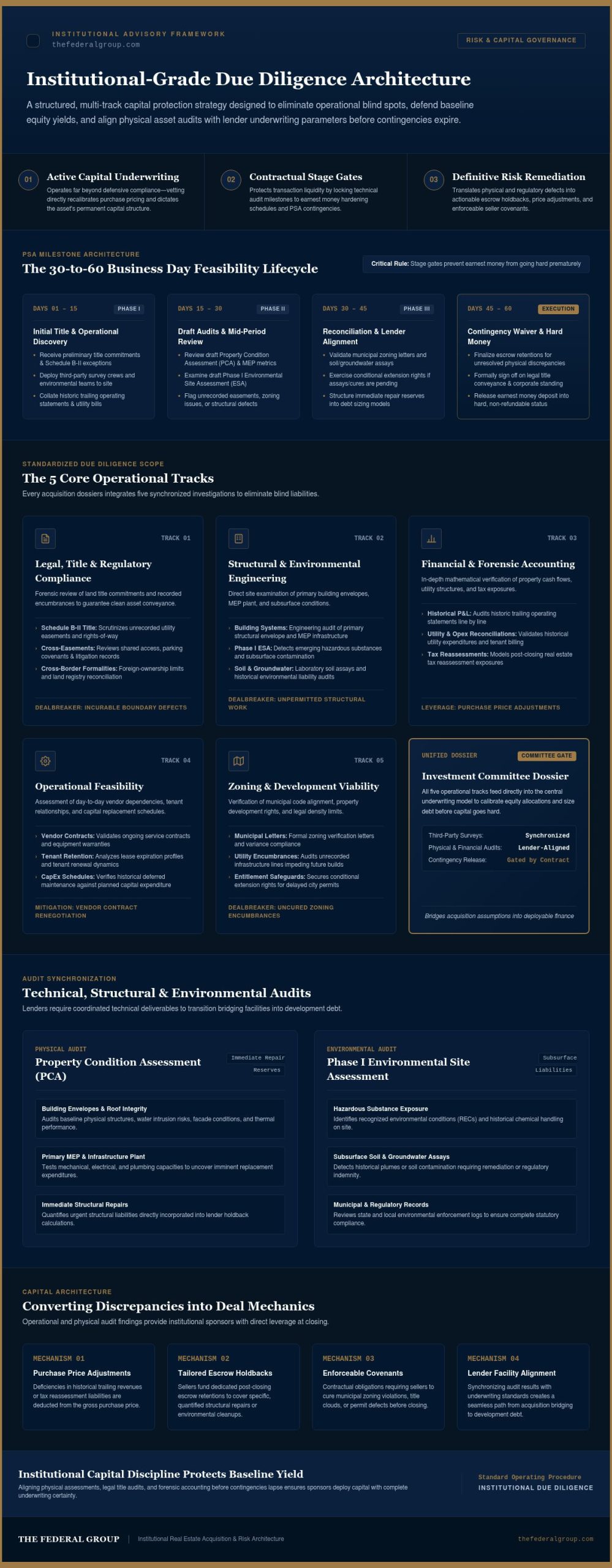
Commercial property due diligence operates as a multi-disciplinary capital protection strategy rather than an administrative compliance routine. Far beyond passive task checklists, established due diligence principles demand an active, forensic investigation into every element that impacts an asset’s revenue profile and legal viability. The primary objectives are straightforward: verify the physical and contractual condition of the real estate, eliminate blind operational risks, and calibrate acquisition pricing against real underwriting parameters. Early audit findings provide institutional sponsors with the leverage required to negotiate purchase price adjustments, structure post-closing escrow retentions, or walk away before capital is permanently compromised.
Rigorous property vetting forms the indispensable foundation for securing institutional development capital and private equity co-investments. When an audit validates structural integrity, clean legal standing, and reliable tenant yields, capital deployment accelerates smoothly. Due diligence serves fundamentally as risk-adjusted capital underwriting that bridges preliminary assumptions with deployable financing.
Core Pillars of the Institutional Due Diligence Architecture
A reliable due diligence checklist for property acquisition integrates four distinct investigative tracks into a unified investment committee dossier:
- Legal and Corporate Compliance: Scrutinizes land title commitments, municipal land-use entitlements, cross-easement declarations, and litigation records to ensure clean conveyance.
- Structural and Environmental Engineering: Audits baseline physical conditions, primary building envelopes, MEP systems, and subsurface soil or groundwater liabilities.
- Financial and Forensic Accounting: Audits historic trailing operating statements, historical utility expenditures, real estate tax reassessment exposures, and tenant billing reconciliations.
- Operational Feasibility: Validates ongoing service contracts, vendor performance warranties, tenant renewal dynamics, and capital expenditure schedules.
Sponsorship leads must actively align third-party survey crews, legal counsel, and environmental professionals with the internal deal team. This coordination ensures all findings directly inform equity allocation and debt sizing.
Managing Timelines and Purchase and Sale Agreement Milestones
Institutional acquisition timelines typically operate within a strict thirty to sixty business day feasibility period. Sponsors must negotiate purchase and sale agreements (PSAs) that correlate these windows with key technical deliverables. Inspection periods must establish clear stage gates, requiring draft engineering reports and title commitments prior to mid-period milestones.
Critically, contracts should incorporate conditional extension rights tied specifically to delayed municipal zoning letters, laboratory soil assays, or pending title dispute cures. Managing earnest money deposit releases alongside these stage gates prevents deposits from going hard prematurely. By aligning the due diligence checklist for property acquisition with binding contract provisions, investment teams protect transaction liquidity while verifying every core asset fundamental.
The Definitive Property Acquisition Checklist: 5 Core Investigative Tracks
Executing an institutional transaction requires structuring raw site findings into actionable decision gates. A comprehensive due diligence checklist for property acquisition partitions the asset into five synchronized investigative tracks: legal title, physical plant, financial performance, operational contracts, and development viability. Cross-border acquisitions introduce added friction, demanding reconciliation with jurisdictional land registries, local foreign-ownership restrictions, and notarization formalities. Deal teams categorize findings into minor adjustments, such as routine repair escrows, or outright dealbreakers like incurable boundary defects or unpermitted structural conversions.
Legal, Title, and Regulatory Compliance Audit
Legal teams begin by dissecting the preliminary title commitment alongside current land records. Key audit targets include:
- Schedule B-II Title Exceptions: Scrutinize unrecorded easements, mineral reservations, utility rights-of-way, and restrictive covenants that limit future redevelopment.
- Zoning and Permitted Uses: Verify local municipal zoning codes, parking minimums, floor area ratios (FAR), and any legal non-conforming status.
- Municipal Code Compliance: Pull certificates of occupancy, open building permits, pending fire code violations, and historical land-use variances.
Financial Forensics, Historical Rent Rolls, and Operational Audits
Forensic accounting validates that the cash flow presented in marketing packages reflects actual operational durability. Underwriters reconcile three to five years of audited trailing operating statements against historical corporate tax returns. They cross-check security deposit balances against bank reserves and verify tenant payment histories.
Each lease demands individual abstraction to flag early termination kick-outs, co-tenancy clauses, exclusive-use restrictions, and ongoing tenant improvement allowances. Teams must collect signed tenant estoppels to confirm lease terms independently. In parallel, operational auditors evaluate vendor maintenance agreements, annual utility capacity charges, and impending municipal tax reassessments upon title transfer.
Development Potential, Utilities, and Entitlement Viability
Long-term asset optimization requires validating the physical environment and development parameters. Environmental investigations must strictly satisfy the EPA All Appropriate Inquiries rule under CERCLA to ensure prospective purchaser protections. Engineering consultants assess municipal water pressure, stormwater retention capacity, and sanitary sewer allocations.
Engaging an integrated design and build developer streamlines lifecycle planning by converting physical entitlement limits into precise construction models. Reviewing architectural massing guidelines, municipal development agreements, and regional infrastructure master plans ensures the asset’s expansion potential aligns with the primary due diligence checklist for property acquisition before closing.
Once your due diligence validates site viability, structuring bespoke bridge financing or co-investment equity through The Federal Group accelerates capital deployment and secures ownership across complex transactions.
Technical, Structural, and Environmental Property Site Assessments
Engineering and environmental audits protect buyers from inheriting severe physical liabilities. While legal reviews examine ownership history, on-site technical diagnostics evaluate physical assets and quantify required capital expenditures. A rigorous due diligence checklist for property acquisition moves through four disciplined steps: commissioning an engineering Property Condition Assessment (PCA), performing a Phase I Environmental Site Assessment (ESA), escalating to subsurface testing when necessary, and auditing life-safety and envelope assemblies.
Property Condition Assessments and Immediate Capital Expenditure Projections
Site investigations begin with an institutional PCA conducted under the active ASTM E2018 standard. Field engineers inspect structural components, foundation slabs, load-bearing masonry, and roof membranes for water intrusion or material fatigue. Specialized technicians inspect primary mechanical, electrical, and plumbing (MEP) infrastructure, vertical transport elevators, and fire suppression systems to benchmark remaining useful life.
Engineering teams organize their financial findings into two separate tables: immediate repair costs and baseline replacement reserves across a standard 10-to-12-year window. Immediate costs isolate active building code violations and urgent life-safety hazards. These immediate line items satisfy the baseline engineering criteria established under OCC commercial real estate lending standards, preventing unexpected equity reductions after contract execution.
Environmental Site Assessments and Hazardous Material Discovery
Environmental diligence requires executing a Phase I ESA strictly compliant with ASTM E1527-21. The assessment reviews historical land titles, aerial photography, regulatory databases, and adjoining properties to identify Recognized Environmental Conditions (RECs). Because per- and polyfluoroalkyl substances (PFAS) carry hazardous substance classifications under CERCLA, historical fire-suppression storage, industrial metal plating, and chemical handling require active evaluation.
When an ESA discovers an active or historical REC, buyers must quickly escalate to an intrusive Phase II assessment. This protocol entails direct soil borings, sub-slab vapor testing, and groundwater monitoring to quantify contamination boundaries. Alongside contamination scans, environmental teams assess regional natural hazard profiles, verifying FEMA 100-year flood zone designations and earthquake Probable Maximum Loss (PML) ratios.
Energy Efficiency, ESG Standards, and Future Retrofit Compliance
Technical due diligence today addresses mandatory performance standards and institutional sustainability criteria. Engineering teams review Energy Star ratings, municipal decarbonization statutes, and regional building emissions penalty thresholds. These local ordinances expose legacy properties to significant annual fines if energy intensity targets are missed.
Asset managers evaluate the capital requirements needed to electrify thermal systems, upgrade glazing performance, and integrate smart building management software. Incorporating lifecycle energy modeling into the primary due diligence checklist for property acquisition ensures sponsors preserve future net operating income and protect institutional liquidity.
Capital Alignment: Transitioning Due Diligence into Financing Architecture
Institutional sponsors recognize that technical audits directly dictate loan covenants and equity participation. A thorough due diligence checklist for property acquisition provides the quantitative foundation for risk-calibrated financing architecture. Credit committees evaluate immediate capital liabilities, tenant lease durations, and environmental risk profiles to set debt yields and leverage thresholds. Incorporating these findings into structured international property development finance guarantees capitalization aligns with the true physical state of the asset.
Underwriting Calibration Based on Physical and Financial Findings
Lenders actively adjust debt sizing when engineering reports reveal operational drag or deferred maintenance. When physical assessments document imminent mechanical replacements or roofing degradation, credit underwriters deduct these capital expenditures directly from effective loan proceeds or mandate cash repair reserves.
Tenant lease reviews drive corresponding adjustments. Expiring leases, co-tenancy vulnerabilities, or tenant concentration risks trigger elevated debt service coverage ratio buffers and expanded interest reserves to safeguard liquidity during repositioning phases. Rather than absorbing these financial adjustments, sponsors leverage the due diligence checklist for property acquisition to negotiate seller credits, establish post-closing escrow holdbacks, or adjust purchase pricing to preserve baseline underwriting yields.
Strategic Deployment of Bridging Loans and Development Capital
Compressed contract timelines rarely accommodate conventional underwriting processes. When sellers demand rapid execution, institutional sponsors deploy short-term bridging finance for land acquisition to capture strategic parcels before final municipal permits are secured. This agile capital secures the site while technical teams complete detailed feasibility evaluations.
Once civil plans, zoning entitlements, and environmental clearances are confirmed, sponsors refinance short-term acquisition debt into structured construction funding. Collaborating with an aligned real estate private equity partner bridges equity capitalization gaps and delivers institutional balance-sheet strength across the entire project lifecycle.
If you’re preparing to capitalize on a high-value asset, contact The Federal Group to structure your acquisition financing with certainty and speed.
Risk Remediation, Transaction Closing, and Post-Acquisition Integration
Due diligence culminates at the closing table, where technical findings transform into enforceable risk remediation tools. Institutional buyers don’t simply accept asset deficiencies uncovered during feasibility reviews; they convert them into binding contractual covenants, seller credits, and structured indemnity protections. A methodical closing protocol ensures clean title conveyance, verifies final lien waivers, and coordinates escrow funds settlement without operational friction.
Contractual Protections and Purchase Price Negotiations
Uncovering physical or legal defects doesn’t have to terminate an acquisition. Buyers preserve transaction momentum by deploying specific contractual mechanisms:
- Representations and Warranties: Structure robust seller representations regarding environmental status, pending litigation, and tenant defaults, pairing them with post-closing indemnity survival periods spanning nine to twelve months.
- Targeted Escrow Holdbacks: Establish formal escrow retentions with precise disbursement triggers to resolve pending municipal code violations, incomplete repairs, or tenant lease disputes.
- Purchase Price Reductions: When an institutional due diligence checklist for property acquisition flags unrecoverable deferred maintenance, sponsors utilize verified engineering cost estimates to negotiate direct price adjustments.
Operational Handover and 100-Day Asset Management Activation
Once funds settle and title transfers, risk mitigation shifts to active site execution. A structured 100-day onboarding roadmap prevents operational blind spots from eroding project yields. Asset management teams immediately issue formal tenant notifications, redirecting rent collections to designated borrower accounts while seamlessly transferring utility meters and building service agreements.
Operations teams promptly mobilize contractors to rectify immediate life-safety items and deferred maintenance documented in the property condition report. Resolving these operational vulnerabilities on day one protects tenant satisfaction and stabilizes net operating income. For sponsors managing complex asset repositioning, value-add conversions, or ground-up construction, partnering with The Federal Group provides bespoke capital deployment solutions, development finance, and private equity co-investments tailored to institutional standards.
Transforming Acquisition Intelligence into Institutional Value
Rigorous property vetting does not merely prevent bad investments; it establishes the commercial leverage needed to optimize your entire capital stack. When your team executes a structured due diligence checklist for property acquisition, technical investigations into title, physical plant, and environmental hazards become valuable tools for negotiating purchase credits and refining debt terms.
Bridging the gap between initial feasibility and operational delivery requires an experienced capital partner. Backed by over a decade of international property development finance and private equity investment expertise, The Federal Group provides integrated end-to-end capabilities spanning agile bridging loans, development finance, and comprehensive design-build execution.
If you’re preparing to acquire a premier asset or unlock development potential, don’t let capital constraints slow your momentum. Discuss your upcoming property acquisition and structured financing with The Federal Group to secure the agility, scale, and certainty your transaction demands.
Frequently Asked Questions
What is the standard duration for an institutional commercial property due diligence period?
Standard feasibility periods generally span 30 to 60 days, depending on asset complexity and transaction size. This timeframe gives engineering, environmental, and legal teams adequate runway to perform field evaluations and secure title documentation. Large commercial or mixed-use portfolios frequently negotiate 15 to 30-day extensions tied to specific gating items, such as delayed municipal zoning letters or laboratory test results.
What is the difference between a Phase I and Phase II Environmental Site Assessment?
A Phase I assessment involves non-invasive historical research, regulatory database reviews, and visual site inspections to identify Recognized Environmental Conditions. In contrast, a Phase II assessment is an intrusive investigation triggered when potential contamination is flagged. It requires direct soil borings, vapor sampling, and groundwater testing to determine the concentration and physical boundaries of hazardous substances before acquisition contingencies expire.
How does a Property Condition Assessment impact loan terms with commercial lenders?
Credit committees analyze the Property Condition Assessment to identify immediate life-safety defects and estimate long-term capital expenditure reserves. If the assessment reveals significant deferred maintenance, lenders often reduce effective loan proceeds, require dedicated cash holdbacks, or adjust required debt service coverage ratios. Incorporating these findings into your due diligence checklist for property acquisition prevents unexpected leverage reductions right before closing.
What are tenant estoppel certificates and why are they vital in commercial property due diligence?
A tenant estoppel certificate is a legally binding document signed by an existing commercial tenant confirming their current lease terms. It verifies base rental amounts, expiration dates, security deposits, and confirms that the landlord isn’t in default. Underwriters rely on estoppels to prevent post-closing income disputes, ensuring the verified revenue matches trailing rent rolls and seller representations.
What legal contingencies should always be included in an acquisition purchase and sale agreement?
Agreements must feature clear contingencies for clean title conveyance, municipal zoning verification, and satisfactory physical and environmental inspections. Contracts should also mandate seller estoppels, unencumbered municipal lien clearance, and specific extension mechanisms. Structuring these provisions alongside a systematic due diligence checklist for property acquisition protects earnest money deposits until all technical and legal hurdles are resolved.
Can short-term bridging finance be secured before all property due diligence is fully completed?
Yes, experienced capital partners can deploy agile bridging capital to lock in opportunistic acquisitions while long-term feasibility is finalized. Underwriters evaluate baseline location fundamentals, sponsor equity, and clear exit pathways. Firms like The Federal Group structure specialized bridging loans for rapid site acquisitions, giving sponsors the flexibility to secure land before refinancing into development finance once complete diligence and entitlements are established.