Ground-Up Construction Finance: 2026 Strategic Guide
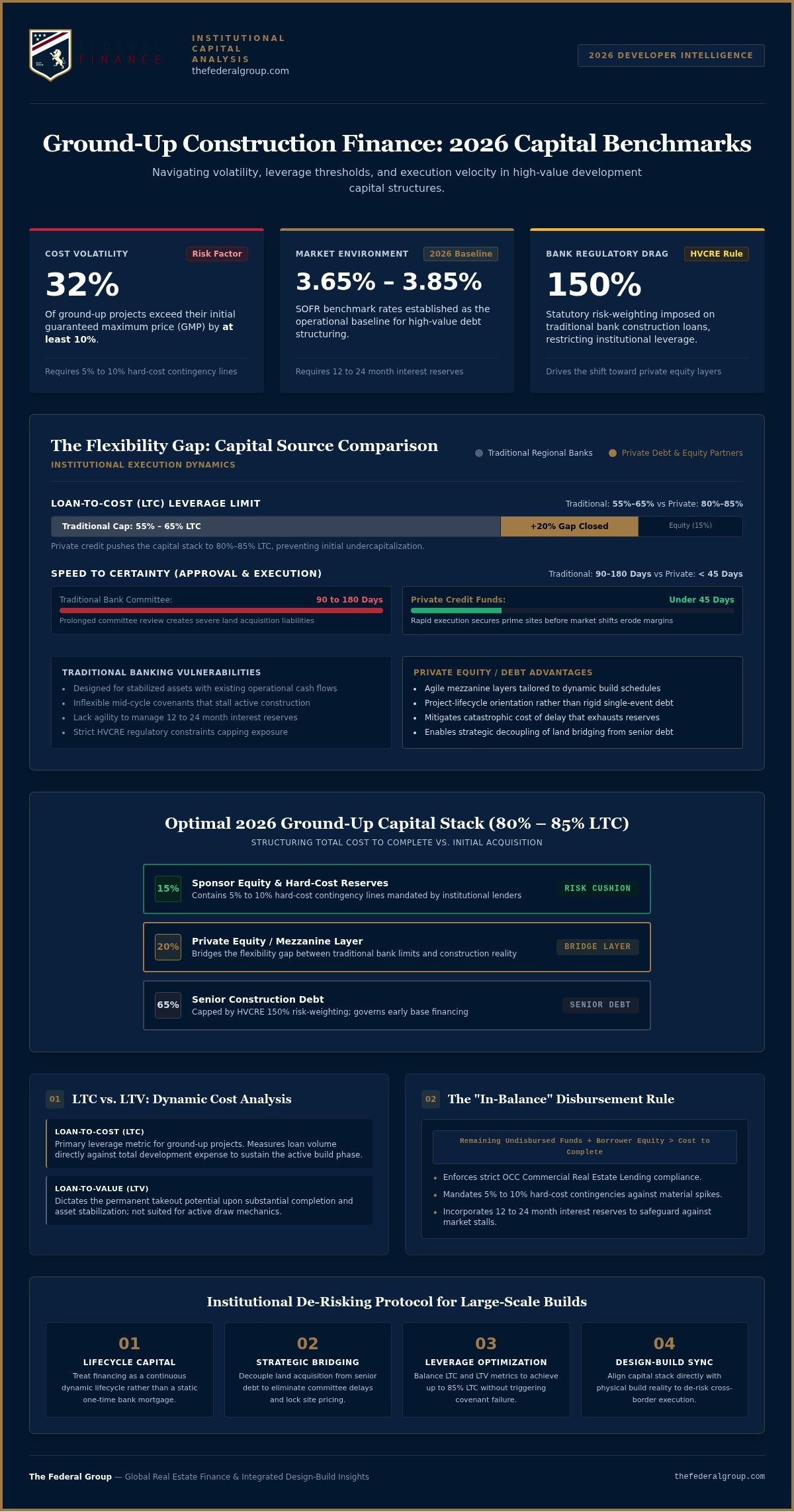
21 September 2026Did you know that 32% of ground-up development projects exceed their initial guaranteed maximum price by at least 10%? You understand that securing ground up construction finance isn’t just about finding a lender; it’s about identifying a partner who recognizes the volatility of 2026’s global markets. Traditional bank lending remains rigid, often capping senior debt at 55% to 65% loan-to-cost while demanding exhausting red tape. It’s frustrating when funding gaps or cross-border complexities threaten to stall a project before the first draw is even certified.
This guide will empower you to master the complexities of structuring capital for large-scale projects, utilizing insights from an integrated global developer and finance partner. We’ll explore how to bridge the flexibility gap with private credit, manage international capital deployment, and leverage design-build integration to ensure your project remains fully funded from site preparation to substantial completion. By aligning your capital stack with the technical realities of the build process, you can achieve global scalability for your portfolio and eliminate the risk of project stagnation.
Key Takeaways
- Identify why viewing capital as a lifecycle solution rather than a one-time loan is essential for maintaining project stability in the 2026 economic environment.
- Learn to optimize your ground up construction finance by balancing LTC and LTV metrics to maximize leverage without compromising institutional security.
- Explore how private equity partnerships provide the necessary flexibility to bypass rigid bank covenants that often threaten progress during the build phase.
- Master the complexities of cross-border capital deployment through strategic hedging and a sophisticated approach to international regulatory frameworks.
- Discover how integrating design and build expertise with institutional finance creates a de-risked ecosystem for large-scale, global developments.
Navigating the Complexities of Ground-Up Construction Finance in 2026
Ground-up construction finance is not a static transaction; it’s a dynamic lifecycle capital solution. In 2026, the economic environment has shifted toward a new baseline of stability. While SOFR benchmark rates have settled between 3.65% and 3.85%, the complexity of securing debt for large-scale builds remains high. Traditional commercial mortgages are designed for stabilized assets with existing cash flows. They lack the structural agility required to handle the 12 to 24 month interest reserves and complex draw mechanics inherent in new developments. Institutional developers now look toward sophisticated project finance structures that account for the total cost to complete, rather than just the initial acquisition value.
Private equity has emerged as the primary mechanism for closing the funding gap. As traditional banks face HVCRE (High-Volatility Commercial Real Estate) regulations that impose 150% risk-weighting on construction loans, their appetite for high-leverage positions has diminished. Private capital provides the necessary equity or mezzanine layers to push a capital stack toward 80% to 85% loan-to-cost. This ensures a project isn’t undercapitalized before the first shovel hits the dirt. Securing ground up construction finance through these private channels allows for a more integrated approach to risk management and long-term project viability.
The Shift Toward Private Capital Partners
Institutional developers are increasingly bypassing regional banks in favor of private debt funds and equity partners. The reason is “speed to certainty.” In a competitive land acquisition market, waiting 90 to 180 days for a bank committee is a liability. Private credit funds often execute in under 45 days. This agility allows developers to secure prime sites and lock in pricing before market fluctuations erode margins. Private equity doesn’t just provide capital; it offers the flexibility to navigate the rigidity of standard bank covenants that can stall a build during mid-cycle adjustments.
De-risking the Early Stages of Development
The primary objection in high-value development isn’t the cost of capital, but the catastrophic cost of delay. A stalled project consumes interest reserves and degrades investor confidence. Using Strategic Bridging Finance for Land: 2026 Developer Guide allows sponsors to maintain momentum while the long-term capital stack is finalized. By decoupling land acquisition from the main construction loan, developers de-risk the early stages and provide a cleaner entry point for senior debt providers. This strategic separation ensures that the build schedule remains the priority, protecting the project’s internal rate of return and overall execution timeline.
The Mechanics of High-Value Construction Capital: LTC, LTV, and Draw Schedules
Structuring ground up construction finance requires a fundamental shift from static valuation to dynamic cost analysis. While Loan-to-Value (LTV) dictates the permanent takeout potential, Loan-to-Cost (LTC) governs the active build phase. In 2026, institutional lenders prioritize LTC because it reflects the actual capital required to reach completion in a volatile market. Loan-to-Cost (LTC) serves as the primary leverage metric for ground-up projects, measuring the loan amount against the total expense of the development.
Inflationary pressures and supply chain fluctuations necessitate robust safety nets. Data suggests that approximately 32% of ground-up projects exceed their initial guaranteed maximum price by 10% or more. Consequently, sophisticated lenders mandate hard-cost contingency lines of 5% to 10%. These reserves ensure the project remains “in-balance,” meaning the remaining undisbursed funds plus borrower equity always exceed the estimated cost to complete. Adherence to OCC Commercial Real Estate Lending guidelines ensures that these disbursement controls and risk management protocols remain institutional-grade, protecting both the sponsor and the capital partner.
Calculating Real-World Leverage
When senior debt from traditional banks caps at 55% to 65% LTC, mezzanine debt and preferred equity become essential. These subordinate layers sit between senior debt and sponsor equity, creating a complex payment waterfall. In this structure, senior debt is serviced first, followed by mezzanine pieces. Optimizing this debt-to-equity ratio is critical for developers who want to maximize their internal rate of return without over-leveraging the asset’s future cash flow. Balancing these layers requires a partner who understands the nuances of high-stakes capital stacks.
Managing the Draw Lifecycle
Capital release is never a lump-sum event; it’s a methodical process tied to architectural milestones. Each month, a third-party monitoring surveyor must physically inspect the site to verify that progress matches the draw request. Lenders also enforce a standard 5% to 10% retainage withhold on contractor billings until substantial completion is certified. Managing the interest carry is equally vital. Developers typically utilize a dedicated 12 to 24 month interest reserve to prevent liquidity gaps during the vertical build phase. For those navigating these high-stakes requirements, aligning with a specialist development finance partner can provide the structural stability needed for global scalability.
Traditional Lending vs. Private Equity: Solving the Flexibility Gap
Securing ground up construction finance through traditional institutional banks often leads developers into a “Rigidity Trap.” These institutions prioritize strict compliance with regulatory standards for commercial real estate and construction lending, which frequently results in inflexible covenants. If supply chain disruptions or labor shortages shift your timeline, a bank’s reaction is often punitive rather than collaborative. In contrast, private equity partners act as active stakeholders. They possess the industrial-scale property expertise to understand why a project deviates from the initial plan and the authority to adjust capital deployment accordingly. While private capital carries a higher coupon, the value of non-recourse funding protects the sponsor’s broader portfolio from the specific risks of a high-value build.
Private equity doesn’t just fund projects; it accelerates them. It doesn’t just manage risk; it absorbs it. By acting as a specialist partner, private equity providers offer a level of integration that retail or regional banks cannot match. This relationship moves beyond the transactional, positioning the financier as a connector of opportunities rather than a passive observer of the build process. For developers scaling international portfolios, this alignment is the difference between a project that stalls and one that completes on schedule.
The Private Equity Advantage in 2026
Joint venture (JV) structures allow developers to access significantly higher leverage than traditional debt products. By aligning with a partner who understands The Strategic Role of a Real Estate Private Equity Partner in 2026, sponsors can reduce their cash-in-deal requirements. This synergy is most potent when the equity partner possesses integrated Design & Build knowledge. They don’t just look at a spreadsheet; they evaluate the architectural feasibility and construction logistics, which allows for more aggressive, yet secure, capital structuring.
When to Choose Bridging Finance
Speed is a premium asset in land acquisition. Bridging loans serve as a fast-track capital solution for “shovel-ready” opportunities where traditional construction underwriting would take too long. This allows developers to secure the site and begin preliminary works while the long-term ground up construction finance stack is finalized. Working with an International Real Estate Finance Partner: 2026 Guide ensures that these bridging solutions are structured to transition seamlessly into development finance, maintaining momentum across global markets.
Structuring the Capital Stack for International Cross-Border Projects
Executing ground up construction finance on an international scale introduces layers of complexity that domestic lenders rarely address. Developers must navigate the friction between different regulatory environments, specifically between the US and UK markets. Sovereign risk and jurisdictional law dictate how capital flows across borders. Cross-border capital deployment is a tool for portfolio diversification. By spreading assets across multiple economies, institutional developers protect their returns from localized downturns. However, this strategy requires a partner capable of managing the Foreign Investment in Real Property Tax Act (FIRPTA) implications in the US or the specific tax treatments of the UK’s development landscape. Utilizing debt structures that qualify for the Portfolio Interest Exemption is one way international sponsors optimize their tax liabilities while maintaining high leverage.
Currency volatility remains the most significant threat to cross-border build margins. A 5% shift in exchange rates during a three year vertical build can erode the entire profit margin of a project. Sophisticated financiers utilize FX swap collars and forward contracts to lock in costs for the total project duration. This ensures that capital draws remain consistent, regardless of fluctuations in the global currency markets. Managing these variables requires a partner with a footprint in both the source and destination of the capital, ensuring that the funding stack is as stable as the physical structure being built.
Managing Global Asset Portfolios
The “Sports Multi-Club Ownership” model is currently influencing how institutional property portfolios are structured. This model prioritizes a synergistic ecosystem where assets in different regions support one another’s growth. The Federal Group applies this logic to property investment, leveraging global market expertise to secure competitive debt pricing that regional lenders cannot offer. Our approach to international capital deployment focuses on creating a seamless flow of funds across jurisdictions, treating a multi-national portfolio as a single, integrated powerhouse rather than a collection of isolated projects.
5 Steps to Securing Cross-Border Construction Finance
- 1. Establish jurisdictional legal entities: Create Special Purpose Vehicles (SPVs) that comply with local corporate governance and tax laws.
- 2. Secure local monitoring partners: Appoint third-party surveyors who understand regional building codes and labor practices to certify draws.
- 3. Align capital draws with local labor and material cycles: Structure the draw schedule to account for regional lead times and seasonal construction windows.
- 4. Hedge currency exposure for the total project cost: Implement hedging strategies at the onset to protect the hard-cost budget from exchange rate shifts.
- 5. Partner with a global financier like The Federal Group: Align with a heavyweight partner who possesses the scale to manage multi-jurisdictional complexities.
If you are looking to scale your development footprint across international borders, partner with The Federal Group to secure a resilient, global capital stack.
The Federal Group Advantage: Integrated Design, Build, and Finance Solutions
Most capital providers treat ground up construction finance as a standalone commodity, detached from the physical realities of the build. This siloed approach creates inherent friction between the financier and the developer, often leading to funding gaps when technical challenges arise. The Federal Group eliminates this disconnect by acting as a heavyweight partner that manages every stage of a project’s lifecycle. We don’t just provide capital; we provide a fully integrated ecosystem where development finance, private equity, and design-and-build expertise converge. This proactive stance ensures that your project is built on a foundation of technical precision and institutional stability, positioning our firm as the logical conclusion for high-value development.
Our personality is not merely reactive. We carry the weight of a seasoned financier but pair it with the forward-thinking mindset of a modern innovator. By housing every necessary discipline under one roof, we provide a de-risked environment where the capital understands the concrete. This synergy ensures that the build process isn’t just funded, but optimized for completion, regardless of the complexity of the global market or the scale of the international challenge.
Beyond the Loan: A Strategic Partnership
Traditional lenders often lack the technical depth to interpret architectural nuances or engineering complexities, which frequently results in delayed draws and project stagnation. Our Federal Holdings division bridges this gap by offering “Full Lifecycle” property development solutions. When your finance partner understands The Efficiency of the Integrated Design and Build Developer in 2026, they can anticipate roadblocks before they affect the draw schedule. This integrated approach replaces the rigid, reactive nature of retail banking with a visionary energy that protects your project’s internal rate of return. It’s a specialist identity that aligns architectural milestones directly with capital stack liquidity.
Securing Your Next Ground-Up Opportunity
Transitioning a project from a conceptual stage to an institutional-grade investment requires meticulous preparation and a sophisticated capital structure. We assist developers in preparing their projects for equity investment by establishing robust jurisdictional legal entities and managing the nuances of international deployment. Whether you’re expanding a property portfolio or exploring the unique diversification of our sports division, our team provides the scale and focused insight necessary for global scalability. We invite you to initiate a consultation to explore how our private equity and ground up construction finance solutions can stabilize your next project. Partner with The Federal Group for your next high-value development to ensure your portfolio achieves the excellence it deserves.
Future-Proofing Your High-Value Development Portfolio
Mastery of 2026’s capital markets requires moving beyond traditional banking limitations. You’ve seen how optimizing LTC ratios and leveraging the flexibility of private equity can bridge the funding gaps that often stall ambitious projects. By integrating sophisticated hedging strategies and jurisdictional expertise, you can navigate cross-border complexities with the same precision applied to the physical build. This strategic alignment ensures your capital stack remains as resilient as the structures you create.
Since our founding in 2009, we’ve positioned ourselves as a heavyweight partner for developers who demand more than just a lender. Our fully integrated Design & Build division and global expertise in property and sports finance provide a de-risked ecosystem for your vision. Securing ground up construction finance doesn’t have to be a source of friction; it should be a strategic advantage that fuels your scalability across international markets. Your vision deserves a partner that understands every architectural and financial nuance.
Secure Strategic Capital for Your Ground-Up Project
We look forward to seeing your next landmark project take shape with the stability and scale it requires.
Frequently Asked Questions
What is the typical LTC for ground-up construction finance in 2026?
In 2026, typical Loan-to-Cost (LTC) ratios for ground up construction finance vary significantly between lender types. Traditional depository banks generally cap senior debt at 55% to 65% LTC to comply with risk-weighting regulations. Conversely, private debt funds and equity partners often advance up to 75% or 85% LTC. This higher leverage allows developers to preserve liquidity, provided they meet the stringent underwriting standards of institutional-grade capital providers.
How does ground-up construction finance differ from a standard commercial loan?
Ground up construction finance is a lifecycle capital solution, whereas standard commercial loans typically fund stabilized, cash-flowing assets. Unlike a lump-sum mortgage, construction funding is disbursed through monthly draws tied to architectural milestones. These structures include dedicated interest reserves and hard-cost contingencies to manage the multi-year build period. Lenders also require third-party monitoring surveyors to certify progress, a layer of oversight absent in standard term loans for existing properties.
Can I use a bridging loan to purchase land before securing construction finance?
Yes, utilizing bridging loans for land acquisition is a common strategy to maintain momentum before the full construction stack is finalized. This fast-track capital allows developers to secure shovel-ready opportunities in competitive markets where traditional bank committee timelines would cause delays. Once the site is secured and preliminary works begin, the bridge facility is typically refinanced into a long-term development finance package, ensuring a seamless transition into the vertical build phase.
What documents are required for a high-value construction finance application?
High-value applications require a comprehensive institutional-grade package. You must provide a detailed feasibility study, architectural plans, and a Guaranteed Maximum Price (GMP) contract from an established contractor. Lenders also demand evidence of planning permissions, environmental reports, and a clear track record of the development team. Financial documentation includes the sponsor’s liquidity proof, personal or corporate guarantees, and a breakdown of the capital stack, including any mezzanine or equity layers.
Is mezzanine finance necessary for ground-up developments?
Mezzanine finance isn’t strictly mandatory, but it’s often essential for bridging the gap between senior bank debt and sponsor equity. Since many traditional banks cap their lending at 60% LTC, mezzanine layers allow developers to reach 80% or 85% leverage. This subordinate debt sits behind the senior lender in the payment waterfall. It’s a strategic tool for developers who want to maximize their internal rate of return while minimizing their initial cash-in-deal.
How do interest rates for private equity development finance compare to banks?
Private equity and non-bank debt funds typically price capital between 9.00% and 12.50% or higher, compared to bank rates which often start between 6.75% and 8.50%. While the coupon is higher, private capital offers significantly more flexibility and higher leverage. Developers often trade the lower cost of bank debt for the speed to certainty and non-recourse structures provided by private partners, which can prevent project stagnation during market shifts.
What are the benefits of an integrated design-and-build finance partner?
An integrated design-and-build finance partner, such as The Federal Group through its Federal Holdings division, de-risks the entire development lifecycle. When your lender understands architectural nuances and construction logistics, they can certify draws faster and anticipate technical roadblocks before they affect the capital stack. This synergy eliminates the friction between the financier and the contractor, ensuring that liquidity remains consistent and the build schedule stays on track from site preparation to completion.
How does cross-border construction finance handle currency risk?
Managing currency risk in cross-border projects involves utilizing sophisticated hedging strategies like FX swap collars and forward contracts. These tools lock in the exchange rate for the duration of the multi-year build, protecting the hard-cost budget from volatility. International finance partners also help structure jurisdictional legal entities to optimize tax liabilities under frameworks like FIRPTA. This ensures that capital draws remain stable across the US and UK markets, regardless of global currency fluctuations.