What Private Equity Looks for in Property Deals: The 2026 Investment Blueprint
18 September 2026If your development’s exit strategy relies solely on traditional cap rate compression, are you truly prepared for the institutional scrutiny of 2026? As global markets stabilize after years of volatility, the criteria for capital allocation have fundamentally shifted. Understanding what private equity looks for in property deals now requires looking beyond simple internal rate of return projections. Investors are increasingly prioritizing integrated de-risking, where the lifecycle from initial design to final exit is vertically aligned. It’s no longer enough to present a lucrative site; you must demonstrate a cohesive ecosystem that accounts for shifting interest rates and complex delivery timelines.
You’ve likely felt the friction of slow capital deployment from traditional lenders or the difficulty of finding partners who grasp the nuances of integrated development. It’s a common frustration in a market where timing is everything. This article provides a definitive blueprint of the quantitative metrics and qualitative indicators global firms use to vet high-value projects. We’ll examine a clear checklist of deal requirements, explore how to structure joint ventures that attract institutional capital, and look at how equity-backed bridging can accelerate your project’s kick-off.
Key Takeaways
- Identify why it’s no longer about debt-driven yields but operational excellence in supply-constrained global markets.
- Analyze the specific benchmarks defining what private equity looks for in property deals, including the balance between IRR and equity multiples.
- Discover how vertically integrated design-and-build models de-risk complex developments to attract faster capital deployment.
- Master the developer’s checklist for stress-testing financial models against the unique economic shocks of 2026.
- Learn how to align with strategic partners who don’t just provide capital but manage the entire project lifecycle.
The Evolution of Private Equity Property Criteria in 2026
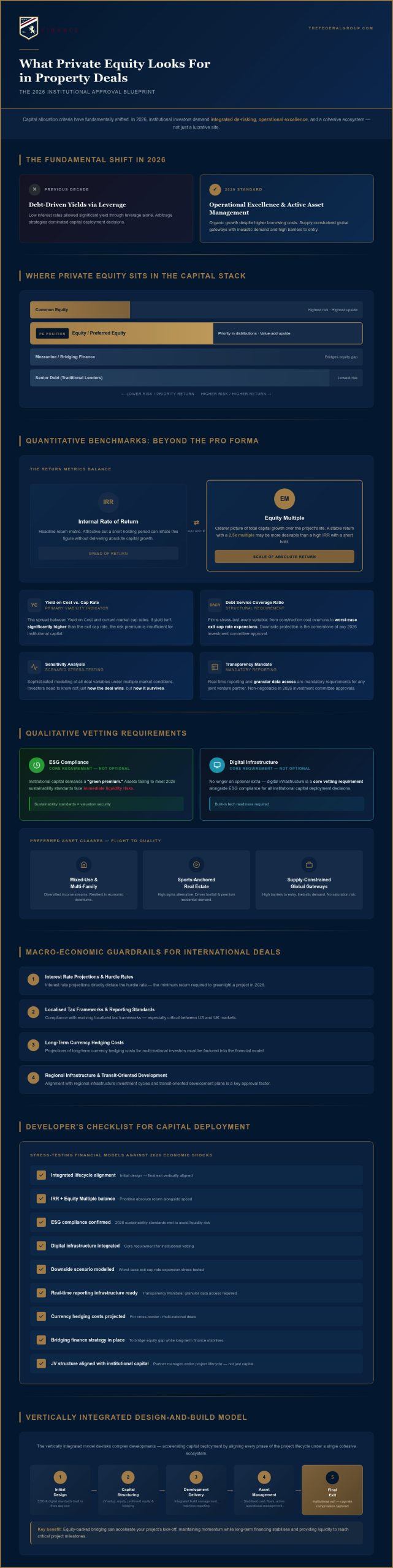
The investment environment of 2026 has moved decisively away from the arbitrage strategies of the previous decade. For years, low interest rates allowed for significant yield through leverage alone. Today, the focus has pivoted toward operational excellence and active asset management. When analyzing what private equity looks for in property deals, the emphasis is now on projects that can generate organic growth despite higher borrowing costs. This shift has elevated the importance of private equity real estate structures that prioritize supply-constrained global gateways where demand remains inelastic. These cities possess high barriers to entry, ensuring that new developments don’t face immediate saturation from competitors.
Digital infrastructure and ESG compliance are no longer optional extras; they’re core vetting requirements. Institutional capital now demands a “green premium,” as assets failing to meet 2026 sustainability standards face immediate liquidity risks. Within the capital stack, private equity typically occupies the higher-risk equity or preferred equity layers. It seeks to partner with developers who provide a clear path to stabilized cash flows through integrated management. This positioning allows firms to capture the upside of value-add projects while maintaining a priority position over common equity holders during the distribution phase.
Macro-Economic Guardrails for International Deals
Cross-border investing requires a sophisticated understanding of currency stability and regulatory shifts, particularly between the US and UK markets. In 2026, interest rate projections directly dictate the hurdle rate, which is the minimum return required to greenlight a project. Several factors now drive these international approvals:
- Compliance with evolving localized tax frameworks and reporting standards.
- Projections of long-term currency hedging costs for multi-national investors.
- Alignment with regional infrastructure investment cycles and transit-oriented development.
As traditional lenders remain cautious, international property development finance and bridging loans have become essential tools to bridge the equity gap. These mechanisms allow developers to maintain momentum while long-term financing stabilizes, providing the necessary liquidity to reach critical project milestones.
The Premium on Asset Class Resilience
Mixed-use and multi-family assets continue to serve as safe havens due to their diversified income streams and resistance to economic downturns. However, we’re seeing the emergence of specialized, sports-anchored real estate developments as a high-alpha alternative. These projects leverage the economic gravity of professional sports to drive footfall and premium residential demand, creating a unique ecosystem for capital deployment. In 2026, the flight to quality in commercial property is defined by a relentless preference for high-amenity, operationally efficient assets that offer long-term valuation security in volatile markets.
The Qualitative and Quantitative Benchmarks for Approval
Private equity vetting has become a rigorous exercise in balancing raw returns with structural stability. When assessing what private equity looks for in property deals, firms now look beyond the headline Internal Rate of Return (IRR). While a high IRR is attractive, the Equity Multiple (EM) provides a clearer picture of total capital growth over the project’s life. A deal with a high IRR but a low EM due to a short holding period might be less desirable than a more stable return with a 2.5x multiple. This balance ensures that capital is deployed efficiently without sacrificing the scale of the absolute return.
Downside protection is the cornerstone of any 2026 investment committee approval. Firms utilize sophisticated sensitivity analysis to stress-test every variable, from construction cost overruns to “worst-case” exit cap rate expansions. They don’t just want to know how the deal wins; they need to know how it survives. This includes a “Transparency Mandate” where real-time reporting and granular data access are mandatory requirements for any joint venture partner.
Quantitative Metrics: Beyond the Pro Forma
The spread between Yield on Cost and current market cap rates serves as the primary indicator of a project’s viability. If the yield isn’t significantly higher than the exit cap rate, the risk premium is insufficient for institutional capital. Debt Service Coverage Ratio (DSCR) requirements have also tightened. Firms now mandate higher cushions to protect against potential interest rate volatility during the development phase. Clear exit horizons, typically between three and seven years, are non-negotiable. Investors need to see a defined path to liquidity through a sale or recapitalization that aligns with the fund’s lifecycle.
Qualitative Indicators: The ‘Investability’ Factor
A developer’s track record often carries more weight than the asset itself. Private equity firms prioritize “sponsor alignment,” which translates to the developer having significant capital at risk alongside the institutional partner. This “skin in the game” ensures that interests are perfectly synchronized throughout the project. Local market expertise provides the “boots on the ground” insight necessary to navigate regional planning hurdles or supply chain disruptions.
New value-add opportunities are emerging through strategic synergies, such as a sports multi-club ownership strategy. These complex, mixed-use developments require a partner who understands the intersection of commercial real estate and international sports finance. Modern deals require a partner who can manage these multi-disciplinary demands with precision. If you’re seeking a partner to help navigate these requirements, consider how The Federal Group’s private equity expertise can bridge the gap between vision and institutional approval.
De-risking Through Integrated Design and Build Models
Fragmented development teams represent a systemic risk in the 2026 investment landscape. When a developer relies on a disconnected web of third-party consultants, the potential for communication breakdown increases. This often leads to budget overruns and timeline slippage. In contrast, what private equity looks for in property deals is a cohesive, vertically integrated structure. This approach eliminates the middleman margin and provides a level of cost certainty that traditional models can’t match. By housing design and construction under one roof, the integrated design and build developer model aligns the project’s physical creation with its financial objectives from day one.
The carry cost of equity in 2026 represents a significant drain on net returns. Every month of delay in the pre-construction phase erodes the potential IRR. Streamlining delivery through vertical integration reduces the time between capital deployment and revenue generation. This rapid execution isn’t just about speed; it’s about protecting the investment’s value against inflation and market shifts. Efficiency in delivery ensures that capital is recycled faster, allowing for a more aggressive and profitable deployment strategy across the portfolio.
Eliminating the Friction of Third-Party Architectural Consulting
In-house design capabilities prevent the scope creep that often plagues complex developments. When architects work alongside financial analysts, the vision is grounded in financial reality. This synergy ensures that the project remains within the parameters defined during the approval stage. This collaboration shortens the due diligence timeline significantly. Pre-vetted construction partners are already integrated into the workflow. This allows for immediate mobilization once funding is secured, removing the typical three-to-six month delay associated with third-party bidding and contract negotiation.
Lifecycle Management as a Trust Builder
Full lifecycle oversight provides the transparency that institutional partners crave. Understanding what private equity looks for in property deals requires a shift toward total management. Overseeing a project from land acquisition through to final disposal ensures that every decision supports the ultimate exit strategy. This holistic approach builds trust by demonstrating a deep commitment to the asset’s long-term performance.
Integrating the development finance lender perspective into the early design phase allows developers to pre-emptively address the specific requirements of institutional capital. This proactive management style ensures that the project remains investable at every stage of its evolution. It provides a level of security and predictability that fragmented teams simply can’t provide, positioning the project as a preferred destination for global capital.
Preparing the Deal: A Developer’s Checklist for Capital Deployment
Capturing institutional attention is the first hurdle in the capital raising process. An institutional-grade executive summary must distill the entire opportunity into a 60-second read. It highlights the location, the strategic thesis, and the risk-adjusted returns. In a competitive environment, what private equity looks for in property deals is immediate clarity on the value proposition. Beyond the summary, your financial modeling must undergo rigorous stress-testing for 2026 economic shocks. This means modeling various inflation scenarios and exit cap rate expansions to prove the deal’s resilience under pressure.
Legal and structural readiness is equally vital. Establishing Special Purpose Vehicles (SPVs) and ensuring tax-efficient cross-border structures demonstrates a high level of sophistication. Developers must often move faster than institutional equity can deploy. This is why bridging finance for land acquisition has become a critical strategic tool. It allows you to secure a site while the long-term private equity partnership is still being formalized, preventing competitors from seizing the opportunity. Understanding what private equity looks for in property deals requires a focus on this level of structural readiness and data integrity.
The Data Room: What Must Be Ready
A robust data room is the bedrock of due diligence. It prevents deal fatigue and signals that the sponsor is prepared for institutional-scale scrutiny. Institutional partners expect to see a comprehensive repository that includes:
- Full planning permissions, environmental impact assessments, and clear title reports.
- Detailed construction budgets backed by fixed-price contract options to mitigate cost volatility.
- Market comparable data (Comps) that justify exit assumptions and rental growth projections.
- Proof of local regulatory compliance and sustainability certifications.
Structuring the Equity Partnership
Choosing between Pari Passu and Preferred Equity models depends on your capital needs and risk appetite. Pari Passu structures treat the sponsor and investor equally on a pro-rata basis. Preferred equity provides the investor with a priority return, which can be more expensive but offers different leverage opportunities. Defining the “Waterfall” structure is where you promote the sponsor’s performance after hitting specific internal rate of return hurdles. Clear Buy-Sell agreements are essential in joint ventures to ensure a pre-defined path for liquidity or dispute resolution. If you’re ready to present a high-value development to institutional partners, contact The Federal Group to align your project with global capital requirements.
The Federal Group: Your Strategic Real Estate Private Equity Partner
The Federal Group bridges the divide between institutional capital and physical development. In the 2026 investment environment, understanding what private equity looks for in property deals requires a partner who manages the entire project lifecycle with clinical precision. We combine our private equity capabilities with the industrial-scale expertise of Federal Holdings. This integration ensures that every design choice supports the ultimate financial exit. By acting as a sophisticated international real estate finance partner, we navigate the complex regulatory and economic nuances of the US, UK, and global markets.
Our approach extends beyond traditional asset classes. We’ve pioneered strategic diversification by linking high-value property developments with professional sports ventures. This ecosystem strategy creates unique value propositions that traditional firms often overlook. Whether it’s a mixed-use residential complex or a sports-anchored multi-club development, our focus remains on superior ROI through vertical integration. We eliminate the friction of fragmented teams, ensuring that capital is deployed where it generates the most significant impact.
A Partnership Beyond Capital
We position ourselves as a heavyweight partner for stakeholders managing high-stakes, international environments. We don’t just provide capital; we provide a vision backed by 2026 market insights. Our team optimizes project lifecycles to ensure stability and ambition are perfectly balanced. Success in international cross-border property development requires this level of specialized expertise. We’ve consistently delivered results by de-risking complex deals through our integrated Federal Holdings division, which manages everything from initial design to final disposal.
Next Steps: Initiating the Partnership
Presenting a project for evaluation is a streamlined, professional process designed for high-value stakeholders. We look for developments that align with our core criteria of operational excellence and supply-constrained gateway locations. The timeline from initial contact to capital deployment is efficient. It reflects our understanding that time is a premium asset in modern finance. Our specialists conduct a thorough vetting process to ensure strategic alignment and structural readiness. If your project meets the rigorous standards of what private equity looks for in property deals, we’re ready to discuss a strategic joint venture. Partner with The Federal Group today to unlock institutional scale and global reach for your next development project.
Architecting Success in the 2026 Capital Market
Navigating the complexities of modern institutional finance requires a shift from chasing raw yield to demonstrating operational resilience. We’ve explored how the 2026 market prioritizes supply-constrained gateway locations and the critical importance of vertical integration. Understanding what private equity looks for in property deals today means presenting a project that is already de-risked through integrated design-and-build models and robust financial stress-testing.
Success in this high-stakes environment depends on aligning with a partner who possesses the scale and specialized expertise to manage every stage of the development lifecycle. The Federal Group acts as an authoritative international partner, providing global reach across US, UK, and international markets. By leveraging our integrated Federal Holdings capability, we help developers bridge the gap between visionary design and institutional approval. It’s time to elevate your project from a site plan to a globally attractive asset.
Secure your next high-value development with The Federal Group and move forward with the momentum of a strategic heavyweight. Your vision deserves a partner who understands both the capital and the construction.
Frequently Asked Questions
What is the typical IRR target for private equity in property deals for 2026?
Private equity firms generally target net IRRs between 15% and 20% for value-add and opportunistic property developments in 2026. These targets reflect the increased cost of capital and the risk premium required for large-scale projects. The focus has expanded to include the equity multiple, as firms prioritize total capital growth over short-term yield. Every fund has specific hurdles, but these benchmarks represent the institutional standard for high-conviction deals.
How does private equity differ from traditional development finance?
Private equity involves an ownership stake in the project, whereas traditional development finance is typically senior debt. Traditional lenders focus on interest coverage and loan-to-value ratios; however, private equity partners share in the project’s upside and downside risk. This makes private equity more flexible for complex projects that require a heavyweight partner to manage the entire lifecycle. It’s about strategic alignment rather than just a lending relationship.
Why is the integrated design and build model preferred by equity partners?
Equity partners prefer the integrated design and build model because it significantly reduces execution risk and eliminates third-party friction. When design, architectural vision, and construction are handled by a single entity like Federal Holdings, it ensures cost certainty and faster delivery. This vertical integration provides the transparency that institutional investors crave. It also aligns the physical development with the financial exit strategy from the earliest stages of land acquisition.
Do private equity firms invest in small-scale residential developments?
Most institutional private equity firms avoid small-scale residential developments due to the high management overhead relative to the capital deployed. They prioritize industrial-scale projects where they can leverage their sophisticated infrastructure and global reach. High-value property deals usually involve multi-family, mixed-use, or specialized assets that offer significant scale. Smaller projects are often left to retail banks or local private lenders who handle less complex capital stacks.
What are the common deal-breakers during the due diligence process?
Common deal-breakers include lack of sponsor alignment, fragmented development teams, and opaque financial modeling. If a developer hasn’t put significant “skin in the game” or lacks a proven track record, it signals high risk. Additionally, unresolved planning issues or unrealistic exit assumptions can halt a deal instantly. Understanding what private equity looks for in property deals means ensuring that every qualitative and quantitative benchmark is met before entering the data room.
How does sports multi-club ownership integrate with real estate deals?
Sports multi-club ownership integrates with real estate through specialized, sports-anchored mixed-use developments. These projects use professional football clubs or stadiums as anchors to drive footfall and increase the value of surrounding residential and commercial assets. This synergy creates a unique ecosystem that diversifies income streams and provides a competitive edge in global gateway cities. It is a specialized asset class that requires a partner with both property and sports finance expertise.
Can a bridging loan be transitioned into a private equity partnership?
Yes, a bridging loan can serve as a strategic entry point that eventually transitions into a long-term private equity partnership. Developers often use bridging finance to secure land or achieve planning milestones quickly. Once the project is shovel-ready and the risk profile is reduced, an equity partner may step in to provide the necessary capital for construction and lifecycle management. This progression allows for rapid project kick-off while formalizing institutional backing.
What geographic markets are currently most attractive to PE real estate funds?
Supply-constrained global gateways in the US and UK remain the most attractive markets for private equity real estate funds. These regions offer currency stability and mature regulatory frameworks that protect international capital. Firms are specifically targeting transit-oriented developments and high-amenity urban centers where demand for multi-family assets stays inelastic. These flight to quality locations provide the valuation security necessary for high-stakes, international investment cycles.