How to Prepare a Property Development Pitch for High-Value Investors in 2026
19 September 2026In the high-stakes environment of 2026, a property pitch that focuses solely on architectural vision is a liability. Global investors no longer prioritize aesthetic grandeur over structural financial security. They demand an integrated strategy that accounts for every variable from initial design to final exit. You likely recognize that learning how to prepare a pitch for property investors involves more than just showing a site plan. Articulating complex financial models and navigating cross-border compliance requirements is increasingly difficult in a volatile market. The fear of project rejection is real when capital is cautious and risk profiles are under intense scrutiny.
Mastering this process requires a shift toward institutional-grade precision. This article provides the framework to align architectural feasibility with sophisticated financial engineering. We will examine how to build a repeatable, high-performance pitching model that minimizes project risk and secures strategic equity or debt partners. By the end of this guide, you’ll have the tools to position your development as a stable, ambitious opportunity ready for international scale.
Key Takeaways
- Transition from speculative flipping to strategic asset creation to meet the 2026 demand for institutional-grade stability and global market alignment.
- Master how to prepare a pitch for property investors by balancing architectural feasibility with sophisticated financial engineering and lifecycle management.
- Tailor your narrative to address the specific psychological drivers of debt lenders focused on security and private equity partners seeking growth.
- Utilize an integrated design and build framework to mitigate operational risks and eliminate the friction inherent in fragmented development models.
- Establish immediate authority through executive presence and use transparent risk assessment to build long-term trust with high-value stakeholders.
The Evolution of the Property Pitch: High-Stakes Development in 2026
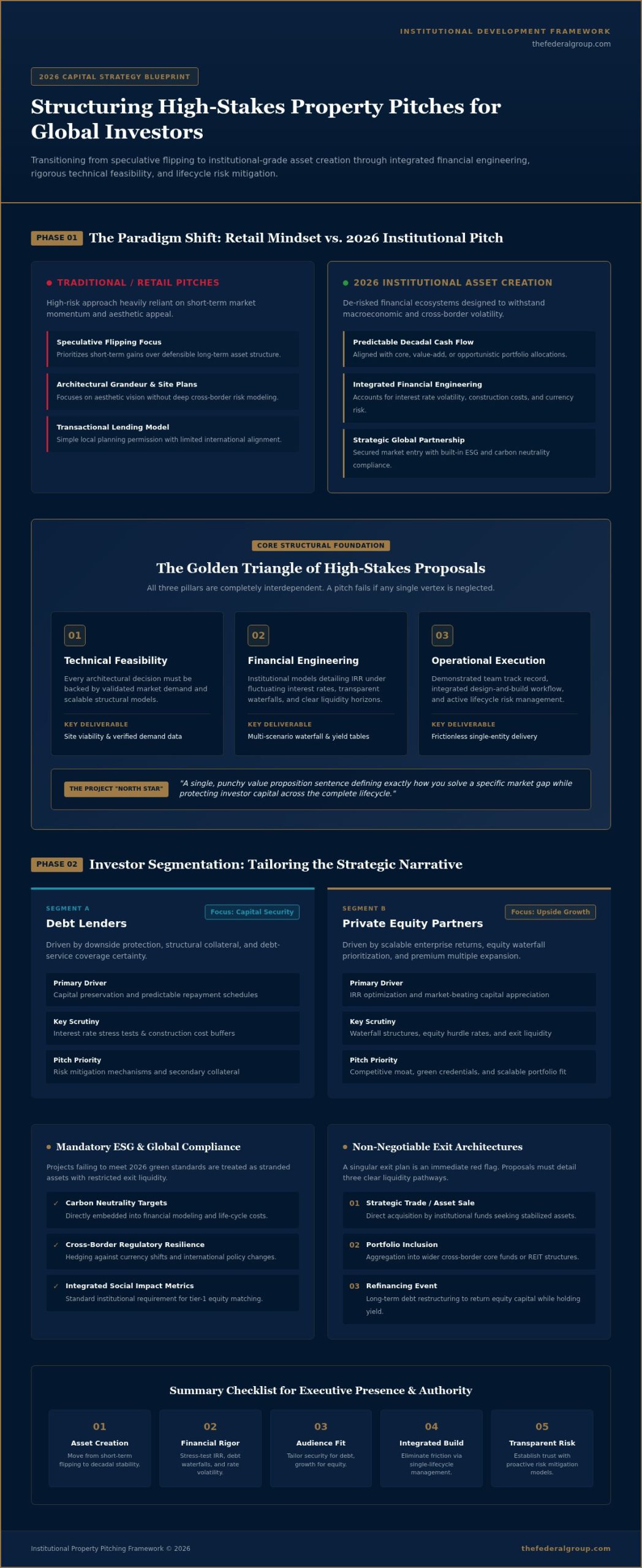
The 2026 market demands a fundamental shift in perspective. Developers are no longer just builders; they are creators of de-risked financial ecosystems. High-value investors have moved away from speculative flipping toward long-term asset creation. This evolution requires a deep understanding of how to prepare a pitch for property investors that prioritizes global market stability. Institutional capital is no longer satisfied with local success. It seeks projects that can withstand international volatility through a strategic partnership model rather than a simple lending arrangement.
Cross-border risk evaluation has become more sophisticated. International real estate finance partners examine more than just local planning permission. They look at currency hedging, geopolitical stability, and the developer’s ability to manage the full project lifecycle. A successful pitch demonstrates that the developer isn’t just seeking capital. Instead, they are offering a secured entry point into a specific market. This transition from a transactional mindset to a strategic one is what separates high-performing developers from the rest of the field.
From Residential Sales to Institutional Asset Creation
Retail pitches often lean on emotional appeal or aesthetic trends. In contrast, institutional pitches focus on data-driven yield and risk mitigation. Successful real estate development in 2026 requires matching your project to an investor’s specific asset class, whether that is core, value-add, or opportunistic. Investors want to see how your project fits their broader portfolio strategy. They prioritize long-term, predictable cash flow over the high-risk, short-term gains associated with traditional speculative sales. You must demonstrate that your project is a high-performance asset designed to generate value across multiple decades.
Why 2026 Investors Prioritize ESG and Global Compliance
Sustainable design is no longer a peripheral consideration. It’s a mandatory requirement for securing private equity. Modern investors view ESG compliance as a primary indicator of an asset’s future-proof status. When you research how to prepare a pitch for property investors, you’ll find that transparent compliance reporting is a major trust-builder. Projects that don’t meet 2026 green standards are viewed as stranded assets with limited exit options. Positioning your development as an environmentally resilient asset ensures it remains competitive in an increasingly regulated global market. High-value partners expect to see carbon neutrality targets and social impact metrics integrated directly into your financial modeling.
Core Pillars of a High-Stakes Development Pitch
The Golden Triangle represents the structural foundation of a professional proposal. It balances technical feasibility, financial engineering, and operational execution. When you master how to prepare a pitch for property investors, you understand that these three pillars are interdependent. A visionary design fails without a rigorous financial waterfall; a high projected return is meaningless if the execution team lacks a proven track record. You must distill this complexity into a single, punchy value proposition sentence. This sentence acts as your project’s North Star, defining exactly how you solve a specific market gap while protecting investor capital.
Rigorous market data must back every architectural decision. Investors in 2026 don’t fund “potential”; they fund validated demand. Your pitch needs to demonstrate that the project isn’t just a standalone building but a scalable model. Aligning your project timelines with investor liquidity requirements is equally vital. If your exit strategy doesn’t match their capital cycle, the pitch will fail regardless of the project’s quality. Precision in these core pillars signals that you’re a sophisticated partner ready for institutional-grade collaboration.
Financial Engineering: IRR, Cash Flow, and Exit Strategies
Institutional partners look past the headline Internal Rate of Return (IRR). They analyze how that return is generated across different market scenarios. In 2026, your financial model must account for interest rate fluctuations and construction cost volatility. Detail the waterfall structure clearly to show how equity partners are prioritized. Providing multiple exit strategies is non-negotiable. Whether it’s a strategic sale, a portfolio inclusion, or a refinancing event, your pitch must demonstrate a clear path to liquidity that accounts for various market conditions.
Feasibility and Architectural Integrity in the Design Phase
Aesthetics are secondary to functionality in high-stakes development. Investors want to see that your architectural integrity is backed by hard demand data. Adopting the principles of an integrated design and build developer allows you to present a project that is already de-risked from a cost perspective. This model ensures that the vision you pitch is actually buildable within the stated budget. Use data to prove demand for your specific layout, showing that every square meter is optimized for yield rather than just visual impact. This approach builds the foundation for long-term private equity collaboration by proving your team understands the entire project lifecycle.
Investor Segmentation: Tailoring Your Narrative for Debt vs. Equity
A fatal error in high-stakes development is treating all capital sources as a monolith. While every investor seeks a return, their psychological drivers and risk tolerances differ fundamentally. Debt lenders prioritize the security of their principal and the certainty of repayment. They’re less interested in your vision for market transformation and more focused on your loan-to-value ratios and interest coverage. Conversely, equity partners seek growth, synergy, and a share of the upside. Understanding these distinctions is the first step in mastering how to prepare a pitch for property investors that actually converts.
Your slide deck must reflect these varied motivations. A debt-focused presentation should emphasize collateral value and liquidity. An equity-focused deck should highlight the project’s unique value proposition and its potential to outperform the market. Fast capital, such as bridging finance, plays a critical role here. It maintains development momentum, allowing you to secure assets while you finalize more complex long-term equity arrangements. This tiered approach to capital ensures your project doesn’t stall due to funding gaps or bureaucratic delays.
Pitching for Bridging Loans and Development Finance
When seeking short-term capital, speed and certainty of execution are your primary selling points. Lenders in this space value a clear exit strategy above all else. Using strategic bridging finance for land allows you to lock in high-potential assets before competitors can react. Your pitch must prove a concrete “bridge to development” plan, showing exactly how the loan will be refinanced or repaid once the project matures. Proving you have the operational discipline to move fast de-risks the lender’s position and secures more favorable terms.
Engaging Private Equity for Strategic Partnerships
Private equity requires a more holistic narrative. You aren’t just selling a building; you’re selling a vision that aligns with the real estate private equity partner‘s existing portfolio. These stakeholders look for operational excellence and management capability. When learning how to prepare a pitch for property investors in the equity space, remember that transparency regarding management capability is as vital as the numbers themselves. Focus on the synergy between your development expertise and their capital reach. A successful equity pitch demonstrates that you’re a strategic partner capable of delivering outsized returns through specialized market insight and efficient execution.
The ‘Integrated’ Edge: De-Risking Your Project Through Lifecycle Management
Fragmented development is the primary red flag for institutional capital in 2026. If your project relies on disconnected third-party contractors and separate architectural consultants, you’re pitching a high-friction model. Investors seek the security of a “Design-Build-Finance” ecosystem where every phase informs the next. This integrated approach eliminates the blame-shifting common in traditional setups; it ensures that the vision pitched at the start is the reality delivered at the end. When you master how to prepare a pitch for property investors, you emphasize this unified chain of command as your core risk-mitigation strategy.
Quantifying the value of in-house construction management is essential for building trust. Integrated projects often demonstrate greater resilience because budget constraints are baked into the design from the first sketch. You aren’t just presenting a vision; you’re presenting a pre-validated execution plan. This level of control allows you to offer price certainty in an era of fluctuating material costs. It transforms the developer from a middleman into a specialist who manages the entire lifecycle, providing a sense of security that fragmented teams cannot match.
Demonstrating Control Over Design and Build Phases
Integrated design prevents mid-construction budget overruns by aligning architectural intent with real-world construction costs. This synergy is reinforced by international property development finance structures that prioritize streamlined build cycles. By managing the build in-house, you remove the margin-on-margin costs of external contractors. This efficiency directly improves the investor’s bottom line while providing a transparent, real-time view of the project’s health. It’s a powerful narrative to present: a project where the builder and the financier are on the same team.
Mitigating Global Market Volatility in Cross-Border Projects
Cross-border developments face unique pressures from currency shifts and regulatory changes. Pitching a project in the US to a UK-based investor requires more than just a strong projected ROI; it requires local market credibility. Leveraging an international real estate finance partner provides this necessary weight. Such a partner understands local planning nuances and tax implications, ensuring the project remains compliant across jurisdictions. This global perspective de-risks the investment by anticipating regional volatility before it impacts the project’s internal rate of return. Use these partnerships to prove that your project is a stable, future-proof asset regardless of its location.
To secure your next high-value project, partner with a team that offers integrated development solutions across global markets.
Executing the Pitch: Professionalism, Precision, and Partnership
The final execution of your pitch is where architectural vision and financial engineering meet reality. You must establish authority within the first five minutes through a commanding executive presence. This initial window isn’t for granular detail; it’s for signaling reliability and scale. High-value stakeholders expect a level of professionalism that reflects the gravity of the capital at stake. When considering how to prepare a pitch for property investors, remember that your delivery must be as precise as your data. If you don’t project confidence in the room, investors won’t trust your ability to lead a complex project in the field.
Technology plays a central role in modern execution. Interactive feasibility models and Virtual Data Rooms (VDRs) are no longer optional. These tools allow investors to stress-test your assumptions in real-time, moving the conversation from a static presentation to an active collaboration. When the Q&A session begins, don’t shy away from project risks. Admitting potential volatility while presenting a clear mitigation strategy is far more profitable than ignoring it. It demonstrates a proactive mindset and a deep understanding of the global market ecosystem. Sophisticated partners value transparency over polished avoidance.
The Anatomy of an Institutional-Grade Pitch Deck
An elite deck follows a structured, hierarchical flow. Start with a high-impact Executive Summary and move logically through market analysis, architectural feasibility, and the final capital stack. Less is more when presenting complex financial data. Use clean, information-dense visuals to convey IRR and exit strategies rather than cluttered spreadsheets. Professional branding is equally vital in high-value finance. A polished, cohesive visual identity signals that your firm possesses the organizational symmetry required to manage large-scale developments. It transforms a simple proposal into an authoritative statement of intent.
Transitioning from Presentation to Strategic Collaboration
The goal of the pitch is to move into the due diligence phase with momentum. Set clear next steps and timelines for capital deployment immediately after the presentation. Understanding how to prepare a pitch for property investors involves knowing how a development finance lender conducts their final evaluation. This transition marks the shift from being a solicitor of funds to a strategic partner. By demonstrating transparency and operational readiness, you build the foundation for a multi-project relationship. Investors aren’t just looking for a single deal; they’re looking for a repeatable, high-performance framework they can trust across their entire portfolio.
Securing the Future of Institutional Development
Success in 2026 requires moving beyond the traditional developer role. You must become a strategic coordinator of financial and architectural ecosystems. Mastering how to prepare a pitch for property investors means proving your project is a de-risked, future-proof asset rather than a speculative gamble. You’ve seen that aligning with institutional expectations involves more than just numbers; it requires an integrated approach to design, build, and finance. By segmenting your narrative for specific capital providers and leveraging lifecycle management, you transform a simple project into a strategic partnership.
Ready to scale your next project? Partner with The Federal Group for integrated property finance and development solutions. Our expertise in high-value international bridging and development finance, combined with integrated design and build capabilities through Federal Holdings, ensures your vision is backed by global sophistication. We specialize in strategic private equity partnerships for global growth, providing the stability and ambition your stakeholders demand. The market for large-scale development is complex, but with the right framework, your project will lead the next generation of global assets.
Frequently Asked Questions
What is the most important slide in a property development pitch deck?
The capital stack is the most critical slide in any institutional-grade deck. It defines the hierarchy of repayment and the specific allocation of debt and equity. Investors use this to understand their position in the event of a liquidation and to assess their risk-adjusted return. A clear, transparent waterfall structure signals that you’ve mastered the financial engineering required for high-stakes development. It moves the conversation from abstract vision to concrete financial reality.
How much detail should I include about construction costs in the first pitch?
Focus on high-level cost-per-square-meter benchmarks and total project contingencies rather than granular line items. High-value investors look for evidence that your estimates are rooted in current market data and include buffers for material volatility. If you work with an integrated design and build partner, you can present these figures with higher certainty. This approach demonstrates operational control and reduces the perceived risk of mid-construction budget overruns during the initial evaluation.
Do property investors prefer debt or equity partnerships in 2026?
Investor preference depends on their specific liquidity needs and risk appetite. In 2026, many institutional players lean toward private equity for projects with high growth potential and strategic synergy. Debt providers remain focused on security and the certainty of repayment. When learning how to prepare a pitch for property investors, you must identify which capital type aligns with your project’s lifecycle. Offering a balanced capital stack often appeals to a broader range of international partners.
How do I pitch a cross-border property development to an international investor?
Emphasize your understanding of local regulatory frameworks and currency hedging strategies. International investors require reassurance that you can navigate regional planning nuances and tax implications effectively. Leveraging an international real estate finance partner provides immediate local credibility and de-risks the entry into a foreign market. Your pitch should highlight how the project remains resilient against geopolitical shifts while providing a stable, high-yield opportunity within a globally diversified portfolio.
What are the common mistakes that cause property developers to lose funding?
The most frequent error is presenting a fragmented development model that lacks a unified chain of command. Investors view disconnected third-party contractors as a primary operational risk. Other mistakes include failing to provide multiple exit strategies or ignoring potential market volatility in financial projections. If your pitch lacks a clear, data-driven narrative on how you’ll manage the full project lifecycle, institutional partners will likely pass in favor of more integrated, de-risked opportunities.
How can I prove project feasibility if the land hasn’t been acquired yet?
Use bridging loan strategies and comprehensive desktop feasibility studies to demonstrate your path to acquisition. High-value investors understand that speed is often a competitive advantage in land procurement. You can prove feasibility by showcasing a “bridge to development” plan that outlines how the asset will be secured and refinanced. This demonstrates that you have the strategic foresight to lock in high-potential sites before competing developers can finalize their funding structures.
Should I mention my exit strategy in the initial presentation?
Yes, a clearly defined exit strategy is mandatory in an institutional pitch. Investors need to see a path to liquidity that matches their own capital cycles. Whether you plan a strategic sale, a refinancing event, or a portfolio inclusion, presenting multiple exit options demonstrates that you’ve accounted for various market conditions. It shows you aren’t just focused on the build, but on the final realization of value for all stakeholders involved.
How does an integrated design and build model affect my pitch’s success?
An integrated design and build model significantly increases your pitch’s success by providing cost and timeline certainty. This framework eliminates the friction between architects and contractors, which is a major selling point for private equity partners. It allows you to present a project that is already de-risked from a technical perspective. Investors are more likely to fund a developer who manages the entire lifecycle, as it ensures the initial vision remains financially viable throughout construction.