Mixed-Use Development Finance: A Guide for Developers
26 September 2026A mixed-use scheme is only as financeable as the way its different uses work together. That’s the central challenge of mixed use development finance: residential, retail, office, or leisure components may each rely on different demand, delivery, and income assumptions, yet capital partners assess the scheme as an integrated asset. A weakness in one component can put pressure on the whole project, even when the others appear strong.
A strong location and design matter, but they’re only part of the case. Capital partners also need confidence in the sponsor’s assumptions, project structure, approvals, delivery plan, and evidence behind projected income. The numbers for each use must support a credible picture of the whole scheme. Incomplete information or unresolved approvals can slow discussions before the opportunity is fully considered.
This guide explains how lenders and capital partners assess mixed-use projects, what risks and evidence gaps to identify before seeking finance, and how to present a coherent case grounded in the project’s realities. It also explores how phasing, demand across different uses, and funding requirements affect project readiness, helping you approach capital conversations with a clearer view of what the scheme needs and why.
Key Takeaways
- Assess a mixed-use scheme as one integrated project, with each component’s risks and assumptions contributing to the overall finance case.
- Understand how lenders review site control, planning, design maturity, costs, programme, and exit assumptions.
- Compare mixed use development finance routes by project stage, capital purpose, risk allocation, control, and repayment plan.
- Build a finance-ready evidence base covering the site, approvals, design, costs, programme, and market assumptions.
- Use focused questions to evaluate whether a capital partner’s experience, capabilities, and process align with your project and jurisdiction.
What Mixed Use Development Finance Must Make Possible
Mixed use development finance is capital structured to support a development containing multiple, connected property uses. The objective isn’t simply to fund separate spaces. It’s to support a coherent project in which the uses, shared infrastructure, delivery plan, and income assumptions work together.
A scheme might combine homes above retail, offices alongside hospitality, or community space with other uses. Residential is not essential, nor does every project need a commercial component. What defines the development is how its uses relate to one another. The Mixed-use development overview offers broader context on the concept and its economic considerations.
What counts as a mixed-use development?
Several properties grouped near each other don’t automatically form one mixed-use project. If they’re planned, delivered, accessed, and operated independently, they may be separate developments in practical and financial terms. Integration is more evident when components share access, services, public realm, or a coordinated delivery strategy.
For example, retail and housing may depend on the same site access and public realm, while offices and hospitality could share supporting infrastructure. Phasing can also connect components: the sequence for delivering one part may affect when another can open or generate income. Make these links explicit in the project case rather than treating proximity as proof of integration.
Why project complexity changes the finance conversation
Different uses bring different demand cycles, prospective occupiers, construction requirements, delivery schedules, and income assumptions. Retail leasing may follow a different timeline from residential sales or office occupancy. A delay to one component can disrupt shared infrastructure, affect access, or postpone another use’s opening, with consequences for the overall feasibility case.
Mixed-use project finance assesses how distinct uses, risks, and delivery schedules combine within one development. Single-use development finance can focus more directly on one asset type and its delivery and income case. That distinction makes coordination central to the funding discussion. Show not only why each component makes sense, but also how dependencies between components will be managed.
Lender appetite, planning requirements, and finance terms vary by project and jurisdiction. The mix of uses, site, approvals, delivery structure, and capital requirement all influence what a capital partner may consider. Confirm local planning and financing requirements for your specific project rather than assuming an approach used elsewhere will apply.
How Capital Partners Assess Mixed-Use Project Financeability
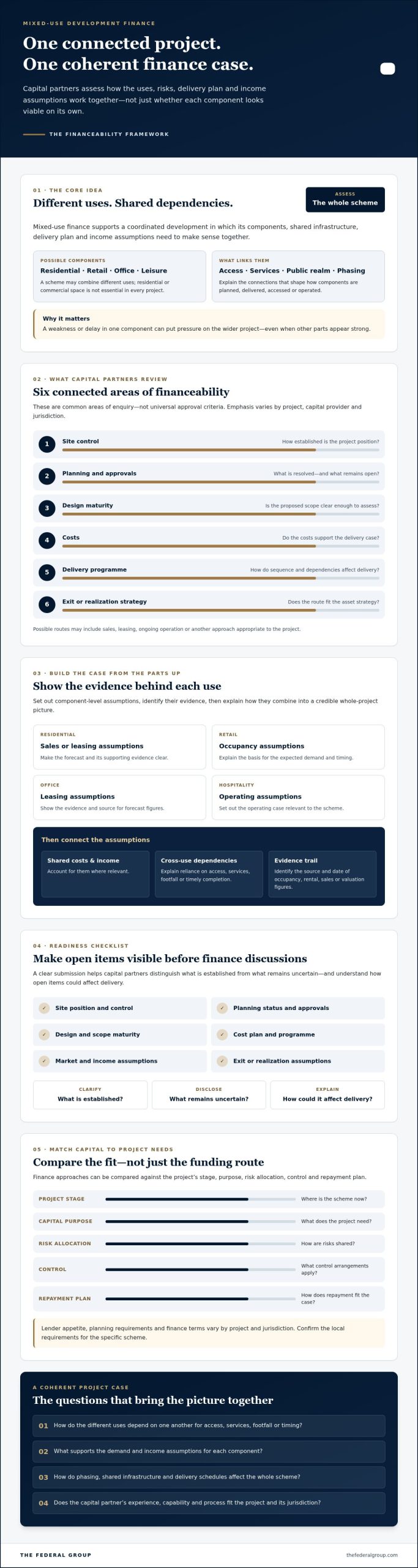
Capital partners commonly review a mixed-use proposal as a connected development case, rather than assessing each use in isolation. The review may cover site control, planning position, design maturity, cost plan, delivery programme, and assumptions behind the project’s exit or realization strategy. These are common areas of enquiry, not universal approval criteria. The depth and emphasis of review vary with the project, capital provider, and jurisdiction.
A clear submission helps partners understand what is established, what remains uncertain, and how each open item could affect delivery. Site control and planning progress indicate readiness, while design, costs, and programme help explain whether the proposed scope can be delivered as planned. Exit assumptions should fit the asset strategy, whether the project anticipates sales, leasing, ongoing operation, or another route.
Testing demand, income, and costs by use
Start by setting out separate assumptions for each component. Depending on the scheme, these could include residential sales or leasing, retail occupancy, office leasing, or hospitality operating assumptions. Explain the evidence behind each forecast, including relevant market information and the source and date of any occupancy, rental, sales, or valuation figures. Unsupported projections weaken confidence; clearly identified assumptions are easier to examine.
Then show how the component-level cases combine. Account for shared costs and income where relevant, and explain whether one use relies on another for access, services, footfall, or timely completion. Harvard Graduate School of Design’s material on financing mixed-income housing provides a useful reference for that housing context, though each project’s requirements depend on its circumstances.
Assessing planning, delivery, and cross-component risks
Planning status and design development help indicate how much work remains before delivery. Record approvals secured, applications or decisions outstanding, and design elements still subject to change. Check planning and other local requirements in the relevant jurisdiction rather than applying assumptions from another market.
Map dependencies across the scheme, including shared access, utility connections, amenities, public realm, and enabling works. For each phase, identify what must be completed first and how a delay could affect other uses, costs, or income timing. Phasing can help structure delivery, but the plan also needs to show how partially completed components will function.
Component assumptions must reconcile with the whole scheme. A credible case for each use is persuasive only when their combined delivery, costs, and income support the project as a whole. Developers considering how capital and delivery perspectives may align can review The Federal Group’s development finance capabilities. Project fit depends on the specific requirements and evidence.
Compare Mixed-Use Finance Approaches Against Project Needs
The right capital route depends on what the project needs, when it needs it, and how its risks and returns are shared. For mixed use development finance, compare options against the scheme’s stage, use of funds, control implications, and a credible repayment or realization plan. Approaches can be considered individually or, where appropriate, in combination. Availability and terms depend on due diligence, jurisdiction, negotiation, and the specific project.
When development finance or bridging finance may fit
Development finance may suit a defined development scope with an evidenced cost plan and delivery programme. The developer should be able to explain what the capital supports, how work will progress, and how the project is expected to reach its next financial milestone. For a scheme with several uses, show how funding supports both the individual components and their shared requirements.
Bridging finance may be considered for a short-term, time-sensitive capital need, such as covering a funding gap while a project moves toward a planned next stage. Its suitability depends on a clear purpose and a realistic repayment or refinancing route. Neither option is automatically available or appropriate for every mixed-use scheme; the project’s status, risks, and jurisdiction matter.
When private equity or a blended approach deserves consideration
Private equity involves an investor participating in the project’s risk and potential return. Consider the implications for governance, decision-making, and the allocation of risk and value, as well as how and when an investor may realize its position. This route may warrant examination where the project’s risk profile or capital needs call for a different balance than debt alone, but the fit depends on the parties and scheme.
A blended approach combines capital sources with different roles or risk positions. It may help address distinct project requirements, but it also adds coordination and documentation considerations. The proposed structure needs project-specific financial and legal review, including attention to jurisdiction, control, repayment priorities, and the plan for realization. For broader context on financing across international property projects, see this guide to international property development finance.
Compare potential routes against five questions before advancing a funding discussion:
- Stage: At what point in the project lifecycle is capital needed?
- Purpose: Which costs, phases, or activities will it support?
- Risk: Who carries delivery, market, and timing exposure?
- Control: What decisions or governance arrangements may change?
- Realization: How will repayment or investor realization occur?
The Federal Group provides development finance, bridging finance, and private equity for property projects. Whether any route is relevant to a mixed-use proposal depends on its evidence, capital requirement, jurisdiction, and partner discussions; no particular outcome should be assumed.
Prepare a Finance-Ready Mixed-Use Development Case
A strong funding discussion starts with a clear project record, not a collection of disconnected documents. For mixed use development finance, prepare evidence that lets a capital partner understand the proposal, test its assumptions, and identify unresolved items. There’s no single pack that suits every project, but reviewing the information in a clear sequence can reveal gaps before they slow discussions.
Build the project information pack
Begin with the project definition: identify each proposed use, how the components connect, the intended delivery sequence, and the capital requirement. Then assemble the relevant evidence, keeping versions current and sources traceable:
- Site and control: Ownership or site-control information, boundaries, and any material conditions or open items.
- Planning and design: Current planning status, supporting documentation, design materials, and decisions or approvals still outstanding.
- Costs and delivery: Cost plan, programme, proposed phases, shared works, and the assumptions behind timing and expenditure.
- Market and operations: Relevant evidence for each use, plus leasing, sales, occupancy, or operating assumptions where applicable. Record the source and date for each figure.
- People and diligence: Relevant advisers and counterparties, their responsibilities, information still due, and open diligence questions.
Use these materials to build a joined-up project model. Show each component’s assumptions separately, then make shared costs, infrastructure dependencies, phasing, and combined cash flow visible. This helps a partner distinguish evidenced inputs from estimates and understand how one use affects the wider case.
Stress-test the scheme before approaching capital
Test plausible changes against the model. What happens if one component takes longer to complete, leases more slowly, sells below the assumption, or generates less operating income? Trace the effects through shared costs, infrastructure delivery, cash flow, and the timing of other phases. Don’t rely on a single base case.
For each key dependency, record the potential impact, mitigation option, responsible party, and decision point. For example, if access or utility works must precede several uses, show how a delay could affect the sequence and what action could limit disruption. Make contingency assumptions explicit, and flag unresolved approvals or evidence gaps rather than presenting them as settled.
Coordination between design decisions and construction delivery can also shape readiness. The Federal Group’s perspective on integrated design and build development provides further context on that relationship. Once your evidence and open items are organized, you can discuss your development project with The Federal Group to explore whether its capabilities may fit your requirements. A suitable route depends on the project, jurisdiction, evidence, and capital need.
Choose a Mixed-Use Development Finance Partner for the Full Project
The right partner should understand more than the funding request. They should be able to discuss how the scheme’s uses, phases, dependencies, and evidence fit together, while being clear about the limits of their experience and the steps required to assess the proposal. For mixed use development finance, that clarity helps you judge project fit and the working relationship before committing time to a funding process.
Questions to ask a prospective capital partner
Use early discussions to understand how a potential partner evaluates the project and how its process works. Ask questions such as:
- How do you assess the interaction between the scheme’s uses, shared infrastructure, phasing, and delivery dependencies?
- What project evidence do you need to understand the site, planning position, design, costs, programme, and income assumptions?
- Who makes decisions, what are the stages of due diligence, and what information is required at each stage?
- How will updates, questions, and changes to assumptions be communicated during review?
- Does your jurisdictional scope cover the project location, and what local requirements should be independently confirmed?
Answers should be specific enough to help you understand the process without being mistaken for a commitment. Confirm relevant jurisdictional requirements with appropriate independent legal, tax, and technical advisers. If a partner discusses experience with comparable mixed-use schemes, ask for verifiable evidence rather than assuming expertise from general property-finance experience.
Where The Federal Group’s capabilities may align
The Federal Group provides international property development finance and bridging loans, and invests in high-potential property developments through private equity. Through Federal Holdings, it also manages development from architectural design through construction. These are distinct capabilities: the relevance of finance, equity, or integrated development depends on the project’s requirements and any discussion with the group. They shouldn’t be read as automatic inclusions in one funding arrangement or as confirmation of a specific mixed-use track record.
For additional perspective on cross-border considerations, review this guide to international real estate finance. A potential partnership should be evaluated against the project’s jurisdiction, evidence, capital requirement, and delivery needs. No approval, funding availability, or project outcome is guaranteed.
If you’re assessing a development and want to explore whether the group’s capabilities may fit, discuss your development project with The Federal Group.
Move Your Mixed-Use Project Forward with a Clear Case
Strong mixed use development finance starts with a joined-up project case. Show how each use contributes to the whole, make delivery dependencies visible, and support demand, cost, and income assumptions with credible evidence. Then compare potential capital routes against the project’s stage, purpose, risks, and realization plan instead of relying on a one-size-fits-all approach.
The Federal Group’s capabilities include property development finance, bridging loans, private equity, and integrated design-and-build development. Through Federal Holdings, development is managed from architectural design through construction. These capabilities may offer complementary perspectives on capital and delivery, but suitability depends on the project, jurisdiction, evidence, and capital requirement. They don’t imply a confirmed mixed-use track record or guarantee funding or outcomes.
If you’re ready to explore whether the group’s capabilities align with your project, discuss your development project with The Federal Group. A clear, well-prepared case is a strong foundation for the next conversation and a practical step toward advancing your development.
Frequently Asked Questions
What is mixed-use development finance?
Mixed-use development finance is capital intended to support a property scheme with multiple connected uses, such as homes alongside retail, offices, hospitality, or community space. The project is considered as a whole, including how the uses share infrastructure, phases, and delivery requirements. The finance case should explain the rationale and assumptions for each component, then show how they combine into a coherent development plan.
How do lenders assess a mixed-use development?
Lenders and other capital partners may review site control, planning status, design maturity, costs, programme, and the proposed exit or realization strategy. They may also examine each use’s demand, income assumptions, and supporting evidence before considering the combined project case. Shared infrastructure and phasing matter because a delay or weaker performance in one component could affect other uses. Review criteria vary by provider, project, and jurisdiction.
Can one finance facility cover multiple uses in a development?
It may be possible for a capital arrangement to support more than one use, but developers shouldn’t assume a single facility will suit every scheme. The provider may consider the uses together or examine them separately within the overall project case. The structure depends on the project, jurisdiction, evidence, capital requirement, and discussions with the potential partner. Clarify how each component, shared cost, and phase would be considered before relying on a proposed approach.
What documents are needed to apply for mixed-use development finance?
Requirements differ, but developers should be ready to provide information on site ownership or control, planning status, and current design. A cost plan, delivery programme, phasing details, and relevant market evidence can help explain feasibility. Include income or operating assumptions for each use, with sources and dates, plus a joined-up view of dependencies and cash flow. Identify outstanding approvals, diligence items, and assumptions that still need confirmation.
Is bridging finance suitable for a mixed-use development?
Bridging finance may be considered for a short-term, time-sensitive property capital need, but suitability depends on the project and a credible repayment plan. Developers should clarify what the funds would support, how long the requirement is expected to last, and what event or source is intended to repay the borrowing. A mixed-use scheme’s phasing, planning position, and delivery risks may affect a provider’s assessment. Availability and terms aren’t guaranteed.
How does private equity differ from development finance for a mixed-use project?
Development finance is generally considered as project funding with an agreed repayment or realization plan. Private equity involves an investor participating in project risk and potential returns, with implications for governance, decision-making, and how value may be realized. The right comparison depends on the project’s capital needs, risk profile, and sponsor priorities. Review proposed arrangements with appropriate advisers, since terms and control rights depend on negotiation and jurisdiction.
What makes a mixed-use development finance-ready?
A finance-ready proposal clearly defines its uses, delivery sequence, capital purpose, and project assumptions. It brings together site-control information, planning and design materials, costs, programme, and relevant market evidence, while showing how the components and shared dependencies fit together. Strong preparation also identifies open approvals, information gaps, sensitivities, and contingency assumptions. Readiness doesn’t guarantee finance, but it helps a capital partner assess the opportunity and identify questions efficiently.