Navigating the Challenges of International Property Development Finance in 2026
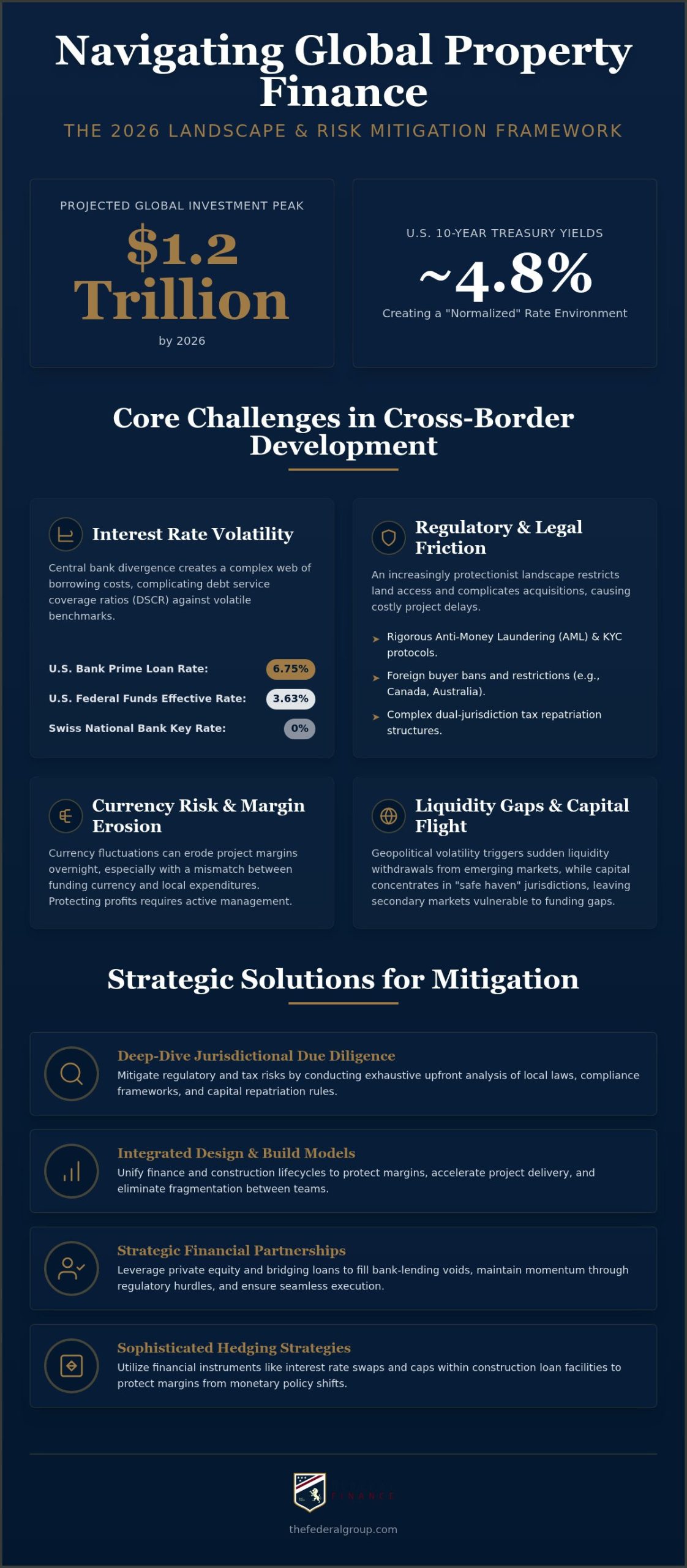
14 September 2026The global real estate market is on track to reach a $1.2 trillion investment peak in 2026; however, with U.S. 10-year Treasury yields hovering near 4.8%, the distance between vision and capitalized reality has never felt greater. You’ve likely seen currency fluctuations erode project margins overnight or felt the friction of inconsistent regulatory frameworks across borders. It’s a high-stakes environment where fragmentation between financiers and construction teams often leads to stalled momentum. Mastering the challenges of international property development finance requires more than just capital; it demands a sophisticated, integrated approach to risk.
This article provides a clear framework for structuring cross-border deployment and mitigating global financing risks. You’ll discover how to unify finance and construction lifecycles to protect your margins and accelerate project delivery. We’ll explore the strategic use of private equity and bridging loans to maintain momentum when regulatory hurdles arise. By the end, you’ll have the insights needed to transform complex international challenges into stable, high-value assets.
Key Takeaways
- Understand the transition to the 2026 normalized rate environment and how geopolitical shifts impact global capital liquidity.
- Navigate the complexities of dual-jurisdiction tax repatriation and AML compliance to avoid costly project delays.
- Protect your development margins against the challenges of international property development finance by managing the mismatch between funding and local expenditures.
- Mitigate cross-border risks through deep-dive jurisdictional due diligence and integrated design and build development models.
- Leverage the synergy between private equity and operational oversight to ensure seamless project execution across international borders.
The 2026 Landscape: Macro-Economic Hurdles in Global Property Finance
International property development finance represents the strategic mobilization of cross-border capital to fund the lifecycle of large-scale real estate projects while navigating diverse economic and regulatory environments. In 2026, the era of ultra-low interest rates has officially concluded. With the U.S. Federal Funds Effective Rate at 3.63% and the Bank Prime Loan Rate at 6.75%, developers are operating in a “normalized” rate environment that demands higher internal rates of return. This shift has fundamentally altered the global property finance landscape, forcing a more disciplined approach to capital deployment. The challenges of international property development finance are amplified by this return to traditional cost-of-capital benchmarks, where every basis point counts toward project viability.
Geopolitical volatility continues to dictate capital flight patterns. Events in the Middle East and shifting trade alliances exert upward pressure on commodity prices and interest rates, often triggering sudden liquidity withdrawals from emerging markets. Simultaneously, Environmental, Social, and Governance (ESG) compliance is no longer optional. Institutional lenders now prioritize green-certified assets; projects lacking robust ESG credentials face a significantly narrower pool of funding, regardless of their projected yields. It’s a high-stakes environment where a project’s carbon footprint is as critical as its balance sheet.
Monetary Policy and Interest Rate Volatility
Central bank divergence has created a complex web of borrowing costs. While the Swiss National Bank maintains a 0% key rate, U.S. 10-year Treasury yields fluctuate between 4.65% and 4.83%. This disparity complicates cross-border borrowing, as developers must manage debt service coverage ratios (DSCR) against volatile benchmarks. To protect margins, sophisticated developers utilize interest rate swaps and caps within their construction loan facilities. These hedging strategies are vital for maintaining stability throughout the multi-year development cycle, ensuring that rising debt costs don’t derail construction momentum.
Liquidity Gaps in Emerging vs. Established Markets
Competition for capital in “safe haven” jurisdictions has reached unprecedented levels. While global investment is forecast to reach $1.2 trillion this year, much of that liquidity is concentrated in primary hubs, leaving secondary markets vulnerable to liquidity traps. Identifying these traps early is essential to avoid stranded assets. As traditional banks retreat to core markets, private equity has emerged as a critical partner. These firms fill the bank-lending void by offering the flexibility and speed required for high-potential global ventures. Addressing the challenges of international property development finance requires this type of strategic partnership, where capital is backed by deep sectoral expertise rather than just institutional mandates.
Regulatory and Legal Complexity: The Friction of Cross-Border Capital
Capital doesn’t move across borders without friction. In 2026, the regulatory landscape has become increasingly protectionist. Canada’s foreign buyer ban remains in effect until January 1, 2027, and Australia has extended restrictions on established dwellings until mid-2029. Even within the U.S., Indiana’s P.L. 131-2026 now prohibits certain foreign government entities and businesses from purchasing property. These shifting laws represent primary challenges of international property development finance, as they restrict land access and complicate the legal basis for acquisition.
Securing an international real estate finance partner is the first step in de-risking these ventures. Beyond ownership bans, developers must clear rigorous Anti-Money Laundering (AML) and Know Your Customer (KYC) protocols. For global HNWIs, the documentation required to prove the provenance of funds can stall a transaction for months. Speed is a competitive advantage; however, it’s often sacrificed at the altar of compliance. A partner who understands institutional requirements can pre-empt these delays, ensuring that the financing remains as agile as the development team.
Tax Structuring and Capital Repatriation
Profit is only theoretical until it’s repatriated. Withholding taxes on development profits can erode margins if capital isn’t routed through a sophisticated Special Purpose Vehicle (SPV). The location of your SPV is a strategic decision that affects debt serviceability and the final exit. When transitioning from construction to sale, your financing must account for the tax duties of the local jurisdiction versus the investor’s home base. Effective structuring ensures these taxes don’t become a dual-jurisdiction trap that penalizes your project’s success.
Sports Real Estate: A Unique Regulatory Challenge
Developing stadium-anchored real estate or multi-club training facilities introduces a second layer of oversight. Developers don’t just answer to financial regulators; they must also navigate the specific rules of sports governing bodies. These projects require a nuanced blend of development finance and specialized equity. Because sports assets have unique liquidity profiles, they’re often leveraged to secure broader property development capital. If you’re looking to scale your portfolio, exploring our private equity solutions can provide the institutional support needed to manage the challenges of international property development finance in this specialized sector.
Currency Risk and the Erosion of Development Margins
Currency volatility is a silent margin killer. In 2026, where profit targets are already squeezed by normalized interest rates, a 5% shift in exchange rates can eliminate a developer’s net return. This risk stems from a fundamental mismatch between the currency of the debt facility and the currency of local construction expenditure. For example, a UK developer funding a project in Texas might secure a GBP-denominated loan, only to see the dollar strengthen against the pound during the early phases of construction. The challenges of international property development finance are most visible when procurement costs in USD rise while the available GBP capital remains static.
This mismatch creates an immediate funding gap that can stall a project before it leaves the ground. Securing fast-action bridging finance for land acquisition allows developers to seize opportunities immediately, providing a critical buffer while more complex, hedged long-term facilities are structured. It’s a strategic move to lock in the asset value while the treasury team finalizes the broader capital stack. Speed in the acquisition phase often dictates whether a project can withstand subsequent market fluctuations.
Forward Contracts and Hedging for Construction
Hedging isn’t just for institutional banks. It’s a necessity for any cross-border build. Locking in rates via forward contracts for multi-year builds provides the cost certainty required to satisfy institutional equity partners. Mid-sized developers must weigh the cost of these instruments against the catastrophic risk of unhedged exposure. Multi-currency facilities offer another layer of protection, allowing firms to manage global procurement by paying a German steel supplier in Euros while managing a project in New York.
Inflationary Pressures on Global Material Costs
Developers currently face a “double whammy.” Local currency devaluation often coincides with global supply chain inflation, driving up the cost of essential materials. This reality forces an increase in contingency funds within international development loans, often as high as 15% to 20% in volatile regions. Integrated design and build models help stabilize these procurement costs. By centralizing the lifecycle through a single partner, developers reduce the number of intermediaries affected by currency friction and supply chain delays, ensuring that the challenges of international property development finance don’t compromise the final build quality.
Strategies for Mitigating International Development Risk
Risk mitigation in 2026 requires an aggressive stance on jurisdictional due diligence. You shouldn’t deploy capital without a forensic audit of local lien laws, planning permissions, and environmental mandates that could halt construction without warning. The challenges of international property development finance are frequently found in these local granularities that traditional lenders often overlook. Institutional-grade property finance partners provide the necessary stability to transform volatile cross-border variables into predictable project milestones. By combining local intelligence with institutional-scale capital structures, developers can effectively insulate their portfolios from the regulatory shocks and currency shifts mentioned earlier.
The Integrated Lifecycle Approach
The traditional separation of architectural vision and financial execution creates unnecessary friction and project risk. Working with integrated design and build developers eliminates this gap by ensuring every design iteration is vetted against the project’s financial feasibility from day one. This ecosystem approach reduces lender anxiety, as it provides a single point of accountability for both the build quality and the budget. When design and construction are unified, the timeline from planning approval to the first shovel in the ground is significantly compressed. This efficiency directly impacts the bottom line by saving months of interest costs on high-value construction facilities.
Leveraging Private Equity for Scale
Strategic growth in international markets often requires capital that goes beyond the conservative limits of senior debt. Private equity provides the flexibility to bridge this gap, allowing developers to maintain momentum on large-scale projects without stalling due to capital constraints. The choice between Joint Venture (JV) equity and mezzanine debt is a tactical one. JV equity allows for a shared risk-reward profile that can attract institutional capital to high-potential global ventures. Conversely, mezzanine debt can provide the necessary leverage without diluting the developer’s ownership stake in the long term. Correctly structuring these equity partnerships is essential for portfolio growth, as it builds the track record necessary to access lower-cost capital in future cycles. If you’re ready to scale your international operations, consider our integrated development finance and private equity solutions to secure your project’s future.
The Federal Group: Solving the Fragmentation of International Finance
Most brokers act as mere intermediaries, offering access to third-party lenders without contributing technical oversight or their own capital. The Federal Group operates as a strategic partner rather than a simple financier. We deploy institutional-scale expertise and private equity to directly address the challenges of international property development finance. By unifying the roles of lender and developer, we eliminate the fragmentation that typically leads to cost overruns and stalled momentum in cross-border ventures. Our integrated model ensures that capital deployment is always aligned with the practical realities of the construction site.
Our global reach extends across the UK, US, and specialized international markets, providing a stable platform for high-value projects. We understand that in a normalized rate environment, timing is the most critical variable. We provide the bridging loans necessary to secure land and maintain project velocity while long-term debt structures are finalized. This proactive stance allows our partners to bypass the delays inherent in traditional banking, turning potential regulatory or liquidity hurdles into manageable milestones.
Comprehensive Capital Solutions
Our capital solutions are engineered for the high-stakes environment of 2026. We serve as an international property development finance authority, offering tailored facilities that account for the nuances of diverse jurisdictions. This expertise is particularly vital for professional sports club owners and institutional investors involved in multi-club ownership. Our specialized sports division manages the unique financial profiles of stadium-anchored developments and global football club investments, ensuring that real estate assets are leveraged effectively within a broader investment strategy.
Designing for Financial Success
Financial success is often determined before the first shovel hits the ground. Through Federal Holdings, our design and build arm, we integrate architectural vision with capital reality. This synergy ensures that every project is vetted for financial feasibility during the design phase, reducing the risk of mid-build budget corrections. Our track record in high-value international development proves that an ecosystem approach is the most effective way to mitigate the challenges of international property development finance. We provide a single point of accountability for the entire lifecycle, from acquisition to completion. Partner with The Federal Group for your next international project to secure a foundation of stability, expertise, and integrated execution.
Mastering Global Capital for the Next Generation of Development
The 2026 real estate landscape demands a shift from reactive brokerage to integrated strategic partnership. Success in this normalized rate environment depends on your ability to synchronize cross-border capital with local execution. By addressing the challenges of international property development finance through rigorous due diligence and sophisticated hedging, developers can protect their margins against currency volatility and regulatory friction. An ecosystem approach, where finance and construction are unified, provides the stability necessary for high-stakes international ventures.
The Federal Group offers the institutional-scale expertise required to navigate these complexities. With our fully integrated Design & Build capability and global expertise in property and sports club finance, we provide specialized, high-value capital solutions that maintain project momentum. Whether you’re managing a stadium-anchored development or a large-scale residential build, we bridge the gap between vision and capitalized reality. Secure your international development’s future with The Federal Group and transform global complexity into a competitive advantage. Your next project deserves the security of an authoritative global partner.
Frequently Asked Questions
What are the biggest risks in international property development finance?
The primary risks include currency fluctuations that erode margins and inconsistent regulatory frameworks across borders. In 2026, foreign ownership laws and stricter AML protocols add layers of complexity. These factors define the core challenges of international property development finance, making it essential to have a partner who understands both the financial structuring and the local construction environment. Such expertise prevents project stalls and ensures capital deployment remains aligned with the project’s physical progress.
How do currency fluctuations affect development loans?
Currency fluctuations create a mismatch between the debt facility’s currency and local construction expenditures. If a developer secures a loan in GBP but pays for labor and materials in USD, a shift in exchange rates can instantly inflate costs. Sophisticated developers mitigate this by using forward contracts or multi-currency facilities. Without these hedges, even a minor 5% swing can eliminate the projected profit margin for a multi-year international project, making currency risk management a priority for global stakeholders.
Is bridging finance suitable for international land acquisitions?
Bridging loans are highly effective for securing international land acquisitions where speed is a competitive advantage. They allow developers to lock in high-value assets immediately while more complex long-term development finance is being structured. This short-term capital maintains project momentum during regulatory delays or extended due diligence periods. The Federal Group specializes in providing these fast-action capital solutions to ensure developers don’t miss windows of opportunity in volatile and highly competitive global markets.
What is the difference between development finance and real estate private equity?
Development finance is a debt-based facility focused on the construction phase, whereas real estate private equity involves a capital injection in exchange for an ownership stake. Private equity offers more flexibility and can bridge the gap between senior debt and the developer’s own equity. While debt requires regular interest payments, equity partners share in the project’s risk and reward. This model is often the preferred route for funding high-potential, multi-jurisdictional ventures with significant scale requirements.
How can an integrated design and build model help secure funding?
An integrated design and build model reduces lender anxiety by providing a single point of accountability for both architectural vision and financial feasibility. When the financier and the developer are unified, as seen with Federal Holdings, the risk of budget overruns due to design changes is minimized. This synergy assures institutional lenders that the project is vetted for technical viability from day one. It streamlines the approval-to-construction timeline, significantly reducing the interest costs associated with long-term construction facilities.
What role does private equity play in sports-related property development?
Private equity provides the strategic capital required for complex sports-related developments, such as stadium-anchored real estate or training facilities. These projects often involve multi-club ownership models where real estate assets are leveraged to drive commercial growth. Because sports developments have unique liquidity profiles, private equity partners offer specialized funding structures that traditional banks often avoid. This enables developers to scale global sports portfolios while managing the specific regulatory hurdles mandated by international sports governing bodies.
How does The Federal Group structure cross-border bridging loans?
The Federal Group structures cross-border bridging loans by prioritizing speed and technical precision. We provide short-term facilities that allow developers to acquire land or maintain momentum during jurisdictional delays. Our approach involves a deep-dive audit of local laws and planning permissions to ensure the capital is secure. By leveraging our global market expertise, we create flexible funding structures that act as a stable bridge to long-term development finance or strategic private equity partnerships.
Can international property finance be used for mixed-use developments?
International property finance is frequently utilized for mixed-use developments that combine residential, commercial, and sports-related assets. These complex projects require multi-disciplinary funding stacks to account for different revenue streams and risk profiles. Successfully navigating the challenges of international property development finance for mixed-use sites involves coordinating various jurisdictional tax structures and SPVs. This ensures that each component of the development, from retail space to luxury apartments, is capitalized for maximum efficiency and long-term stability.