Property Development Finance: Developer’s Guide 2026
14 October 2026What if the strongest funding offer on paper is the wrong partner for your project? Choosing among property development finance lenders means looking beyond headline terms to find capital that fits the development’s stage, risk profile and delivery requirements.
That assessment can be difficult. Debt providers and equity partners play different roles, while bridging finance may suit a different point in the project lifecycle. Cross-border structures, counterparties and execution demands add further considerations, and a mismatch between the funding and the project can put progress at risk.
This guide gives you a practical framework for evaluating funding partners by project fit, capital structure, execution capability and international experience. You’ll learn how development debt, bridging finance and private equity can support different needs, how to compare funding options on an equivalent basis, and what to include in a credible project case. It also explains why finance capability and practical development experience matter when funding decisions need to connect with delivery.
Key Takeaways
- Match property development finance lenders to your project’s stage, geography, capital needs and delivery complexity, not just their product range.
- Compare development debt, bridging finance and private equity by the role each can play in your funding plan. Structures and terms vary by project.
- Assess a finance partner’s relevant development and asset experience alongside its ability to support execution.
- Build a coherent project case by linking feasibility evidence, funding requirements, milestones and risks.
- The Federal Group brings development finance, bridging loans and private equity together with practical development experience and an international perspective.
What property development finance lenders do, and where their role begins
Property development finance lenders provide capital for defined stages of a development project. Funding is shaped around the asset, business plan and delivery pathway. This differs from retail banking: the financing is assessed against a project’s development requirements and risks, rather than everyday banking needs or a standard personal home loan.
A development finance facility funds eligible project costs through a defined development plan; a standard residential mortgage typically finances a home purchase or ownership, not the staged delivery of a development. The distinction matters from the outset. A lender considers how the proposed use of capital connects to project progress, while the sponsor remains responsible for assembling a viable scheme and contributing the required resources.
Development is a sequence of decisions and work, from securing a site to completing an asset. The Real Estate Development Overview provides broader context on that lifecycle. For developers, the financing question is how capital needs change as the project advances, not simply how much can be borrowed against a property.
Which development stages may require lender capital?
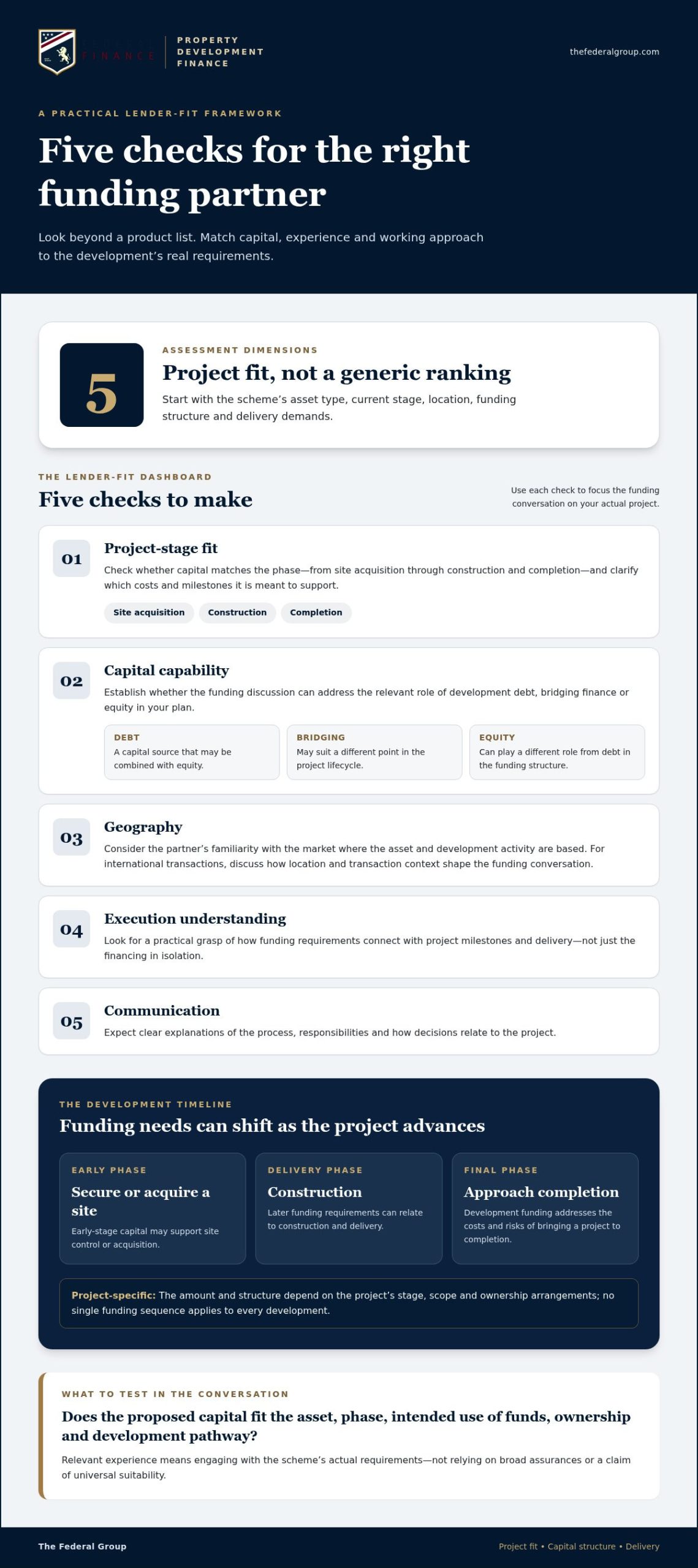
Funding needs can arise during site control or acquisition, then shift as construction begins and the project approaches completion. Early-stage capital may support securing or acquiring a site; later requirements can relate to construction and delivery. To map your likely needs, list the project’s major costs by phase, when each cost falls due and which milestone it supports. The amount and structure depend on the project’s stage, scope and ownership arrangements, so no single funding sequence applies to every development.
Development funding also serves a different purpose from long-term financing for a completed, income-producing asset. A development facility addresses costs and risks associated with bringing a project to completion. Once the asset is complete and generating income, its financing needs may be assessed on a different basis.
What does a development finance lender contribute?
A lender contributes capital and considers how a financing structure could align with the project’s needs and milestones. That means looking at the proposed scheme, use of funds and delivery plan, rather than simply assessing a developer’s property search. The developer’s case should explain how the opportunity can become a deliverable project.
Lender capital is only one part of the funding picture. Sponsor equity is the developer’s own capital committed to the project; debt and equity can be combined in different ways depending on the project structure. The balance affects how much funding is required, how risk is shared and what resources remain available through delivery. A sources-and-uses schedule, showing where funds come from and what they pay for, helps make these elements clear.
For a wider view of financing considerations across international projects, explore the international development finance guide. The Federal Group provides development finance, bridging loans and private equity for international property projects, bringing financing experience alongside a practical understanding of development execution.
How to assess property development finance lenders for project fit
A lender’s broad product list won’t tell you whether its capital, experience and working approach match your scheme. Start with the project itself: its asset type, current stage, location, funding structure and delivery demands.
Lender fit depends on the project’s requirements, not a generic ranking of finance providers. Use these five criteria to focus your assessment:
- Project-stage fit: Check whether the capital aligns with the current phase, from site acquisition through construction and completion. Clarify which costs and milestones the proposed funding is intended to support.
- Capital capability: Establish whether the financing discussion can address the relevant role of debt, bridging finance or equity.
- Geography: Consider the partner’s familiarity with the market where the asset and development activity are based.
- Execution: Look for a practical understanding of how funding requirements connect with project milestones and delivery.
- Communication: Expect clear explanations of process, responsibilities and how decisions relate to the project.
Relevant experience matters more than a catalogue of products. A partner that understands the asset type and development stage can engage with the project’s actual requirements rather than relying on a generic description of what it funds. For example, a site requiring substantial construction work raises different questions from an asset nearing completion. Look for specific engagement with your scheme, not a claim of universal suitability.
Does the lender understand your project and market?
Test whether the proposed capital corresponds to the asset, project phase and intended use of funds. For an international transaction, local market familiarity also matters: the partner should be able to discuss how the project’s location and transaction context shape the funding conversation. Ask whether the discussion addresses the scheme’s ownership, structure and development pathway, rather than relying on broad assurances.
Can the finance partner support the project’s complexity?
Complexity may involve several funding needs, delivery stages or markets. A finance partner should be able to explain how debt, bridging finance or equity could be relevant, without suggesting that one structure applies to every project. Clear communication about process, responsibilities and decision-making helps developers understand how the financing discussion connects to execution. The international real estate finance partner guide provides further context on cross-border considerations.
For a cross-border development, assess the connection between market understanding, transaction structure and delivery expertise. A gap in any one area can complicate coordination: financing discussions may not reflect local context, or capital planning may not align with project milestones. The Federal Group brings an international property finance perspective alongside practical development experience, including through Federal Holdings’ integrated design-and-build operation. Explore its international property finance and development perspective as you consider how those capabilities relate to your project.
Compare development finance lenders by capital type and project purpose
Assess capital by the job it needs to do. A site purchase, a time-sensitive transaction and a construction programme can call for different funding approaches. Start by comparing purpose and timing, then consider how each form of capital affects the project’s obligations, risk allocation and delivery plan.
The table outlines typical roles, not fixed rules. Property development finance lenders and capital partners may structure funding differently, and a project can combine more than one source. There is no universal capital stack or standard set of terms.
| Capital type | Typical role | Consider alongside |
|---|---|---|
| Development debt | Funding eligible requirements connected with a development project. | Project stage, planned use of funds and repayment strategy. |
| Bridging finance | Short-term capital for a time-sensitive property need. | The specific funding gap and the project’s next financing or delivery milestone. |
| Private equity | Investment participation in a project or venture. | How investment economics, rights, control and risk are agreed. |
When might development finance or bridging finance fit?
Development finance may suit eligible costs associated with carrying a project forward, with the funding discussion shaped by its stage and structure. Bridging finance is generally considered for a short-term property requirement where timing is central, such as addressing a funding need between transaction milestones. It isn’t simply interchangeable with development funding: the intended use and the plan beyond the immediate need matter. For land-specific context, see this bridging finance for land guide.
How does equity differ from debt in a development?
Debt creates a financing obligation under agreed terms; equity involves an investment participation. Equity can affect the project’s economics and decision-making differently from borrowing, while debt and equity both expose participants to project risk in distinct ways. Rights, control and financial outcomes depend on the agreed structure, so compare the full arrangement rather than a label alone.
Consider a hypothetical project that needs capital to secure a site before a construction plan is ready. Its immediate requirement may differ from the funding needed once delivery is underway. The developer could assess whether short-term bridging finance addresses the first need, whether development debt better aligns with later project costs, or whether equity participation fits the wider funding plan. The answer depends on the project, not a preset sequence.
Compare options by mapping each proposed source to a defined use of funds and milestone. Identify what the capital supports, how long the need is expected to remain, and what obligations or participation follow. This makes it easier to see whether a structure supports delivery or adds complexity the project doesn’t require. Avoid comparing a debt offer and an equity proposal on a headline figure alone; their roles and risk profiles differ.
Prepare a credible project case before approaching finance partners
A clear funding case helps property development finance lenders understand what the project requires, why it is feasible and how capital relates to delivery. The aim isn’t to make uncertainty disappear. It’s to distinguish established facts from assumptions and show how each material assumption affects the plan.
Build the case in sequence:
- Define the project. Summarize the asset, site location, ownership or control position, development concept and current stage. State the planning status and intended outcome, such as a completed asset for sale or an operating property.
- Assemble feasibility evidence. Bring together the information behind the project’s assumptions, including relevant market analysis, development costs and planning or construction considerations. Identify what is confirmed, what remains subject to change and the basis for important projections.
- Map funding needs. Connect expected costs and their timing to proposed capital sources. Explain the intended use of funds, when the project needs them and how each funding requirement relates to the relevant phase or milestone.
- Outline delivery. Set out the project-specific timeline, key milestones, material risks and completion strategy. Explain the intended exit or operating approach and how it relates to the development plan.
What should a development finance proposal explain?
Make the core story easy to follow: what the asset is, where the site is, what will be developed, the project’s current stage and what the requested funding is intended to support. Include a milestone sequence and clearly label timing assumptions as estimates, not established outcomes. Highlight material planning, construction, market and cross-border considerations, and explain how they may affect delivery or funding needs.
How can developers present feasibility and funding needs?
Use a joined-up narrative rather than disconnected spreadsheets and documents. Show how budget assumptions support the development plan, how proposed capital sources relate to costs, and when funding is expected to be required. If a projection depends on an assumption, state its basis and make the dependency visible. This helps finance partners assess the logic of the proposal without mistaking an estimate for a confirmed fact.
Keep the material consistent across the summary, cost plan and milestone schedule. If a change in planning status, construction scope or market assumptions would alter the funding requirement, explain that relationship. For wider context on structuring capital for substantial schemes, the large-scale development funding guide explores considerations relevant to larger projects.
A disciplined project case gives financing discussions a clear starting point. Read about The Federal Group’s development finance as part of your funding research.
How The Federal Group approaches property development finance
The Federal Group is an international property finance and development group. Its capital solutions include development finance, short-term bridging loans and private equity. These are distinct forms of capital, each considered in relation to a project’s purpose and structure; they don’t carry identical terms or apply in the same way to every opportunity.
For developers comparing property development finance lenders, the group’s perspective connects capital discussions with project execution. Funding requirements relate to practical development decisions, including the project stage, intended use of capital and delivery plan. That practical lens helps frame a discussion around the scheme, while project outcomes still depend on the specific project and its execution.
A finance partner with development experience
Through Federal Holdings, The Federal Group also operates as an integrated design-and-build developer, managing property projects from design through construction. This development experience sits alongside the group’s finance activity, bringing a practical understanding of how delivery considerations can inform funding discussions.
That combination is relevant when financing and execution need to be considered together. For example, a project’s construction approach and milestones can influence how a developer explains capital requirements. Understanding those connections supports a grounded conversation about funding structure, without implying that any financing partner can remove project risk or guarantee results.
Explore the right next conversation for your project
A focused discussion can begin with four essentials: the project’s current stage, its geography, the capital requirement and the execution context. Explain what the funding is intended to support, how the project is expected to progress, and where development or cross-border complexities may affect the plan. This gives the conversation a clear, project-specific foundation.
Development finance can address eligible project funding needs, bridging loans a short-term property requirement, and private equity investment participation. The appropriate route depends on the project and agreed structure. The development finance lender case study offers a relevant example to explore alongside these capabilities.
Bring your project stage, location, capital needs and delivery plan into the conversation. Discuss your property development project with The Federal Group.
Turn your funding strategy into a project conversation
Translate your project’s priorities into a focused funding discussion. Bring forward the decisions that will shape delivery: what the capital needs to support, how the project is expected to progress, and where market or execution complexity calls for careful coordination. This gives property development finance lenders a clearer basis for engaging with the opportunity.
The Federal Group is an international property finance and development group with development finance, bridging loans and private equity capabilities. Through Federal Holdings, it also operates as an integrated design-and-build developer. These capabilities offer different ways to connect capital considerations with development experience, depending on the project.
Start with a clear account of your project’s stage, geography, funding requirement and delivery context. Discuss your property development project with The Federal Group and take the next step towards a considered funding strategy.
Frequently Asked Questions
How do property development finance lenders assess a project?
Property development finance lenders assess the proposed scheme, its funding requirement and the developer’s plan for delivering it. They may examine whether the project’s assumptions are consistent across its cost plan, schedule and intended outcome. To prepare, identify the main dependencies, such as planning decisions or construction scope, and explain how a change could affect costs, milestones or funding needs. This keeps the discussion grounded in the project.
What documents do property development finance lenders usually request?
Documents vary by lender and project, but a useful starting file may include a project summary, site and ownership information, planning records, a development budget, feasibility evidence and a milestone schedule. Lenders may also seek information on the sponsor and proposed capital sources. Keep versions current, label estimates clearly and reconcile key figures across documents. This helps finance partners follow the project’s assumptions without mistaking draft information for confirmed details.
Can a property development finance lender fund land acquisition?
Yes, land acquisition can form part of a development funding requirement, depending on the project and financing structure. Explain the site’s role in the scheme, its current status and how acquisition connects to the next development steps. A time-sensitive purchase may raise different questions from a site already controlled by the developer. The intended use of funds and the wider plan help establish which type of capital is relevant.
How much equity do developers need for development finance?
There’s no single equity amount that applies to every development. The contribution depends on the project’s costs, risk profile, available capital and agreed financing structure. Rather than relying on a generic percentage, prepare a sources-and-uses schedule showing expected costs and how each source is intended to fund them. Include sponsor equity separately from proposed debt or investment capital, and explain assumptions that could change the amount required.
Are property development finance lenders available for international projects?
Yes, some finance partners work with international property projects. Cross-border opportunities can involve distinct market, transaction and delivery considerations, so present the asset location and project structure clearly. Explain how ownership, the funding plan and development activity relate across the relevant jurisdictions, without assuming that experience in one market automatically translates to another. The Federal Group is an international property finance partner providing capital solutions for international property projects.
What is the difference between a development finance lender and an equity partner?
A development finance lender provides debt, creating a repayment obligation under the agreed financing arrangement. An equity partner invests in the project and participates according to the agreed investment structure. The distinction can affect project economics, decision-making and how risk is shared. Review the proposed rights and obligations, not just the capital amount, and consider how each structure interacts with the development plan and the sponsor’s objectives.
Can one finance partner support more than one stage of a development?
Potentially, but support across stages depends on the project, financing structure and partner capabilities. A developer might discuss an early site requirement and later construction funding as connected but distinct needs; that doesn’t mean one facility or set of terms automatically covers both. Map upcoming milestones and capital requirements, then make clear which needs are immediate and which relate to later phases.