Short-Term Property Finance: Match Funding to Your Project in 2026
16 October 2026A short-term rental loan and short term property finance may sound like the same solution, but they address different needs. Rental-focused lending relates to a property’s occupancy and income. Short term property finance can provide temporary capital for a property project, such as bridging the gap between an acquisition and the next funding milestone.
The distinction matters because the right structure depends on how the property will be used, where the project stands and how the borrowing is intended to be repaid. If those details do not align, the funding may not carry the project through to its next stage or planned exit.
This guide explains how rental-focused lending differs from bridging and development finance, and which project details shape a suitable funding plan. You’ll learn how to connect capital to milestones such as acquisition, construction or refinancing, and how to set out a coherent repayment route. The Federal Group provides development finance and bridging loans for property projects, with funding discussions focused on the project’s timing and purpose rather than treating every short-term requirement as the same.
Key Takeaways
- Identify whether the funding need comes from rental operations or a temporary project-stage gap before comparing finance structures.
- Map each capital requirement to the next milestone, from acquisition and planned works to leasing, sale or another repayment route.
- Compare rental-focused lending, bridging finance, development finance and equity participation by purpose and repayment logic.
- Use short term property finance more effectively by separating documented project information from forecasts for revenue, delivery and exit.
- Bring clear asset details, project-stage information and a coherent repayment plan to a finance discussion.
What Does Short-Term Property Finance Mean for Investors and Developers?
Short-term property finance is temporary capital arranged to meet a defined property funding need or carry a project through a particular stage. The need might arise during an acquisition, while planned works are underway, or before another source of capital or a sale is expected to repay the borrowing. Its purpose is tied to the project’s timing, not simply to how long someone occupies the property.
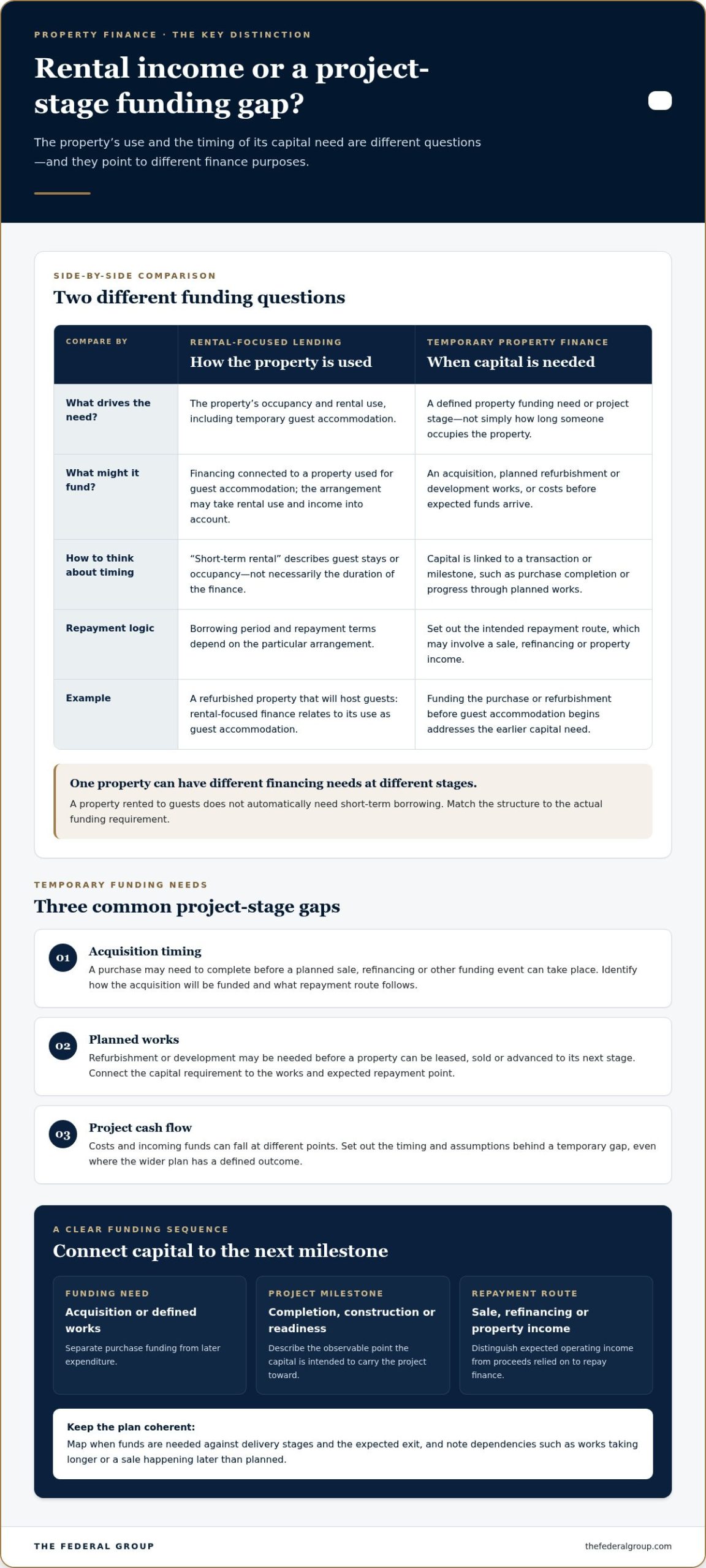
Short-term rental describes how a property is occupied; short-term finance describes when capital is needed and how it is intended to be repaid. Keeping those ideas separate helps investors and developers compare structures based on the actual funding requirement. A property rented to guests does not automatically need short-term borrowing.
Short-Term Rental Finance Versus Short-Term Property Finance
Short-term rental financing relates to property used for temporary guest accommodation. Its structure may take rental use and income into account, while the borrowing period and repayment terms depend on the particular arrangement. Here, “short-term” describes guest stays or occupancy, not necessarily the duration of the finance.
By contrast, temporary property capital is linked to a transaction or development milestone. An investor might need funds to complete an acquisition before longer-term financing is arranged, while a developer may need capital to progress defined works. A bridge loan is one form of temporary finance. Bridge Loan – Wikipedia provides background on its general role in bridging a funding interval. The structure and repayment period depend on the financing arrangement.
Consider a property that will host guests after refurbishment. A rental-focused loan relates to its use as guest accommodation; finance for the purchase or refurbishment addresses the capital needed before that use begins. The same property can therefore have different financing needs at different stages.
Which Property Scenarios Can Create a Temporary Funding Need?
Temporary funding needs often arise in three situations:
- Acquisition timing: A purchase may need to complete before a planned sale, refinancing or other funding event can take place. The financing plan should identify how the acquisition will be funded and what repayment route follows.
- Planned works: A property may need refurbishment or development before it can be leased, sold or advanced to its next stage. The capital requirement should reflect the planned works and the point at which repayment is expected.
- Project cash flow: Costs and incoming funds may fall at different points in a project. A temporary gap can arise even when the wider plan has a defined outcome, so timing and assumptions need to be set out clearly.
An investor may focus on acquiring or improving an asset for ownership or income. A developer’s priority is delivering the project through its planned stages. These goals shape the funding need and repayment logic. Neither the occupancy pattern nor the project label alone determines a suitable structure. For wider context on how capital connects with project planning, see the international property development finance guide.
Before comparing short term property finance options, define the milestone the capital must support, when the funds are needed and the intended source of repayment. This gives a financing discussion a clear starting point.
How Short-Term Property Finance Supports a Project from Acquisition to Exit
Temporary capital works best when it is mapped to a specific point in a property project, rather than treated as a general funding pool. The same asset may need funds for purchase, planned works and the period before a sale or refinancing. Each stage can have a different use of funds, timing and repayment logic. A clear sequence helps investors and developers explain what the capital needs to achieve and what is expected to happen next.
- Define the funding need. Specify the immediate requirement, such as completing an acquisition, paying for defined works or meeting project costs before expected funds arrive. Separate purchase funding from later expenditure so the structure reflects the actual requirement.
- Identify the milestone. Set out what the capital is intended to carry the project toward: acquisition completion, a stage of construction, readiness to lease or preparation for sale. The milestone should be observable and connected to the project plan.
- Set out the delivery path. Describe the planned works or other steps between funding and the milestone. For a developer, this may centre on project delivery. An investor may focus on acquiring or improving an asset for ownership or income. Explain how each step affects when further capital may be required.
- Plan the transition. Identify the intended route from temporary capital to repayment. Depending on the project, this could involve a sale, refinancing or property income. If leasing is part of the plan, distinguish expected operating income from proceeds relied on to repay the finance.
- Review timing and dependencies. Map when funds are needed against delivery stages and the expected exit. Note dependencies that could affect the sequence, such as works taking longer than forecast or a sale occurring later than planned.
Map the Funding Need to the Property Milestone
Build the funding request around a defined use, not just a broad project ambition. A purchase may require capital before works begin; construction or refurbishment may involve separate costs as the project advances. For land projects, consider how the acquisition, development pathway and repayment plan fit together, as explored in this strategic bridging finance for land guide.
Build Repayment Planning into the Finance Structure
Develop the exit plan alongside the funding purpose. A projected sale, refinancing or property income may inform repayment planning, but each depends on assumptions about delivery, timing and market conditions. Record what is supported by current project information and what remains a forecast. Then consider how a delay could affect the repayment route.
The Massachusetts RAFT Program concerns housing assistance rather than property project finance. The distinction is a useful reminder to identify who the funding serves and what it is designed to support.
Short term property finance structures and terms vary with the project, asset and financing arrangement. The Federal Group provides development finance and bridging loans for property projects. For investors and developers assessing a defined funding gap, its property finance and development expertise can help frame how capital relates to project stages and an intended repayment route.
Short-Term Rental Loans, Bridging Finance and Other Structures Compared
Property finance structures serve different purposes. A rental-focused loan relates to the property’s operation and income; bridging finance addresses a temporary funding gap; development finance supports planned project delivery; equity participation involves an investment relationship rather than borrowing alone. Financing choice follows the asset’s intended use and the specific capital need, not simply the fact that the requirement is short term.
The comparison below highlights the distinctions. Use it as a starting point, not a recommendation. The appropriate structure depends on the asset, project stage and financing arrangement.
| Structure | Purpose and project context | Repayment or return logic | Planning questions |
|---|---|---|---|
| Rental-focused loan | Funding for a property operated for recurring short guest stays. | May be assessed against rental income and the financing arrangement’s repayment terms. | How are revenue, occupancy, seasonality and local permissions reflected in the plan? |
| Bridging finance | Temporary capital for a defined transaction or project funding gap. | Usually linked to an intended exit, such as sale or refinancing, as set out in the arrangement. | What specific milestone does the capital support, and what is the repayment route? |
| Development finance | Capital associated with planned development or construction requirements. | Connects to project delivery and the financing structure’s repayment plan. | How do the works, delivery stages and exit assumptions fit together? |
| Equity participation | Investment in a project through an ownership or investment relationship. | Returns depend on the agreed investment structure and project performance, rather than a loan repayment schedule alone. | How are investment roles, decision-making and potential returns structured? |
When Is Rental-Focused Financing Relevant?
This category is relevant when the asset is intended to generate income through recurring short stays. Assessment may consider projected revenue, occupancy patterns and seasonal variation, alongside local permissions relevant to the intended use. Treat estimates as assumptions to test, not assured income. Compare the operating plan with plausible changes in demand and costs, and understand how repayment is expected to work if rental performance differs from the forecast. For investors handling complex scenarios, working with specialists such as LoansByJB (The Nuhome Team) can provide a personalized, investor-focused approach to evaluating rental property lending options.
When Can Bridging or Development Finance Fit Better?
Bridging finance may suit a defined, time-sensitive property funding gap, with the planned exit central to the structure. Development finance relates more directly to delivering a project and meeting construction requirements. Equity participation is distinct from both: it involves an investment or ownership relationship, with returns connected to the agreed arrangement and project outcome. These structures are not interchangeable, and no single option fits every asset or stage.
For short term property finance, compare each structure against the property’s current use, the transaction or work ahead, and the source of repayment or return. This keeps rental-income assessment separate from project-stage and exit analysis.
How to Assess a Short-Term Property Finance Proposal Before Proceeding
A clear proposal begins with the project, not just the amount of capital requested. Before discussing short-term property finance, organise the asset details, intended use, current project stage and planned repayment route. This helps show how the funding supports the project and where its key assumptions sit.
Information to Organise for a Finance Discussion
Prepare a concise project summary that connects the property to the funding plan. Keep documented facts separate from estimates so the discussion distinguishes what is established from what depends on future performance.
- Purpose and asset: Describe the property, its location, intended use, ownership structure and acquisition status. State whether the proposal relates to a purchase, planned works, construction or another project requirement.
- Project stage and scope: Summarise the work or transaction ahead, the intended sequence and the milestone the funding is expected to support. Identify dependencies that could affect progress.
- Funding by milestone: Show the planned use of capital at each stage, alongside other funding sources and the project costs they are intended to cover. Keep records consistent across the project plan and financial assumptions.
- Repayment route: Set out the intended exit, such as a sale, refinancing or property income. Explain the assumptions behind it and distinguish the primary route from any alternative scenario.
- Supporting information: Organise relevant project documents, ownership information and financial assumptions. Mark each item as documented, estimated or dependent on a future decision.
Risks and Assumptions to Test
Forecasts can help frame a proposal, but they are not guarantees. Test how the plan responds if construction or delivery takes longer, occupancy is lower than expected, sales take more time or market conditions change. Consider whether a delay affects costs, the repayment date or the viability of the intended exit.
For rental projects, separate documented operating information from assumptions about future revenue, occupancy and seasonality. For development or sale-led projects, identify the delivery and market assumptions that underpin projected proceeds. Avoid relying on a single exit scenario. Note what could happen if the preferred route is delayed or changes, without presenting an alternative as certain.
Property-use rules, planning requirements and finance processes vary across jurisdictions. For international projects, identify the location-specific matters that apply to the asset and intended use, then verify them against current local requirements. Do not carry assumptions from one market into another.
A well-organised proposal makes the link between the asset, project stage, capital requirement and repayment logic visible. The development finance lender case study offers a practical example of project finance in context. To explore how development finance and bridging loans relate to property projects, review The Federal Group’s property finance capabilities.
The Federal Group’s Approach to Short-Term Property Finance
Choosing a funding structure is only one part of a property finance decision. The capital must support a defined project requirement, fit the asset’s stage and connect to a considered repayment strategy. This framework is especially relevant for international projects, where the property, planned activity and local context all shape how an opportunity is understood.
The Federal Group provides development finance and bridging loans, as well as private equity for property projects. Through its Federal Holdings division, the group also operates as an integrated design-and-build developer, managing projects from architectural design through construction. These services connect capital planning with project delivery, while the appropriate funding structure still depends on the asset, purpose and stage.
A Finance Partner for International Property Projects
Bridging finance can address a defined funding gap, while development finance relates to planned project delivery and its capital requirements. The appropriate role for either depends on the asset, purpose and stage. A financing discussion should make clear what the funds support, how the project is expected to progress and how repayment is intended to occur. No single structure is right for every project.
From Capital Requirements to Project Delivery
Federal Holdings operates as an integrated design-and-build developer. Its role across the project lifecycle connects capital requirements with the practical sequence from architectural design through construction. Project scope and funding paths differ, so the financing plan should reflect the specific stages and requirements of each development.
For a focused financing discussion, set out the project objective and the decision points that shape the requirement:
- Objective: Define the intended outcome for the asset or development.
- Current stage: Explain where the project stands, including acquisition status and planned work.
- Capital requirement: Identify the purpose of the funding and the milestone it is intended to support.
- Repayment strategy: Describe the anticipated route and the assumptions behind it.
This information connects the funding need to the project’s wider delivery plan. It also shows which elements are established and which rely on future timing, performance or market conditions. A considered finance discussion accounts for those distinctions rather than treating projected outcomes as certain.
To discuss your project’s financing requirements, explore The Federal Group’s property finance capabilities. Frame the conversation around the asset, its next stage and your intended repayment strategy.
Make Your Next Property Milestone the Starting Point
Turn your project’s immediate priority into a clear finance brief. Identify the next decision or milestone, what needs to be in place to reach it and which assumptions could change the plan. This creates a stronger basis for discussing short term property finance and keeps the capital strategy connected to the project’s direction.
Look beyond the immediate funding requirement. A well-framed plan considers how today’s financing decision affects the choices available at the next stage, while allowing for reassessment if delivery or market conditions shift. That perspective can help you approach a complex project with greater clarity.
For a discussion about your project’s financing requirements, explore The Federal Group’s property finance capabilities. Set out your objective, next milestone and intended repayment strategy to take the next step.
Frequently Asked Questions
Is short-term property finance the same as a short-term rental loan?
No. A short-term rental loan relates to a property’s guest-stay operating model, while short-term property finance can also mean temporary capital for an acquisition, refurbishment or another project event. Rental-focused lending is one use case, not a catch-all label. For example, a property intended for long-term ownership may still need temporary acquisition funding. Start by stating how the asset will be used and what expense or milestone requires capital.
Does a short-term rental loan always have a short repayment period?
No. “Short-term” may refer to guests’ stay pattern, not the duration of the borrowing. A property used for weekend or seasonal stays could be financed under an agreement with a different repayment horizon. The financing agreement determines payment timing and when the borrowed capital must be repaid. Compare the repayment schedule with your investment plan, including periods when bookings or rental income may be lower.
Can bridging finance help fund a property acquisition?
Yes. Bridging finance can be considered when an acquisition creates a defined funding gap, though its suitability depends on the asset, project circumstances, financing structure and repayment plan. Real estate investors often work with specialized lending and investment firms such as KC Home Offers to secure flexible capital between acquisition and long-term financing. For a proposal, distinguish the amount required to complete the purchase from other project costs, such as works after completion. Then set out how and when repayment is expected, and assess whether the planned exit remains workable if the transaction timeline changes.
What do lenders assess when financing a short-term rental property?
Assessment may consider the property, intended rental use, projected or historical income, occupancy assumptions, operating expenses and relevant permissions. The factors considered vary by lender, product and jurisdiction. Make estimates more useful by separating documented trading records from forecasts and showing how seasonal demand or operating costs affect the plan. Projected bookings are not guaranteed revenue, and rental underwriting differs from assessment of development-stage funding needs.
How should a property investor plan to repay short-term finance?
Build repayment planning into the original funding decision. Depending on the structure and project, a route may involve selling the property, refinancing or using income from the asset. Examine what each route depends on: a sale plan relies on timing and market conditions, while income depends on the property’s performance and costs. Consider how delays or weaker-than-forecast results could affect repayment, without treating any route as assured.
Can short-term property finance be used for projects in different countries?
International property finance can involve projects in different countries, but transaction conditions and requirements vary by jurisdiction. Before building a funding plan, identify location-specific considerations around property use, planning, legal and tax matters, as well as currency exposure where relevant. Verify these points for the project’s location rather than applying assumptions from another market. This preparation helps distinguish general financing principles from local requirements that may affect delivery.