Capital Stack for Design-Build: 2026 Funding Guide
24 August 2026In 2026, the traditional separation of design, construction, and finance is no longer just an inefficiency; it is a structural liability that erodes project ROI before the first shovel hits the ground. For those managing high-stakes international developments, the standard approach to a capital stack for design-build developers often fails to account for the rapid, integrated nature of modern delivery. You likely understand the frustration of capital lock-up during long cycles or the friction caused by lenders who don’t grasp the nuances of the build process.
It’s time to move beyond passive capital. This guide provides the strategic framework to master institutional capital stacks and integrated finance models, ensuring you secure the high-value funding required for global scale. We will explore how to optimise your financial structure for maximum returns, utilise fast bridging for land acquisition, and capitalise on the synergy between design and delivery. By the end, you will know how to partner with financiers who treat your construction timeline as a strategic roadmap rather than a risk factor. This approach ensures your capital remains as agile as your development team.
Key Takeaways
- Understand the hierarchy of property assets to establish a stable financial foundation for large-scale international development projects.
- Optimise the capital stack for design-build developers by balancing senior debt with strategic bridging finance to secure prime sites before full funding is approved.
- Navigate complex joint venture structures and private equity models to align interests between developers and institutional financiers.
- Apply a rigorous five-step framework for financial modelling and sensitivity analysis to mitigate international risks in the 2026 market.
- Leverage the “integrated advantage” to reduce friction costs and de-risk delivery through a unified design, build, and finance model.
Mastering the Capital Stack for Design-Build Developers
The capital stack represents the financial architecture of a development, dictating exactly how every pound or dollar flows through the project lifecycle. It is far more than a ledger of loans; it is a hierarchy of risk that determines who gets paid and when. For high-value international projects, this capital structure serves as the bedrock of project viability. A well-constructed capital stack for design-build developers does more than fund a project; it aligns the financial incentives of the financier with the operational milestones of the builder. In 2026, with construction spending projected to rise, the interaction between senior debt and flexible equity layers is the primary lever for managing capital lock-up.
The Hierarchy of Repayment and Risk
The stack is organised by priority, where the lowest layers carry the least risk and the highest layers offer the greatest potential returns. Senior debt typically covers 50% to 70% of the project cost. In 2026, institutional lenders are pricing these loans between 6.5% and 9% because they hold first-priority claim and are secured by the underlying asset. Mezzanine finance fills the void between senior loans and developer equity. With rates between 12% and 20%, it is a vital tool for firms looking to keep their own capital liquid for land acquisitions or new opportunities. Equity sits at the peak. It is the most expensive capital because it carries the most risk, but it also captures the lion’s share of the profit once the project is realised. Optimising the capital stack for design-build developers requires a deep understanding of how these layers interact under stress, particularly when 28.6% of builders report going over budget due to labor and material volatility.
Calculating the Weighted Average Cost of Capital (WACC)
WACC is the definitive metric for assessing whether a design-build project can withstand international market volatility. For international property development, WACC is the blended average rate a developer pays to finance their assets, calculated by weighting each component of the capital stack according to its proportion of the total funding. Balancing leverage is essential to optimise ROI without over-extending the project’s debt service capabilities. If a developer leans too heavily on high-cost mezzanine debt, the WACC rises, potentially stifling the project’s ability to survive cost overruns. Conversely, an integrated model allows for more precise financial forecasting. This precision can lower the perceived risk for senior lenders and improve the overall WACC, making the project far more attractive to institutional partners.
Strategic Debt Layers: Senior Loans and Bridging Finance
Senior debt serves as the primary engine for ground-up international construction. In the 2026 market, with the Federal Reserve benchmark rate established between 3.50% and 3.75%, senior debt typically carries interest rates ranging from 6.5% to 9%. This directly impacts the capital stack for design-build developers as lenders price their risk against these benchmarks. Developers must navigate the nuances of fixed versus variable rate structures. While variable rates offer potential savings if benchmarks drop, fixed-rate construction-to-permanent loans provide the stability required for high-stakes projects. Institutional lenders prioritise Loan-to-Cost (LTC) during the build phase, often capping exposure at 70% of total project costs. This differs from Loan-to-Value (LTV), which becomes the dominant metric only as the project nears completion and permanent refinancing. This alignment of funding and delivery is often formalised through a Design-Build-Finance procurement model, which streamlines the transition from acquisition to completion.
Bridging Finance for Strategic Land Acquisition
Strategic land acquisition in global markets demands a level of agility that standard development finance rarely permits. Strategic bridging loans, currently priced between 8% and 11%, provide the necessary speed to lock in land before competitors can mobilise. This fast capital deployment allows developers to secure planning permission and maintain project momentum. It’s a tactical move to establish site control while the more complex layers of the capital stack for design-build developers are being structured. If your strategy involves aggressive site acquisition in emerging hubs, our Strategic Bridging Finance for Land: 2026 Developer Guide provides the necessary roadmap for rapid deployment.
Construction Finance and Drawdown Management
Efficient drawdown management is the pulse of any large-scale build. Construction finance is typically released in stage-based tranches, contingent upon rigorous verification via Quantity Surveyor (QS) reports. This methodical approach ensures that the financier’s exposure remains aligned with the physical value created on-site. For international deployments, managing these releases across different jurisdictions requires a partner with a deep understanding of cross-border regulations. Integrating credit lines into the construction programme helps mitigate the risk of cost overruns, which 33% of builders now attribute to rising labour costs. For developers aiming for maximum efficiency, securing development finance through an integrated partner ensures that capital flows remain uninterrupted, regardless of the project’s geographic complexity.
Equity Integration and Institutional Partnership Models
Equity serves as the strategic catalyst for scaling global property portfolios. It provides the high-risk, high-reward layer that allows developers to pursue visionary projects that traditional debt won’t fully cover. In the current environment, sophisticated firms must re-invent the capital stack to better align with long-term operational goals. This is often achieved through a PropCo/OpCo model. By separating the property-owning company (PropCo) from the operating company (OpCo), developers can isolate real estate risk from business operational risk. This structure is increasingly prevalent in large-scale commercial hubs and sports precincts, where the real estate value is intrinsically tied to the success of the tenant’s business model. A well-structured capital stack for design-build developers uses this separation to attract specific types of institutional investors who may prefer the stability of land over the volatility of business operations.
The Role of a Real Estate Private Equity Partner
Choosing a private equity partner is a decision that extends far beyond a simple capital injection. A heavyweight partner provides strategic market insight and access to global networks that can accelerate project timelines. For a capital stack for design-build developers, the equity layer must be structured through clear waterfalls and profit-sharing agreements. These mechanisms ensure that all stakeholders remain committed to the project’s long-term success. Understanding The Strategic Role of a Real Estate Private Equity Partner in 2026 is essential for developers who aim to capitalise on institutional-grade opportunities while maintaining operational control. This alignment de-risks the project for senior lenders, as they see a committed, professional equity partner at the helm.
Synergistic Investments in Sports Multi-Club Ownership
Alternative assets like sports infrastructure represent a frontier where real estate and operational excellence converge. Stadium and precinct developments are no longer isolated projects; they are anchors for massive property plays involving retail, hospitality, and residential components. The Federal Group maintains a unique position through its specialised Sports Division, which focuses on global football club assets. By integrating sports-related infrastructure into the broader development capital stack, developers can unlock unique value drivers. This ecosystem approach ensures that the physical asset benefits from the consistent, high-volume traffic generated by multi-club ownership strategies. It transforms a standard development into a destination-driven investment that commands premium institutional interest and offers a hedge against traditional market cycles.
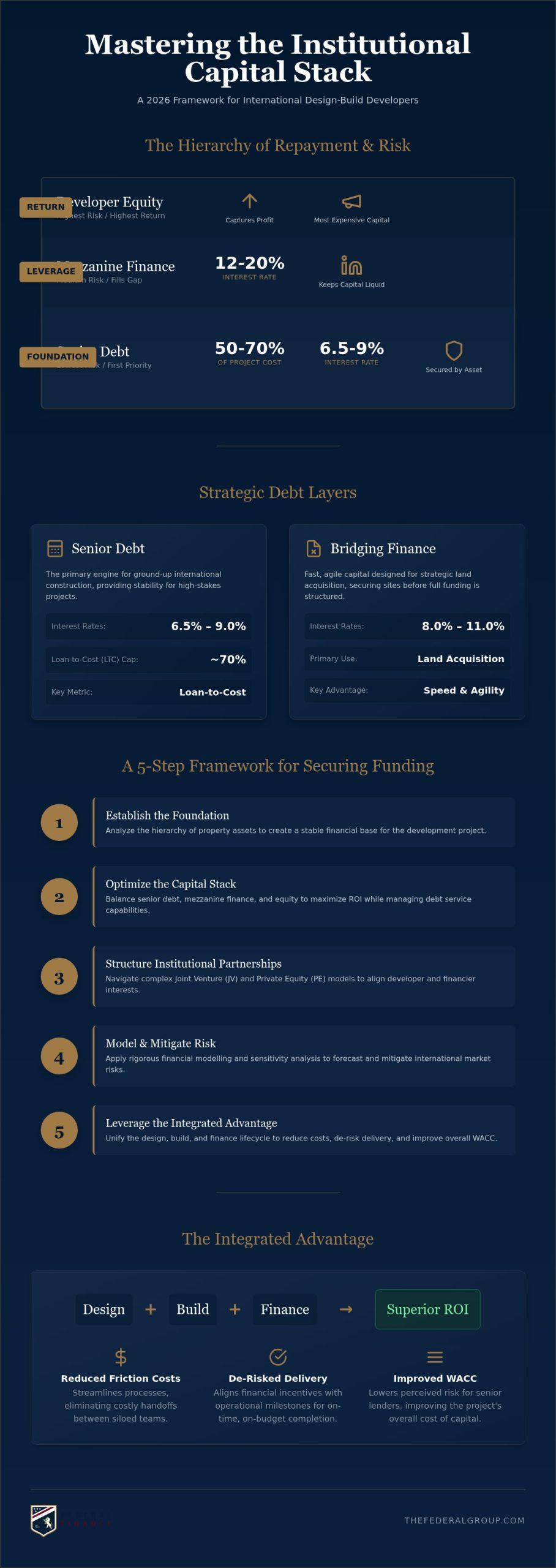
How to Secure Funding for a Large Construction Project: A 5-Step Framework
Securing institutional funding for a large-scale project requires a methodical approach that mirrors the precision of the construction process itself. For those structuring a capital stack for design-build developers, the objective is to present a risk-mitigated ecosystem that appeals to both senior lenders and private equity partners. In a market where 33% of builders identify labour costs as a primary budget challenge, your framework must demonstrate resilience against volatility.
The 5-Step Framework for 2026:
- Step 1: Rigorous Financial Modelling. Stress-test your WACC against current benchmark rates and account for the 29-30% gross markups typical in the current sector.
- Step 2: Securing Site Control. Utilise strategic bridging or option agreements to demonstrate project readiness and lock in prime locations.
- Step 3: Information Memorandum Compilation. Build a narrative that proves the efficiency and cost-certainty of the integrated design-build model.
- Step 4: Cross-Border Due Diligence. Work with a global partner to navigate varied tax, legal, and planning jurisdictions.
- Step 5: Closing and Deployment. Finalise the legal framework and initiate the capital drawdown programme to maintain site momentum.
Developing an Institutional-Grade Information Memorandum
Lenders aren’t just buying into a project; they’re investing in your ability to execute. A high-quality IM highlights architectural feasibility and clear exit strategies while showcasing the inherent cost-certainty of the design-build model. By demonstrating that design and construction are unified, you lower the perceived risk of friction-related delays. An institutional-grade IM for an international lender is a data-driven narrative that synthesises architectural feasibility, a proven track record, and a transparent exit strategy into a singular, risk-mitigated investment proposition.
Navigating Cross-Border Regulatory Requirements
International property finance introduces layers of complexity, from managing currency risk to addressing international tax implications. Each jurisdiction has unique planning laws and compliance standards that can derail a project if not managed proactively. Understanding these nuances is critical when expanding your footprint into new markets. Partnering with an International Real Estate Finance Partner: 2026 Guide ensures you have the local expertise to navigate these hurdles. This proactive approach to the capital stack for design-build developers ensures that your project remains compliant and profitable across borders. If you’re ready to scale your international portfolio, contact The Federal Group to discuss your project’s financial architecture.
The Integrated Advantage: Aligning Finance with the Design-Build Lifecycle
The most significant challenge in modern construction finance is the disconnect between the boardroom and the building site. Traditional lenders often lack the technical insight to understand the day-to-day realities of a project, leading to conservative lending and restrictive drawdowns. By adopting an integrated model, you fundamentally de-risk the project. This alignment reduces friction costs by ensuring that the finance partner and the construction team share a unified vision of the project timeline. For a capital stack for design-build developers, this integration means that capital deployment is synchronised with actual build progress rather than arbitrary milestones. This synchronicity is vital for maintaining momentum in high-stakes environments where delays can compromise institutional-grade returns.
Integrated models also allow for more flexible capital structures. When the financier understands the specific technical risks of a build, they are more likely to provide the high-leverage senior debt or mezzanine layers required for complex projects. This deep understanding of the build process allows for a more aggressive yet secure financial strategy, ensuring that the project remains well-capitalised throughout every phase of the development lifecycle.
Maximising ROI with Full Lifecycle Development
Effective communication from initial design to final handover is the cornerstone of project efficiency. Integrated oversight allows for real-time adjustments, significantly reducing the likelihood of budget-erasing change orders. When the financier is also the developer, the incentive to maintain strict cost control is absolute. You can explore this further in our guide on The Efficiency of the Integrated Design and Build Developer in 2026. This model ensures that every decision made during the design phase is vetted for financial feasibility, protecting the project’s bottom line. It transforms the build process from a series of disjointed phases into a continuous, value-driven lifecycle that prioritises speed to market and capital efficiency.
Bespoke Capital Solutions for Global Developers
The Federal Group provides more than just capital; we provide a partnership rooted in operational expertise. Our Federal Holdings division acts as a fully integrated design and build developer, allowing us to offer bridging loans and development finance that are perfectly tailored to the construction lifecycle. We leverage our global footprint to support developers in cross-border scaling, providing the stability required for high-value international projects. We understand that every project has unique requirements, which is why we prioritise bespoke solutions over rigid, off-the-shelf finance. Structuring a robust capital stack for design-build developers requires a partner who understands the intricacies of the build. To begin optimising your next project, contact our team to initiate a consultation and secure the strategic funding your development demands.
Future-Proofing Your Development Finance Strategy
The 2026 construction landscape demands a departure from fragmented financing. Success now relies on a capital stack for design-build developers that mirrors the integration of the build itself. By aligning senior debt with agile bridging finance and institutional equity, you secure the liquidity needed to scale across international borders. The ability to de-risk projects through a unified design and construction lifecycle remains the ultimate competitive advantage for high-value stakeholders.
The Federal Group brings this vision to life through our fully integrated design and build expertise and a specialised sports and property private equity division. We maintain a proven international track record in institutional-grade capital deployment, ensuring your project remains resilient against global market volatility. Whether you’re targeting large-scale commercial precincts or sports multi-club ecosystems, we provide the stability and scale required for visionary development.
Partner with The Federal Group for your next high-value development project and transform your project’s financial architecture into a catalyst for growth. We’re ready to help you capitalise on the opportunities of tomorrow.
Frequently Asked Questions
What are the primary components of a capital stack for design-build developers?
The primary layers include senior debt, mezzanine finance, and equity, arranged by repayment priority. Senior debt forms the base, offering the lowest cost, while equity sits at the peak with the highest risk. In a capital stack for design-build developers, these components are often optimised to leverage the cost-certainty of the integrated model. This structure ensures that capital is deployed efficiently, matching the rapid pace of the design-build construction cycle.
How much equity is typically required for international property development finance?
Institutional lenders typically require developers to provide 10% to 30% of the project’s total cost as equity. The specific requirement depends on the lender’s Loan-to-Cost (LTC) thresholds and the project’s geographic risk. In 2026, many developers partner with private equity firms to cover this requirement. This strategy allows them to capitalise on high-value international projects while maintaining the liquidity needed for land acquisition and other strategic development opportunities.
Can bridging loans be used for the entire construction phase of a project?
Bridging loans are short-term instruments designed for rapid acquisition, not the full construction lifecycle. With floating rates between 8% and 11% in 2026, they are significantly more expensive than senior construction debt. Using them for an entire project would unnecessarily inflate the project’s WACC. Developers should use bridging to secure a site and then transition to long-term development finance once the planning and architectural phases are complete to ensure maximum ROI.
What is the difference between LTC and LTV in institutional property finance?
LTC measures the loan amount against the total construction cost, while LTV compares it to the asset’s appraised value upon completion. Lenders prioritise LTC during the build phase to manage their exposure to cost overruns. Once the project is finished and generating revenue, LTV becomes the metric for permanent refinancing. This transition allows developers to pull out equity or lower their interest rates based on the stabilised value of the completed property.
How does an integrated design and build model help in securing better funding terms?
Integrated models secure better funding terms by reducing the friction costs associated with traditional construction. Lenders offer more favourable rates when they see that design and construction are managed by a single, accountable entity. This reduces the risk of change orders and delays, which are the primary causes of budget failure. When structuring a capital stack for design-build developers, this integration provides the transparency institutional partners need to commit larger tranches of capital.
What are the risks of using private equity in the capital stack?
The main risks include the high cost of capital and the potential for misaligned exit strategies. Private equity partners require a significant share of the profits and often demand a seat at the decision-making table. If the developer’s timeline for completion doesn’t match the partner’s fund lifecycle, it can lead to forced asset sales. Developers must carefully structure equity waterfalls to ensure that their interests remain protected throughout the project’s duration.
How do I manage currency risk in cross-border property development?
Managing currency risk requires sophisticated hedging strategies like forward contracts or currency swaps. For cross-border projects, developers often seek to align the currency of their debt with the currency of the asset’s future revenue. This natural hedge prevents exchange rate volatility from impacting the project’s ability to service its debt. Working with an international finance partner is essential to navigate the tax and regulatory implications of moving capital across different jurisdictions.
What role does sports multi-club ownership play in property development finance?
Sports multi-club ownership acts as a catalyst for high-value precinct development by providing a guaranteed anchor tenant. Stadiums and training facilities drive consistent traffic, which supports the valuation of adjacent hospitality, retail, and residential assets. This ecosystem approach makes the project more attractive to institutional lenders, as the operational success of the sports clubs provides a diversified revenue stream that is less dependent on traditional real estate market fluctuations.