Development Finance vs Bridging Loan: A Strategic Comparison for Global Developers (2026)
23 July 2026In the high-stakes arena of international property, the most expensive capital isn’t the one with the highest interest rate; it’s the capital that arrives three days too late to secure a site. You recognize that speed is a currency in its own right, especially when competing for prime assets in an environment where acquisition windows are increasingly narrow. Choosing between development finance vs bridging loan structures isn’t merely a matter of comparing interest rates. It’s a strategic decision that determines how effectively you can unlock equity and maintain momentum across a project’s entire lifecycle.
We understand the frustration of capital lock-up during lengthy planning phases and the friction caused by misaligned funding. This article provides the structural framework you need to master these financial vehicles, ensuring your capital stack is as robust as your architectural vision. You’ll gain a clear understanding of when to deploy the tactical agility of a bridging loan and when to transition into the staged efficiency of development finance. We’ll examine the latest 2026 market data to help you optimize cash flow and secure your position as a heavyweight in the global development landscape.
Key Takeaways
- Distinguish between tactical liquidity for immediate site acquisition and structural funding for long-term construction to align capital with specific project stages.
- Evaluate how lump sum liquidity versus staged tranches impacts your project’s internal rate of return (IRR) and overall cash flow efficiency.
- Identify the optimal timing for development finance vs bridging loan deployment based on planning status and the necessity for rapid, high-value asset control.
- Analyze the nuances of Loan-to-Cost (LTC) and Loan-to-Value (LTV) ratios alongside interest treatment models to minimize borrowing costs and maximize leverage.
- Leverage integrated capital and construction expertise to bridge the gap between complex financial structuring and physical project execution.
Understanding the Fundamentals: Bridging Finance vs Development Loans
In high-value property development, capital is a tool for precision. The choice between a development finance vs bridging loan structure is dictated by the specific phase of the asset’s lifecycle. While both are secured debt instruments, their utility diverges significantly regarding speed, duration, and monitoring intensity. Modern developers view these not as competing products, but as sequential components of a sophisticated capital stack. The primary differentiator lies in the balance between the speed of deployment and the depth of project oversight required by the lender.
Bridging Loans: The Tactical Acquisition Tool
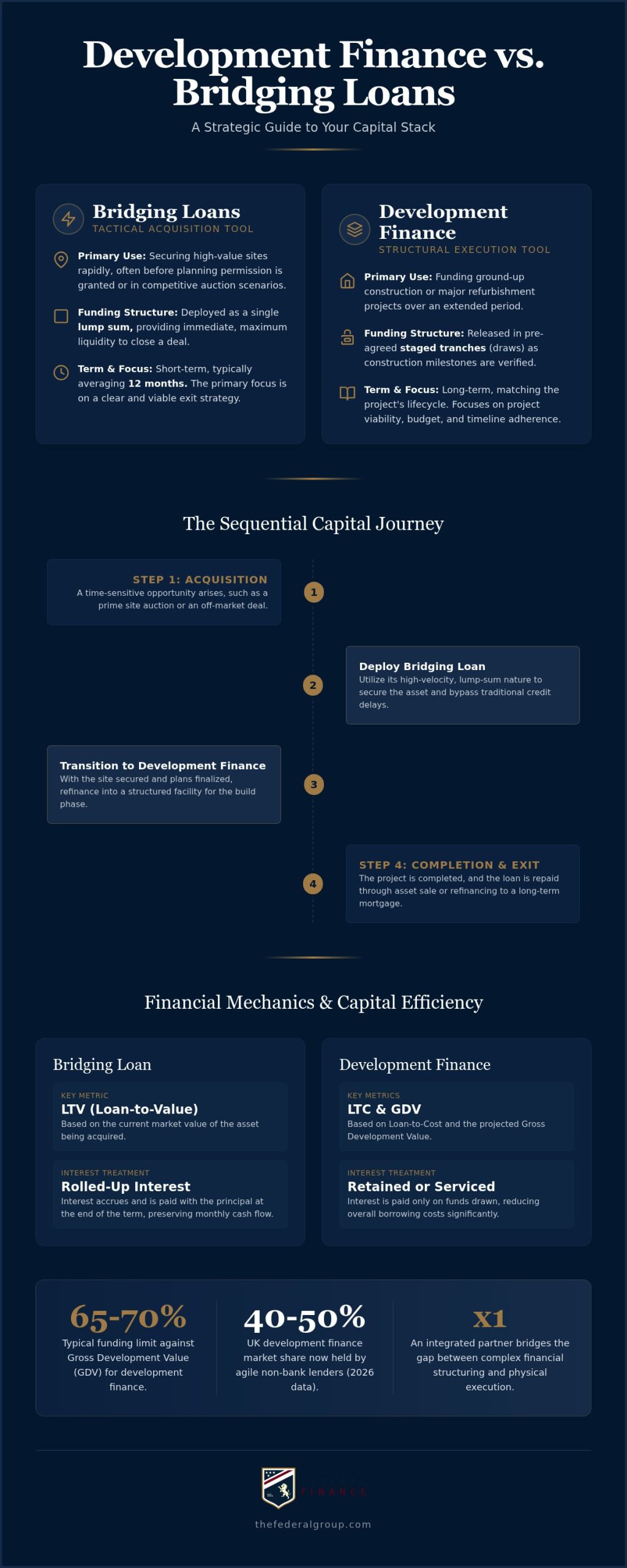
A Bridge loan serves as a high-velocity catalyst for immediate liquidity. It is the primary vehicle for developers who need to secure a high-value site before planning permission is finalized or during competitive auction scenarios. These loans are typically asset-backed and short-term, often with an average term of 12 months according to 2026 market data. The focus isn’t on the construction process but on the ‘Exit Strategy.’ Developers must demonstrate a clear path to repayment, usually through a sale or refinancing into a longer-term facility. Bridging finance acts as a specialized speed-to-market instrument that allows developers to bypass the traditional credit delays of institutional lenders to secure time-sensitive opportunities.
Development Finance: The Structural Execution Tool
Development finance is a more complex, project-specific facility engineered for the construction phase. Unlike the lump-sum nature of a bridge, these funds are released in tranches. Lenders structure these deals based on the Gross Development Value (GDV) and the Loan to Cost (LTC) ratio. An Independent Monitoring Surveyor (IMS) typically audits the site to verify progress before each draw is authorized. This oversight ensures the project maintains momentum and remains viable. It’s the industry standard for ground-up construction and substantial refurbishments where risk must be managed across a multi-year timeline. Lenders will typically fund up to 65-70% of the GDV, providing the depth of capital necessary for industrial-scale execution.
By 2026, the global market has moved away from siloed financial products. Developers now prioritize integrated capital solutions that offer greater flexibility. This shift is driven by the need for agility in a landscape where non-bank lenders now account for 40-50% of UK development finance. A single partner who understands both the financial architecture and the physical design-build process reduces friction. This integrated approach allows for a seamless transition from the initial bridge acquisition to the structural execution phase without the capital lock-up that often plagues traditional schemes. It provides the stability of institutional finance paired with the visionary energy of modern development.
Structural Mechanics: Staged Draws vs Lump Sum Liquidity
The architecture of your capital stack determines the agility of your execution. While the previous section defined the roles of these vehicles, their structural mechanics reveal how they influence your project’s Internal Rate of Return (IRR). A bridging loan functions as a lump sum injection, providing immediate liquidity against the asset’s current value. Development finance, however, operates through tranches, releasing capital only as specific construction milestones are met. This fundamental difference in delivery dictates how you manage equity throughout the project lifecycle.
Managing interest is another critical divergence. Bridging facilities often utilize rolled-up interest, where the total cost is settled at the end of the term, preserving monthly cash flow for immediate operational needs. Development finance typically offers more varied models, including retained interest or serviced interest, depending on the project’s projected revenue and the developer’s liquidity profile. These structural choices aren’t just administrative; they’re strategic levers used to optimize liquidity across high-value portfolios.
The Drawdown Process Explained
The drawdown mechanism in development finance is designed to mitigate lender risk while reducing the borrower’s interest burden. Because capital is released in stages, you aren’t paying interest on the full facility from day one. This contrasts sharply with the lump sum nature of bridging. Transitioning from an acquisition bridge to a construction facility requires meticulous timing to ensure no gap in funding. Developers who understand this in-depth guide to development finance mechanics can better forecast their net equity requirements. If you’re managing complex, high-value sites, structuring these transitions requires a partner with both financial and operational expertise.
Collateral and Security Requirements
Security structures in high-stakes finance are rarely simple. Most lenders require a first legal charge over the asset, though mezzanine layers may accept a second charge to fill capital gaps. In the comparison of development finance vs bridging loan criteria, bridging leans heavily on the current “as-is” asset value. Development finance requires a deeper dive into project viability and the developer’s specific track record. It’s a move from asset-backed lending to project-backed partnership.
Personal Guarantees (PGs) remain a standard expectation in international property finance, though their scope can often be negotiated based on the strength of the corporate entity. For international developers, cross-border security adds layers of jurisdictional complexity. Ensuring that collateral is properly perfected across different legal systems is essential for maintaining the stability of your global portfolio. Bridging terms typically range from 3 to 18 months, while development facilities extend from 12 to 36 months to accommodate the construction lifecycle.
Strategic Deployment: When to Bridge and When to Fund Development
Sophisticated developers don’t view capital through a binary lens. In the current 2026 market, the decision regarding a development finance vs bridging loan structure is often a matter of sequencing rather than simple selection. While bridging provides the tactical speed necessary to seize an undervalued asset, development finance offers the structural depth required to see a project through to completion. Understanding when to deploy each vehicle is the hallmark of a seasoned global developer.
Consider the scenario of a rapid acquisition. When a high-value international site becomes available without finalized planning permission, a bridging loan is often the only viable tool. With an average completion time of 53 days, bridging allows you to secure the asset while others are still navigating institutional credit committees. Conversely, for ground-up residential or mixed-use construction, development finance is a necessity. Its staged drawdowns align with the construction lifecycle, ensuring that capital is available exactly when the Independent Monitoring Surveyor verifies project milestones.
Investors frequently utilize the ‘Bridge-to-Let’ model to maximize ROI. This involves using a bridge to purchase and rapidly refurbish an international property before transitioning into long-term private equity or traditional debt. A common objection is the higher headline rate of bridging, which currently averages around 0.82% per month. However, when compared to the opportunity cost of losing a high-potential deal due to funding delays, bridging is often the more cost-effective choice. Bridging loans and development finance serve different ends of the risk-reward spectrum; the former buys you time, while the latter buys you execution.
The Sequential Strategy: Bridge-to-Development
The most effective use of these tools is often sequential. You deploy a bridge to secure the site and maintain momentum while your team refines architectural designs and secures planning uplift. Once you’re ready to break ground, you refinance the bridge into a lower-cost development facility. This pivot reduces your overall cost of capital as the project moves from the high-risk planning phase into the more predictable construction phase. It ensures you don’t have expensive bridging capital locked up during a multi-year build, nor do you miss the acquisition window by waiting for a construction-ready facility. For developers looking to synchronize capital tranches with delivery schedules, understanding the full scope of financing a design-build project is essential to maintaining momentum from acquisition through to completion.
Case Study: High-Value International Mixed-Use
In a recent $50m+ mixed-use project, a developer utilized a $15m bridging facility to secure a prime urban site within a 14-day window. This rapid deployment prevented a competitor from triggering a pre-emption right. During the initial six months, the developer finalized the design-build specifications and transitioned into a $35m development finance facility. By integrating these solutions, the developer maintained a seamless capital flow without the friction of multiple lender due diligence processes. For those managing similar complexities, Structuring Development Finance for Mixed-Use Projects requires a partner capable of managing the entire lifecycle from acquisition to exit.
Capital Efficiency: Analyzing Interest, Fees, and Exit Strategies
True capital efficiency is rarely found in the headline interest rate. For global developers, the structural comparison of development finance vs bridging loan requires a deep dive into the total cost of capital, including arrangement fees, exit fees, and ongoing monitoring costs. Arrangement fees for both facilities typically range between 1% and 2% of the gross loan amount. While many lenders have waived exit fees in early 2026, some still charge between 0.5% and 1.5% for development facilities. These costs must be weighed against the agility provided by the funding vehicle.
Borrowing power is defined by two distinct metrics: Loan-to-Value (LTV) and Loan-to-Cost (LTC). Bridging loans are primarily driven by LTV, often reaching up to 75% or 80% of the asset’s current value. Development finance focuses on LTC, typically covering 65% to 70% of the project’s costs. Gross Development Value (GDV) represents the estimated market value of the completed project, serving as the primary benchmark for determining total loan capacity. Understanding these ratios is essential for minimizing your own capital outlay and maximizing Return on Equity (ROE).
Optimizing the Capital Stack
Strategic developers often fill the equity gap by layering senior debt with mezzanine finance or private equity. Current mezzanine rates sit between 12% and 15% per annum, providing a higher leverage solution that preserves your liquidity for other opportunities. For large-scale projects, securing private equity for design-build developers through an integrated partner can provide the institutional-scale capital needed to bridge the gap between senior debt and total project costs. Risk mitigation is achieved through integrated design and build expertise, which provides lenders with greater confidence in project timelines. If you are looking to optimize your capital stack, integrating these financial layers into a single, cohesive strategy is paramount.
Repayment and Exit Planning
Your exit strategy must align with 2026 market liquidity. Once construction is complete, development exit finance can bridge the gap between the build phase and a final sale or long-term refinancing, often at a lower cost than the construction facility itself. For international projects, repayment involves navigating cross-border tax and legal frameworks. Whether the exit is a straightforward asset sale or involves more complex synergies like multi-club sports ownership, planning for the transition is as critical as securing the initial funding. Non-bank lenders now account for nearly half of UK development finance, offering more creative exit structures than traditional retail banks.
Beyond Lending: Integrated Capital Solutions with The Federal Group
Selecting the right structure for development finance vs bridging loan deployment is merely the first stage of a successful project. While many comparison platforms act as simple middlemen connecting developers with third-party lenders, The Federal Group operates as a sophisticated partner with deep roots in both finance and execution. We are active developers as well as financiers. This dual identity allows us to offer a holistic ecosystem that manages every stage of a project’s lifecycle, from the initial tactical acquisition to the final exit.
Our competitive advantage is anchored in Federal Holdings, which provides fully integrated Design & Build Development capabilities. This integration removes the traditional friction between capital providers and construction teams. When we structure a facility, we do so with the technical precision of a builder and the strategic oversight of an institutional financier. We understand the physical realities of industrial-scale property because we manage those projects ourselves, ensuring that your capital stack is perfectly aligned with your architectural vision. Developers seeking a comprehensive approach to financing a design-build project through integrated capital raising will find that aligning financial structure with construction delivery is the defining factor in project success.
Why an Integrated Partner Matters
Managing cross-border projects in the US, UK, and international markets requires localized expertise and an understanding of complex regulatory landscapes. Our global reach allows us to structure private equity and debt solutions that respect the specific jurisdictional requirements of high-value assets. For stakeholders in the professional sports arena, our specialized Sports Division offers multi-club ownership synergies that traditional property lenders cannot replicate. We connect opportunities across sectors, creating a capital stack that is as versatile as it is secure, reducing the operational risks that often plague siloed development schemes.
Next Steps for Your Project
Success in the 2026 market requires a proactive approach to project feasibility. We begin every partnership with a rigorous consultation to analyze the viability of your vision against current economic conditions, including the 3.75% Base Rate environment. From there, we structure a bespoke capital solution tailored to your specific timeline and project goals. We focus on maintaining project momentum and optimizing cash flow through every phase of construction.
If you are ready to move beyond transactional lending and secure a partner with the scale and specialized insight to drive your project forward, we invite you to Partner with The Federal Group for your next high-value project. Let us help you master the strategic differences between development finance vs bridging loan structures to ensure your project reaches its full potential.
Optimizing Project Velocity for the Global Market
Navigating the complexities of the 2026 property market requires more than just access to capital; it requires the precision to deploy the right vehicle at the right time. The choice of development finance vs bridging loan structures isn’t just about cost. It’s a strategic decision that influences your project’s Internal Rate of Return and overall speed to market. You have explored how bridging serves as a tactical acquisition tool while development finance provides the structural tranches needed for large-scale execution.
Success in international development rests on your ability to integrate these financial tools into a seamless capital stack. As a specialized global capital partner, we offer the institutional-scale private equity for design-build developers and integrated design & build expertise required to manage every stage of your project’s lifecycle. This holistic approach reduces operational friction and instills security in high-value stakeholders across your entire portfolio.
Secure Strategic Funding for Your Next International Development
Your next project represents a significant opportunity in a competitive global landscape. We are ready to provide the stability and forward-thinking mindset necessary to turn your vision into a completed asset.
Frequently Asked Questions
What is the main difference between bridging and development finance?
The primary differentiator lies in the funding structure and the level of project oversight required. Bridging loans provide a lump sum for immediate liquidity, while development finance is released in stages as construction milestones are verified by an Independent Monitoring Surveyor.
Can I use a bridging loan for construction work?
Bridging loans are generally unsuitable for heavy construction projects. These facilities are designed for rapid acquisition or light refurbishment, whereas ground-up construction requires the staged tranches and monitoring inherent in development finance to manage risk across the project lifecycle.
Is development finance more expensive than a bridging loan?
Development finance usually offers lower annual interest rates than bridging, yet the total cost can be higher due to arrangement fees and ongoing monitoring. When evaluating a development finance vs bridging loan structure, consider that bridging rates average 0.82% monthly, while senior development rates often fall between 6.5% and 9.5% per annum.
How long does it take to secure development finance versus a bridging loan?
Securing a bridging loan is significantly faster, with an average completion time of 53 days according to 2026 market data. Development finance requires more intensive due diligence, including site surveys and viability assessments, which often extends the timeline to several months before the first drawdown is authorized.
Can I switch from a bridging loan to development finance?
Transitioning from a bridge to a construction facility is a standard strategic move for global developers. This sequence allows you to secure a high-value asset immediately and refinance into a lower-cost development loan once architectural designs and planning permissions are finalized.
What exit strategies are acceptable for a bridging loan?
Acceptable exit strategies include the sale of the property, refinancing into a term mortgage, or transitioning into a development finance facility. Lenders prioritize a clear, documented plan that ensures the capital is returned within the typical 12-month term.
Do I need a personal guarantee for international property finance?
Personal guarantees are a standard requirement in the international market to ensure developer commitment and mitigate lender risk. While the scope of the guarantee is often negotiable for institutional-scale entities, it remains a fundamental component of the security package for complex, high-value assets.
How does the Loan-to-Cost (LTC) ratio affect my funding?
The LTC ratio dictates the percentage of the total project budget that a lender is willing to advance. Most lenders fund up to 70% of the total cost, meaning the developer must provide the remaining 30% as equity to maintain a balanced capital stack and demonstrate financial commitment.