Financing a Design-Build Project: A Strategic Guide to Capital Raising in 2026
4 August 2026With approximately $875 billion in commercial mortgage debt scheduled to mature in 2026, the margin for error in capital structuring has effectively vanished. For sophisticated developers, the challenge of financing a design build project is no longer just about securing a loan; it’s about synchronizing capital tranches with a compressed delivery schedule. You’ve likely experienced the friction caused by capital stack fragmentation and the high interest rates on short term bridging, which can reach 14.00% for specific asset classes. This chronic misalignment between design phases and funding tranches often stalls momentum and erodes project ROI before the first foundation is poured.
By mastering property developer capital raising through an integrated lens, you can transform these financial hurdles into strategic advantages. This guide provides a roadmap to securing capital structures that accelerate high value projects while mitigating the risks inherent in a rebalancing market. We’ll explore how to optimize your capital stack, leverage 2026 legislative shifts in Progressive Design-Build, and utilize integrated delivery models to ensure your international developments remain both liquid and profitable.
Key Takeaways
- Learn how the Design-Build-Finance (DBF) model eliminates traditional development bottlenecks by unifying architectural milestones with capital tranches.
- Discover advanced strategies for financing a design build project that balance Loan-to-Cost (LTC) and Loan-to-Value (LTV) ratios to maximize project liquidity.
- Understand the strategic necessity of bridging finance in securing high-value sites and pre-construction rights within a fast-paced global market.
- Master a five-step roadmap for capital raising that aligns rigorous project feasibility with the most efficient debt and equity structures available in 2026.
- Explore the “Integrated Advantage” of partnering with an entity that manages both the construction lifecycle and the capital stack to drive superior ROI.
Understanding the Design-Build-Finance (DBF) Ecosystem
In the volatile 2026 property market, the traditional separation of architectural vision, construction execution, and capital allocation has become a liability. The Design-Build-Finance (DBF) model addresses this by consolidating these pillars under a single contractual entity. This approach simplifies the process of Understanding the Design-Build-Finance (DBF) Ecosystem, providing a streamlined alternative to the fractured delivery methods of the past. When financing a design build project, the developer no longer acts as a middleman between disconnected vendors. Instead, they operate within a unified ecosystem where capital is pre-allocated to match specific design milestones and construction phases from day one.
Traditional siloed financing often creates bottlenecks that modern developers can’t afford. When a developer must negotiate separate design and construction loans, administrative friction increases, and project momentum stalls. These delays are particularly costly in a high-interest environment where commercial bridge loan rates currently range from 9.00% to 14.00% depending on the asset class. Integrated project delivery eliminates these gaps, ensuring that capital is available exactly when the construction schedule demands it, reducing the “carry cost” of idle land and stagnant plans.
The Funding-Execution Gap in Traditional Development
Separate loans create more than just paperwork; they create structural risk. If a design phase extends without a locked financing tranche, “design creep” can push the project beyond its original budget before a single brick is laid. Interest rate volatility further complicates this. An unintegrated project might be feasible during the initial sketches but become underwater by the time construction financing is secured. Integrated financing a design build project mitigates this by locking in capital structures that align with specific construction milestones, preventing the funding-execution gap from eroding projected margins.
The Private Sector Evolution of Design-Build Finance
While DBF was once reserved for massive public infrastructure, high-value private commercial projects are now adopting these models to manage complexity and scale. Successfully navigating these high-stakes environments requires a deep understanding of international property development finance to manage cross-border capital flows and diverse regulatory requirements. For the 2026 developer, the integrated capital stack is a strategic arrangement where equity, mezzanine, and senior debt are pre-synchronized to the construction lifecycle. This evolution allows for faster project launches and more predictable ROI in an era defined by global economic rebalancing and institutional caution.
Property Developer Capital Raising: Structuring the Stack
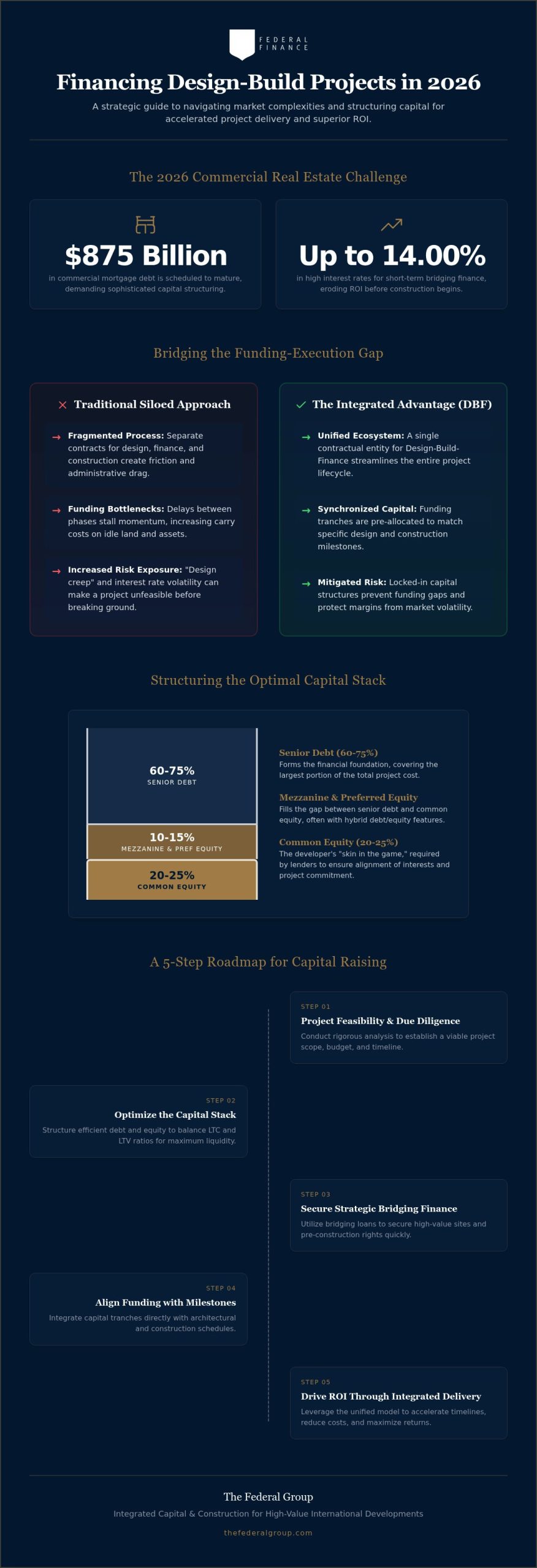
The capital stack serves as the financial foundation for any industrial-scale development. For those financing a design build project, this structure must be robust enough to withstand market fluctuations while remaining flexible enough to accommodate design iterations. Senior debt typically forms the base, often covering 60% to 75% of the total project cost. Above this lies the mezzanine layer and preferred equity, with common equity from the developer filling the remaining gap. Institutional lenders in 2026 generally require a down payment or “skin in the game” of 20% to 25% of the total project cost to ensure a strict alignment of interests between all stakeholders.
Balancing Loan-to-Cost (LTC) and Loan-to-Value (LTV) ratios is a technical necessity. While LTC dictates the immediate liquidity available for construction, LTV determines the project’s long-term viability and eventual exit strategy. Refinancing activity is expected to surge throughout 2026 as nearly $875 billion in commercial mortgage debt matures. This makes property developer capital raising a continuous strategic process rather than a one-time event. Securing Funding for a Design-Build Project often hinges on the developer’s ability to demonstrate a compressed delivery timeline that reduces the duration of high-interest exposure.
Mezzanine and Preferred Equity in Design-Build
Mezzanine finance acts as a vital bridge when senior debt limits leave a capital shortfall. It carries a higher cost than senior debt but remains less dilutive than bringing in additional common equity partners. In the 2026 environment, mezzanine structures are often tied to specific Internal Rate of Return (IRR) targets, which typically range from 12% to 18% for high-value urban developments. Preferred equity offers an additional layer of security for investors, providing a fixed return before common equity holders receive distributions. These instruments allow developers to scale their operations without over-extending their own balance sheets during the critical design phases.
Institutional vs. Private Capital Sources
The choice between a traditional bank and a private fund depends on the project’s complexity and the required speed of execution. Depository lending from banks saw an 80% year-over-year increase in early 2026, yet these institutions remain conservative regarding high-risk design phases. Engaging a real estate private equity partner provides the agility needed for complex builds where architectural changes might occur mid-cycle. Private capital often prioritizes the total project ecosystem over rigid, siloed loan tranches. As private real estate strategies raised $43.96 billion in the first quarter of 2026 alone, understanding how to access private equity for design-build developers has become an essential competency for those seeking large-scale funding. If you are looking to optimize your capital stack, exploring bespoke development finance options can provide the necessary leverage to maintain construction momentum.
Strategic Bridging Finance for Land and Pre-Construction
Speed is the primary differentiator in the 2026 land market. As institutional competition for prime development sites intensifies, the ability to close an acquisition in weeks rather than months determines which projects move forward. Conventional construction loans are often too slow for these high-stakes windows, making bridging finance for land acquisition a critical tool for securing development rights. This short term capital allows developers to lock down a site while the more complex process of financing a design build project is finalized in the background.
The transition from a bridge loan to a long term development facility requires precise timing. If the transition is delayed, the higher interest rates of bridging capital, which can exceed 10.75% for industrial and multifamily assets, begin to erode the project’s contingency funds. Developers must understand the nuances of a development finance vs bridging loan strategy to know exactly when to switch. A well timed exit from a bridge loan into a senior development facility ensures that the project’s capital costs remain aligned with the construction schedule’s risk profile.
Maintaining Momentum with Fast Bridging Solutions
Short term capital does more than just buy land; it keeps the architectural and engineering phases on schedule. Without immediate funding, the design team’s progress can stall, leading to “stalled site” syndrome where land carry costs accumulate without any tangible advancement. Proactive refinancing is the only way to avoid this trap. In 2026, bridging lenders prioritize exit strategies anchored in either a committed development facility or a verified pre-sale percentage that covers the debt service. This clarity allows the design build team to continue their work with the confidence that the capital stack is secure for the next phase of delivery.
De-risking the Pre-Construction Phase
Bridging loans provide the necessary liquidity to fund feasibility studies, environmental assessments, and planning permissions. These activities are essential for de-risking the project before institutional debt is sought. Selecting an international real estate finance partner with cross border expertise is vital for projects involving global stakeholders or complex regulatory environments. By utilizing The Integrated Advantage of a design build team, developers can mitigate planning risks early. This integrated approach ensures that the design remains within the financial parameters established by the bridging lender, making the eventual transition to a full construction facility much smoother. This synergy between design and finance is the hallmark of successful financing a design build project in the current global economy.
Securing Funding for a Design-Build Project: A 5-Step Roadmap
Successfully financing a design build project requires a transition from visionary concept to institutional-grade execution. While the capital stack defines the “what,” this roadmap provides the “how,” ensuring that your funding remains as integrated as your architectural plan. In a market where approximately $875 billion in commercial debt is maturing throughout 2026, lenders have become increasingly selective, prioritizing projects with transparent, methodical delivery structures.
- Step 1: Comprehensive Project Feasibility and Design Baseline. Before approaching capital partners, establish a rigorous design baseline that accounts for current material costs and labor availability. Lenders in 2026 require more than a sketch; they demand a data-backed feasibility study.
- Step 2: Identifying the Optimal Capital Structure. Determine the precise mix of senior debt, mezzanine finance, and equity. This step builds on the LTC and LTV balancing discussed earlier to ensure the project remains liquid during volatile interest rate shifts.
- Step 3: Preparing the Institutional-Grade Funding Proposal. Package your project as a low-risk, high-reward asset. This involves consolidating architectural renders, cash flow projections, and contractor guarantees into a single, cohesive narrative.
- Step 4: Managing Due Diligence and Underwriting. Navigate the lender’s scrutiny of your technical and financial assumptions. Expect a focus on technology integration, as many firms are now utilizing AI to enhance cost-certainty and decision-making.
- Step 5: Harmonizing Drawdown Tranches with Construction Milestones. Ensure that capital is released in lockstep with physical progress. This synchronization prevents the “funding-execution gap” and keeps your construction momentum at its peak.
Preparing the Perfect Funding Proposal
Lenders prioritize certainty above all else. When financing a design build project, your proposal should highlight a Guaranteed Maximum Price (GMP) contract. This contractual mechanism shifts the risk of cost overruns away from the lender and toward the delivery team, making the project significantly more attractive to institutional banks. An integrated developer’s track record serves as a powerful proof point here, demonstrating a history of completing complex builds within budget. Your documentation must include detailed cash flow projections that reflect the 2026 reality of higher labor costs and stabilized material prices.
Managing Cross-Border Financing Nuances
International design-build projects face unique challenges, particularly regarding currency risk and varied local regulations. A shift in exchange rates can quickly erode the IRR of a project if the capital is not hedged or structured correctly. Navigating these hurdles requires a global finance partner who understands the specific legislative landscape of the target region, such as the 2026 Progressive Design-Build authorizations in the U.S. or evolving school construction laws in Utah and Tennessee. Utilizing a “one-stop” international capital solution simplifies this complexity, providing a single point of accountability for your global development portfolio. For developers pursuing hospitality assets within mixed-use schemes, understanding the specific demands of hotel development financing in 2026 is essential, particularly given the $18.7 billion in hotel CMBS loans maturing this year. To secure a structure tailored to your next international project, consult with our strategic finance team today.
The Integrated Advantage: The Federal Group Solutions
The complexities of financing a design build project require more than a traditional lender; they demand a partner capable of navigating the intersection of institutional finance and large-scale construction. The Federal Group delivers this through a unique, dual-pillar approach. While Federal Holdings manages the architectural vision and physical delivery, our finance division structures the capital stack to ensure liquidity at every milestone. This model eliminates the friction between disconnected vendors, providing a single point of accountability that protects investor ROI and accelerates project timelines.
By uniting these disciplines, we address the core pain points identified throughout this guide. The fragmented capital stacks and misaligned funding tranches that often plague high-value developments are replaced by a synchronized ecosystem. This proactive stance allows us to manage every stage of a project’s lifecycle, from the initial site acquisition to the final asset disposition, ensuring that the financial structure always supports the build’s physical reality. In a market where speed and cost-certainty are the primary currencies, this integrated model offers a decisive competitive edge.
Full Lifecycle Property Development
Our capabilities extend across the entire development spectrum. We don’t just provide capital; we manage the risk profile of the asset from day one. This begins with strategic bridging loans for land acquisition, allowing developers to secure prime sites in competitive markets without waiting for traditional bank underwriting. Once the land is secured, our in-house design and build management team takes over, ensuring that the architectural plans remain within the parameters of the pre-negotiated development finance. This vertical integration creates significant efficiency gains, as the “Integrated Developer” model reduces the administrative overhead and communication gaps that typically slow down traditional projects.
Leveraging Global Private Equity Expertise
The Federal Group’s authority in international finance is further strengthened by our diverse portfolio, including sports multi-club ownership and private equity. These divisions create unique capital synergies, allowing us to access specialized funding pools and institutional partners that traditional property lenders cannot reach. This breadth of expertise is particularly valuable for complex, multi-disciplinary projects that require a sophisticated understanding of global markets and asset classes. Whether you’re developing a stadium-adjacent commercial hub or an industrial-scale residential complex, our integrated approach ensures your project is backed by a stable, high-performance capital structure. Developers with hospitality components in their portfolio will find that our expertise in mixed-use hotel development financing provides a critical advantage when navigating the complex underwriting requirements of blended revenue assets.
Success in the 2026 property market belongs to those who can master the synthesis of design, construction, and capital. If you’re ready to move beyond fragmented delivery models and secure a streamlined future for your portfolio, Contact The Federal Group to discuss your design-build project financing. Our team is prepared to architect a capital solution that matches the scale of your ambition.
Securing Your Competitive Edge in Integrated Development
The property market of 2026 demands a departure from fragmented development silos. Success now hinges on the synchronization of capital tranches with architectural milestones, ensuring that liquidity is available exactly when the construction schedule requires it. Strategic bridging finance remains the primary tool for securing high-value sites, while a disciplined five-step roadmap provides the institutional-grade certainty that lenders expect. Ultimately, financing a design build project is most efficient when the capital stack is as integrated as the physical delivery.
The Federal Group has specialized in high-value cross-border developments since 2009, providing the stability and scale required for complex international challenges. Through Federal Holdings, our integrated design and build division, we ensure that your financial strategy and construction schedule move in perfect harmony. Your vision deserves a financial structure built for speed, security, and superior ROI.
Partner with The Federal Group for Integrated Property Finance and secure a strategic ally that manages the full project lifecycle with precision and authority.
Frequently Asked Questions
How does financing a design-build project differ from a traditional build?
Financing a design-build project differs by consolidating the design, construction, and capital tranches into a single contractual framework. Unlike traditional methods where separate loans create administrative friction, the integrated model synchronizes funding with architectural milestones. This alignment reduces the carry cost of idle land and prevents the funding-execution gap that often stalls siloed developments.
What is the typical interest rate for property development bridging loans in 2026?
As of July 2026, commercial bridge loan interest rates typically range from 9.00% to 14.00% depending on the asset class and risk profile. For high-demand sectors like multifamily and industrial properties, rates are tighter, ranging from 9.00% to 10.75%. Hotel and office properties often see wider rates between 9.75% and 14.00% due to their higher risk profiles in the current market rebalancing.
Can I secure 100% financing for a design-build project?
Securing 100% financing is extremely rare in the institutional market, as lenders generally require a down payment of 20% to 25% of the total project cost. This skin in the game ensures that the developer’s interests remain aligned with the capital providers. While some private equity structures offer higher leverage, they usually involve a significant share of project equity or preferred returns to offset the lender’s risk.
What is the role of mezzanine finance in a developer’s capital stack?
Mezzanine finance fills the critical gap between senior debt and the developer’s equity, typically covering the 10% to 20% portion of the capital stack. It’s a subordinated instrument that carries a higher interest rate than senior debt but is less dilutive than bringing on additional common equity partners. This allows developers to maintain project control while reaching the necessary Loan-to-Cost (LTC) thresholds for large-scale builds.
How do lenders evaluate the design-build contractor’s experience?
Lenders perform rigorous due diligence on a contractor’s technical track record, financial stability, and historical delivery speed. They prioritize firms that utilize Guaranteed Maximum Price (GMP) contracts and demonstrate a history of completing industrial-scale projects within budget. In 2026, proficiency in project management technology and AI-driven cost forecasting has become a critical benchmark for securing institutional approval.
What happens if a design-build project goes over budget during the construction phase?
If a project exceeds its budget, the outcome depends on the contract structure, though Guaranteed Maximum Price (GMP) agreements typically shield the owner and lender from overruns. The contractor or developer usually absorbs these costs unless the budget increase is due to owner-requested changes. Integrated financing a design build project mitigates this risk by identifying cost spikes during the design phase before physical construction begins.
Are there specific tax advantages to integrated design-build-finance models?
Integrated models often allow for more efficient utilization of capital allowances and interest deductibility across the project lifecycle. By consolidating the delivery phases, developers can sometimes accelerate depreciation schedules on specific assets or optimize the timing of tax-deductible interest payments. These advantages vary significantly by jurisdiction, making the selection of a global finance partner essential for optimizing the fiscal efficiency of international developments.