Private Equity for Design-Build Developers: Securing Large-Scale Funding in 2026
6 August 2026In 2026, the most successful developers don’t just find lenders; they partner with integrated finance groups that align capital, design, and construction under a single strategic ecosystem. As private real estate strategies raised $43.96 billion in the first quarter of this year alone, the competition for high-value international development finance has intensified. You understand that traditional, fragmented capital stacks are no longer sufficient for global projects. Securing private equity for design-build developers requires a partner who recognizes that the build phase is as critical as the initial numbers.
We recognize the challenge of managing regulatory shifts like the new FinCEN reporting mandates and the 21st Century ROAD to Housing Act while maintaining project momentum. It’s difficult to bridge the gap between visionary architecture and institutional finance when partners don’t speak both languages. This guide shows you how to structure complex capital stacks and leverage integrated design-build models to secure the funding your large-scale projects demand. We’ll examine how to achieve higher LTV ratios through strategic equity partnerships and reduce construction risk by unifying your financing under a single, authoritative framework.
Key Takeaways
- Move beyond regional banking silos to access multi-jurisdictional capital solutions tailored for the 2026 international development landscape.
- Master the construction of a modern capital stack using private equity for design-build developers to bridge the funding gap between site acquisition and project completion.
- Use integrated design and build models as a primary de-risking tool to improve lending terms and attract institutional-grade investment.
- Consolidate your project’s lifecycle under a single strategic partner to improve ROI and eliminate the friction typically found between finance and construction phases.
Navigating International Property Development Finance in 2026
International property development finance has evolved into a sophisticated, multi-jurisdictional capital solution. In 2026, the reliance on regional bank silos is fading. Developers managing large-scale projects now seek global finance partners who can navigate cross-border regulatory complexities and currency fluctuations without the friction of local lending limitations. This shift toward alternative real estate financing is driven by a volatile market where traditional lenders have tightened criteria. An international real estate finance partner serves as the strategic architect for scaling global portfolios, providing the necessary liquidity to enter high-barrier markets. Speed matters in a high-stakes market.
The Rise of Multi-Jurisdictional Capital
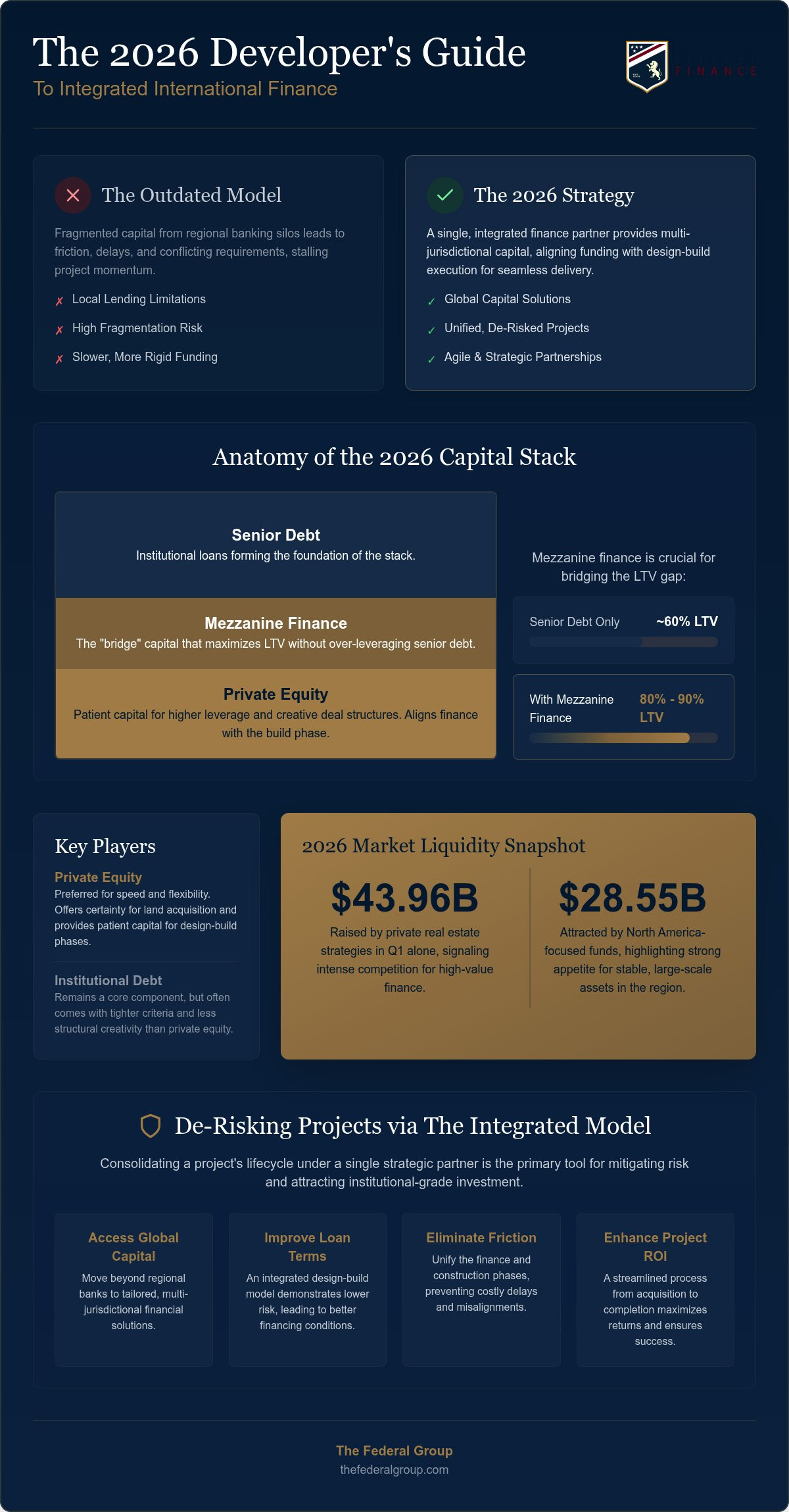
Liquidity trends in early 2026 favor high-value, mixed-use developments that demonstrate resilience against inflationary pressures. North America-focused private real estate funds alone attracted $28.55 billion in capital in Q1 2026, signaling a strong appetite for stable, large-scale assets. For projects spanning the US and UK, unified capital structures are essential to mitigate fragmentation risk. This risk occurs when multiple local lenders impose conflicting covenants or disparate reporting requirements. By consolidating the capital stack, developers ensure that their design-build project delivery remains agile, allowing for seamless transitions between planning and construction phases across different legal jurisdictions.
Key Players: Institutional vs. Private Equity Partners
While institutional debt remains a component of many stacks, the flexibility of private equity for property developers has become the preferred choice for those prioritizing speed. In a climate where commercial loan rates can reach 12.75%, the value of private equity lies in its ability to provide certainty for land acquisition. Professional developers are increasingly moving toward a Financier-Developer hybrid model. This approach integrates capital provision with operational expertise. Leveraging private equity for design-build developers allows for higher leverage and more creative deal structures than traditional banks permit. It transforms the lender from a passive observer into a proactive partner invested in the project’s physical and financial success. Results-driven developers prioritize these specialized partnerships to de-risk their pipelines.
Structuring the 2026 Capital Stack for Design-Build Projects
The architecture of a modern real estate capital stack is more complex than a simple debt-to-equity ratio. In 2026, developers must navigate a tiered structure where senior debt, mezzanine finance, and private equity work in concert. Property developer capital raising is no longer just about volume; it’s about the precision of each layer. Securing high-value sites in competitive international markets requires immediate liquidity. Bridging finance provides this initial burst, allowing for rapid land acquisition before transitioning into a stabilized, long-term funding programme. This approach prevents deal fatigue and keeps the design-build lifecycle moving without interruption.
Utilizing private equity for design-build developers offers a distinct advantage in this environment. Unlike traditional lenders, equity partners often provide the patient capital required for the intricate pre-construction phases of a design-build project. This alignment of capital and vision ensures that the developer can focus on execution rather than constant refinancing cycles. It’s about building momentum from day one.
Balancing Mezzanine and Senior Debt
Mezzanine finance has become the essential glue for large-scale international projects in 2026. With bank-financed construction loan rates for professional builders ranging from 6.5% to 9.5%, mezzanine layers help maximize LTV ratios without over-leveraging the senior debt service coverage. Mezzanine capital is the bridge between senior debt and pure equity. It provides the necessary lift to move from a 60% LTV to an 80% or 90% total debt position, which is often the difference between a viable project and a stalled one. Protecting the debt service coverage ratio (DSCR) remains paramount as interest rates stabilize at their new plateau.
The Strategic Role of a Real Estate Private Equity Partner
Selecting a real estate private equity partner is a strategic decision that influences the entire project lifecycle. Modern joint venture structures allow developers to retain significant management control while benefiting from the balance sheet of an institutional partner. This is particularly relevant when private equity for design-build developers is structured to reward performance through promote hurdles. In the 2026 market, exit strategies must be flexible. Whether the plan involves a direct asset disposal or a strategic refinance, the partnership must be predicated on a shared long-term outlook. Developers looking to secure their next high-value site should consider how bridging loans can facilitate quick closings while the broader capital stack is being finalized.
De-risking Large-Scale Projects via Integrated Design and Build
Traditional lenders often worry that integrated models lack the competitive tension found in siloed procurement. However, in the high-stakes environment of 2026, the opposite is true. Fragmentation creates “gap risk,” the dangerous space between an architect’s vision and a financier’s budget where projects often fail. An integrated design and build developer eliminates this friction by ensuring every design choice is vetted against real-time capital costs. This internal synergy is exactly what providers of private equity for design-build developers prioritize: a single point of accountability that guarantees cost-certainty from day one.
By adopting a “Federal Holdings” style of integration, the transition from the capital raise to the first ground-break is streamlined. This model reflects the Design-Build-Finance-Maintain framework often utilized in large-scale infrastructure. It ensures that the entity responsible for the build is also incentivized by the long-term financial health of the asset. When the builder and the financier speak the same language, architectural vision remains anchored in financial viability, reducing the likelihood of mid-project redesigns that drain equity.
Navigating Regulatory and Legal Variations
Managing a global portfolio requires a deep understanding of jurisdictional nuances. Developers must navigate the complexities of New York Lien Law while simultaneously adhering to UK construction regulations. A global partner provides the necessary oversight for cross-border legal compliance, particularly regarding the FinCEN reporting mandates that became effective on March 1, 2026. These rules require strict disclosure for all-cash transactions involving LLCs and trusts. Ensuring that your KYC and AML requirements are met at the institutional level is critical for maintaining the flow of international property development loans.
Managing Currency and Interest Rate Volatility
Interest rate stabilization in 2026 doesn’t mean the end of volatility. With commercial loan rates ranging from 5.21% to 12.75% as of August, hedging strategies are mandatory for multi-jurisdictional budgets. Fixed-rate bridging loans serve as a vital tool, protecting development momentum during the transition to permanent financing. Structuring facilities for multi-currency drawdowns allows developers to match payments to construction phases in local currencies. This prevents sudden FX shifts from eroding the project’s profit margins. Success in 2026 depends on this level of technical precision in capital management.
How to Secure Funding for Large-Scale Property Development
Securing multi-million dollar funding in 2026 requires more than a visionary rendering. It demands a methodical execution plan that prioritizes speed and structural integrity. Institutional lenders have moved toward more conservative risk profiles, making the preparation phase the most critical part of the capital raise. Success depends on your ability to present a project that is financially resilient and operationally integrated from day one.
- Step 1: Conduct a Multi-Market Feasibility Study. Your analysis must account for the 2026 regulatory environment, including the 21st Century ROAD to Housing Act. Factor in current commercial mortgage rates, which start at approximately 5.58%, to ensure your pro forma remains viable under various interest rate scenarios.
- Step 2: Assemble an Integrated Project Team. Lenders favor developers who align design, build, and finance within a single ecosystem. This vertical integration mitigates the risk of cost escalations, which reached an annual rate of 4.7% for the Building Cost Index in August 2026.
- Step 3: Utilize Bridging Finance. Speed is a competitive advantage in land acquisition. Use bridging loans to secure high-value sites immediately. This provides the necessary breathing room to finalize the more complex layers of the long-term capital stack.
- Step 4: Develop a Global-Standard Investment Memorandum. This document serves as your primary pitch to international capital partners. It must be exhaustive, transparent, and formatted for institutional review.
- Step 5: Finalize the Capital Stack. Blend senior debt with mezzanine and private equity to reach your target LTV. A diversified stack provides the flexibility needed to manage large-scale, multi-year builds.
Preparing the Investment Memorandum
The Investment Memorandum is the primary tool for attracting institutional capital. It must contain hyper-local market data, precise architectural renderings, and granular exit plans that reflect the 2026 economic outlook. When targeting private equity for design-build developers, your memorandum should emphasize how your integrated model prevents the “gap risk” between design intent and construction budget. Showcasing a unified timeline from initial ground-break to final asset disposal instills a sense of security in high-stakes partners. Include your compliance strategy for FinCEN reporting mandates to demonstrate a commitment to global transparency standards.
Strategic Exits: Development Finance vs. Bridging Loans
The choice between a development finance vs bridging loan exit depends on your long-term hold strategy. In the 2026 market, many developers opt to refinance into permanent debt once the build phase is complete. This allows for a transition from construction-grade capital to stabilized mortgage products. Proving project viability to international property investment groups requires a transparent track record of meeting delivery milestones. If you are ready to secure a unified capital solution for your next global project, contact The Federal Group to discuss our private equity and development finance options.
Strategic Synergy: The Future of Integrated Capital Solutions
Maximizing returns in the 2026 property market requires more than efficient construction; it demands a seamless fusion of capital and execution. Choosing a single partner for financing a design-build project eliminates the traditional friction between architectural intent and financial capability. When the entity providing the equity also manages the build phase, project timelines compress and cost overruns diminish. This unified approach directly improves the bottom line by removing the layered fees and conflicting incentives found in fragmented development teams.
The Federal Group occupies a unique position as both a seasoned financier and an integrated developer. Through our Federal Holdings division, we offer an ecosystem where development finance and private equity meet industrial-scale property expertise. This model provides a level of certainty that traditional structures can’t match. By leveraging private equity for design-build developers through an integrated partner, you ensure that every dollar of capital is deployed with technical precision and strategic oversight. It’s a model built for the high-stakes demands of 2026.
The ROI of the Integrated Design-Build Ecosystem
Reducing the gap between architectural design and capital deployment is the most effective way to protect project margins. Internal synergies allow for real-time value engineering, ensuring that design choices are always aligned with the available capital stack. In 2026, integrated models consistently outperform fragmented ones by reducing the time spent on iterative redesigns and secondary funding rounds. Streamlining construction finance for developers through internal synergies doesn’t just save time; it creates a more resilient investment vehicle. This efficiency is particularly valuable when managing the 3.1% annual escalation in the Construction Cost Index reported in August 2026.
Sports Multi-Club Ownership and Property Value
The intersection of professional football club investment and property development represents a new frontier for institutional-grade growth. Global sports multi-club ownership has emerged as a powerful driver of commercial real estate value, particularly in the hospitality and mixed-use sectors. Diversifying a portfolio with sports assets strengthens a developer’s overall credit profile. These assets provide non-cyclical cash flows that balance the traditional volatility of the property market. This strategic synergy allows developers to access more competitive terms for private equity for design-build developers by showcasing a broader, more stable asset base. Developers active in the hospitality sector should also explore how hotel development financing strategies can be integrated into a mixed-use capital structure to maximize returns across asset classes.
Global sports investment groups are creating an entirely new asset class for 2026, where stadium-anchored developments serve as the catalyst for wider urban regeneration. Success in this evolving landscape requires a partner with the scale to manage global football club investments and the technical insight to deliver complex projects. If you’re ready to explore these integrated capital solutions, contact The Federal Group to discuss how our specialized expertise can transform your global development strategy.
Mastering the 2026 Development Landscape
The 2026 market demands a departure from traditional, siloed development methods. Success relies on the ability to unify capital, design, and construction under a single strategic framework. By mastering the tiers of the modern capital stack and de-risking projects through vertical integration, developers can secure the high-leverage funding necessary for international scale. This shift toward an ecosystem approach ensures that architectural vision remains grounded in financial reality throughout the project lifecycle.
Accessing private equity for design-build developers is no longer just about capital; it’s about finding a partner who understands the technical complexities of the build phase. The Federal Group has served as international property finance specialists since 2009, offering a unique financier-developer model. Through Federal Holdings, we provide fully integrated design and build capabilities, while our sports multi-club ownership division offers unparalleled asset diversification to strengthen your credit profile. These internal synergies provide the stability required to manage global portfolios with confidence.
Secure your project’s future by aligning with a partner that possesses the scale and specialized expertise to navigate the global landscape. Partner with The Federal Group for Your Next High-Value Development and transform your visionary concepts into stable, institutional-grade assets. The opportunities for large-scale growth in 2026 are significant for those ready to lead with integration.
Frequently Asked Questions
What is the primary benefit of private equity for design-build developers?
The primary benefit of utilizing private equity for design-build developers is the enhanced flexibility and higher leverage it provides compared to institutional senior debt. Private equity allows for creative capital structures that can fund the critical pre-construction and design phases that traditional banks often avoid. This patient capital ensures the project maintains momentum while the long-term debt layers are being finalized. It transforms the lender into a strategic partner invested in the project’s physical completion.
How does international property development finance differ from domestic loans?
International property development finance differs from domestic loans by requiring sophisticated management of cross-border legal frameworks and multi-jurisdictional compliance. Developers must navigate varying lien laws and regulatory requirements, such as the FinCEN reporting mandates that govern all-cash entity transactions. These facilities also require robust currency hedging strategies to protect construction budgets from FX volatility. Success depends on partnering with a financier who understands the operational nuances of each specific territory.
Why is bridging finance for land acquisition critical for large-scale projects?
Bridging finance is critical for large-scale projects because it provides the speed necessary to secure high-value sites in competitive global markets. Land acquisition often requires a rapid closing that traditional development finance cannot accommodate due to lengthy underwriting processes. By using a bridging loan, developers can seize opportunities immediately while they assemble the more complex layers of their permanent capital stack. This strategic tool ensures that prime development opportunities aren’t lost to more liquid competitors.
What are the requirements for securing cross-border construction finance in 2026?
Securing cross-border construction finance in 2026 requires rigorous adherence to international transparency standards and detailed project documentation. Lenders demand comprehensive Investment Memorandums that include multi-market feasibility studies and clear compliance paths for local regulations like the 21st Century ROAD to Housing Act. Developers must also satisfy stringent KYC and AML requirements to prove the legitimacy of international capital flows. Demonstrating a track record of successful delivery in diverse jurisdictions significantly improves the likelihood of approval.
How do developers manage currency risk in multi-jurisdictional property finance?
Developers manage currency risk in multi-jurisdictional property finance by utilizing multi-currency drawdown facilities and professional hedging instruments. These structures allow capital to be released in the local currency of the construction site, matching payments to specific build phases. This prevents sudden shifts in exchange rates from eroding project margins or creating funding gaps. Aligning your financing with a partner who possesses global treasury capabilities is essential for maintaining cost-certainty across a diversified international portfolio.
Can an integrated design-build model help in securing lower interest rates?
An integrated design-build model helps secure more favorable lending terms by significantly reducing the “gap risk” between architectural vision and financial reality. Lenders perceive integrated projects as lower risk because a single entity is accountable for both the budget and the physical delivery. This cost-certainty allows for higher LTV ratios and can lead to more competitive pricing on mezzanine and senior debt layers. Using private equity for design-build developers within an integrated framework eliminates the friction typically found in fragmented development teams.
What is the role of a real estate private equity partner in high-value projects?
A real estate private equity partner acts as a strategic architect for a developer’s balance sheet, providing the institutional-grade capital needed for expansion. Beyond providing funds, these partners often bring global networks and specialized expertise that help in de-risking complex projects. They typically enter through joint venture structures that allow developers to retain management control while accessing significant liquidity. This partnership is essential for scaling into new international markets where local capital might be restricted or insufficient.
How long does it typically take to secure funding for an international property development?
Securing funding for an international property development typically takes between three to six months, depending on the complexity of the multi-jurisdictional capital stack. While bridging finance can often be arranged in a matter of weeks to facilitate land acquisition, the finalization of senior debt and private equity layers requires extensive due diligence. Developers can expedite this process by preparing global-standard documentation and feasibility studies in advance. Working with an integrated partner who understands both finance and construction further streamlines the underwriting timeline.