Creative Financing for Real Estate Developers: Strategic Capital Structures in 2026
16 September 2026In 2026, relying solely on institutional debt isn’t just conservative; it’s a structural risk to project viability. You’ve likely felt the friction as the Federal Reserve holds rates between 3.50% and 3.75% while signaling further hikes this September. These elevated costs, paired with restrictive loan-to-value ratios, are stalling high-value developments that should be breaking ground. Traditional banking no longer provides the velocity required for international property markets. Mastering creative financing for real estate developers has become the primary differentiator between stagnant portfolios and successful global acquisitions.
We understand that navigating complex capital stacks and cross-border movement requires more than just a lender; it requires a strategic partner. This guide promises to equip you with sophisticated capital strategies to fund high-value projects beyond the reach of standard commercial mortgages. You’ll learn how to leverage private equity partnerships and bridging solutions to maintain project momentum. We will detail the integration of mezzanine debt and green bonds to secure high-leverage funding while minimizing equity dilution in an increasingly tight credit environment.
Key Takeaways
- Identify why traditional debt is insufficient in the 2026 economic landscape and how to pivot toward more resilient, institutional-grade models.
- Master the implementation of creative financing for real estate developers by leveraging strategic bridging loans and private equity to secure rapid land acquisitions.
- Learn to engineer a sophisticated capital stack that balances senior debt, mezzanine financing, and equity to optimize your project’s weighted average cost of capital.
- Navigate the complexities of international finance, including currency risk management and tax-efficient capital deployment for high-value cross-border projects.
- Discover how an integrated design-build partner model de-risks developments and improves financing terms through specialized, in-house architectural and construction expertise.
The Shift in Real Estate Capital Markets: Why Traditional Debt is Insufficient
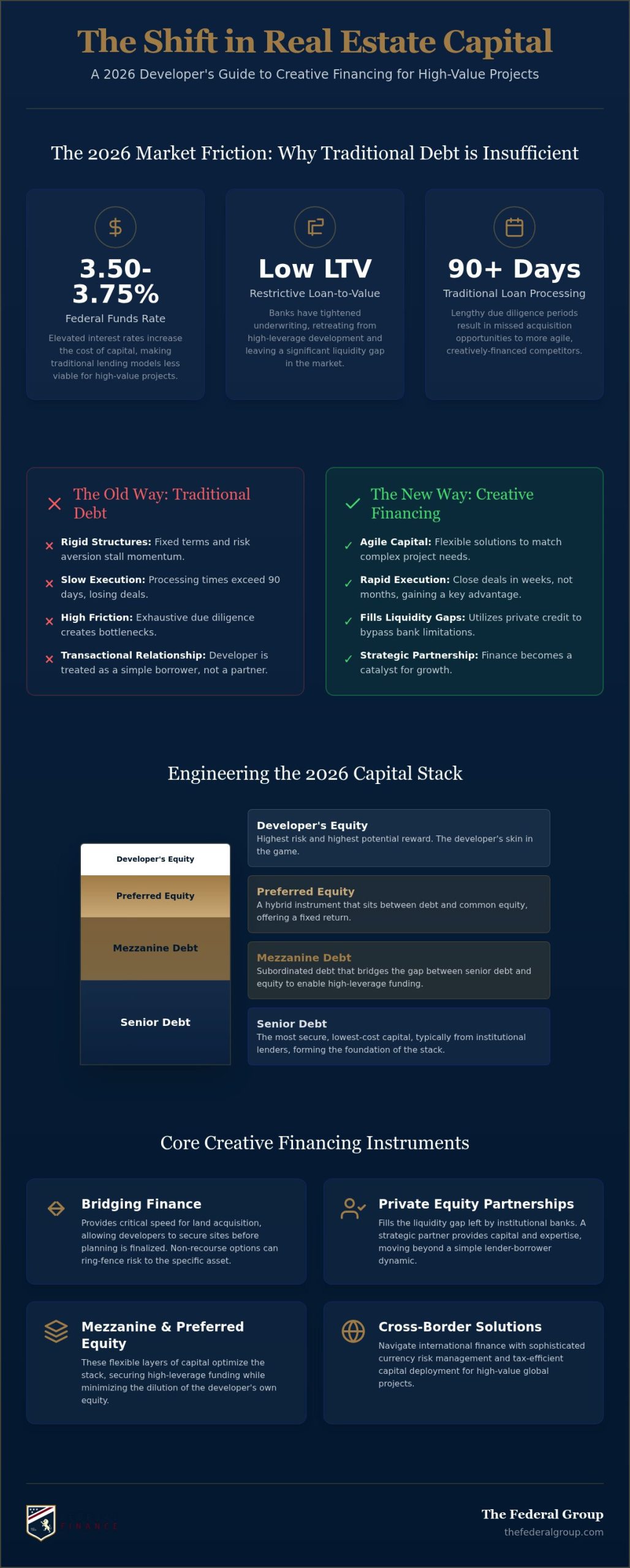
Institutional-grade property development requires a fundamental departure from the rigid structures of retail banking. In the current economic cycle, creative financing for real estate developers represents the strategic assembly of diverse capital sources to bypass the limitations of conventional senior debt. As of September 2026, the Federal Funds Rate remains elevated at 3.50% to 3.75%, creating a higher cost of capital that traditional lending models struggle to absorb. This shift has redefined the relationship between developers and financiers. Success no longer depends on finding the lowest headline interest rate; it relies on identifying a strategic capital partner capable of providing the flexibility required for complex, high-value projects.
The Liquidity Gap in Institutional Banking
Traditional banks have significantly tightened their underwriting criteria, often retreating from high-leverage development due to increased regulatory pressure and risk aversion. This retreat has left a substantial liquidity gap in the market. Private credit has emerged as the dominant force, offering the leverage and terms that institutional banks simply cannot match. Rigid loan-to-value (LTV) ratios and exhaustive due diligence periods in the banking sector often stall project momentum, leading to missed opportunities in volatile international markets. By utilizing Creative financing techniques, developers can access mezzanine debt and preferred equity to fill these gaps, ensuring that capital remains available even when traditional channels constrict.
The Developer’s Need for Agile Capital
The cost of delay is often greater than the cost of capital itself. When a prime land acquisition opportunity arises, traditional loan processing, which can take ninety days or longer, frequently results in the loss of the deal to more agile competitors. In the 2026 market, a developer’s ability to close in weeks rather than months is the primary competitive advantage. Agile capital solutions, such as bridging loans, provide the speed necessary for rapid market entry. These tools allow developers to secure assets immediately, providing the breathing room to structure long-term financing or equity partnerships without the pressure of a collapsing acquisition timeline. This transition from being a simple borrower to a strategic partner allows for a more integrated approach to project lifecycles, where finance is a catalyst for growth rather than a hurdle to overcome.
The modern developer must look beyond the balance sheet of a single bank. Success in 2026 demands a capital ecosystem that prioritizes execution speed and structural flexibility. By integrating private equity and specialized development finance, firms can maintain project velocity even in a restrictive lending environment. This proactive stance ensures that high-value developments move from concept to completion without the friction typically associated with legacy banking institutions.
Core Creative Financing Models for High-Value Development
Creative financing for real estate developers isn’t a single product; it’s a sophisticated suite of instruments designed to optimize liquidity and project velocity. In 2026, where traditional bank LTVs remain conservative, developers must utilize a hybrid approach. This involves layering senior debt with more agile, non-traditional sources to ensure projects move forward without capital bottlenecks. The goal is to build a resilient structure that protects the developer’s equity while maximizing the potential for high-value acquisitions.
Maximizing Acquisition Speed with Bridging Finance
Speed is the primary currency in modern land acquisition. Using bridging finance for land acquisition allows developers to secure high-potential sites before planning permission is finalized. This is critical when competing for assets in fast-moving international markets. Non-recourse bridging options are particularly valuable, as they ring-fence the risk to the specific asset rather than the developer’s entire portfolio. Successful firms typically use these short-term facilities to bridge the gap until they can transition into long-term development finance once the project is de-risked.
The Role of Private Equity Partners
For large-scale projects, the real estate private equity partner model offers a path to institutional-grade scale. Private equity provides the “dry powder” needed for opportunistic global acquisitions that debt alone cannot cover. These partnerships often utilize waterfall structures to align interests, ensuring preferred returns for investors while rewarding the developer for exceeding performance benchmarks. It’s a strategic trade-off: you’re exchanging a portion of the equity for the stability and capital depth required to execute visionary developments that would otherwise be out of reach.
Mezzanine debt sits as the crucial layer between senior debt and developer equity. With interest rates for mezzanine debt typically ranging from 12% to 20% in the September 2026 market, it represents a more expensive but highly flexible alternative to diluting equity further. Joint Venture (JV) structures take this a step further by sharing both risk and reward. In a JV, capital partners provide significant funding in exchange for active participation in the project’s success. This model is particularly effective for developers entering new international territories where local capital partners can provide both funding and market expertise. If you’re looking to scale your portfolio through these advanced structures, exploring bespoke development finance solutions can provide the necessary foundation for your next project.
By integrating these models, developers can create a capital ecosystem that is both robust and responsive. The key is to match the specific financing tool to the project’s current lifecycle stage, ensuring that capital is always available when it’s needed most.
Engineering the 2026 Capital Stack: Hybrid and Integrated Solutions
Engineering a resilient capital stack in 2026 requires more than just securing a primary lender; it demands the precise calibration of various funding layers to optimize the project’s Weighted Average Cost of Capital (WACC). For high-value developments, the capital stack is a dynamic hierarchy of risk and return. By blending senior debt with mezzanine layers and strategic equity, developers can create a structure that absorbs market volatility while maintaining project velocity. The WACC serves as the ultimate metric for success here, as it quantifies the blended cost of all capital sources. A well-engineered stack ensures that even as mezzanine rates hover between 12% and 20%, the overall cost of capital remains sustainable through the inclusion of lower-cost senior debt and retained equity.
Risk mitigation is inherently built into this diversified approach. Rather than being vulnerable to the credit appetite of a single institution, developers who utilize creative financing for real estate developers distribute their exposure across multiple capital partners. This diversification provides a safety net; if one funding source faces liquidity constraints, the entire project isn’t immediately jeopardized. It’s a proactive strategy that transforms finance from a static line item into a strategic ecosystem.
Optimizing LTV and LTC for High-Value Projects
Modern creative structures allow developers to push leverage boundaries significantly further than traditional banking allows. While a standard bank might cap a loan at 60% of the project’s value, integrated capital stacks can achieve 85% or higher Loan-to-Cost (LTC) ratios. This is achieved by layering mezzanine debt or preferred equity on top of the senior facility. Lenders still require “skin in the game” to ensure developer commitment, but these sophisticated structures allow that equity to be used more efficiently across multiple projects. By reducing the upfront cash requirement, developers maintain the liquidity needed to pursue concurrent global opportunities without overextending their balance sheets.
The Hybrid Debt-Equity Model
The hybrid model is particularly effective when balancing the immediate cost of debt against the long-term value of retained equity. Convertible debt has become a popular instrument in this space, allowing capital to enter as debt with the option to convert into equity at a later project milestone. This provides the developer with lower initial interest payments while offering the partner a share in the project’s eventual success. This approach is a cornerstone of international property development finance, where hybrid models are used to bridge the gap between local debt markets and global private equity. Retaining a higher percentage of equity through these hybrid solutions ensures that the developer captures more of the upside once the project reaches stabilization, provided the cost of the debt layers is managed with technical precision.
Navigating Cross-Border Complexities in International Finance
International property development in 2026 demands a sophisticated understanding of global capital flows and regulatory friction. For those utilizing creative financing for real estate developers, the challenge isn’t just securing funds but managing the technical complexities of multi-jurisdictional deployment. Currency risk remains a primary concern; a 5% fluctuation in the Euro or Pound against the Dollar can erode development margins before the first brick is laid. Tax efficiency also plays a critical role, as developers must navigate specific cross-border tax treaties to avoid double taxation on capital gains. Working with an international real estate finance partner is no longer optional for high-stakes projects. It’s the only way to ensure that the capital stack remains resilient across different regulatory environments.
Structuring for Multi-Jurisdictional Projects
Strategic capital protection often involves the use of offshore Special Purpose Vehicles (SPVs). These entities allow developers to ring-fence specific assets, protecting the wider group from the liabilities of a single international project. However, the success of these structures depends on aligning finance drawdown schedules with local planning laws and new transparency requirements. For instance, FinCEN reporting requirements that took effect on March 1, 2026, mandate strict disclosure for legal entities involved in property transfers. Developers must ensure their SPV structures comply with these evolving international standards to avoid costly delays.
Regulatory hurdles currently impacting global capital movement include:
- FinCEN Reporting: Mandatory “Real Estate Report” filings for all-cash transfers involving legal entities.
- Tax Treaty Compliance: Navigating updated interest deductibility rules across US and European jurisdictions.
- ESG Standardization: Managing divergent green financing compliance standards between the UK and EU.
Additionally, developers must mitigate interest rate volatility between central bank regimes. While the Federal Reserve held rates at 3.50% to 3.75% in mid-2026, the European Central Bank and Bank of England often follow different trajectories. This divergence requires a diversified hedging strategy to stabilize long-term debt costs across a global portfolio.
High-Value Asset Classes: Beyond Residential
Creative financing for real estate developers is increasingly moving toward mixed-use and industrial-scale projects that offer higher yields than traditional residential models. We’re seeing a significant shift toward sports infrastructure as a viable asset class. This includes the emerging synergy between property development and sports multi-club ownership. Funding for stadium development often requires a blend of private equity and specialized bridging loans to manage the unique lifecycle of sports-related assets. These projects demand an integrated approach where the financier understands both the property market and the commercial drivers of professional sports. If you’re planning a complex, cross-border development, you can partner with an integrated finance expert to secure the agility your project requires.
The Federal Group Advantage: An Integrated Partner Model
Execution risk is the primary deterrent for institutional lenders in the 2026 climate. The Federal Group addresses this directly by operating as an integrated design and build developer through Federal Holdings. This model collapses the traditional silos between the financier, the architect, and the contractor. By managing the full project lifecycle, we eliminate the “leakage” that typically occurs when disparate vendors misalign on timelines or budget constraints. This level of internal oversight de-risks the development, allowing for more favorable terms and higher leverage than what is available through standard market channels. Creative financing for real estate developers is most effective when it’s backed by the technical certainty of in-house construction expertise.
The Synergy of Design, Build, and Finance
Operating an integrated ecosystem ensures that financial structures are perfectly calibrated to the physical realities of the build. Our in-house architectural and construction teams provide real-time data that informs our private equity and development finance decisions. This synergy reduces friction during the drawdown process, as the financier and the contractor are part of the same strategic entity. We don’t just provide capital; we provide a visionary partnership that understands the nuances of industrial-scale property development and high-value mixed-use projects. This approach has been a cornerstone of our operations as an international property finance partner since 2009, ensuring that capital is deployed with surgical precision.
Partnering for the Long Run
The Federal Group’s commitment extends beyond the completion of a single asset. We focus on helping our partners transition from individual projects to global development portfolios. Our expertise in bridging loans and strategic equity allows developers to move with the speed required for land acquisition, while our sports division provides unique access to the growing market of sports multi-club ownership and stadium infrastructure. This breadth of capability allows us to support visionary projects that traditional banks often find too complex to underwrite.
Strategic growth in 2026 requires a partner who possesses both the scale of a global corporation and the focused insight of a specialist consultancy. We provide the agility needed to navigate cross-border complexities while maintaining the stability required for long-term institutional success. Whether you’re breaking ground on a new international development or seeking to diversify into sports-related real estate, our integrated model provides the foundation for resilient growth. Secure your next high-value project with The Federal Group’s bespoke capital solutions and experience the advantage of a truly integrated financial partner.
Securing Global Momentum Through Strategic Capital Integration
The financial landscape of 2026 demands a departure from legacy lending models. We’ve established that mastering creative financing for real estate developers is essential for navigating high interest rates and restrictive LTV ratios that otherwise stall project momentum. Success now depends on engineering a sophisticated capital stack that balances mezzanine layers, private equity, and agile bridging solutions. By integrating these instruments, developers can maintain project velocity and capture high-value opportunities across international borders without overextending their own liquidity.
The Federal Group provides the stability and scale required for these complex challenges. Our fully integrated design-build capability ensures that every project is optimized for performance from inception to exit, while our strategic bridging solutions allow for rapid land acquisition in competitive markets. We offer global expertise in property and sports private equity, transforming the role of the financier into a proactive, visionary partner. This holistic approach de-risks the development process and provides the structural resilience needed for industrial-scale success.
Partner with The Federal Group for Integrated Development Finance to scale your global portfolio with confidence. Your next visionary project deserves a capital structure as ambitious as its design.
Frequently Asked Questions
What is creative financing for real estate developers?
Creative financing for real estate developers involves the strategic integration of non-traditional capital sources to fund high-value projects. It moves beyond the restrictive LTV ratios of institutional banking by utilizing mezzanine debt, private equity, and bridging loans. These structures allow developers to maintain project velocity when traditional lenders retreat. By layering different capital types, firms can optimize their weighted average cost of capital while securing the necessary liquidity for large-scale global acquisitions.
How does bridging finance differ from traditional construction loans?
Bridging finance focuses on execution speed and short-term liquidity, whereas traditional construction loans are structured around long-term build milestones. A bridging facility allows for rapid site acquisition before planning permission is finalized, providing a competitive edge in volatile markets. Construction loans typically involve more rigid underwriting and slower drawdown schedules. Bridging solutions are often non-recourse, protecting the developer’s wider portfolio from risks associated with a single high-value asset.
Can creative financing be used for international property development?
Creative financing is often the only viable path for international property development due to the complexity of cross-border capital movement. It facilitates the use of offshore Special Purpose Vehicles and helps navigate divergent regulatory regimes in the US, UK, and Europe. These structures allow developers to deploy capital efficiently while managing local tax treaties and planning laws. A global finance partner ensures that the capital stack remains resilient against localized economic shifts or liquidity constraints.
What are the risks of high-leverage creative capital stacks?
High-leverage capital stacks increase the sensitivity of a project to market volatility and interest rate fluctuations. While these structures allow for 85% or higher LTC ratios, the blended cost of capital is typically higher than senior debt alone. Developers must manage the increased servicing costs associated with mezzanine layers and preferred equity. Failure to meet aggressive performance benchmarks can lead to equity dilution or the loss of project control if the exit strategy is not executed precisely.
How does an integrated design and build model affect project financing?
An integrated design and build model significantly de-risks a project from a financier’s perspective. When the developer, architect, and contractor operate as a single entity, the risk of leakage or budget overruns due to vendor misalignment is minimized. This technical certainty often results in more favorable financing terms and higher leverage. Lenders view the internal oversight of the construction lifecycle as a safeguard against the execution delays that frequently plague traditional development projects.
Is private equity better than mezzanine debt for large-scale projects?
Private equity and mezzanine debt serve different strategic functions within a capital stack. Private equity provides institutional stability and dry powder for massive acquisitions but requires the developer to trade a portion of project ownership. Mezzanine debt is more expensive in terms of interest rates, which often range from 12% to 20% as of late 2026, but it allows the developer to retain more equity. The choice depends on whether the priority is maximizing scale or preserving long-term retained value.
What happens if a project exceeds its timeline under a bridging loan?
If a project exceeds its timeline, a bridging loan typically requires an extension or a transition into a longer-term development facility. Bridging finance is designed as a short-term instrument with a clear exit strategy, such as refinancing or asset sale. Exceeding the term can result in significant extension fees or higher interest rates. Developers must maintain a proactive relationship with their finance partner to secure additional breathing room or restructure the debt before the facility matures.
How do developers manage currency risk in international financing?
Developers manage currency risk by utilizing sophisticated hedging instruments and matching the currency of their debt to the project’s projected income. This prevents fluctuations in exchange rates from eroding development margins during the construction phase. Using offshore SPVs can also help stabilize capital flows across different central bank regimes. Strategic partners often employ forward contracts or options to lock in exchange rates, ensuring that cross-border capital deployment remains predictable despite global market volatility.