Real Estate Concept Development: Securing Equity Stakes Before Construction
15 September 2026The most significant appreciation in modern property development occurs long before the first shovel hits the dirt. While traditional models focus on physical completion, the 2026 market rewards the intellectual architecture of a project. Securing a real estate concept development equity stake no building requires a sophisticated understanding of how to value intangible assets against future yields. You likely recognize that your land or visionary concept holds immense potential, yet you struggle to quantify that intellectual property without being diluted by institutional lenders who prioritize brick and mortar over strategic vision.
We understand the difficulty of maintaining control when traditional finance fails to recognize the value of pre-development milestones. This guide provides a clear framework for structuring concept-for-equity swaps that maximize your ROI on raw land assets. We will preview the essential steps for identifying integrated partners capable of cross-border execution and navigating the 2026 regulatory environment, including the 21st Century ROAD to Housing Act. By the end of this analysis, you’ll possess the strategy to secure high-value partnerships and protect your equity before a single brick is laid.
Key Takeaways
- Understand how to quantify the value of intellectual property and land entitlements to secure a real estate concept development equity stake no building before capital is deployed.
- Compare Joint Venture and Pure Equity models to determine which structure best protects your vision while ensuring long-term project viability.
- Discover how an integrated design-build ecosystem reduces the friction between concept and completion, making early-stage equity more attractive to institutional partners.
- Explore the strategic use of bridging loans to maintain project momentum and protect ownership percentages during the critical pre-construction phase.
- Identify the specific criteria for selecting a global partner that combines private equity expertise with physical execution capabilities to ensure seamless project delivery.
Defining Real Estate Concept Development and Pre-Building Equity
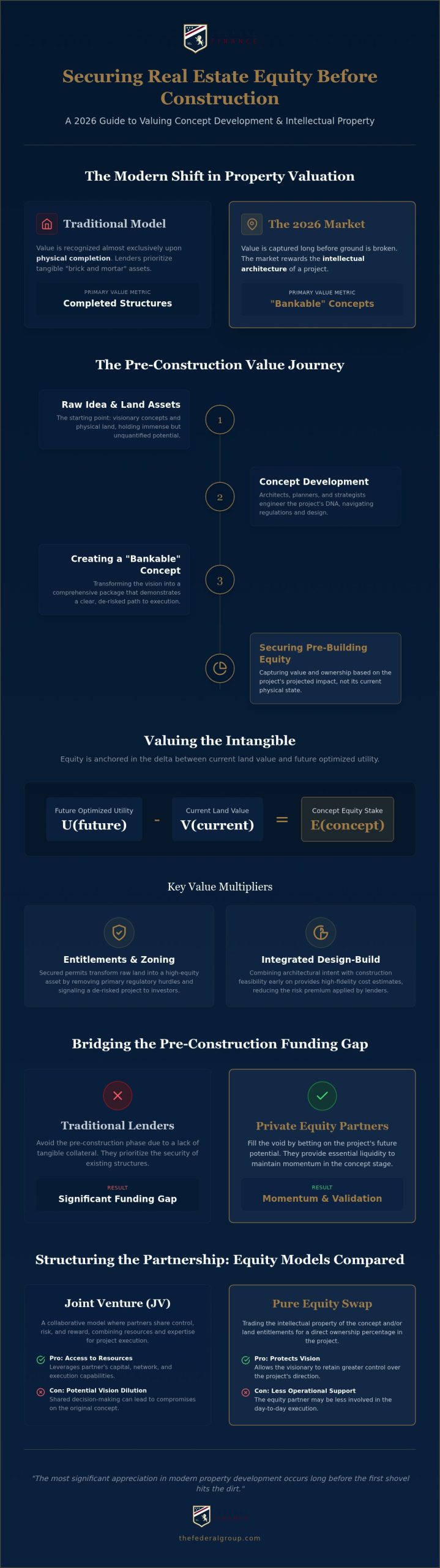
Real estate concept development represents the critical transition from a raw idea to a bankable financial instrument. It’s the stage where architects, planners, and strategists engineer the project’s DNA. In 2026, the market has shifted. Investors no longer wait for physical structures to assign value. Instead, they look at the intellectual property of a site. This shift allows for a real estate concept development equity stake no building scenario, where value is captured through entitlements and design before ground is broken.
The process of Real estate development is an ecosystem of risk management. Traditionally, equity was tied strictly to land ownership or capital injection. Today, sweat equity from developers who secure complex permits or design high-density solutions is equally vital. Land-owner equity remains the foundation, but the visionary who navigates the 2026 regulatory environment, such as the 21st Century ROAD to Housing Act, brings a unique tier of value that demands ownership. This recognition of intellectual architecture allows stakeholders to secure positions based on the project’s projected impact rather than its current state.
The Value of a ‘Bankable’ Concept
Private equity partners prioritize concepts that demonstrate a clear path to execution. A bankable concept isn’t just a sketch; it’s a comprehensive package including detailed feasibility studies, environmental impact mitigation, and a defined exit strategy. In 2026, high-value stakeholders demand architectural vision that addresses global sustainability trends and urban density requirements. Concept-driven equity is the valuation of future utility before physical construction. When these elements align, the pre-development phase becomes a high-growth investment period rather than a dormant waiting room.
Equity vs. Debt in Pre-Construction
Traditional lenders often avoid the pre-construction phase because it lacks tangible collateral. Banks prioritize the security of existing structures, leaving a funding gap during the concept stage. Private equity fills this void by betting on the project’s future potential. Partnering with an international real estate finance partner allows developers to bridge this gap. These partners provide the necessary liquidity to maintain momentum while the project is still in its conceptual infancy. This specialized capital is essential for securing a real estate concept development equity stake no building, as it validates the project’s worth to future institutional investors and ensures the visionary isn’t diluted by high-interest bridging costs.
Mechanics of the Equity Stake: Valuing the Intangible
Establishing value in the absence of physical assets requires a shift from historical data to predictive modeling. A real estate concept development equity stake no building is anchored in the delta between current land value and future optimized utility. High-stakes investors assess the “probability of delivery.” This metric includes the strength of the architectural vision, the depth of market demand, and the viability of the financial stack. When a developer brings a bankable concept to the table, they aren’t just selling a dream; they’re providing a de-risked roadmap for institutional capital.
Integrated design acts as a valuation multiplier in this pre-construction phase. By combining architectural intent with construction feasibility early on, developers provide high-fidelity cost estimates that traditional consultants often miss. This reduces the risk premium lenders apply to unbuilt projects. When design and finance operate under one roof, the transition from concept to physical asset becomes a seamless progression rather than a series of disjointed handovers. This cohesion is what allows a visionary to command a significant equity percentage before a single brick is laid.
Entitlement and Zoning as Value Drivers
Secured permits transform raw land into a high-equity asset by removing the primary regulatory hurdles that stall projects. In the 2026 landscape, zoning isn’t just a hurdle; it’s the foundation of the equity swap. For a deeper look at how these mechanics function within broader funding models, this Construction Finance Explainer outlines the risks equity investors assume. Navigating cross-border regulations requires a partner who understands local nuances while maintaining global standards. Successfully rezoning a parcel from industrial to high-density residential can double its value overnight, providing the leverage needed to negotiate a favorable equity position.
Protecting the Concept-Provider’s Stake
Performance-based milestones are essential for maintaining the integrity of the partnership. Concept providers must ensure their real estate concept development equity stake no building is protected through ironclad legal frameworks and clawback provisions. It’s often beneficial to partner with an integrated design and build developer to ensure the physical execution doesn’t dilute the original vision. These agreements should clearly define the “promote” structure, where the visionary receives a disproportionate share of profits once the capital partners hit a specific internal rate of return.
The distribution of capital, often referred to as the “waterfall,” must be meticulously defined. In a concept-for-equity arrangement, the visionary’s payout is usually tied to project milestones like achieving stabilized occupancy or final certificate of occupancy. This ensures the concept provider remains engaged through the entire lifecycle. While capital partners receive their preferred return first, the visionary’s stake allows for significant upside that reflects the initial risk taken during the “no building” phase. If you’re looking to structure such a deal, consulting with a strategic finance partner can help clarify these complex waterfalls and ensure your intellectual property is fairly compensated.
De-risking the ‘No Building’ Development Phase
The pre-construction phase is historically the most volatile period in the property lifecycle. Stakeholders face binary risks: either the project moves forward with massive value creation, or it stalls due to regulatory or financial friction. In 2026, market volatility remains a constant factor, even as commercial real estate investment is projected to reach $562 billion. This influx of capital demands higher transparency and sophisticated de-risking strategies for any real estate concept development equity stake no building. Without a tangible asset, the primary risks include zoning rejection, environmental discovery, and shifting interest rates, such as the Wall Street Journal Prime Rate which sat at 6.75% in September 2026.
Integrated lifecycle models serve as the primary defense against these early-stage vulnerabilities. By controlling every stage from architectural design to final construction, a partner can identify potential “deal-killers” before capital is fully committed. This foresight is critical for maintaining the valuation of a concept. When the execution arm and the financing arm are aligned, the friction between vision and reality disappears, ensuring that the project remains viable even if market conditions shift during the entitlement period.
Eliminating the ‘Design-Build’ Gap
Fragmented project management is a primary driver of equity dilution. When architects and contractors operate as separate entities, the concept-provider often faces “design creep” where costs spiral beyond initial feasibility. An integrated model removes this friction by aligning architectural intent with construction realities from day one. Choosing a development finance lender who also manages construction ensures that the project remains bankable throughout the transition from paper to pavement. This synergy acts as a powerful risk-mitigation tool, preventing the common hand-off errors that destroy early-stage equity value.
Financial Cushioning with Bridging Solutions
Maintaining momentum during the entitlement phase requires strategic liquidity. Many visionary projects fail because they lack the capital to survive the “no building” period while waiting for permanent financing. Utilizing bridging finance for land acquisition allows developers to secure high-potential sites without waiting for institutional construction loans. This short-term capital acts as a safety net, protecting long-term equity stakes from dilution during cash-flow gaps.
Securing Pre-Development and Acquisition Financing is a critical step in de-risking the project for future partners. It provides the necessary runway to finalize permits and environmental reviews without compromising the developer’s ownership percentage. By managing cash flow effectively before the first shovel hits the ground, concept providers can weather the 2.0% GDP growth forecasted for 2026 while positioning their asset for maximum ROI upon physical completion.
Structuring the Partnership: Equity Models Compared
Establishing a real estate concept development equity stake no building requires a sophisticated legal and financial architecture. In 2026, the complexity of global markets requires a more nuanced approach than standard LP/GP models. While pure equity investment provides capital with minimal operational interference, the Joint Venture (JV) framework allows for a more integrated partnership. This is especially critical during the pre-construction phase, where the concept provider’s intellectual property must be protected against dilution as capital requirements grow.
The “Promote” structure remains the most effective tool for incentivizing the visionary. It allows the concept originator to earn a disproportionate share of the profits once the capital partner achieves a predetermined hurdle rate. When land serves as the primary collateral, negotiating this split requires a transparent valuation of the “uplift” created by the concept itself. A real estate private equity partner provides the institutional weight necessary to validate these valuations, ensuring that the visionary’s stake reflects the future project value rather than just the current soil value.
The Joint Venture Framework
In a JV, roles must be delineated with technical precision. The Capital Partner provides the liquidity, while the Concept Partner manages the bankable vision. Governance in “no building” projects often grants the concept partner veto rights over design changes that could compromise the project’s core identity. Exit strategies must be established early; this allows concept-stage partners to recapitalize or exit once the project achieves specific milestones, such as final zoning approval or reaching a shovel-ready status.
Global Scaling Strategies
Scaling a proven concept across international territories requires access to an international property development finance network. This allows for the replication of high-value models in diverse markets while mitigating regional risks. The following table compares the two primary equity paths for pre-construction ventures:
| Feature | Direct Equity | Mezzanine Equity |
|---|---|---|
| Risk Profile | First-loss position; highest risk during entitlement. | Subordinate to senior debt but senior to direct equity. |
| Return Structure | Uncapped upside based on project performance. | Fixed interest rate plus a smaller equity kicker. |
| Control Rights | Significant governance and decision-making authority. | Limited control; typically step-in rights upon default. |
To explore how these structures can be tailored to your specific project, contact our private equity team for a strategic consultation.
The Federal Group: Realizing Concepts Through Integrated Execution
Securing a real estate concept development equity stake no building requires a partner that understands both the abstract value of a vision and the concrete realities of construction. The Federal Group operates at this intersection. We provide the institutional weight of a private equity firm paired with the technical precision of a design-build developer. This dual capability allows us to value intellectual property where traditional lenders see only risk. By integrating finance and execution, we ensure the visionary’s equity isn’t just a placeholder; it’s a growing share of a viable global asset.
Our firm bridges the gap between conceptual architecture and institutional-grade finance. We don’t just provide capital. We provide an execution arm that validates the project’s worth to the global market. This integrated approach is essential for maintaining the momentum of a project during the volatile pre-construction stage, where many concepts fail due to a lack of coordinated leadership. By maintaining control over the entire lifecycle, we protect the project from the friction points that typically arise when shifting between architects, lenders, and contractors.
A Fully Integrated Lifecycle Partner
Our ecosystem is built on a single point of accountability. Through Federal Holdings, our integrated design-build division, we manage the architectural and engineering risks that typically dilute early-stage equity. Simultaneously, our development finance arm provides the liquidity needed to navigate the pre-construction phase. This visionary capital approach allows us to back unique real estate concepts that require more than just a loan. They require a strategic partner. We manage every stage of the project lifecycle, from the initial feasibility study to international asset management, providing a stable platform for high-value stakeholders.
Next Steps for Concept Holders
Transforming a concept into a bankable asset begins with a rigorous assessment of the project’s DNA. Our private equity team evaluates concepts based on their scalability, market demand, and regulatory viability. The due diligence process for pre-construction partnerships is thorough. It focuses on the de-risking strategies discussed throughout this guide. We look for partners who’ve secured land or entitlements and possess a clear vision for the site’s future utility. Our goal is to ensure a seamless transition from concept development to global asset management, maximizing the ROI of the original vision.
Partner with The Federal Group to realize your development vision
Capitalizing on the Visionary Phase of Development
Securing a real estate concept development equity stake no building requires moving beyond traditional valuation models. Success in 2026 depends on your ability to quantify the bankability of a concept through entitlements, zoning, and strategic design. We’ve explored how integrated lifecycle partners provide the necessary de-risking and financial cushioning to transform raw land into institutional-grade assets. By aligning with a partner that manages both the capital stack and the physical construction, you protect your ownership from dilution during the volatile pre-development period.
The Federal Group offers a unique ecosystem designed for high-value stakeholders. With over 15 years of international property finance expertise and a fully integrated Design & Build division through Federal Holdings, we possess the scale to execute across US, UK, and international markets. Our global reach ensures your project has the stability it needs from inception to completion. Contact The Federal Group for Integrated Development Finance Solutions to discuss your project. Your vision deserves a partner capable of turning intellectual property into a physical reality.
Frequently Asked Questions
Can I get an equity stake in a real estate project if I only have the concept?
Yes, you can secure an equity stake based on a concept if it includes a bankable feasibility study and architectural vision. This intellectual property represents the project’s DNA. In the 2026 market, visionary capital recognizes the value of pre-development milestones. A real estate concept development equity stake no building is possible when the originator de-risks the project through entitlements and strategic planning, allowing them to negotiate ownership before capital is deployed for physical construction.
How is land valued for equity purposes if there is no building yet?
Land valuation in the pre-construction phase is determined by its residual value once developed, rather than its current state. Appraisers look at the highest and best use allowed by current or projected zoning. Secured permits and entitlements act as value multipliers. Because 2026 global real estate investment volumes are rising, reaching $888.6 billion in 2025, the potential for future yield is a primary driver for institutional partners during the valuation process.
What is the difference between sweat equity and capital equity in development?
Capital equity refers to tangible contributions like cash injections or raw land assets provided by investors. Sweat equity represents the non-monetary value contributed by the developer, such as architectural design, securing complex permits, and managing the entitlement process. Both are critical for a successful project. In sophisticated partnerships, the developer’s intellectual property is often rewarded with a promote structure, allowing them to earn a higher percentage of profits after capital partners reach their hurdle rate.
How do I protect my concept from being ‘stolen’ by a finance partner?
Protection comes from ironclad legal agreements and choosing partners with established global reputations. You should utilize Non-Disclosure Agreements and clear concept-for-equity contracts before sharing proprietary data. Working with an integrated partner like The Federal Group ensures alignment; since we manage the entire lifecycle from design to build, there is no hand-off risk. This stability protects your vision from being diluted or appropriated by third-party consultants or predatory lenders.
Is it possible to secure development finance for a project with no physical collateral?
Securing traditional bank loans without physical collateral is difficult, but private equity and specialized development finance fill this gap. These lenders focus on the project’s future potential and the developer’s track record. Bridging loans are often used to maintain momentum during the entitlement phase. With the Wall Street Journal Prime Rate at 6.75% in September 2026, finding a partner who values the no building stage allows you to secure liquidity without providing existing structures as security.
What are the common equity splits for concept-stage real estate partnerships?
Equity splits are highly project-specific, but concept originators typically negotiate between 10% and 30% of the project’s equity. This percentage often depends on how much de-risking has already occurred, such as obtaining zoning approval or environmental clearances. A real estate concept development equity stake no building is usually structured with a tiered waterfall. This ensures capital partners receive their preferred return first, while the visionary benefits significantly from the project’s long-term appreciation and final success.
How long does the concept-to-construction phase typically take for high-value projects?
High-value projects usually require 12 to 36 months to move from initial concept to the start of construction. This timeline is heavily influenced by local zoning laws and the complexity of environmental reviews. With the 21st Century ROAD to Housing Act streamlining some federal reviews in 2026, some timelines may compress. However, maintaining a steady pace requires a partner who can manage bridging finance and design-build logistics simultaneously to prevent costly delays during this critical phase.
Does The Federal Group invest in international ‘no building’ projects?
The Federal Group actively partners on high-potential projects across the US, UK, and international territories. We specialize in projects that require a combination of private equity and integrated design-build expertise. Our global reach allows us to support developers during the no building stage by providing both the capital and the execution arm needed for success. We don’t offer retail banking; instead, we focus on institutional-grade developments where our international finance expertise adds the most value.