Private Equity Investment in Soccer Clubs: The 2026 Strategic Outlook
31 August 2026Over 36% of clubs in Europe’s “Big Five” leagues now operate with the strategic backing of private equity, venture capital, or private debt firms. This figure signals a definitive shift from the era of local benefactors to a period of institutional dominance where capital efficiency is as vital as tactical execution. You’ve likely seen how the high volatility of match-day results can compromise a club’s valuation, making traditional ownership models feel increasingly precarious in a globalized market. Private equity investment in soccer clubs has emerged as the essential lever for stabilizing these assets and transforming them into sophisticated, diversified commercial entities.
This article explores how institutional capital is reshaping global soccer through multi-club ownership, infrastructure development, and sophisticated financial structuring. You’ll gain a clear understanding of the Multi-Club Ownership (MCO) model and learn to identify non-matchday revenue streams that provide a buffer against sporting unpredictability. We’ll also outline the complexities of acquisition finance and the regulatory shifts introduced by the UK’s Football Governance Act and the 2026 UEFA MCO updates. By the end, you’ll understand why the most successful investors are moving beyond the pitch to build integrated sports and infrastructure ecosystems.
Key Takeaways
- Analyze the “World Cup 2026 Effect” and how it accelerates the transition from individual benefactors to institutional investment frameworks.
- Evaluate the strategic advantages of multi-club ownership (MCO) as a primary vehicle for private equity investment in soccer clubs to mitigate relegation risks.
- Learn to unlock non-matchday revenue streams through the development of integrated sports and entertainment districts that offer year-round yields.
- Navigate complex regulatory hurdles, including the 2025 Football Governance Act and updated UEFA ownership thresholds for 2026 compliance.
- Explore the synergy between private equity and bridging loans for efficient club acquisition and precinct redevelopment.
The Institutionalisation of Soccer: Market Landscape in 2026
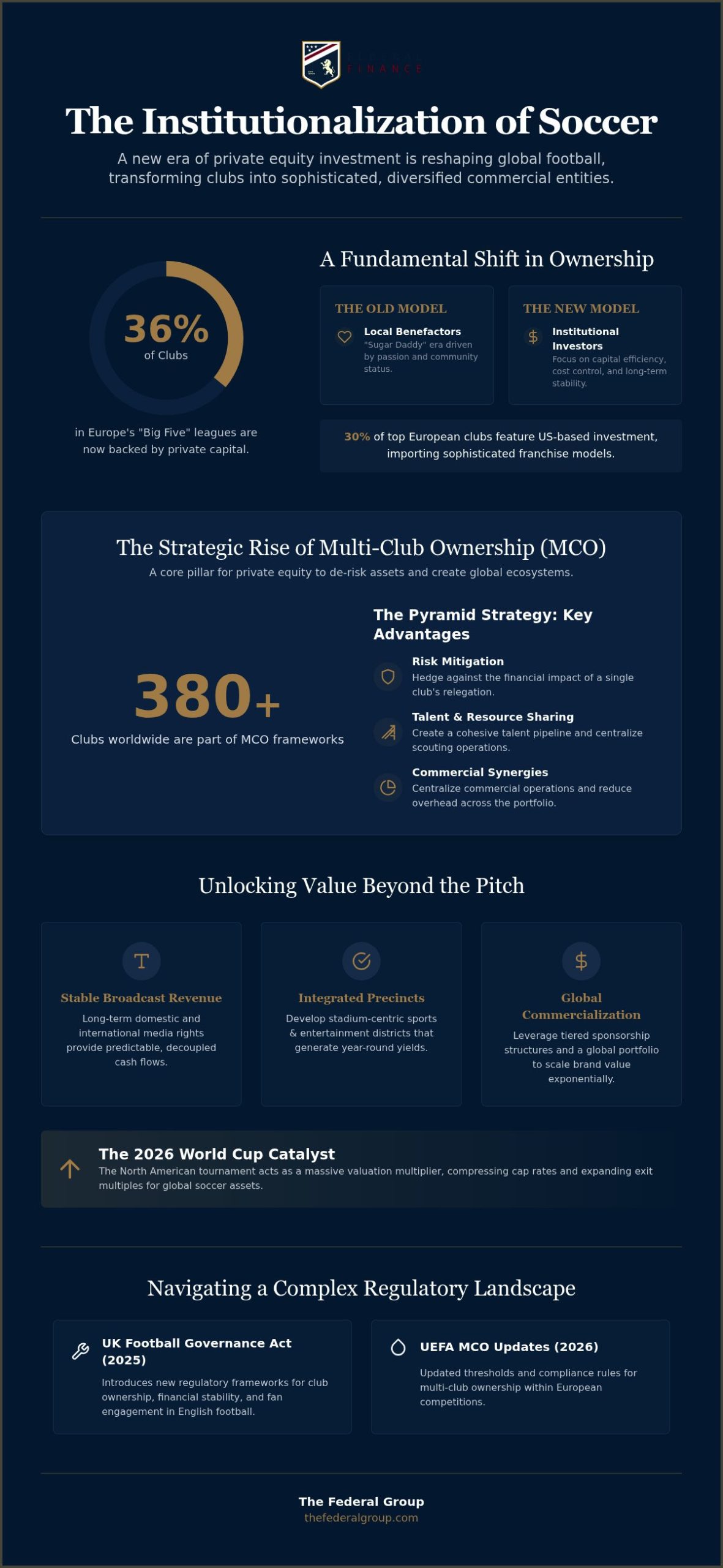
The ownership profile of professional soccer has undergone a fundamental transformation. By the start of the 2025-26 season, over 36% of clubs in Europe’s “Big Five” leagues had secured financial backing from private equity, venture capital, or private debt firms. This shift marks the decline of the “sugar daddy” era, replaced by a rigorous institutional approach that prioritizes long-term fiscal stability over vanity-driven spending. Private equity investment in soccer clubs is no longer an outlier; it’s the dominant mechanism for modernizing club operations and scaling global brands in a high-stakes environment.
Market penetration by North American capital has reached a critical mass. Roughly 30% of clubs in top European tiers now feature US-based investment, reflecting a belief that European soccer remains undervalued compared to closed-league American franchise models. These investors bring a sophisticated playbook focused on cost control, stadium monetization, and digital engagement. They’re effectively bridging the gap between traditional sports culture and modern financial engineering, ensuring that clubs operate as lean, profit-oriented enterprises rather than sentimental community assets.
The 2026 FIFA World Cup Catalyst
The upcoming tournament in North America is acting as a massive valuation multiplier for global soccer assets. Host cities are seeing unprecedented infrastructure development, while broadcast rights continue to reach new plateaus. The “World Cup Effect” functions as a powerful valuation catalyst, compressing cap rates and expanding exit multiples as global attention drives up the scarcity value of professional club licenses. This surge in commercial interest provides a clear entry point for funds looking to capitalize on the sport’s expanding footprint before the global spotlight further drives up acquisition costs.
Soccer as a Recurrent Revenue Asset
Institutional investors now view soccer as a resilient alternative asset class rather than a speculative gamble. While match-day income remains significant, the focus has pivoted toward stable, multi-year broadcast contracts and tiered sponsorship structures. Data analytics now plays a critical role in de-risking athletic performance, allowing owners to project player values and performance metrics with institutional precision. This analytical layer provides a sense of security that was previously missing from the sport’s financial landscape.
- Broadcast Stability: Long-term domestic and international rights provide predictable cash flows that are largely decoupled from the broader economy.
- Commercial Ecosystems: Leading entities like the City Football Group demonstrate how a global portfolio can centralize commercial operations and reduce overhead.
- Asset Comparison: Soccer ROI increasingly tracks alongside high-performing commercial real estate indices, yet offers higher potential for brand-driven exponential growth.
By treating private equity investment in soccer clubs as a play for “integrated sports ecosystems,” firms can generate value that persists regardless of the scoreline. This institutionalization ensures that the financial health of the club is no longer tied solely to the volatility of a single 90-minute match.
The Strategic Rise of Multi-Club Ownership (MCO) Models
The Multi-Club Ownership (MCO) model has evolved from a niche experiment into a core pillar of private equity investment in soccer clubs. As of early 2026, approximately 380 clubs worldwide are part of MCO frameworks. This structure allows investors to deploy a “Pyramid Strategy,” connecting clubs across different tiers and geographies to create a cohesive talent and commercial ecosystem. By owning assets in multiple leagues, firms can effectively hedge against the catastrophic financial impact of relegation. If one club drops a division, the portfolio’s overall value remains anchored by other performing assets in different regions.
Successful implementation requires meticulous financial structuring for multi-club ownership to ensure capital is allocated where it generates the highest yield. This model isn’t just about risk mitigation; it’s about industrializing the path to profitability. The impact of private equity on soccer clubs is most visible here, as it replaces fragmented local management with a centralized, data-driven corporate hierarchy that views every club as a functional unit within a larger machine.
Operational Synergies in Multi-Club Portfolios
Centralization is the primary driver of MCO efficiency. By using shared scouting systems, a group can identify a prospect in South America and place them in a Belgian development club before they graduate to a Premier League flagship. This reduces transfer market spend and ensures a steady pipeline of internal talent. Beyond the pitch, MCOs offer global sponsorship packages that provide brands with exposure across multiple markets through a single contract. Shared technical directors and medical infrastructure further drive down operational overhead, creating a scalable blueprint for growth. This integrated approach allows a portfolio to function as a single commercial ecosystem rather than a collection of isolated assets.
Regulatory Navigation for MCO Investors
The regulatory landscape is tightening to preserve competition integrity. UEFA’s updated multi-club ownership criteria, effective by 1 March 2026, focus on preventing a single entity from exerting control over more than one club in the same competition. Investors must navigate Article 5 rules by establishing independent board structures and proving that influence is limited. Holding at least 10% of shares while being a leading shareholder can now trigger scrutiny, as can providing 30% or more of a club’s total revenue. Managing these conflict-of-interest risks requires a sophisticated legal and financial approach.
The Federal Group’s Sports Division provides the specialized expertise needed to structure these complex cross-border acquisitions while ensuring total regulatory compliance. This level of institutional oversight ensures that private equity investment in soccer clubs remains a viable strategy for those who can manage the operational complexities of the modern game.
Unlocking Value Through Stadium and Precinct Development
Modern private equity investment in soccer clubs recognizes that the pitch is only one part of the value chain. The most resilient portfolios treat the club as an anchor tenant for a broader real estate ecosystem. By shifting focus from a traditional stadium to an integrated “Sports and Entertainment District,” investors create a permanent asset base that remains productive regardless of league position. Real estate acts as a financial floor; even if a club faces a sporting downturn, the underlying land and commercial precinct retain significant intrinsic value and provide stable collateral for future financing.
This transition requires a move away from isolated match-day operations toward a model of continuous engagement. When a club controls its precinct, it captures a larger share of the fan’s wallet through retail, hospitality, and even residential integration. This diversification is essential for institutional investors who require predictable yields that aren’t tied solely to the volatility of on-field results.
The 365-Day Revenue Engine
Maximizing yield requires converting stadium footprints into mixed-use hubs that operate every day of the year. Private equity firms are increasingly funding high-value property developments around clubs, integrating premium hospitality and year-round event spaces into the master plan. This approach transforms a venue from a cost center that sits idle for the majority of the year into a constant source of cash flow. The private equity’s impact on soccer is most profound when it drives urban regeneration; modern arenas act as catalysts for local economic growth, attracting secondary investments and raising the valuation of the entire precinct through 365-day utility.
Financing Infrastructure Improvements
Structuring the capital stack for these large-scale developments involves a precise balance of debt and equity. Many investors utilize bridging finance for land acquisition to secure strategic sites quickly before permanent financing is arranged. This agility is essential in competitive urban markets where land availability is scarce. It’s a critical component of successful private equity investment in soccer clubs, as it allows for the rapid transformation of underutilized land into high-yield assets.
To ensure maximum capital efficiency, savvy investors leverage the expertise of an integrated design and build developer. This model eliminates the friction between architects, contractors, and financiers, ensuring that stadium improvements are delivered on time and within budget. The Federal Group’s Sports Division excels here, managing the entire project lifecycle from initial land acquisition to the final construction of world-class sporting assets. This integrated approach ensures that the physical development of the stadium precinct is as sophisticated as the financial structuring of the club itself.
Risk Mitigation: Fan Sentiment and Regulatory Hurdles
Private equity investment in soccer clubs involves a unique set of risks that extend far beyond standard financial modeling. Unlike traditional asset classes, soccer clubs are high-stakes emotional assets where fan sentiment directly impacts commercial viability. Navigating the “vulture capital” perception is a strategic necessity for institutional owners. Investors who fail to prioritize community-first investment often face significant backlash, which can lead to organized boycotts and regulatory intervention. Successful firms use ESG (Environmental, Social, and Governance) frameworks to demonstrate a commitment to the club’s long-term health rather than just short-term extraction.
Managing the human element is equally critical during periods of institutional restructuring. Excessive squad turnover or frequent managerial changes can destabilize team performance and erode the club’s brand equity. Savvy investors maintain stability by appointing experienced sporting directors who bridge the gap between the boardroom and the pitch. This ensures that the implementation of high-level financial discipline doesn’t come at the expense of the club’s competitive edge or cultural soul.
Preserving Club Heritage and Social Value
Fan engagement has evolved into a critical KPI for determining a club’s long-term valuation. In a globalized market, maintaining a distinct local identity prevents the alienation of the core supporter base, which remains the primary driver of domestic broadcast and match-day revenue. Modern MCO structures must be careful not to dilute this heritage through over-standardization. Sustainable profitability in soccer requires a strategy that respects the club’s historical narrative while implementing the rigorous fiscal discipline of a global enterprise. By treating fans as stakeholders rather than just customers, private equity firms can secure the social license necessary for large-scale precinct development.
Regulatory Compliance and Exit Strategies
The regulatory landscape is becoming increasingly complex with the implementation of the UK’s Football Governance Act 2025. This legislation established the Independent Football Regulator (IFR), which now possesses broad powers to approve ownership suitability and monitor financial planning. Investors must also navigate league-specific restrictions, such as Germany’s “50+1” rule, which prevents external investors from gaining a majority of voting rights. Identifying “red flags” during due diligence, such as undisclosed liabilities or organized fan opposition, is vital for protecting capital. Exit pathways are diversifying as the market matures, with options ranging from secondary buyouts by larger funds to strategic acquisitions by sovereign wealth funds.
For those seeking to navigate these complex regulatory and social landscapes, The Federal Group’s Sports Division provides the strategic oversight needed to balance institutional growth with local heritage.
The Federal Group: Your Partner in Global Sports Private Equity
The Federal Group operates a dedicated Sports Division focused on identifying and scaling high-potential professional football clubs. We recognize that private equity investment in soccer clubs requires a specialized blend of financial discipline and operational expertise. Our team targets assets where institutional oversight can modernize commercial structures while preserving the unique cultural identity of the club. We don’t just provide capital; we act as a strategic partner that manages the entire investment lifecycle, ensuring that every club in the portfolio operates at peak efficiency.
Speed of capital deployment is a vital competitive advantage in professional soccer transactions. Whether navigating a tight transfer window or a competitive acquisition process, the ability to move quickly is essential for securing premium assets. We combine our deep knowledge of the sports market with the scale of a global corporation, positioning us as a heavyweight partner for high-value stakeholders. Our integrated approach ensures that the financial health of the club is supported by the physical development of the stadium precinct, creating a resilient, multi-dimensional investment.
Integrated Capital Solutions
Facilitating rapid club acquisitions requires agile financial instruments. We utilize bridging loans to provide immediate liquidity, allowing investors to finalize transactions while long-term capital structures are being finalized. As an international real estate finance partner, we bridge the gap between sports-specific investment and large-scale property development. We structure equity partnerships designed for long-term growth, offering a one-stop solution that integrates acquisition finance, stadium design, and precinct management. This eliminates the friction often found in complex, multi-party sports deals.
Executing the Global Multi-Club Strategy
Our vision for a cross-border, integrated soccer portfolio focuses on creating synergies across different geographies and tiers. We leverage our expertise in global property markets to enhance sports club valuations by transforming underutilized stadium footprints into high-yield entertainment districts. This strategy ensures that every club serves as an anchor for a broader commercial ecosystem. By combining private equity investment in soccer clubs with our design and build development capabilities, we create assets that deliver value 365 days a year. Partner with The Federal Group for sports and property investment to capitalize on the institutionalization of the world’s most popular sport.
Capitalizing on the Institutional Era of Global Soccer
The transition from speculative ownership to institutionalized management is now irreversible. Modern private equity investment in soccer clubs focuses on building integrated ecosystems that combine on-field performance with year-round precinct yield. Success in this high-stakes landscape requires navigating the 2026 UEFA multi-club ownership updates and the UK’s Independent Football Regulator requirements with technical precision. Investors who prioritize community-first ESG frameworks alongside rigorous fiscal discipline will secure the most resilient long-term valuations.
The Federal Group offers a specialized Sports Division with global reach to guide stakeholders through these complexities. We provide an integrated design and build capability for stadium precincts alongside deep expertise in complex cross-border financial structuring. By aligning institutional capital with large-scale infrastructure development, we help our partners achieve stability in a historically volatile market. Our proactive approach ensures that every stage of the project lifecycle is managed with the visionary energy required for modern sports assets.
Explore Sports Private Equity Opportunities with The Federal Group and lead the next generation of global soccer investment with a partner that understands the intersection of finance and development.
Frequently Asked Questions
Why is private equity suddenly investing in soccer clubs?
Institutional capital seeks soccer for its resilient, non-correlated returns and historically undervalued media rights. Unlike traditional assets, soccer offers global brand scalability and predictable broadcast revenue tiers. Private equity firms view clubs as content factories that generate consistent engagement regardless of broader economic cycles. This shift away from vanity ownership allows for the implementation of high-level financial engineering and operational efficiency to drive long-term yields across international markets.
What is the Multi-Club Ownership (MCO) model in soccer?
The MCO model involves a single entity or group owning significant stakes in multiple professional clubs across different leagues. This structure creates a global ecosystem for talent development, where players move between sister clubs to optimize their market value. By centralizing scouting, medical, and commercial operations, MCOs reduce overhead and diversify risk. It’s a strategic framework that allows investors to protect capital against the volatility of a single club’s sporting performance.
How do private equity firms make money from soccer clubs?
Profit is generated through the appreciation of media rights, commercial sponsorships, and the development of stadium precincts. Firms also extract value by optimizing the player trading market and reducing operational inefficiencies. Private equity investment in soccer clubs often focuses on transforming a club into a diversified entertainment group. This includes monetizing digital content and leveraging the stadium as a 365-day revenue engine through retail, hospitality, and residential integration.
What are the biggest risks of private equity investment in sports?
Regulatory shifts and fan backlash represent the most significant threats to institutional capital. New licensing requirements, such as the UK’s Football Governance Act 2025, can impose strict financial planning conditions on owners. Additionally, the high volatility of match-day results can impact valuation if the club isn’t properly diversified. Investors must also manage the reputational risk of being perceived as vulture capital, which can alienate the core supporter base and trigger organized boycotts.
How does stadium development affect a soccer club’s valuation?
Modern stadium development acts as a valuation multiplier by providing a stable, asset-backed floor for the investment. Integrated Sports and Entertainment Districts generate non-matchday revenue that is decoupled from league standings. The Federal Group specializes in this area, using integrated design and build capabilities to transform stadium footprints into high-yield precincts. This real estate component provides essential collateral for debt structuring and ensures the club remains a productive, year-round commercial entity.
Is multi-club ownership legal under UEFA and FIFA rules?
Yes, though it’s subject to increasingly stringent integrity regulations. UEFA’s 2026 updates require clubs to prove by 1 March that no single entity exerts decisive influence over more than one club in the same competition. Control is often defined by a 30% shareholding or significant revenue contribution. Investors must establish independent board structures and demonstrate operational separation to participate in continental tournaments like the Champions League while maintaining a global portfolio.
Can private equity firms own multiple clubs in the same league?
Most domestic leagues and the new Independent Football Regulator (IFR) prohibit owning a controlling interest in two clubs within the same division to prevent conflicts of interest. However, minority stakes are often permitted depending on the specific league’s rulebook. Private equity investment in soccer clubs typically bypasses these restrictions by building a Pyramid Strategy that connects clubs across different tiers or international jurisdictions to maximize talent pathways and commercial reach.
What role does the 2026 World Cup play in soccer investment?
The 2026 FIFA World Cup serves as a massive catalyst for infrastructure investment and global valuation growth. The tournament drives unprecedented commercial interest in North American and global soccer assets, compressing cap rates as clubs become scarcer and more prestigious. This event provides a clear exit pathway or a valuation reset for existing owners. It also accelerates the development of modern stadium precincts as host cities upgrade facilities to meet international standards.