Financial Structuring for Multi-Club Ownership: 2026 Guide
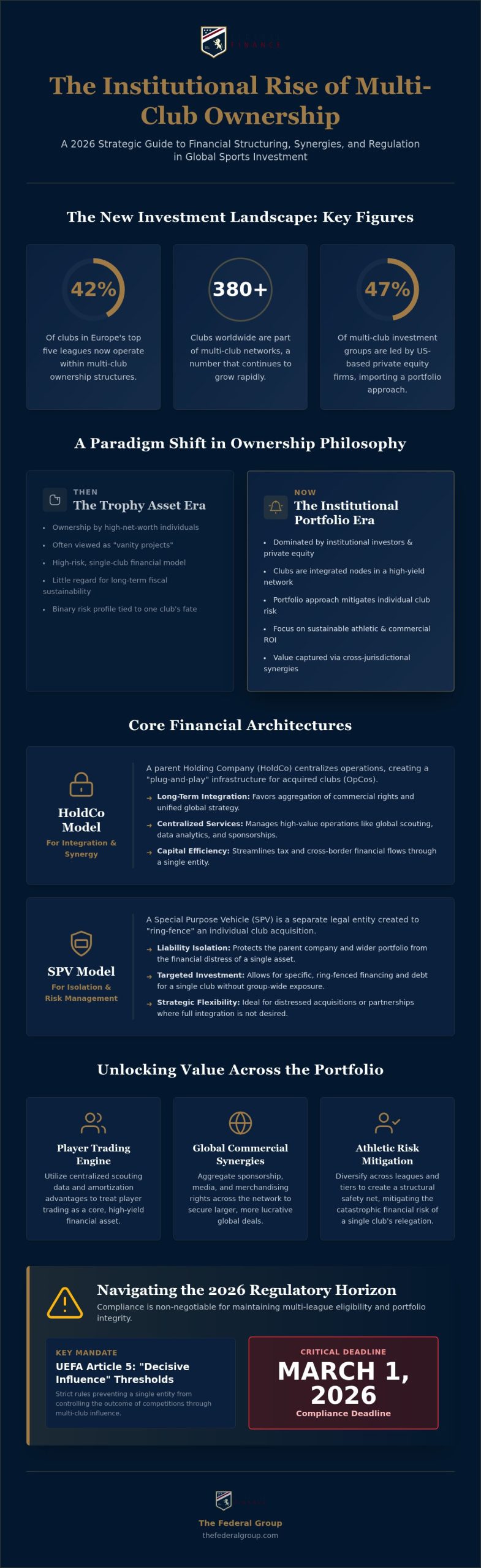
8 August 2026Nearly 42% of clubs in Europe’s top five leagues now operate within shared ownership ties. It’s a figure that signals a fundamental shift in global sports investment. The era of the “trophy asset” has concluded. Today, sophisticated institutional investors view these entities as integrated nodes within a high-yield private equity network. You understand that managing such a portfolio requires more than ambition; it demands a rigorous approach to financial structuring for multi-club ownership that can withstand intense regulatory scrutiny.
This 2026 guide provides the technical framework needed to navigate the March 1 compliance deadline and the “decisive influence” thresholds enforced by UEFA. We’ll show you how to utilize Special Purpose Vehicles (SPVs) and holding company structures to eliminate capital inefficiency while maximizing commercial synergies. You’ll discover how to leverage player trading as a core financial asset and ensure your operations align with the latest financial fair play standards. We provide a clear roadmap for transforming a collection of clubs into a cohesive, high-performance sports ecosystem.
Key Takeaways
- Master the technical distinctions between HoldCo and SPV models to optimize your financial structuring for multi-club ownership and eliminate capital inefficiency.
- Navigate the 2026 UEFA Article 5 “decisive influence” thresholds and the critical March 1st compliance deadline to ensure multi-league eligibility.
- Discover how to leverage player trading as a high-yield financial engine by utilizing amortization advantages and centralized scouting data.
- Transition from passive “trophy asset” ownership to a sophisticated, institutional-grade sports portfolio designed for sustainable athletic and commercial ROI.
- Understand how to integrate specialized private equity and bridging loan solutions to bridge the gap between traditional finance and modern sports investment.
The Evolution of Sports Multi-Club Ownership Strategy in 2026
Sports investment has matured into a disciplined, high-stakes asset class. As of 2026, approximately 380 clubs worldwide operate within multi-club structures, representing a decisive departure from the era of “trophy assets.” In that previous cycle, high-net-worth individuals funded vanity projects with little regard for fiscal sustainability. Today, the market is dominated by institutional-grade portfolios. Sophisticated financial structuring for multi-club ownership allows firms to treat clubs as interconnected nodes, optimizing everything from scouting budgets to commercial sponsorships across multiple jurisdictions.
The role of private equity has been transformative in this growth. These firms provide the patient capital and rigorous governance required to scale operations internationally. By viewing a football club not as a standalone business but as a component of a larger financial ecosystem, investors can capture value that remains hidden in traditional single-club models. Understanding the full scope of professional football club investment as a data-driven discipline is essential for any institutional player seeking to compete in this rapidly evolving market.
From Single Club to Global Network
Investors are no longer satisfied with the binary risk of a single-club model. The historical volatility of European leagues, specifically the threat of relegation, often discouraged institutional capital. Today, US-based private equity firms, which account for 47% of multi-club investment groups, have imported a portfolio approach to mitigate this risk. By spreading capital across multiple tiers and territories, they’ve created a structural safety net. If one club underperforms, the network’s collective value remains stable. The City Football Group model serves as the definitive blueprint for this transition, demonstrating how centralized governance can drive profitability and global brand scaling simultaneously.
The 2026 Investment Landscape
This year marks a critical juncture for the industry. Emerging markets in South America and Asia have become primary targets for expansion as domestic regulations evolve to permit foreign investment. These regions offer untapped talent pools and growing media markets that complement traditional European holdings. We’re seeing a convergence where media rights and club ownership are no longer separate silos; instead, they form a unified revenue stream. In this environment, financial structuring for multi-club ownership is the primary tool for aggregating these disparate assets into a singular, high-yield vehicle. Multi-club ownership in 2026 is a diversified asset class that integrates athletic performance, global media distribution, and real estate development into a resilient financial ecosystem. Investors seeking a comprehensive overview of this approach can explore the sports multi-club ownership model strategic framework to understand how private equity firms are extracting value through centralized data analytics and integrated talent pipelines.
Key Financial Structuring Models for Global Sports Portfolios
Strategic financial structuring for multi-club ownership relies on a delicate balance between centralized control and localized risk management. While many analysts focus on the “why” of expansion, the “how” is dictated by the precise allocation of debt and equity. A primary decision involves choosing between a consolidated Holding Company (HoldCo) or a series of ring-fenced Special Purpose Vehicles (SPVs). A HoldCo favors long-term integration and the aggregation of commercial rights. In contrast, an SPV allows an investor to isolate the liabilities of a distressed acquisition. It’s a method that protects the broader portfolio from unforeseen financial contagion.
Debt acts as the connective tissue in these models. Cross-collateralization enables owners to leverage the asset value of a flagship club to fund satellite acquisitions in emerging markets. This mechanism effectively de-risks the entry into new territories. It maintains a lean equity requirement at the group level, ensuring that the primary capital remains available for high-impact athletic investments.
The HoldCo-OpCo Structure
This model centralizes high-value operations like global scouting and data analytics within the parent company. It creates a “plug-and-play” infrastructure for new acquisitions. Tax efficiency is achieved by managing cross-border flows through a single sophisticated entity. This reduces the friction of international sports investment. While the “HoldCo” manages the strategy, the individual clubs-or “OpCos”-maintain enough autonomy to preserve their local identity and fan engagement. This balance is vital for long-term athletic ROI. Effective financial structuring for multi-club ownership isn’t just about tax domiciles; it’s about the agility of your capital.
Leveraging Bridging Finance for Acquisitions
In the fast-moving world of sports M&A, the ability to deploy capital quickly is often the difference between a successful takeover and a missed opportunity. Bridging loans provide the immediate liquidity required to secure assets in distressed or competitive situations. This approach mirrors the tactical use of bridging finance for land acquisition, where tangible property assets like stadiums or training facilities serve as collateral. Utilizing these specialized bridging loans allows investors to execute rapid expansion plans without waiting for traditional banking cycles to conclude.
Driving Value Through Operational and Athletic Synergies
The actual value of a multi-club model lies in its ability to generate economies of scale that a single club cannot match. By centralizing commercial operations, portfolios can negotiate group-wide sponsorship and media deals, commanding a premium from global brands seeking multi-market exposure. It’s a shift that transforms individual clubs from isolated entities into high-performing components of a broader financial ecosystem. Effective financial structuring for multi-club ownership ensures that these commercial gains are distributed efficiently to fuel athletic growth. Centralized bargaining power doesn’t just increase top-line revenue; it provides a competitive moat against smaller, independent rivals.
The Economics of Multi-Club Player Pathways
Player trading serves as the primary financial engine for modern sports portfolios. Centralized data scouting reduces the “cost of failure” by ensuring that transfer decisions are based on cross-network performance metrics rather than subjective scouting. This approach allows investors to move talent through different tiers of the network, maximizing the player’s market value at every stage of their development. Player amortization allows the network to spread the acquisition cost of a talent over the length of their contract; meanwhile, internal transfers can optimize these book values to meet specific league-level profitability requirements. By developing talent internally across various leagues, a group can significantly reduce external transfer spend while building an inventory of liquid athletic assets.
Real Estate and the “Stadium District” Model
Modern sports investment frequently intersects with large-scale property development. Transforming a stadium from a match-day venue into a 365-day revenue stream is essential for achieving institutional-grade ROI. This involves developing mixed-use precincts, including residential, retail, and hospitality assets, around the core sports infrastructure. Integrating international property development finance into the sports portfolio allows owners to diversify their income streams and hedge against the inherent risks of athletic underperformance. The Federal Group’s design and build advantage enables investors to manage the entire lifecycle of these “Stadium Districts,” from initial capital deployment to final construction. Working with a specialized development finance lender that provides full-lifecycle funding ensures that capital moves seamlessly from land acquisition through to final build, eliminating the costly delays that fragment traditional capital stacks. This holistic approach to financial structuring for multi-club ownership ensures the real estate asset actively contributes to the club’s long-term sustainability and creditworthiness.
Navigating Regulatory Constraints and Financial Sustainability
Regulatory scrutiny is intensifying as multi-club structures become the industry standard. UEFA Article 5 remains the primary hurdle for investors. It dictates that no individual or entity may have “decisive influence” over more than one club participating in a UEFA competition. As of 2026, regulators have adopted a “substance over form” approach. They look beyond simple shareholding percentages to examine financial dependencies and operational synergies. Recent guidance suggests that holding 30% of a club’s shares or providing 30% of its total revenue are now primary indicators of such influence. The November 2025 CAS decisions confirmed that the March 1, 2026, compliance deadline is a hard cutoff. Any financial structuring for multi-club ownership must be finalized by this date to ensure eligibility for the following season.
The impact of FIFA’s third-party ownership (TPO) bans adds another layer of complexity. These rules prevent external entities from owning a player’s economic rights, making internal player pathways within an MCO even more valuable. Investors must ensure that cross-club transfers occur at fair market value to avoid allegations of circumventing Profitability and Sustainability Rules (PSR). For those new to the sector, a thorough grounding in the fundamentals of professional football club investment in 2026 provides critical context for understanding how these regulatory frameworks interact with modern portfolio strategy.
Compliance by Design
Strategic investors are moving away from temporary “blind trusts” toward permanent structural solutions. This involves creating independent board mandates and strictly enforced arm’s length transaction protocols. It’s possible to structure minority stakes that provide strategic influence without triggering a breach of “decisive influence” thresholds. Preparation is already beginning for the next wave of regulatory shifts expected in 2027. These are likely to focus on even stricter dilution of equity and complete governance separation for clubs in the same competition tier.
The Risk of Over-Leveraging
Managing debt-to-equity ratios is critical in high-volatility sports markets. Over-leveraging a portfolio to fund rapid expansion can leave the flagship asset vulnerable if a satellite club fails or suffers relegation. Sophisticated financial structuring for multi-club ownership utilizes ring-fenced debt and contingency funds to isolate these risks. Insurance products now play a larger role in sports finance, protecting against the sudden loss of media rights or match-day income. Investors seeking to navigate these complex regulatory and financial requirements can partner with The Federal Group for specialized capital solutions and strategic guidance.
Strategic Private Equity: Partnering for Multi-Club Success
The complexity of modern sports portfolios requires a partner that understands both the technicalities of the balance sheet and the physical reality of the asset. The Federal Group serves as this essential bridge. We offer a level of integration that traditional niche consultancies often lack. By acting as a sophisticated real estate private equity partner, we help investors unlock the latent value of stadium precincts and training facilities while simultaneously managing the intricate sports club private equity requirements of a global network. This dual expertise is critical for a resilient financial structuring for multi-club ownership. It ensures that every capital injection, whether through a bridging loan or long-term equity, is optimized for both athletic performance and institutional-grade asset appreciation.
Investors shouldn’t have to navigate the silos between property finance and sports management. We provide a single, authoritative point of contact for complex, international challenges. This integrated approach instills confidence in high-value stakeholders, signaling a readiness for the high-stakes environment of 2026 football investment.
A Holistic Approach to Sports Assets
Our dedicated Sports Division operates with a global mandate, financing acquisitions and developments across the US, UK, and Europe. We don’t just provide capital; we provide a fully integrated design, build, and finance model via Federal Holdings. This allows for the seamless development of high-value sports infrastructure that meets current sustainability and commercial standards. Our bespoke capital solutions are designed for the specific volatility of the sports market, offering the stability of institutional property development with the agility required for rapid portfolio expansion. We’ve mastered the art of combining property expertise with high-level sports investment to create a more secure asset class.
The Future of Integrated Sports Finance
As the regulatory landscape shifts toward greater transparency, the most successful MCOs will be those that view their clubs as part of a diversified real estate and media ecosystem. The Federal Group is uniquely positioned to facilitate this next generation of ownership. We provide the technical precision needed to manage financial structuring for multi-club ownership, ensuring compliance with UEFA standards while driving group-wide commercial synergies. Whether you’re entering a new market in South America or scaling an existing European portfolio, we offer the results-driven partnership required for sustained success. Partner with The Federal Group for your sports investment strategy to secure a sophisticated, future-proof sports portfolio that dominates both on and off the pitch.
Securing the Future of Global Sports Portfolios
The 2026 landscape demands a shift from passive ownership to active, integrated management. Success now hinges on your ability to master financial structuring for multi-club ownership while navigating the strict “decisive influence” thresholds set by global regulators. By centralizing commercial operations and treating stadium districts as year-round revenue engines, investors can build a resilient financial ecosystem. This isn’t just about athletic performance; it’s about the long-term stability of an institutional-grade asset class.
The Federal Group provides the specialized expertise required to execute these complex strategies. As an integrated design and build developer with a dedicated global sports investment division, we possess the unique capability to manage every stage of your portfolio’s lifecycle. Our expertise in high-value development finance allows us to bridge the gap between traditional property assets and modern sports investment.
Explore Bespoke Sports Investment Solutions with The Federal Group
The era of the fragmented club model is over. With the right strategic partner, your portfolio can achieve the scale and sophistication required to lead the next generation of professional sports.
Frequently Asked Questions
What is the most common financial structure for multi-club ownership?
The HoldCo-OpCo model is the most prevalent structure. A central holding company owns several subsidiary operating companies, which are the individual clubs. This allows for centralized commercial operations and debt management while isolating the financial risks of each club. It’s a fundamental part of financial structuring for multi-club ownership that ensures group-level control without sacrificing club-level operational agility.
How does UEFA Article 5 impact multi-club ownership in 2026?
UEFA Article 5 prohibits any entity from having “decisive influence” over more than one club in the same competition. In 2026, regulators look beyond ownership percentages to examine financial dependency and shared board members. The March 1 deadline is a strict cutoff for compliance. Clubs failing to restructure by this date risk exclusion from European competitions, making precise legal and financial planning essential for MCO sustainability.
Can property assets like stadiums be used to finance club acquisitions?
Stadiums and training facilities are high-value tangible assets that frequently serve as collateral for bridging loans. Investors use these property assets to secure immediate liquidity for new acquisitions or infrastructure upgrades. This strategy integrates real estate development with sports finance, allowing for more flexible capital deployment. Utilizing the “Stadium District” model ensures that physical assets contribute directly to the group’s overall creditworthiness.
What are the primary risks of a multi-club ownership strategy?
Regulatory shifts and over-leveraging are the most significant threats. A sudden change in league rules or UEFA standards can jeopardize the eligibility of the entire portfolio. Additionally, financial failure at a satellite club can drain resources from the flagship asset if debt isn’t properly ring-fenced. Reputational risks also exist; poor governance at one club can negatively impact the commercial value and fan engagement of the entire group.
How does private equity drive value in professional football clubs?
Private equity firms introduce institutional-grade governance and long-term capital to a historically volatile industry. They drive value by implementing data-driven scouting and centralizing commercial negotiations to achieve economies of scale. By viewing clubs as nodes in a broader ecosystem, these firms can unlock revenue streams that independent clubs often overlook. This professionalization transforms football clubs from vanity projects into high-yield, scalable financial assets.
Is multi-club ownership allowed in the English Premier League?
Multi-club ownership is permitted in the Premier League, provided the entities don’t hold significant interests in other clubs within the same league. Owners must pass the Owners’ and Directors’ Test and comply with strict rules regarding fair market value for inter-club transfers. As of 2026, nearly 42% of clubs in Europe’s top leagues have shared ownership ties, with the Premier League remaining a primary target for global investment groups.
What is the role of bridging loans in sports club acquisitions?
Bridging loans provide the rapid liquidity necessary to secure club assets in competitive or distressed scenarios. These short-term financing solutions allow investors to execute takeovers quickly while long-term equity or debt structures are finalized. In a fast-paced market where timing is critical, bridging finance acts as a tactical tool. It’s often the preferred method for institutional investors looking to expand their sports portfolios without the delays of traditional banking cycles.
How do MCOs manage player transfer amortization across multiple clubs?
MCOs use player amortization to spread the cost of a transfer over the length of a contract, which helps manage annual profit and loss statements. Within a network, internal transfers can be used to optimize these book values and ensure individual clubs meet local financial fair play standards. This is a technical aspect of financial structuring for multi-club ownership that requires precise accounting to ensure all transactions reflect fair market value.