Property Development Joint Venture Finance: The Strategic Guide for 2026
22 July 2026In 2026, the traditional debt-heavy model is no longer the fastest route to scaling a global portfolio. Sophisticated developers are instead pivoting toward property development joint venture finance to bypass capital constraints and unlock institutional-grade opportunities that were previously out of reach. You’ve likely felt the friction of tightening lending thresholds or the headache of aligning interests across complex, cross-border equity structures. It’s frustrating when high-value projects stall simply because the capital stack doesn’t match your operational vision.
We’ll show you exactly how to master the complexities of structuring high-value equity partnerships and institutional JV finance to scale your global property portfolio. This guide provides a clear framework for choosing international finance partners and mastering JV waterfall structures, ensuring your interests align with your capital members. We’ll explore the latest strategies for de-risking large-scale projects and navigating the 2026 regulatory environment, including the new Building Safety Levy and shifting interest rate benchmarks. You’ll gain the technical precision needed to transform your development arm into a high-momentum equity ecosystem.
Key Takeaways
- Understand why institutional private equity is superseding traditional bank debt as the primary engine for high-value development scaling in 2026.
- Define the distinct roles of operating and capital members to ensure operational control remains balanced with strategic institutional oversight.
- Learn to structure sophisticated property development joint venture finance models using waterfall distributions and “promote” incentives to align stakeholder interests.
- Identify strategies for maintaining tax efficiency and regulatory compliance when managing complex cross-border property portfolios.
- Discover the strategic advantage of partnering with an integrated entity that provides both private equity and design-and-build expertise.
The Evolution of Property Development Joint Venture Finance in 2026
The landscape of property finance has fundamentally shifted. High-value projects now require more than just a standard loan agreement. Property development JV finance is a strategic alignment of specialized expertise and institutional capital. It represents a deeper commitment than a simple lender-borrower relationship. It functions as a collaborative ecosystem where risks and rewards are shared. For those understanding joint ventures, the focus has moved from mere land-for-cash swaps toward institutional private equity partnerships that provide the agility needed in a volatile market.
The Shift from Debt to Equity-Driven Growth
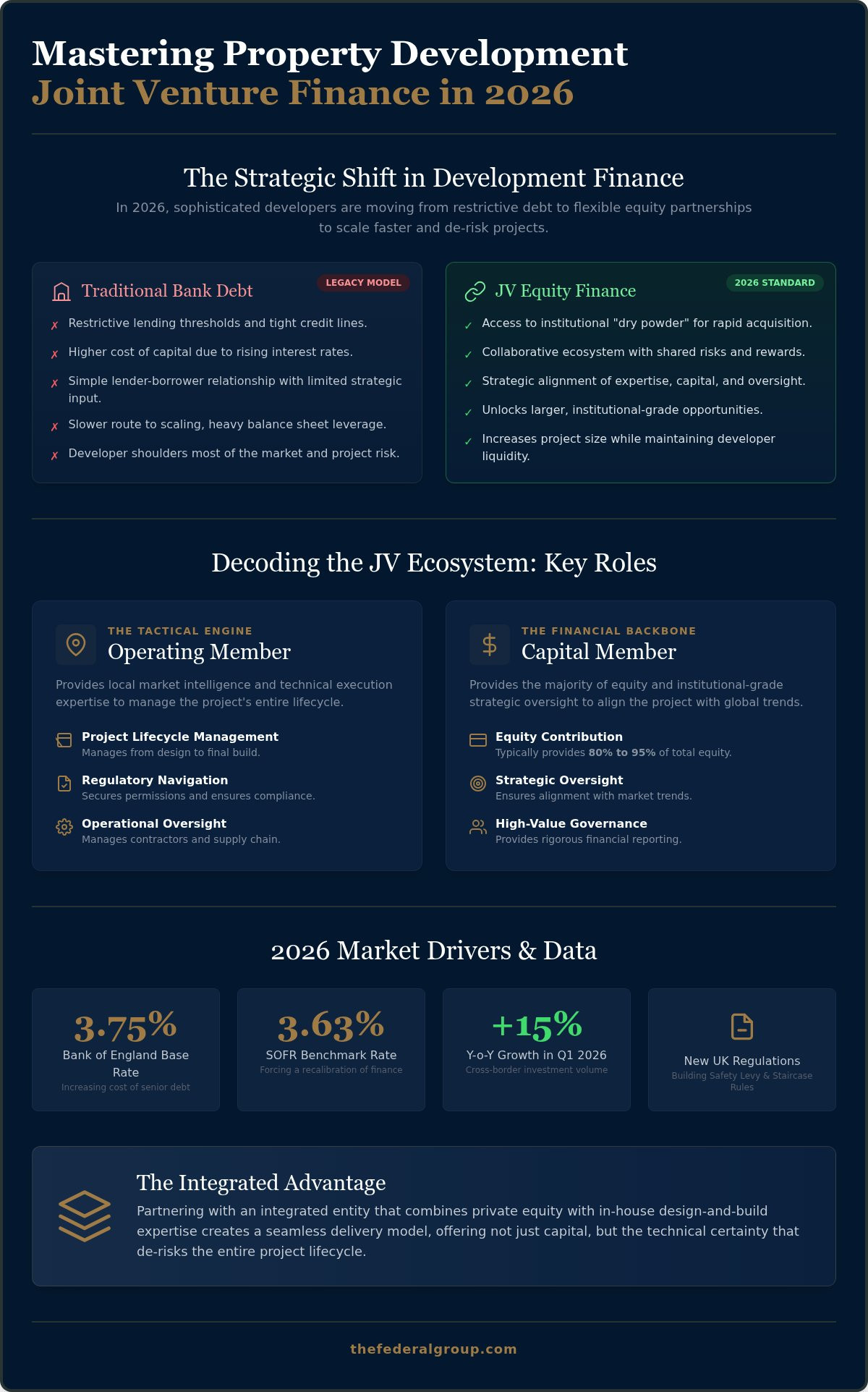
Traditional bank debt has become increasingly restrictive. With the Bank of England base rate at 3.75% and the Secured Overnight Financing Rate (SOFR) at 3.63% as of mid-2026, the cost of senior debt has forced a recalibration. Developers are finding that flexible equity partnerships offer the “dry powder” necessary for rapid acquisitions when traditional credit lines tighten. This environment favors the “integrated developer.” Firms like The Federal Group combine private equity with in-house design and build capabilities to create a seamless delivery model. These partners don’t just provide capital. They offer technical certainty that de-risks the entire project lifecycle from the first shovel in the ground.
Strategic Advantages for Modern Developers
Scaling a global portfolio in 2026 requires a departure from heavy balance sheet leverage. Joint ventures allow developers to increase project size while maintaining liquidity. Global cross-border investment volume grew by 12% in 2025 and rose another 15% year-on-year in Q1 2026. This surge is driven by developers accessing off-market opportunities through their partners’ localized networks. It’s often about who you know as much as what you build. By leveraging a partner’s existing infrastructure, developers can enter new territories with a pre-established presence.
Risk mitigation is the primary driver behind this evolution. By sharing liability with an institutional partner, developers can navigate the complexities of international property markets without shouldering the entire burden of market shifts. Property development joint venture finance provides a buffer against localized downturns. It allows for a more resilient, diversified asset base. It’s no longer just about funding. It’s about strategic survival and aggressive growth in a sophisticated global economy.
Decoding the JV Ecosystem: Operating Members vs. Capital Partners
A successful partnership relies on a granular understanding of roles. In the sphere of property development joint venture finance, the “Operating Member” and the “Capital Member” perform distinct yet symbiotic functions. While some market participants simplify these roles as “sweat equity” versus “cash,” a modern Real Estate Joint Venture Structure involves a much more sophisticated division of liability, decision-making authority, and fiduciary duty. The alignment of these two entities determines the project’s ultimate stability and yield.
Responsibilities of the Operating Member
The Operating Member acts as the project’s tactical engine. They manage the entire lifecycle from architectural inception to the final build. Their primary duties include securing local planning permissions and navigating new 2026 regulations, such as the Building Safety Levy and the requirement for second staircases in residential buildings over 18 meters. They handle the daily oversight of contractors and supply chain logistics. Their value lies in technical expertise and local market intelligence. They don’t just manage the site; they ensure the design-and-build phase meets the rigorous technical specifications required by institutional investors.
The Value-Add of the Capital Partner
The Capital Member provides the financial backbone, typically contributing 80% to 95% of the total equity. Beyond providing property development joint venture finance, they bring institutional-grade strategic oversight. They ensure the project remains aligned with global market trends and provide the transparency needed for high-value stakeholders. This role involves rigorous financial reporting and strategic exit planning. Whether the goal is a rapid sale or long-term asset management, the Capital Member ensures the project is positioned for maximum liquidity in the global market. Understanding the strategic role of a real estate private equity partner is essential for developers seeking to align institutional capital with operational expertise in today’s complex market.
Decision-making authority is a critical differentiator between these roles. The Operating Member typically holds rights regarding daily execution, but the Capital Member retains ultimate control over “capital events,” such as refinancing or asset disposal. This hierarchy ensures that the institutional partner’s capital is protected while the specialist partner has the autonomy to execute the build. This structure creates a balance of power that de-risks the project for all involved parties.
The Federal Group bridges the traditional gap between these two roles. Because we operate both a private equity arm and a dedicated design-and-build division, we understand the pressures facing the Operating Member while maintaining the standards of a Capital Partner. This integrated approach eliminates the friction often found in cross-border JVs where interests might otherwise diverge. If you’re looking to scale your portfolio with a partner that understands every facet of the development lifecycle, exploring our Private Equity and Development Finance solutions is a logical next step.
Strategic Waterfall Structures and Profit Distribution Models
Institutional capital demands precision in how returns are calculated and distributed. In the context of property development joint venture finance, the “waterfall” is the contractual blueprint that dictates the order of cash flow distribution. It ensures that the Capital Member’s investment is prioritized while providing the Operating Member with a clear path to performance-based rewards. Modern property development joint venture agreements have evolved beyond simple splits. They now utilize multi-tiered structures that account for preferred returns, common equity, and the “promote.”
The Internal Rate of Return (IRR) hurdle acts as a performance benchmark that must be surpassed before the Operating Member can access a “promote” or disproportionate share of the remaining profits. This mechanism ensures that the capital partner achieves a baseline level of profitability before the sponsor is rewarded for outperformance. In high-value developments, this structure balances the high-stakes nature of the investment with the visionary energy required to execute the project.
Common Distribution Tiers in 2026
The 2026 market typically follows a four-tier distribution model to maintain balance between risk and reward. This hierarchy provides a methodical approach to liquidity events.
- Tier 1: Return of Capital. All available cash flow is distributed to the Capital Member and Operating Member pro-rata until their initial investment is fully recovered.
- Tier 2: Preferred Return. Investors receive a “pref,” often ranging from 6% to 8% in the current market, representing a baseline interest on their unreturned capital.
- Tier 3: The Catch-Up. The Operating Member receives a specific percentage of the profits to “catch up” to the Capital Member’s preferred return ratio.
- Tier 4: The Promote. Remaining profits are split according to agreed percentages, often 80/20 or 70/30, rewarding the Operating Member for achieving high IRR targets.
Aligning Incentives to Minimize Friction
Alignment is the cornerstone of a resilient partnership. Sophisticated property development joint venture finance structures include clawback provisions to protect the Capital Member. These provisions require the Operating Member to return previously distributed “promote” funds if the overall project performance drops below agreed hurdles at the final exit. This ensures the sponsor remains committed until the very end of the project lifecycle.
Transparency in reporting is non-negotiable. Real-time access to financial data and construction progress reports builds the trust necessary to manage large-scale, international developments. By setting realistic performance hurdles based on current SOFR or Bank of England rates, partners can focus on execution rather than litigating over misaligned expectations. A well-structured waterfall doesn’t just divide profits. It de-risks the entire venture by ensuring every stakeholder is incentivized to reach the same finish line.
Navigating Cross-Border JV Finance and International Compliance
Global cross-border real estate investment volume grew by over 12% in 2025. In the first quarter of 2026, global investment into standing assets rose another 15% year-on-year. This surge reflects a market hungry for diversification, yet managing property development joint venture finance across multiple jurisdictions introduces a layer of friction that domestic-only developers often underestimate. Success in this arena requires a sophisticated understanding of how capital flows through different tax regimes and regulatory environments. It’s not just about building; it’s about the technical precision of the capital stack.
Global Regulatory Frameworks
Compliance in 2026 is a moving target. Anti-Money Laundering (AML) and Know Your Customer (KYC) protocols have become more stringent to ensure the integrity of high-value capital flows. Developers must navigate divergent local laws that can impact project viability. For instance, the UK’s Building Safety Levy, coming into force on October 1, 2026, applies to new residential developments of 10 or more dwellings. Meanwhile, the US is preparing for the “21st Century ROAD to Housing Act” which takes effect in early 2027. These regulatory shifts demand that international JVs remain agile. Tax treaties are equally critical. Structuring a partnership to leverage bilateral agreements can prevent the double taxation of distributions, preserving the project’s net yield.
Mitigating International Risks
Currency volatility can erode the margins of even the most successful builds. With the Bank of England base rate at 3.75% and the US Secured Overnight Financing Rate (SOFR) at 3.63% as of mid-2026, interest rate disparities can shift the cost of capital overnight. Hedging strategies are no longer optional. They are a prerequisite for securing institutional-grade property development joint venture finance. Most global projects utilize a Special Purpose Vehicle (SPV) to ring-fence assets and liabilities within a specific jurisdiction. This legal separation protects the parent entities from localized litigation or insolvency risks while facilitating smoother capital repatriation. Developers who engage a dedicated real estate private equity partner with cross-border operational expertise are significantly better positioned to manage these jurisdictional complexities from the outset.
The Federal Group specializes in these complex, cross-border capital solutions. We provide the stability of an institutional partner with the localized insight of a developer who understands the ground-level realities of both the UK and US markets. Our integrated approach ensures that capital repatriation and tax efficiency are baked into the project structure from the outset. If you’re ready to expand your reach into new international markets, contact us today to discuss our Development Finance and Private Equity expertise.
The Integrated Advantage: Partnering with The Federal Group
Fragmented partnerships often collapse under the weight of misaligned timelines and third-party friction. While competitors frequently suggest hiring separate architectural consultants and contractors, this approach leads to higher costs and slower execution. The Federal Group operates as a singular ecosystem. Property development joint venture finance becomes significantly more efficient when the capital member possesses in-house design and build capabilities. We don’t just provide the funding; we provide the technical certainty required to deliver high-value assets in a volatile 2026 market.
Full Lifecycle Development Support
Our integrated model, managed through Federal Holdings, oversees every stage of the project from initial architectural design to final construction. This “one roof” philosophy eliminates the common equity gap that stalls many large-scale developments. By removing the need for external consultants, we maintain absolute control over the supply chain and build quality. This level of integration is particularly vital for international developers looking to move across borders without the headache of managing local contractor networks from afar. Our specialization in international property ensures that every project meets institutional standards from the first shovel in the ground. It’s a model designed for speed and reliability, positioning us as a heavyweight partner rather than a mere service provider.
Bespoke Capital Solutions
The Federal Group provides a comprehensive suite of financial instruments tailored for professional developers. Our property development joint venture finance solutions often include strategic bridging loans for rapid land acquisition, allowing partners to secure off-market opportunities before traditional debt can be arranged. We leverage our private equity arm to fund projects that require a sophisticated capital stack, including those in the professional sports and high-end residential sectors. Developers seeking to understand how private equity for property developers has evolved in 2026 — including the impact of 100% bonus depreciation and the 21st Century ROAD to Housing Act — will find that an integrated capital model is now essential for executing high-value, cross-border projects at scale. Our Sports Division creates unique investment synergies, offering multi-club ownership opportunities that cross-pollinate with our property assets. This breadth of expertise allows us to structure deals that are both tax-efficient and highly liquid.
Initiating a high-value partnership begins with a rigorous appraisal of the asset’s global potential followed by a bespoke structuring of the equity stack. We focus on transparency and results-driven execution. If you’re ready to scale your portfolio with a partner that manages the entire project lifecycle, the next step is a direct consultation to align our integrated resources with your vision. You can explore our full range of Private Equity and Design & Build Development services to see how our global reach can de-risk your next large-scale venture.
Securing Your Global Development Legacy
The landscape of 2026 demands a strategic shift from traditional debt toward sophisticated equity partnerships. Success hinges on mastering the technicalities of property development joint venture finance, from precise waterfall structures to the complexities of cross-border compliance. By aligning with a partner that provides institutional capital alongside integrated design and build capabilities, you eliminate the friction of fragmented delivery. This holistic approach ensures your portfolio remains resilient against market volatility while capturing high-value international opportunities.
The Federal Group offers the stability and specialized expertise required to navigate these high-stakes challenges with confidence. Our global reach across property and professional sports markets provides a unique ecosystem for growth. It’s time to elevate your strategy and secure the capital stack your vision deserves. Partner with The Federal Group for your next high-value development project to leverage our international expertise in bridging loans and private equity. Your next landmark project is within reach with the right institutional partner by your side.
Frequently Asked Questions
What is the typical equity split in a property development joint venture?
Institutional capital partners typically provide 80% to 95% of the total equity required for a project. The operating member or sponsor contributes the remaining 5% to 20%. This specific ratio ensures the developer has sufficient “skin in the game” to align their interests with the high-value stakeholders providing the bulk of the liquidity.
How does a ‘Promote’ structure work in real estate JV finance?
A promote is a financial incentive that allows the operating member to receive a disproportionate share of profits once specific performance hurdles are met. After the capital partner receives their initial investment and a preferred return, the remaining cash flow is split. This mechanism rewards the sponsor for achieving a high Internal Rate of Return (IRR) and exceeding baseline expectations.
Can bridging loans be used as part of a joint venture agreement?
Bridging loans are frequently used to facilitate rapid land acquisition before the full equity stack is finalized. This strategy allows the partnership to secure off-market opportunities in competitive global markets without waiting for long-term financing. It provides the agility needed to move quickly while the more complex JV documentation is being completed.
What are the main risks for the Capital Member in a development JV?
The primary risks involve construction delays, cost overruns, and shifts in market liquidity at the point of exit. Capital members mitigate these threats by implementing rigorous financial reporting and clawback provisions. Partnering with an integrated developer further reduces risk by ensuring technical certainty throughout the build phase.
How do cross-border regulations affect international JV distributions?
International distributions are subject to bilateral tax treaties and localized regulatory levies. For example, projects in England must account for the Building Safety Levy effective October 2026. Using a Special Purpose Vehicle (SPV) helps manage these jurisdictional complexities. It ensures that capital repatriation remains tax-efficient and compliant with global AML and KYC protocols.
What is the difference between a JV and a traditional development loan?
A traditional loan is a debt obligation with fixed interest payments, while property development joint venture finance is a partnership based on shared equity and profits. JVs offer greater flexibility and higher leverage than standard senior debt. This model aligns the interests of the financier and the developer, focusing on the project’s ultimate success rather than mere repayment.
How does an integrated design and build model improve JV efficiency?
Integration eliminates the friction and cost of managing multiple third-party consultants. By keeping architectural design and construction under one roof, the partnership gains absolute control over the supply chain and project timelines. This streamlined approach provides the capital partner with a single point of accountability and reduces the overall equity gap.
Is private equity a viable option for mid-sized property developments?
Private equity has become a highly viable alternative to traditional bank debt for mid-sized projects with strong yield potential. It offers a more agile and sophisticated form of property development joint venture finance in the 2026 credit environment. Developers can leverage private equity for property developers to scale their portfolios more rapidly than they could through standard retail banking channels.