Private Equity for Property Developers: 2026 Guide
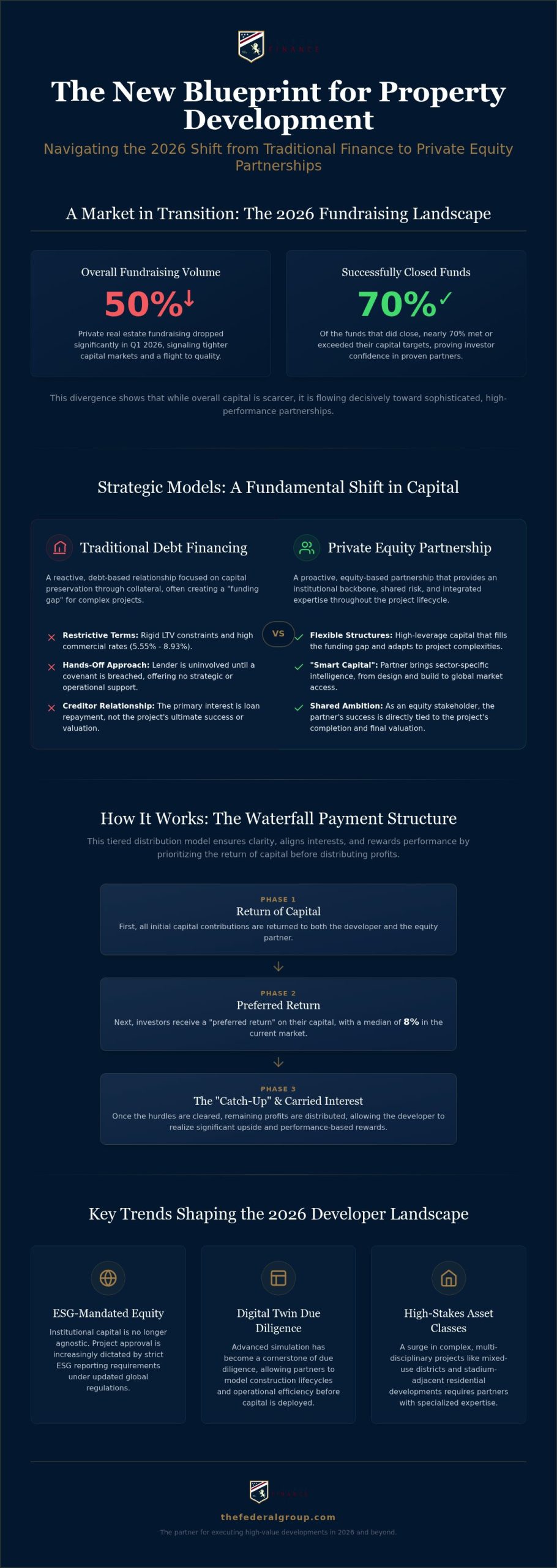
16 August 2026While private real estate fundraising dropped 50% in the first quarter of 2026, nearly 70% of funds that did close met or exceeded their capital targets. This divergence signals a massive shift in how institutional capital flows into the built environment, making private equity for property developers the primary engine for global scale. If you’re feeling the squeeze of restrictive bank lending or slow deployment cycles, you aren’t alone. Most developers now find that traditional institutions lack the agility to handle the complexity of modern, cross-border projects. You need a partner that understands the physical realities of the build lifecycle, not just a balance sheet.
This guide reveals how modern partnerships provide the scale and integrated expertise required to execute high-value developments in 2026. We’ll examine the impact of the 21st Century ROAD to Housing Act, the return of 100% bonus depreciation, and how an integrated capital model de-risks your entire project from architectural design to final completion. By the end, you’ll know how to secure flexible, high-leverage capital that aligns with your long-term portfolio ambitions and allows you to scale your operations internationally.
Key Takeaways
- Learn why institutional capital has transitioned from a passive funding source to an active growth partner in the 2026 property market.
- Understand how the integrated “design and build” approach to private equity for property developers accelerates deployment and reduces project risk.
- Discover the mechanics of Joint Venture structures that maximize developer liquidity while maintaining project momentum.
- Gain insights into navigating the complex regulatory landscape and currency risks for cross-border developments across the US and UK.
- Identify the critical vetting criteria for selecting a partner with proven expertise in high-stakes asset classes like residential and professional sports.
The Evolution of Private Equity for Property Developers in 2026
In 2026, private equity for property developers has transitioned from a lender of last resort to a primary vehicle for strategic growth. While traditional retail banking services remain constrained by legacy risk models, alternative institutional equity offers the agility required for industrial-scale projects. Developers now prioritize “smart capital” where the financier brings sector-specific intelligence and operational support rather than just liquidity. Private equity real estate is an integrated partnership model designed to facilitate the acquisition, development, and management of high-value property assets through shared risk and institutional expertise.
The landscape has shifted because the traditional “2% and 20%” model is fading, with mean management fees for 2026 vintage funds hitting a record low of 1.57%. This fee compression, coupled with the projected 20% consolidation of global managers by 2029, means developers are working with larger, more sophisticated entities. These firms don’t just provide funds; they provide a gateway to global markets. This evolution reflects a mature industry where success depends on strategic choices rather than just riding a wave of low interest rates.
Current Trends Shaping the 2026 Developer Landscape
Institutional capital is no longer agnostic about project impact. ESG-mandated equity now dictates project approval, as funds face stricter reporting requirements under updated global regulations. Additionally, digital twin technology has become a cornerstone of due diligence, allowing partners to simulate construction lifecycles and operational efficiency before capital deployment. We’re also seeing a surge in mixed-use and stadium-adjacent residential developments, where private equity provides the scale to manage these multi-disciplinary, high-stakes ecosystems that require specialized expertise.
Why Traditional Debt is No Longer Sufficient for Large-Scale Projects
Conventional commercial mortgage rates, ranging from 5.55% to 8.93% in August 2026, often come with rigid LTV constraints that ignore the complexities of modern builds. This creates a significant “funding gap” where developers struggle to cover the mezzanine and top-slice requirements of a project. Private equity fills this void by providing flexible, high-leverage structures that traditional lenders avoid. For those scaling portfolios across borders, relying on debt alone often leads to stalled momentum. Understanding international property development finance is critical when bank lending criteria fail to account for the visionary nature of global assets.
Strategic Models: Real Estate Equity Partnerships vs. Traditional Finance
Traditional finance operates on a reactive, debt-based relationship where the lender’s primary interest is capital preservation through collateral. In contrast, private equity for property developers functions as a proactive partnership. While a bank remains “hands-off” until a covenant is breached, a private equity partner provides an institutional backbone throughout the build lifecycle. This shift from a creditor to a stakeholder changes the project dynamic from one of oversight to one of shared ambition. Developers often fear a loss of control when entering equity arrangements, but the reality in 2026 is that shared risk provides a safety net that traditional debt cannot match. When your financier is also an equity stakeholder, their success is inextricably linked to the project’s completion and final valuation.
The financial alignment in these partnerships is governed by the “Waterfall” payment structure. This tiered distribution model ensures clarity and rewards performance. Typically, the first tier involves the return of initial capital to all partners. The second tier covers the preferred return, which currently sees a median of 8% in the real estate sector. Once these benchmarks are met, the “catch-up” and “carried interest” tiers allow the developer to realize significant upside. In a mature market, this structure incentivizes the developer to exceed targets while providing the partner with the security of a prioritized return. It’s a sophisticated method for balancing the scales of risk and reward in high-stakes global developments. For a deeper analysis of how these structures are evolving, exploring strategic real estate equity partnership models for 2026 provides essential context on aligning interests from the outset.
The Joint Venture (JV) Model for Developers
The JV structure remains the gold standard for aligning interests in large-scale projects. By co-investing capital, both parties demonstrate “skin in the game,” which significantly de-risks the venture for external stakeholders. Utilizing property development joint venture finance allows developers to maintain liquidity for other portfolio opportunities while benefiting from the partner’s balance sheet. In 2026, governance in these ventures is managed through digital-first environments, providing real-time transparency into milestones and capital deployment. This level of integration ensures that decision-making is data-driven and agile.
Preferred Equity vs. Common Equity: Choosing the Right Stack
Understanding where capital sits in the stack is vital for protecting developer upside. Preferred equity occupies a middle ground, sitting behind senior debt but ahead of common equity in the repayment hierarchy. It’s often used to replace high-cost mezzanine debt, which in August 2026 can carry rates exceeding 12%. Common equity, while the most expensive in terms of profit share, offers the greatest flexibility and the longest investment horizon. Choosing the right blend depends on your specific exit strategy and the capital requirements of the asset class. If you are looking to scale your portfolio with a partner that understands these nuances, you might explore how integrated capital models support global growth.
Integrated Capital: The Power of Design and Build Expertise
Traditional private equity models often fail because of a fundamental disconnect between the boardroom and the build site. While financiers analyze spreadsheets, developers grapple with the physical realities of material procurement and labor shortages. The “Federal Model” bridges this gap by integrating architectural and construction expertise directly into the capital stack. By positioning the financier as an active partner with deep technical knowledge, projects gain a level of certainty that generic funding cannot provide. This integrated approach ensures that every dollar deployed is informed by a granular understanding of the architectural and construction lifecycle, rather than just financial projections.
In the 2026 market, where construction loan rates for bank financing range between 6.5% and 9.5%, efficiency is the only way to protect margins. Working with a partner that possesses internal design and build capabilities significantly reduces due diligence cycles. Instead of waiting weeks for third-party consultants to verify site feasibility, an integrated partner conducts these assessments in-house. This speed is critical for securing high-value assets in competitive global markets. Using private equity for property developers as a tool for both funding and execution de-risks the most volatile phases of the project, ensuring that construction begins with a fully vetted, optimized plan.
Reducing Friction Between Finance and Construction
Standard private equity firms frequently struggle with construction-phase delays because they don’t speak the language of the job site. When a project hits a technical snag, a traditional lender’s first instinct is to freeze capital. An integrated design and build developer takes the opposite approach, utilizing architectural oversight to solve problems in real-time. This integration streamlines the “Draw” process. Because the funding partner manages the project management ecosystem, capital deployment is synchronized with physical milestones, preventing the liquidity bottlenecks that often stall large-scale developments.
Maximizing ROI Through Lifecycle Management
End-to-end involvement from a strategic partner increases the ultimate exit valuation of an asset. By maintaining architectural control and operational oversight, the partnership ensures that the final product meets the highest institutional standards. This efficiency also allows developers to better leverage tax incentives like the permanently restored 100% bonus depreciation and the increased Section 179 deduction limit of $2.56 million. Proving operational efficiency through a single, integrated partner reduces the cost of capital over the project’s life. It transforms the relationship from a simple loan into a sophisticated mechanism for scaling projects from initial design through to final disposition.
Global Deployment: Scaling Portfolios Across International Borders
Scaling a property portfolio internationally requires more than just capital; it requires a navigator. In 2026, the US and UK markets present a paradox of high demand and tightening institutional restrictions. For instance, the 21st Century ROAD to Housing Act, enacted in July 2026, fundamentally changed the landscape by prohibiting large institutional investors from purchasing additional single-family homes. This regulatory shift forces developers to pivot toward multi-family, mixed-use, or industrial assets. In this environment, the expertise of a real estate private equity partner becomes indispensable for identifying compliant entry points in competitive urban centers.
Managing currency volatility and capital repatriation remains a primary concern for high-value international projects. A sophisticated partner with a global footprint mitigates these risks by structuring equity in a way that aligns with local tax laws while ensuring liquidity across borders. By leveraging local knowledge, developers can secure land in prime locations where traditional banks hesitate due to cross-border complexity. Utilizing private equity for property developers provides the institutional weight needed to bypass these logistical hurdles, ensuring that capital flows as quickly as the project demands.
Cross-Border Compliance and Capital Solutions
The One Big Beautiful Bill Act (OBBBA) introduced permanent 100% bonus depreciation, but applying this across international entities requires precise financial engineering. Developers must also ensure strict AML and KYC compliance, especially as SEC Form PF amendments take effect in October 2026. Partnering with an international real estate finance partner ensures these regulatory hurdles don’t stall your capital flow. It’s about building an ecosystem where compliance is a facilitator of growth rather than a bottleneck.
Strategic Bridging for International Land Acquisition
Site acquisition in fast-moving markets often moves faster than institutional equity can be deployed. This is where bridging finance for land acquisition serves as a critical tactical tool. Short-term liquidity allows you to secure the asset immediately, maintaining momentum while the long-term equity partner finalizes their due diligence. This dual-track approach ensures you don’t lose prime opportunities to more agile competitors. If you’re ready to expand your footprint, contact The Federal Group to discuss your international scaling strategy.
Securing the Right Partner: Beyond the Capital Stack
Selecting a source of private equity for property developers is a long-term strategic decision that extends far beyond the initial capital injection. In a market where global manager consolidation is projected to reach 20% by 2029, vetting the stability and liquidity of a potential partner is paramount. You need a partner whose vision aligns with the gravity of industrial-scale projects and who possesses the institutional weight to see them through multiple cycles. While a competitive waterfall structure is important, the true value lies in a partner’s ability to provide follow-on funding and operational insight when market conditions shift.
Track records must be evaluated with precision. A firm specializing in traditional residential assets may lack the nuanced understanding required for complex, stadium-adjacent developments or professional sports infrastructure. Visionary developers often find that generic private equity firms struggle to grasp the momentum required for high-stakes, multi-disciplinary projects. Cultural alignment ensures that both parties are prepared for the high-stakes reality of global development, where speed and certainty are the primary currencies of success. Preparing your development for an institutional-grade pitch requires a clear demonstration of how your vision meets these high standards of operational excellence.
Due Diligence on Your Private Equity Partner
Rigorous due diligence is a two-way street. Before committing, assess the partner’s specific history in your target asset class. For instance, if your project involves mixed-use residential near a professional sports venue, verify their experience in managing the unique regulatory and logistical challenges of sports-adjacent assets. Check their current assets under management and their commitment to the sector; with mean management fees hitting record lows of 1.57% in 2026, you want to ensure your partner isn’t cutting corners on project oversight. Confirm their capacity for follow-on funding to prevent mid-project liquidity gaps that could derail your construction timeline.
The Integrated Advantage: Why The Federal Group?
The Federal Group represents a new breed of “integrated” partner. We combine deep international finance expertise with the physical execution capabilities of Federal Holdings, our dedicated design and build division. This dual identity allows us to manage the entire lifecycle of a project, from the initial architectural vision to final disposition. By working with a financier who is also a developer, you eliminate the friction between capital deployment and site reality. We understand the visionary energy required for large-scale global assets because we live it every day. If you’re ready to scale your portfolio with a partner that brings institutional scale and specialist insight, Partner with The Federal Group for your next development.
Scaling High-Value Portfolios Through Strategic Integration
The 2026 property market demands more than just liquidity; it requires an ecosystem of support. We’ve explored how private equity for property developers has evolved into a strategic partnership model that de-risks the construction lifecycle through integrated design and build expertise. From navigating the complexities of the 21st Century ROAD to Housing Act to utilizing joint venture structures for international scale, the modern developer must prioritize partners who offer both capital and operational intelligence. Success in this mature landscape depends on aligning with a firm that understands the physical realities of the job site as well as the nuances of the capital stack.
The Federal Group stands at the intersection of institutional finance and industrial-scale development. As specialists in international development finance with a proven track record across the US, UK, and professional sports markets, we provide the integrated design and build expertise required to execute visionary projects. We manage the entire lifecycle to ensure project certainty and maximized returns. It’s time to move beyond traditional debt and embrace a model built for the future of global real estate. Partner with The Federal Group for Integrated Property Finance to begin your next high-value development today.
Frequently Asked Questions
What is the typical minimum project value for real estate private equity?
Institutional private equity for property developers typically targets projects with a gross development value (GDV) exceeding $10 million. While smaller boutique funds may consider lower thresholds, global firms often prioritize assets in the $50 million to $500 million range to justify the extensive due diligence required. This scale ensures the project can support the institutional reporting requirements and governance structures that define high-stakes property partnerships in 2026.
How does private equity differ from a standard development loan?
Standard development loans are debt instruments that require fixed interest payments and principal repayment regardless of project success. Private equity is an ownership stake where the financier shares in both the risk and the ultimate profit. Unlike a bank, an equity partner is a stakeholder in the project’s valuation. This alignment often allows for higher leverage and greater flexibility during construction than a restrictive, covenant-heavy commercial mortgage would permit.
Will I lose control of my project if I partner with a private equity firm?
Partnering with a private equity firm does not mean surrendering operational control. As the General Partner (GP), you manage the daily execution and visionary direction of the development. The equity firm acts as a Limited Partner (LP), providing capital and strategic oversight. While they hold governance rights on major decisions, such as asset disposition or significant budget alterations, the partnership is designed to empower the developer to execute their specific expertise.
What are the requirements for a property developer to secure private equity in 2026?
Securing private equity for property developers in 2026 requires a proven track record and a robust ESG framework. Developers must provide granular data through digital twin technology to simulate project lifecycles. Institutional-grade pitches also require a transparent exit strategy and evidence of architectural feasibility. Firms look for partners who demonstrate operational efficiency and an ability to manage the complexities of modern, industrial-scale property assets.
How long does the due diligence process take for institutional equity?
The due diligence process for institutional equity typically spans 60 to 90 days. This period involves a comprehensive audit of site titles, environmental impact, architectural designs, and financial projections. Using an integrated partner that possesses internal design and build capabilities can often compress this timeline. Because these specialists understand the physical construction lifecycle, they can verify technical feasibility faster than traditional firms relying solely on third-party consultants.
Can private equity be used for international land acquisition?
Private equity is a highly effective tool for securing land in competitive international markets. It’s frequently deployed alongside strategic bridging finance to allow for rapid site acquisition before long-term equity structures are fully finalized. This approach provides the liquidity needed to move on prime urban assets in the US or UK. Leveraging equity for land ensures the developer has a stable capital base for the subsequent construction and disposition phases.
What is the difference between GP and LP in a property development context?
The partnership is divided into two distinct roles:
- General Partner (GP): The developer responsible for daily operations and build execution.
- Limited Partner (LP): The institutional investor providing the majority of the capital stack.
This structure limits the LP’s liability to their investment amount while the GP receives a management fee and a share of the profits through a performance-based waterfall.
How do private equity firms exit a property development project?
Exit strategies for private equity real estate usually involve a sale to institutional buyers, real estate investment trusts (REITs), or large-scale portfolio aggregators. Some projects conclude with a refinancing event that allows the equity partner to repatriate their capital while the developer retains a long-term interest. In 2026, many funds also utilize secondary markets to provide liquidity for their investors before the physical asset reaches final disposition.