Bridging Loans & Commercial Development: 2026 Guide
7 August 2026In the high-stakes arena of global property, the difference between a landmark acquisition and a missed opportunity isn’t just capital; it’s the speed of deployment. Many developers find themselves paralyzed as traditional bank approvals crawl forward while prime assets are snatched up by more agile competitors. It’s a common frustration to watch a project’s momentum stall because your liquidity is locked in existing portfolios. This is where the strategic use of bridging loans and commercial development expertise becomes a decisive competitive advantage.
You’ll master the complexities of short-term capital deployment. This guide shows how bridging finance sustains momentum in high-value commercial property development. We’ll examine the mechanics of securing land quickly and bridging the gap between acquisition and planning permission. By the end, you’ll understand how to maintain project velocity until a permanent exit or refinance is secured, ensuring your vision remains on track from the initial bid to final completion.
Key Takeaways
- Discover how development velocity drives capital deployment and why immediate liquidity is essential for maintaining project momentum.
- Master the technical nuances of LTV and LTGDV to structure high-leverage deals that satisfy institutional underwriting requirements.
- Identify the strategic distinctions between bridging loans and commercial development finance to optimize funding for both acquisition and construction phases.
- Evaluate the 2026 commercial landscape to mitigate exit risks and ensure seamless transitions to long-term financing or asset disposal.
- Leverage an integrated capital and construction model to minimize the operational friction between finance acquisition and project delivery.
The Strategic Role of Bridging Loans in Commercial Development
Commercial bridging finance is a short-term, asset-backed capital solution designed to provide immediate liquidity. While some developers still view it as a fallback, institutional leaders treat it as a precision tool for capital deployment. What is a bridging loan? At its core, it’s a mechanism to secure assets while permanent financing is structured. In 2026, the primary driver for bridging loans and commercial development is velocity. Market windows for high-value assets open and close with extreme speed. Waiting for a traditional bank’s six-month underwriting process often means losing the site entirely. The shift from emergency funding to strategic capital deployment reflects a more sophisticated approach to risk and opportunity.
This agility is vital for the integrated design and build developer. By controlling the capital flow from the outset, a developer can align finance with architectural timelines and procurement schedules. It transforms finance from a reactive necessity into a proactive asset that powers every stage of the project lifecycle. The synergy between bridging loans and commercial development allows for aggressive expansion without over-leveraging existing cash reserves or stalling during critical planning windows.
Maintaining Momentum in the Development Lifecycle
Project velocity is the lifeblood of institutional property development. Bridging the gap between site acquisition and the start of construction prevents the dead time that often erodes project viability. During the planning and architectural design phases, developers use these funds to maintain a full team of consultants. Beyond professional fees, short-term capital is increasingly used to secure materials in a volatile global supply chain. Locking in steel or specialized glass prices early can save millions in the long run. This liquidity ensures that the project doesn’t lose its place in the contractor’s schedule while waiting for long-term funding to be released.
Bridging for Land Acquisition and Site Assembly
Speed is the ultimate currency in land acquisition. High-value plots are often sold under tight deadlines that traditional lenders cannot meet. By utilizing bridging finance for land acquisition, developers can close in weeks rather than months. This is particularly effective for site assembly in urban centers. When a large-scale mixed-use project depends on acquiring multiple adjacent parcels, bridging finance offers the flexibility to purchase each piece as it becomes available. It creates a cohesive site ready for a larger development exit or refinance, providing the breathing room needed to finalize the master plan without the pressure of an immediate construction deadline.
Key Mechanics: How Bridging Finance Facilitates Project Agility
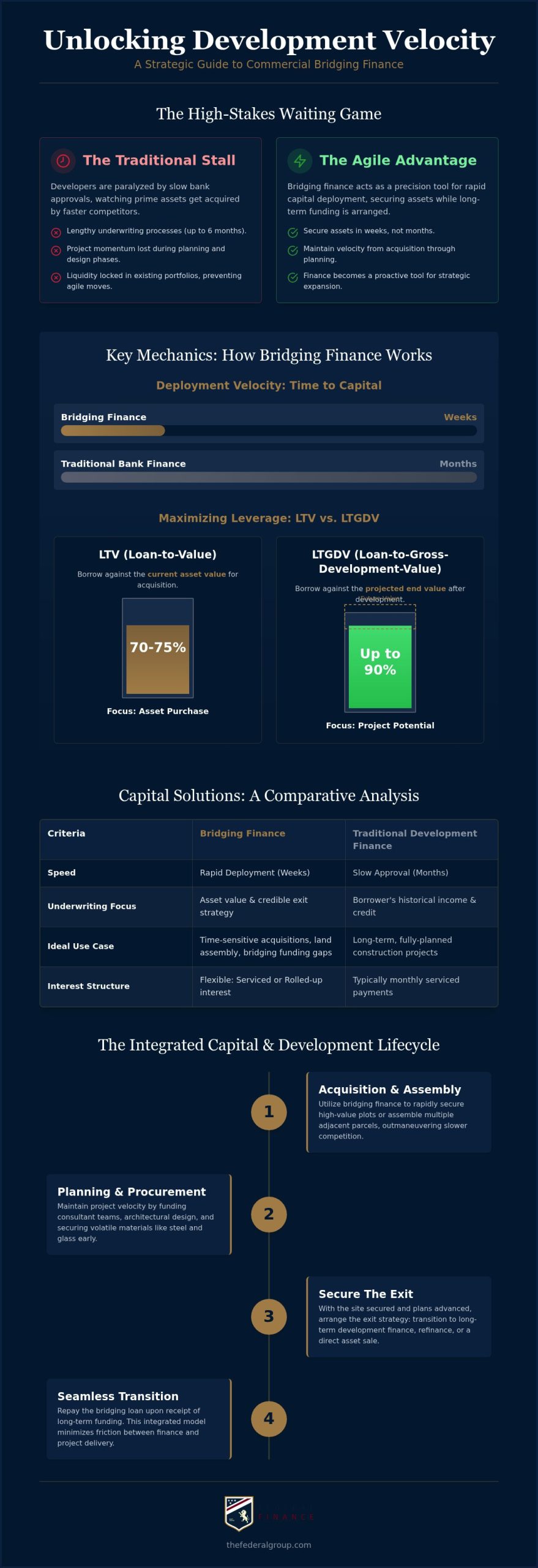
Successful deployment of bridging loans and commercial development capital depends on a granular understanding of leverage and liquidity. Unlike traditional term loans, bridging is structured around the immediate value of the asset and the viability of the transition. How bridge loans work in a commercial context involves balancing the Loan-to-Value (LTV) for the initial purchase against the Loan-to-Gross-Development-Value (LTGDV) for the project’s completion. In 2026, lenders typically cap LTV at 70% to 75% for commercial assets, but the real strategic advantage lies in LTGDV, which allows developers to borrow against the projected end value. This technical distinction is critical for maximizing equity efficiency across a portfolio.
Lenders in this space prioritize the ‘Exit Strategy’ above almost all other variables. Whether the plan involves a transition to long-term development finance, a direct asset sale, or a refinance into a commercial mortgage, the credibility of this exit dictates the terms of the facility. Since the underwriting focus is on the asset’s potential rather than just the borrower’s historical income, the process moves significantly faster than retail banking. While a traditional mortgage might take months to clear committee, a bridging facility can be deployed in weeks, ensuring that time-sensitive opportunities aren’t lost to competitors. Elite developers seeking fast bridging loans for property development can access capital in as little as 24 to 72 hours, a critical advantage when competitive bidding windows are measured in days rather than weeks.
Cash flow management is further optimized through flexible interest structures. Developers can choose between serviced interest, where payments are made monthly, or rolled-up interest, where the cost is capitalized into the loan and settled upon exit. This flexibility ensures that capital remains available for construction costs rather than being drained by debt service during the build phase. For those managing complex portfolios, aligning with a strategic capital partner ensures that these technical mechanics work in favor of the project’s long-term internal rate of return.
International Capital Deployment and Cross-Border Considerations
Navigating cross-border transactions requires more than just capital; it demands an international real estate finance partner who understands local regulatory nuances. In a globalized market, managing currency fluctuations and diverse legal frameworks is essential when deploying capital into multi-asset portfolios across different jurisdictions. Bridging finance provides the necessary speed to move capital across borders, allowing developers to hedge against local market volatility by diversifying their geographic footprint without the delays of international retail banking.
Underwriting Based on Asset Value and Potential
Bridging lenders prioritize the asset’s ‘as-is’ value and its residual potential over the borrower’s personal balance sheet. In the 2026 market, valuations are increasingly sensitive to planning status and environmental compliance. A site with ‘subject to planning’ potential is underwritten differently than one with full consent, often requiring a lender who can assess the ‘residual’ land value. This asset-centric approach allows developers to unlock value in properties that traditional institutions would deem too speculative, provided there’s a clear path to value uplift and a robust exit plan.
Comparing Capital Solutions: Bridging vs. Traditional Development Finance
Choosing between capital solutions requires a clear-eyed assessment of the project’s timeline and risk profile. Traditional development finance is structured for the long haul, typically covering the entire construction phase with lower annual interest rates. However, its rigid underwriting and slow disbursement make it unsuitable for the initial land grab. In contrast, bridging loans and commercial development capital prioritize speed. While monthly interest rates for bridging are higher, the facility can be secured in a fraction of the time required for a standard commercial mortgage.
A developer’s ROI isn’t just calculated on the interest rate. It’s calculated on the cost of delay. If waiting for traditional funding causes a site to be lost or a construction window to be missed, the ‘cheaper’ capital becomes the more expensive option. When evaluating Commercial Real Estate Financing Explained, it’s evident that bridging loans and commercial development strategies often sit at the base of the capital stack during the transition phase, providing the foundation until senior debt or mezzanine finance can be layered in once planning is solidified.
The Strategic Transition: Refinancing the Bridge
Successful developers don’t stay on a bridge longer than necessary. The goal is to move from high-cost liquidity to lower-cost long-term funding as soon as the project de-risks. This often happens once planning permission is granted or the initial groundworks are complete. In 2026, many use a ‘Development Exit’ loan to bridge the gap between finishing construction and achieving full occupancy or a final sale. This transition reduces debt service costs while the asset is marketed, protecting the project’s final margins and allowing capital to be recycled into the next opportunity.
Bridging for Commercial Refurbishment and Change of Use
Not every project starts from the ground up. The 2026 market sees a high volume of ‘permitted development’ projects, particularly converting redundant office spaces into residential or mixed-use assets. Utilizing commercial bridging finance is the preferred route for these refurbishments. It allows for rapid acquisition and covers the ‘heavy refurbishment’ costs before the asset is seasoned enough for a traditional commercial term loan. This speed is essential for seizing undervalued assets that require immediate intervention to unlock their residual value.
Risk Mitigation and Exit Strategies for High-Value Projects
The primary risk in bridging loans and commercial development isn’t the cost of the capital, but the failure of the exit strategy. A failed exit occurs when the borrower cannot refinance or sell the asset before the term expires, potentially leading to default or expensive extensions. In the 2026 commercial sector, market liquidity and buyer demand are heavily influenced by fluctuating interest rates, which currently range between 9% and 14% per annum for commercial assets. Developers must prove that their project remains viable under these conditions to satisfy the underwriting requirements of take-out lenders.
De-risking a high-value project requires rigorous professional valuation and legal due diligence from the outset. Lenders increasingly demand “stress-tested” exit plans that account for potential shifts in asset values or construction delays. Contingency planning is no longer optional; it is a structural necessity. This involves identifying secondary exit routes, such as moving from a sale strategy to a long-term hold, or securing pre-negotiated term extensions. By addressing these variables early, developers protect their equity and maintain the trust of institutional partners.
Structuring Robust Exit Plans
A definitive exit plan typically follows one of three paths: the sale of the completed asset, refinancing into a commercial mortgage, or a private equity buyout. Timing is the critical factor. Developers need to position their assets for sale well before the bridging facility matures to avoid “fire-sale” scenarios. If the intention is to hold the asset, transitioning into a long-term commercial mortgage or Commercial Mortgage-Backed Security (CMBS) requires the property to be stabilized and income-producing. In some complex international projects, Private Equity partners are utilized to take out the bridging facility, providing a more permanent capital structure for the next phase of the asset’s lifecycle.
Managing Interest Rate Volatility
Central bank policies continue to exert pressure on 2026 bridging rates, making interest rate hedging a vital component of any risk management strategy. Developers use caps and collars to protect against sudden spikes in short-term debt costs. This financial discipline ensures that the project’s internal rate of return remains intact even if the macro environment shifts. Rolled-up interest protects project cash flow during construction by capitalizing the debt service into the loan amount rather than requiring monthly payments. This allows the developer to focus all available liquidity on the build itself, ensuring that milestones are met without the distraction of ongoing interest obligations.
Partnering for Success: Integrated Capital Solutions with The Federal Group
Capital is only as effective as the execution it supports. In the complex landscape of 2026, the traditional lender-borrower relationship is often insufficient for high-value projects. Success requires a strategic partnership that understands the nuances of both the balance sheet and the build site. The Federal Group operates at this intersection, providing an ecosystem where bridging loans and commercial development expertise exist under one roof. This integration eliminates the silos that typically cause delays, ensuring that financial structures are perfectly aligned with the physical realities of the project.
Leveraging international property development finance allows developers to navigate sophisticated global markets with confidence. When a partner possesses deep expertise in both private equity and physical development, they bring a unique perspective to risk assessment. We don’t just evaluate the loan; we evaluate the project’s lifecycle. This holistic approach reduces the friction between securing capital and delivering a finished asset, allowing for a more aggressive and efficient deployment of resources across diverse jurisdictions.
The Integrated Advantage: Finance Meets Design & Build
Project timelines are significantly reduced when capital and construction move in lockstep. Through Federal Holdings, we manage the entire lifecycle from initial architectural design to the final exit. This integrated model ensures that bridging loans and commercial development milestones are synchronized. When the design team, the build team, and the finance team operate within the same strategic framework, the risk of project stalls is minimized. Capital deployment is precisely timed to construction phases, maximizing equity efficiency and ensuring that project momentum never falters due to administrative bottlenecks.
Global Reach, Local Expertise
Navigating the US, UK, and international markets requires a partner with a seamless global footprint. The Federal Group provides access to institutional-grade capital for high-potential commercial ventures, regardless of where the opportunity arises. Our presence in key international hubs allows us to offer localized insight backed by global scale. This dual capability ensures that developers can seize opportunities in competitive urban centers while maintaining a stable, centralized capital source. We provide the stability of an institutional heavyweight with the focused, proactive mindset of a specialized consultancy.
Discover how The Federal Group can accelerate your next development and provide the integrated capital solutions your project demands.
Securing Your Vision in a Competitive Global Market
The 2026 commercial landscape demands more than just capital; it requires the agility to act before a window of opportunity closes. We’ve examined how bridging loans and commercial development strategies provide the necessary liquidity to secure high-value assets and maintain project momentum through critical planning phases. Success in this high-stakes environment depends on a granular understanding of exit strategies and the ability to transition seamlessly from short-term debt to long-term stability.
The Federal Group has operated as international property finance specialists since 2009. We offer a unique ecosystem as a fully integrated design and build developer through Federal Holdings. This expertise in private equity and global capital deployment ensures your project is managed with technical precision from acquisition to delivery. Don’t let traditional banking inertia stall your progress. A strategic partner with deep sector knowledge can mean the difference between a stalled project and a landmark success.
Partner with The Federal Group for Your Next High-Value Development and secure the strategic partnership your vision deserves. The future of commercial development belongs to those who move with speed and certainty.
Frequently Asked Questions
What is the typical duration of a commercial bridging loan in 2026?
Commercial bridging loans typically last from a few weeks up to 24 months. The industry average in 2026 remains approximately 12 months, providing sufficient time for developers to secure planning permission or transition to long-term funding. These terms are designed for short-term agility rather than permanent debt. Flexibility is a hallmark of the sector, allowing for early redemption once the project reaches a pre-defined milestone or exit point.
Can bridging finance be used for international property acquisitions?
Bridging finance is frequently utilized for international property acquisitions. Specialist financiers with a global footprint manage the complexities of cross-border capital deployment and diverse regulatory requirements. This capability is essential for developers targeting prime assets in the US, UK, and other major markets. Utilizing bridging loans and commercial development capital internationally allows for rapid diversification without the friction typically associated with local retail banking institutions.
How quickly can a commercial bridging loan be deployed for a land purchase?
Deployment speed is a primary advantage, with many facilities finalized within two to four weeks. While the market average for completion is roughly 55 days, specialist partners can move much faster to secure time-sensitive land purchases. For developers requiring fast bridging loans for property development, funding can be structured and deployed in as little as 24 to 72 hours in competitive acquisition scenarios. This rapid turnaround is crucial in competitive bidding environments where sellers prioritize certainty and speed. It provides the immediate liquidity needed to hold a site while the developer finalizes more permanent, long-term financing arrangements.
What are the most common exit strategies for commercial bridging loans?
The most common exit strategies include refinancing into a long-term commercial mortgage or the outright sale of the completed asset. In more complex scenarios, a private equity buyout or a transition into development finance for the construction phase is preferred. Lenders prioritize the credibility of these plans during underwriting. A robust exit strategy ensures the bridge is a temporary tool that leads to a stabilized financial position or a profitable project conclusion.
Is bridging finance suitable for large-scale mixed-use developments?
Bridging finance is highly suitable for large-scale mixed-use developments, particularly during the site assembly and planning phases. It allows developers to consolidate multiple parcels of land into a single cohesive project. This liquidity supports the project before it qualifies for traditional construction funding. By using bridging loans and commercial development capital, stakeholders can maintain momentum while navigating the complex zoning and architectural requirements typical of high-value mixed-use ventures.
How do bridging loan interest rates compare to traditional development finance?
Interest rates for bridging are higher than traditional development finance, reflecting the speed and increased risk of short-term lending. In 2026, commercial bridging rates generally range between 9% and 14% per annum. While traditional bank loans offer lower rates, they lack the flexibility and rapid deployment capabilities of a bridge. Developers often view the higher cost of capital as a necessary investment to avoid the far greater costs of project delays.
What information do I need to provide for a bridging loan application?
Applicants must provide detailed information regarding the asset’s current value and a comprehensive exit strategy. Lenders also require architectural plans, planning status, and the developer’s track record in similar projects. While borrower income is considered, the focus is primarily on the asset’s residual value and the viability of the transition plan. Providing professional valuations and legal due diligence upfront significantly accelerates the approval process and ensures more favorable terms.
Can bridging loans be used for distressed asset acquisitions or auctions?
Bridging loans are an ideal solution for distressed asset acquisitions and auction purchases. Since auctions typically require completion within 28 days, traditional mortgages are rarely an option. Bridging provides the immediate capital needed to meet these strict deadlines. It’s also effective for acquiring assets that require immediate refurbishment to unlock value. This allows developers to secure underperforming properties at a discount and stabilize them before seeking long-term refinance.