Commercial Bridging Finance: 2026 Strategic Guide
29 July 2026What if the greatest risk to your 2026 development pipeline isn’t the volatility of the market, but the inertia of your capital? You’ve likely felt the frustration of watching a prime international asset slip away while a traditional bank’s credit committee moves at a glacial pace. It’s a common reality for institutional developers; the complexity of cross-border deals often clashes with the rigid requirements of legacy lenders. You know that securing commercial bridging finance shouldn’t feel like a desperate measure. Instead, it’s a strategic tool used to maintain momentum and lock in value before a window of opportunity closes.
This guide will show you how to master the mechanics of high-stakes capital to ensure your projects never stall. You’ll learn how to structure bridge-to-exit pathways that protect your long-term margins and how to leverage institutional-grade funding for complex asset acquisitions. We’ll explore the seamless transition from immediate bridge capital to sustainable development finance, providing a clear roadmap for navigating global market dynamics with a partner who understands the entire development lifecycle.
Key Takeaways
- Understand how institutional-grade capital prioritizes speed and agility over raw interest rates to secure high-value assets in competitive global markets.
- Master the structural nuances of commercial bridging finance, including how to optimize interest retention and LTV ratios for maximum liquidity.
- Identify the critical transition points between short-term bridging and long-term development finance to protect your project’s capital stack throughout its lifecycle.
- Learn to navigate the regulatory and currency complexities of international acquisitions, including specialized assets like sports stadiums and multi-club ownership.
- Discover the strategic advantage of partnering with a lender whose internal design and build expertise informs more precise and reliable funding decisions.
What is Commercial Bridging Finance in the Institutional Market?
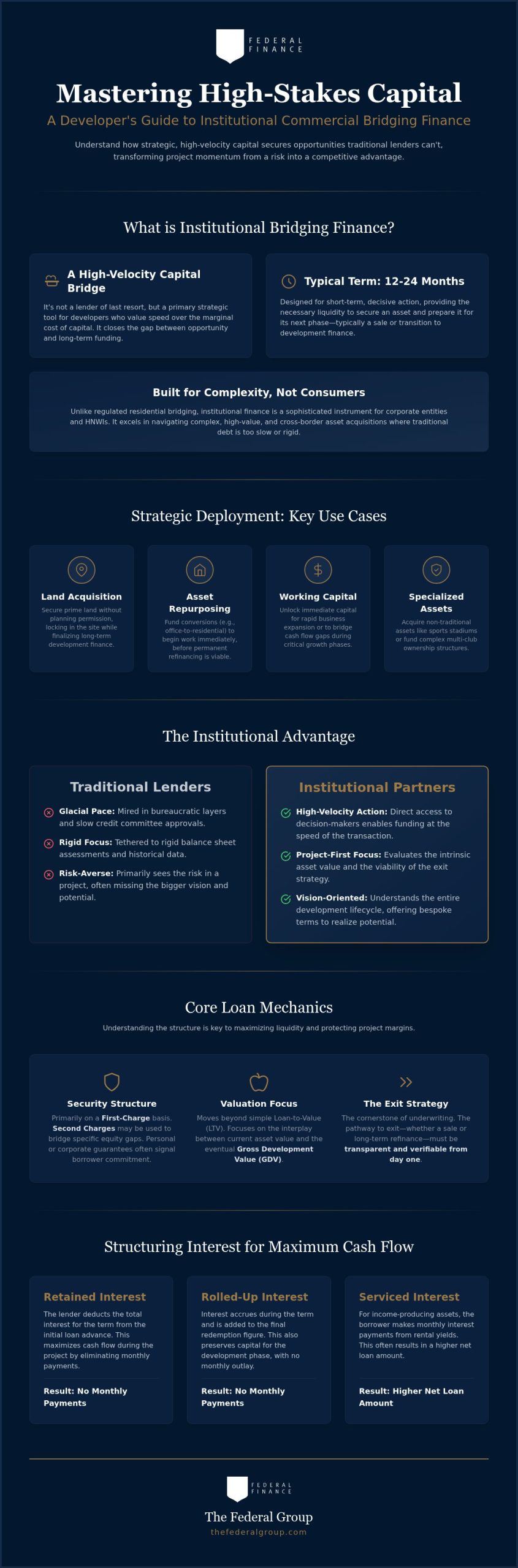
Efficiency is the ultimate competitive advantage in the 2026 property market. Institutional bridging finance serves as a high-velocity capital bridge, typically spanning a term of 12 to 24 months. It isn’t a lender of last resort; it’s a primary choice for developers who value speed over the marginal cost of capital. In a high-stakes environment, market volatility creates windows of opportunity that close as quickly as they open. Securing a first-mover advantage requires a funding partner capable of moving at the speed of the transaction. Unlike regulated residential bridging, which focuses on consumer protection and standard property values, institutional commercial bridging finance is built for complexity. It’s a sophisticated instrument for high-net-worth individuals and corporate entities acquiring assets where traditional debt would be too slow or too rigid.
Key Use Cases for Strategic Bridging
Strategically deployed capital can transform a project’s trajectory. Developers often use bridging finance for land acquisition without planning permission, allowing them to lock in the site while finalizing long-term development finance. Another prominent trend involves the repurposing of commercial assets, such as office-to-residential conversions, where immediate funding is required to begin structural changes before permanent refinancing becomes viable. Beyond property, these loans are increasingly used to unlock working capital for rapid business expansion or specialized acquisitions, including the high-growth sector of professional sports multi-club ownership.
The Institutional Advantage: Beyond Traditional Lending
Private capital partners offer a level of flexibility that retail banks cannot match. While traditional institutions are tethered to rigid balance sheet assessments, institutional lenders focus on the intrinsic value of the underlying asset and the viability of the exit strategy. This project-first approach allows for bespoke terms that reflect the unique risks and rewards of large-scale international developments. Institutional bridging finance is a bespoke capital tool for sophisticated investors. By partnering with a firm that understands the entire development lifecycle, from design to equity, developers gain a partner who sees the vision rather than just the risk. This depth of insight is particularly valuable when managing commercial bridging finance for non-traditional assets or cross-border transactions where local market nuances are paramount.
Core Mechanics: Evaluating High-Value Bridging Loan Structures
Structuring commercial bridging finance requires a granular understanding of how debt interacts with project liquidity. While retail lenders fixate on loan-to-value (LTV) ratios, institutional partners evaluate the interplay between current asset value and the eventual gross development value (GDV). High-value bridging typically operates on a first-charge basis, securing the lender’s position as the primary creditor. In some complex capital stacks, a second charge may be utilized to bridge a specific equity gap. The exit strategy remains the cornerstone of the underwriting process. Whether the plan involves a sale or a transition into long-term funding, the pathway must be transparent and verifiable from day one. Personal or corporate guarantees often serve as secondary security, signaling the borrower’s commitment to the project’s success.
Structuring Interest for Maximum Cash Flow
Interest structures dictate the project’s monthly breathing room. Retained interest involves the lender setting aside the total interest cost from the initial loan advance; this ensures no monthly payments are required during the term. Rolled-up interest achieves a similar outcome by adding the interest to the final redemption figure, which preserves development capital for the build phase. For income-producing assets, serviced interest allows the borrower to pay monthly from existing rental yields. This approach often results in a higher net loan amount because the interest isn’t deducted upfront. Selecting the right structure depends entirely on the asset’s cash flow profile and the developer’s wider capital requirements.
Underwriting Speed and Due Diligence
Institutional lenders bypass the bureaucratic layers of traditional banking through direct access to decision-makers. This speed doesn’t compromise rigour; instead, it utilizes specialized expertise to identify legal red flags early in the process. The Federal Group leverages its deep background in international property development finance to accelerate the valuation and legal stages. By understanding the technicalities of global construction and asset management, we ensure that due diligence is thorough yet efficient. It’s often beneficial to partner with a specialist who views the transaction through an operational lens, not just a financial one. This integrated perspective allows for a faster move from initial inquiry to drawdown, which is vital when a deal’s success hinges on rapid execution.
Commercial Bridging vs. Development Finance: A MOFU Comparison
Choosing between commercial bridging finance and development funding isn’t a matter of preference; it’s a matter of timing. Bridging finance offers the agility needed to secure an asset, while development finance provides the sustained capital required for the construction phase. The cost of capital for a bridge loan is typically higher, reflecting the lender’s rapid deployment and increased risk. However, the speed of execution often offsets these costs by preventing lost opportunities. For a project to remain viable, developers must analyze how the loan duration impacts their overall return on investment. Short-term bridging should serve as a tactical entry point, leading toward a planned transition into lower-cost, long-term development debt once the project is de-risked.
When to Choose Bridging Over Development Loans
Speed is the primary driver in high-stakes acquisitions. For instance, auction purchases often require completion within 28 days, a timeline that traditional development loans simply cannot meet. Bridging allows you to secure the site immediately. Similarly, developers use bridging finance for land acquisition to bank strategic land while finalizing construction permits. This hold period requires flexible capital that doesn’t demand the exhaustive build contracts or technical audits associated with full development finance. Bridging also plays a vital role in rescuing stalled projects. If a developer faces a funding gap or a broken development scenario, a bridge can provide the liquidity needed to reach a point where the project becomes refinancable. For a deeper understanding of how bridging loans and commercial development strategies work together to sustain project momentum from acquisition through to exit, a comprehensive review of the mechanics is essential for any institutional developer.
Integrating Private Equity for Growth
A sophisticated capital stack often relies on more than just debt. Partnering with a real estate private equity partner can significantly enhance the effectiveness of your commercial bridging finance. By increasing equity participation, you can reduce the total cost of debt and improve your leverage with lenders. This integrated approach allows developers to scale global property portfolios without over-extending their own balance sheets. When private equity and bridging finance work in tandem, they create a robust financial ecosystem. This synergy ensures that every stage of the development lifecycle, from initial acquisition to final exit, is supported by capital that matches the project’s specific risk profile and growth objectives.
Navigating Cross-Border and Complex Asset Acquisitions
Global expansion requires more than just capital; it demands a sophisticated understanding of jurisdictional friction. International commercial bridging finance serves as the lubricant for these high-friction transactions. When moving capital across borders, currency volatility and divergent regulatory frameworks can erode the value of a deal before it even closes. Institutional lenders who operate globally mitigate these risks by providing local market intelligence alongside the capital itself. This dual-layered approach ensures that a developer in London can move as confidently in the New York or European markets as they do in their home territory. Success in this arena depends on a lender’s ability to synthesize local property laws with international tax structures to maintain project momentum.
Financing International Property Development
By 2026, the divergence between the US and UK bridging markets has become more pronounced. While the US market often prioritizes large-scale multifamily acquisitions, the UK sector remains focused on high-density urban repurposing and sustainable development. Structuring loans for cross-border land acquisition requires a lender who can navigate both the legal nuances of the host country and the specific reporting requirements of the borrower’s parent entity. Institutional property investment groups provide the necessary stability for these global deals, acting as a strategic backstop that ensures momentum isn’t lost to administrative delays or sudden shifts in local lending appetites.
Specialized Sector Bridging: Professional Sports
The utility of bridging finance extends far beyond traditional real estate. In the professional sports sector, investors are increasingly using commercial bridging finance to facilitate football club acquisitions and the rise of multi-club ownership models. These transactions often move at breakneck speed, requiring capital that can be deployed before the next transfer window or commercial cycle begins. Exit strategies in this niche are uniquely tied to commercial revenue streams, such as broadcasting rights, stadium naming rights, and match-day hospitality yields. Sports multi-club ownership relies on agile capital solutions to maintain a competitive edge across multiple jurisdictions simultaneously.
Integrated design and build expertise is the ultimate de-risking tool for international bridging. When a lender understands the physical constraints of a project through an integrated ecosystem like Federal Holdings, they can underwrite the loan with far greater precision. This technical insight allows for a more decisive funding stance on complex assets that traditional banks would typically avoid due to perceived risk. If you are preparing for a high-stakes international acquisition or a specialized sector purchase, you should consult with our strategic finance team to explore bespoke bridging options that align with your global objectives.
Partnering with The Federal Group for Integrated Capital Solutions
The Federal Group redefines the lending relationship by acting as a strategic partner rather than a transactional vendor. We operate at the intersection of institutional finance and industrial-scale development. This positioning allows us to provide commercial bridging finance that’s informed by real-world operational data rather than just theoretical risk models. Our integrated ecosystem ensures that capital deployment is never a bottleneck; it’s a catalyst for project completion. By centralizing your financing and development needs through a single point of contact, you gain access to global capital markets with the specialized insight of a niche consultancy. It’s a model built for the high-stakes environment of 2026, where time is the most valuable asset in your capital stack.
Our Holistic Approach to Property Finance
The synergy between our lending arm and Federal Holdings, our integrated design and build division, provides a unique advantage. We don’t just review balance sheets; we understand the architectural and structural realities of the assets we fund. This technical depth allows us to combine bridging loans with private equity to create a seamless capital solution for the entire project lifecycle. We often invest our own capital alongside our partners, ensuring our interests are perfectly aligned with the long-term success of the development. This co-investment model builds a foundation of security and stability for institutional investors navigating complex international markets. It’s an “ecosystem” approach that manages every stage of a project’s lifecycle, from architectural design to final construction.
Initiating Your Strategic Bridging Application
Precision in the initial application phase is essential for maintaining the speed required in the current market. High-value commercial bridging finance requires a comprehensive documentation package to ensure rapid underwriting. Professional developers should prepare detailed development schedules, a clearly articulated exit strategy, and independent asset valuations. Our global offices are equipped to handle these complex submissions across multiple jurisdictions, providing a streamlined pathway from consultation to drawdown.
The timeline from initial inquiry to capital deployment is optimized for high-stakes transactions. While traditional banking approvals can take months, our direct access to decision-makers allows for a significantly accelerated process. If you’re ready to secure your next international asset or maintain momentum on a high-value development, contact our global offices to begin structuring your bespoke capital solution. We stand ready to provide the institutional-grade capital and technical expertise your vision requires.
Securing Your Position in the 2026 Global Market
Capital agility is the defining factor for success in high-value development. You’ve seen how commercial bridging finance functions as more than a temporary fix; it’s a strategic instrument for capturing international assets and maintaining momentum when traditional banks falter. By mastering the mechanics of high-stakes capital and planning clear exit pathways, you protect your long-term margins while scaling your global portfolio.
The Federal Group stands as a heavyweight partner in this landscape. We combine specialized expertise in international property finance and private equity with the technical power of Federal Holdings, our integrated design and build developer. Whether you’re targeting cross-border land acquisitions or the specialized sector of global sports multi-club ownership, our ecosystem is built to de-risk your ambition. Our team manages every stage of the lifecycle, ensuring your projects move from vision to completion without delay.
Contact The Federal Group to Structure Your Commercial Bridging Solution and ensure your capital stack is ready for the challenges of tomorrow. Your next project deserves a foundation built on institutional-grade certainty and visionary speed.
Frequently Asked Questions
What is the typical interest rate for commercial bridging finance in 2026?
Interest rates are determined by the specific risk profile of the asset and the complexity of the jurisdiction involved. While market conditions fluctuate, institutional lenders prioritize the total cost of capital, including arrangement fees and exit terms, over headline rates. Borrowers often find that the flexibility of the interest structure, such as retained or rolled-up options, is more critical for project liquidity than the base percentage itself.
How fast can high-value commercial bridging loans be deployed?
High-value capital can typically be deployed within 7 to 14 days following the completion of valuations and legal due diligence. This rapid execution is possible because institutional partners provide direct access to decision-makers, bypassing the bureaucratic committees of traditional retail banks. For time-sensitive acquisitions like auction purchases or competitive land bids, this speed ensures that developers can meet completion deadlines without risking their deposits.
Can bridging finance be used for international property acquisitions?
Yes, bridging finance is a primary tool for securing international property assets across diverse jurisdictions. Institutional lenders with a global presence can navigate the cross-border regulatory hurdles and currency fluctuations that often stall traditional financing. This capability is essential for developers looking to scale their portfolios in markets like the US, UK, and Europe, where local market knowledge is as critical as the capital itself.
What are the most common exit strategies for commercial bridge loans?
The most common exit strategies involve refinancing into long-term development debt or the outright sale of the asset upon completion of a milestone. A transparent exit pathway is the cornerstone of commercial bridging finance underwriting. In many scenarios, developers use the bridge to reach a specific point, such as obtaining planning permission, which then allows for a transition into lower-cost, permanent funding.
Is bridging finance available for professional sports club acquisitions?
Specialized bridging solutions are available for professional sports club acquisitions and the development of stadium infrastructure. This type of financing allows investors to move quickly during critical windows, such as ownership transitions or transfer periods. Lenders evaluate the club’s commercial revenue streams, including broadcasting rights and match-day hospitality, as the primary security and exit strategy. It’s a highly specialized niche requiring an integrated partner.
What is the maximum LTV for a commercial bridging loan on a development site?
Maximum loan-to-value (LTV) ratios for development sites generally range between 60% and 75% of the current site value. However, institutional lenders may also consider the gross development value (GDV) when structuring the loan. The specific ratio depends on the project’s risk profile, the developer’s experience, and whether the land already has planning permission. Higher leverage often requires additional security or personal guarantees.
How does bridging finance differ from mezzanine debt?
Bridging finance is typically a first-charge short-term loan used for asset acquisition, whereas mezzanine debt is a secondary layer of funding that sits between senior debt and equity. While commercial bridging finance provides the primary capital to secure an asset, mezzanine debt is often used to fill an equity gap in a larger capital stack. Bridging is a standalone acquisition tool; mezzanine is a supplementary leverage enhancer.
Can a new development company qualify for institutional bridging finance?
New development companies can qualify for institutional bridging if the underlying asset is strong and the management team demonstrates significant industry expertise. Lenders prioritize the viability of the project and the strength of the exit strategy over the age of the borrowing entity. Partnering with an integrated firm that provides design and build capabilities can also help de-risk the application for newer firms seeking high-stakes capital.