Fast Bridging Loans for Property Development: A 2026 Strategic Resource
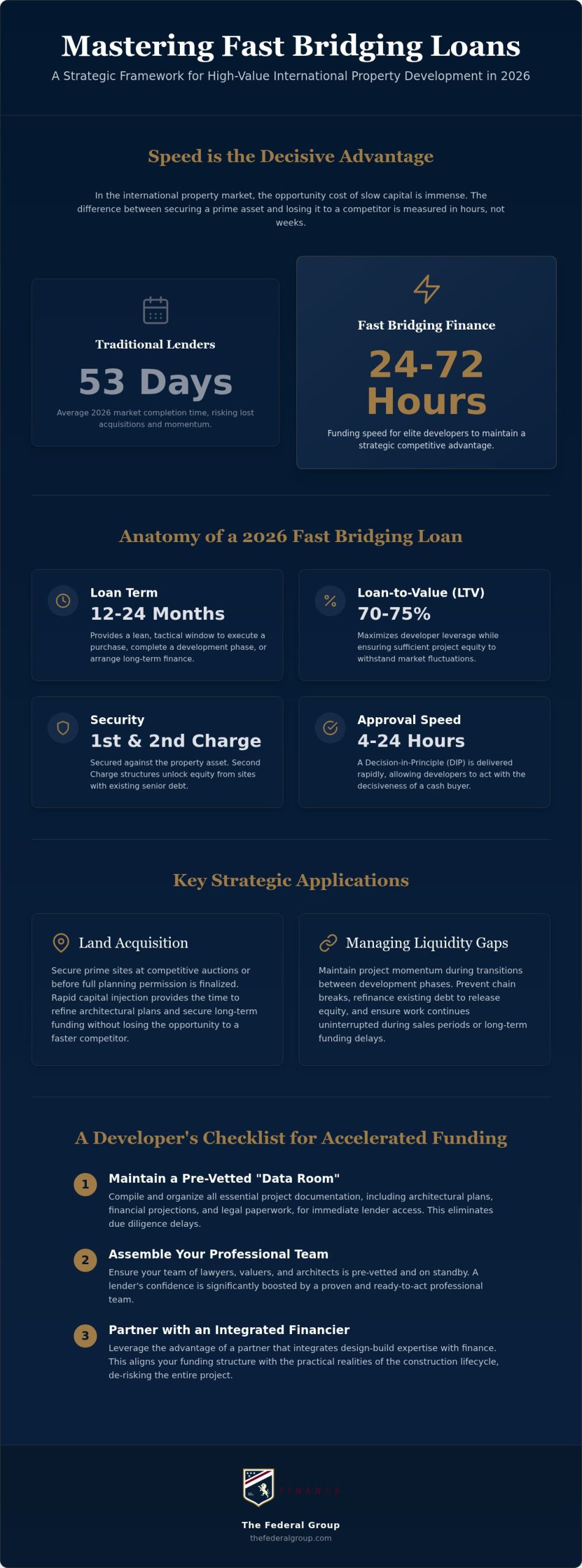
15 August 2026In high-stakes property development, the true cost of a missed opportunity is rarely the interest rate; it is the time lost to a lender that fails to grasp the architectural complexities of the site. You understand that in a competitive international market, a delay of even a few days can collapse a high-value acquisition or stall a project’s momentum during critical refinancing windows. While the average market completion time for 2026 sits at 53 days, elite developers require fast bridging loans that can fund in as little as 24 to 72 hours to maintain a strategic advantage.
We agree that rigid criteria and fragmented capital pools are no longer sufficient for the scale of modern global projects. This resource provides a strategic framework to master the mechanics of rapid short-term capital deployment, ensuring you secure international property opportunities with precision. You will learn how integrating design-build expertise with flexible private equity structures eliminates the friction of traditional lending. We will examine the essential 2026 benchmarks for LTV thresholds and exit strategies, positioning you to partner with a financier that manages the entire project lifecycle.
Key Takeaways
- Recognize that speed is the primary differentiator in the 2026 international property market, where rapid capital deployment prevents lost acquisitions and construction delays.
- Master the mechanics of fast bridging loans, typically structured for 12 to 24 months, to secure high-value assets without the friction of traditional institutional banking.
- Understand the critical distinction between regulated residential bridging and unregulated commercial bridging to navigate complex due diligence and global compliance requirements.
- Accelerate capital deployment by maintaining a pre-vetted “Data Room” featuring your professional team of lawyers, valuers, and architects for immediate lender access.
- Leverage the strategic advantage of an integrated design and build partner to align your funding structure with the practical realities of the construction lifecycle.
The Critical Role of Speed in High-Value Bridging Finance
In the 2026 international property market, liquidity is the ultimate arbiter of success. Speed has evolved from a luxury into the primary differentiator for developers competing for prime global assets. When institutional capital pools remain stagnant due to rigid bureaucratic processes, the window for high-value acquisitions often closes. Private institutional lenders have stepped into this void, offering fast bridging loans that prioritize execution over exhaustive administrative cycles. This agility allows developers to act with the decisiveness of a cash buyer while maintaining the leverage required for large-scale projects.
The opportunity cost of slow capital is quantifiable. It manifests as lost land acquisitions, forfeited deposits, and stalled construction schedules that erode project margins. Traditional banking structures often struggle with the technical nuances of international development; this leads to delays that can jeopardize an entire portfolio’s stability. By contrast, agile finance partners understand the build lifecycle, positioning short-term capital as a strategic bridge to permanent development finance rather than just a temporary fix.
Bridging as a Tool for Land Acquisition
Securing prime sites often requires acting before full planning permission is finalized. Developers utilize bridging finance for land acquisition to lock in opportunities at competitive auctions where traditional lenders refuse to engage. This rapid injection of capital provides the breathing room to refine architectural plans and secure long-term funding without losing the site to a faster competitor. Success in these high-stakes environments depends on balancing deployment speed with the structural flexibility needed for subsequent development phases.
Managing Liquidity During Development Gaps
Momentum is fragile during the transition between project phases. Fast bridging loans serve as a vital tool for managing liquidity when long-term funding cycles face unexpected delays. Whether you’re refinancing existing debt to release equity for a new venture or preventing a chain break in a complex commercial transaction, short-term capital ensures the work doesn’t stop. It provides a stabilized environment during sales periods or refinancing windows; this allows developers to maintain operational pace without sacrificing equity or project control. This proactive approach to gap funding is essential for sustaining a global development footprint.
Anatomy of a Fast Bridging Loan: Mechanisms and Requirements
A bridging loan is a specialized, asset-backed financial instrument designed for rapid deployment when traditional term debt is too slow or rigid. In the 2026 market, these facilities have transitioned away from the multi-year cycles of the past. Modern fast bridging loans typically feature terms of 12 to 24 months, providing a lean, tactical window to execute a purchase or complete a development phase. They’re secured primarily against the property asset itself, which allows the lender to focus on the collateral’s value rather than the borrower’s long-term income projections.
Borrowing power in high-value international sectors is governed by the loan-to-value (LTV) benchmark, which currently stabilizes between 70% and 75%. This margin ensures sufficient equity remains in the project to weather market fluctuations while providing the developer with maximum leverage. Security is typically established through a “First Charge,” giving the lender primary claim over the asset. However, “Second Charge” structures are increasingly common for developers looking to release equity from a site that already has existing senior debt. Understanding this hierarchy is essential for managing a complex capital stack across multiple jurisdictions.
The Fast Approval Lifecycle
The speed of a decision determines the viability of the deal. You should expect a decision-in-principle (DIP) within 4 to 24 hours of submitting your core project data. While traditional finance relies on weeks of physical surveys, modern lenders utilize automated valuation models (AVMs) to verify asset worth instantly for lower-risk deals. For industrial-scale developments, rapid physical inspections are prioritized to ensure the capital is ready when needed. Fast bridging is defined as capital deployed within three to ten working days of the initial inquiry.
Interest Structures and Exit Strategies
Cash flow preservation is a critical priority for large-scale builds. Developers can choose between monthly serviced interest or “rolled-up” interest, where the total cost is deferred and paid at the end of the term. Rolled-up interest is often the preferred choice for fast bridging loans because it removes the burden of monthly repayments during the construction phase. This allows you to reinvest every pound of operational capital back into the site’s physical progress.
The most scrutinized element of any application isn’t the current asset value, but the exit strategy. Lenders require a clear, credible path to repayment, usually through refinancing onto a long-term development facility or the final sale of the asset. A robust exit plan signals professional competence and reduces the risk profile for the financier. If you’re looking to structure a facility that aligns with your specific build timeline, exploring bespoke bridging solutions can provide the necessary flexibility to secure your next international opportunity.
Commercial vs. Residential Bridging: Navigating Speed and Complexity
The distinction between regulated residential bridging and unregulated commercial finance is the most critical factor in determining deployment speed. Residential bridging, often overseen by the Financial Conduct Authority (FCA), prioritizes consumer protection and affordability checks. While necessary for individual homeowners, these regulations can introduce friction into high-stakes development timelines. Conversely, commercial bridging finance operates in an unregulated environment; this allows for greater structural flexibility and rapid decision-making tailored to institutional needs.
Speed trade-offs in the commercial sector typically stem from the complexity of the asset rather than the lender’s capital. High-value projects often involve intricate title deeds, multi-layered zoning laws, and environmental restrictions that require specialized legal scrutiny. In 2026, we’ve seen a significant rise in semi-commercial bridging for urban mixed-use developments. These assets combine residential units with retail or office space, requiring a lender that can analyze two distinct income streams simultaneously without stalling the approval process.
High-Value Development Bridging
For projects involving heavy refurbishment or structural redevelopment, fast bridging loans provide the essential capital to initiate work before long-term financing is secured. The interaction between bridging loans and commercial development is strategic; it allows you to manage the transition from acquisition to the build phase seamlessly. By securing a facility that recognizes the value of the completed project rather than just the purchase price, you maintain construction momentum while finalizing the primary development facility.
International Cross-Border Challenges
Executing a bridging deal across multiple jurisdictions, such as the US and UK markets, requires more than just capital. It demands a partner capable of navigating disparate legal systems and tax regimes simultaneously. Currency risk management is a primary concern when deploying international capital at speed. Fluctuations can erode margins before the project even breaks ground. To accelerate the process, elite developers rely on lenders with deep local market expertise; this ensures valuation reports are accurate and legal due diligence reflects the specific nuances of the local planning environment. This integrated approach is what allows for the deployment of capital across borders in days, not months.
Accelerating the Deployment of Short-Term Capital: A Developer’s Checklist
Securing fast bridging loans requires more than just a high-value asset; it demands a state of operational readiness that allows a lender to execute without friction. Developers who successfully capture international opportunities often maintain a “Data Room” that is perpetually audit-ready. This centralized repository ensures that when a site becomes available, the financier can access all necessary due diligence materials immediately. Delays are rarely caused by a lender’s lack of capital, but rather by a borrower’s inability to provide structured information at pace.
Aligning your internal stakeholders is equally vital. Ensure that all directors and beneficial owners are briefed and available for electronic signatures. Signature delays are a common bottleneck in cross-border transactions where time zones and travel schedules can interfere with completion. By pre-vetting your professional team of lawyers, valuers, and architects, you ensure that every participant in the transaction is prepared for the high-stakes tempo of bridge finance.
Documentation Readiness
A comprehensive data room must include updated asset schedules, verified proof of an exit strategy, and the current status of all planning permissions. For projects involving international entities, detailed corporate structure charts are mandatory to verify ultimate beneficial ownership. You should ensure your compliance files are current; AML readiness means having three years of certified records and source-of-wealth documentation ready for submission. Having these documents pre-vetted by your own compliance officer can shave days off the underwriting process.
Valuation and Legal Efficiency
Efficiency in the legal and valuation phases is the most significant lever for speed. Instructing dual-representation legal teams can cut timelines in half by allowing one firm to act for both the borrower and the lender under a single set of instructions. This eliminates the back-and-forth negotiations that often stall simple transactions. Additionally, you should pre-order site surveys and environmental reports if they aren’t already on file.
- Desktop Valuations: For initial approval speed, many lenders utilize desktop valuations to provide an immediate decision-in-principle while physical inspections are scheduled.
- Professional Panel: Use pre-vetted valuers and lawyers who are already on the lender’s approved panel to avoid lengthy onboarding processes.
- KYC Readiness: Maintain digital copies of certified ID and proof of address for all key stakeholders to satisfy Anti-Money Laundering protocols instantly.
Anti-Money Laundering (AML) and Know Your Customer (KYC) protocols are non-negotiable in the 2026 regulatory environment. Readiness in these areas signals professional sophistication and allows the lender to move straight to the technical merits of the deal. If you’re preparing for a high-value acquisition and require a partner that understands the urgency of these timelines, contact The Federal Group to discuss your capital requirements and streamline your deployment strategy.
The Federal Group Advantage: Integrated Finance for Global Development
True agility in finance is rarely a matter of administrative speed; it is the result of deep sector integration. While many lenders operate as detached capital providers, The Federal Group functions as an integrated design and build developer. This dual identity allows us to evaluate the technical and structural merits of a project with the same precision as the financial risks. By removing the need for protracted third-party consultations, we facilitate fast bridging loans that are rooted in the physical realities of the construction lifecycle. Our expertise ensures that capital deployment is not just rapid, but strategically aligned with your project’s specific engineering demands.
Managing high-value assets across global markets requires an ecosystem approach to finance. Our global footprint allows us to structure cross-border bridging solutions that navigate disparate legal and tax regimes with institutional stability. We provide bespoke capital structures that extend beyond standard property acquisitions, supporting diverse portfolios that include high-value commercial assets and specialized infrastructure. Partnering with an international property development finance specialist means you gain a heavyweight partner capable of managing every stage of a project’s lifecycle, from the initial bridge to the final build.
Beyond Property: Sports and Niche Asset Bridging
Our expertise extends into the high-stakes world of professional athletics. The Federal Group’s Sports Division applies the logic of fast bridging loans to professional football club acquisitions and critical stadium infrastructure. We provide the immediate liquidity needed to secure multi-club ownership opportunities or to fund rapid facility upgrades during off-season windows. This synergy between sports ownership and large-scale development requires a financier that understands the unique revenue streams and valuation metrics of global athletics. We act as the connector of these opportunities, providing the scale of a corporation with the focused insight of a niche consultancy.
Securing Your Next Move
Execution is the hallmark of a specialist. Our proactive mindset ensures that due diligence on complex, multi-disciplinary projects is completed with a sense of momentum that traditional banks cannot replicate. We prioritize results-driven capital deployment, ensuring that your development maintains its pace regardless of market volatility or refinancing delays. This commitment to stability and ambition makes us the preferred partner for visionary developers operating at scale. If you are ready to secure your next international project, contact our global offices for a bespoke bridging consultation. We’re ready to deploy the capital and expertise necessary to transform high-value opportunities into completed assets.
Mastering Your Capital Deployment Strategy
Success in the 2026 international property market hinges on the ability to move with precision and pace. You’ve seen how documentation readiness and a clear exit strategy transform capital from a bottleneck into a competitive advantage. Mastering the mechanics of fast bridging loans ensures you can secure high-value sites and maintain development momentum without the friction of traditional institutional banking. Moving fast doesn’t mean compromising on structural flexibility; it means partnering with a financier that understands the architectural stakes.
The Federal Group offers a unique synergy of decades of experience in high-value development finance and fully integrated design and build expertise. With a robust global presence across US, UK, and European markets, we provide the institutional stability required for your most complex challenges. It’s time to move beyond transactional lending and engage with a partner dedicated to every stage of your project’s lifecycle. We’re ready to help you navigate the complexities of global acquisition with confidence.
Secure Fast Bridging Finance for Your Next Project
Frequently Asked Questions
How fast can a bridging loan realistically be completed in 2026?
Completion timelines in 2026 vary based on the complexity of the asset and legal structure. While the current market average for completion is approximately 53 days, expedited cases for straightforward acquisitions are frequently funded within 24 to 72 hours. Achieving this level of speed requires a developer to have a pre-vetted data room and a financier capable of rapid, in-house underwriting without relying on external bureaucratic committees.
What is the typical interest rate for a fast bridging loan for developers?
Market data for 2026 indicates that monthly interest rates for bridging finance typically range from 0.51% to 2%. The industry average has stabilized at approximately 0.82%, though the specific rate depends heavily on the loan-to-value ratio and the project’s risk profile. Most developers choose to roll up this interest into the total loan facility to preserve liquidity for construction costs and operational overhead during the build phase.
Can I get a bridging loan for land without planning permission?
Yes, bridging finance is a standard tool for securing land before full planning permission is finalized. This allows you to lock in a strategic site at auction or through private sale while your architectural team refines the project details. Lenders evaluate the site’s inherent value and your track record as a developer. A clear exit strategy, such as refinancing once permission is granted, remains essential for a successful application.
What are the main risks associated with fast bridging finance?
The primary risk involves the potential failure of the exit strategy within the short 12 to 24-month term. If a property sale is delayed or a refinancing deal collapses, you may face higher default interest rates. It’s critical to have a secondary exit plan to maintain stability. Additionally, the compressed nature of fast bridging loans requires a partner who understands construction risks to ensure the capital structure remains viable throughout the term.
Do I need a physical valuation for a 48-hour bridging loan?
Physical valuations are not always mandatory for an initial decision-in-principle. Many lenders utilize Automated Valuation Models or desktop assessments to provide immediate approval for lower-risk assets. However, for industrial-scale developments or complex commercial sites, a physical inspection is typically required before the final drawdown of funds. Speed is maintained by using pre-approved surveyors who are accustomed to the high-stakes tempo of international development finance.
What happens if my exit strategy fails at the end of the term?
If an exit strategy fails, you should engage your lender immediately to negotiate a term extension or a bridge-to-bridge facility. Lenders generally prefer to restructure the debt rather than initiate repossession, provided the project’s underlying value remains strong. Failure to repay on time can trigger penalty rates and impact your ability to secure future institutional funding. Transparent communication is the most effective way to manage unexpected delays in sales or refinancing.
Are bridging loans available for international property projects?
Bridging finance is widely available for international projects across the US, UK, and European markets. These cross-border facilities require a specialist lender capable of navigating different legal jurisdictions and managing currency risks. The Federal Group provides fast bridging loans for global acquisitions and specialized infrastructure, such as sports multi-club ownership. Success in these projects depends on aligning with a partner who possesses local market expertise and a global operational footprint.
How much can I borrow using a fast bridging loan structure?
Borrowing limits are primarily governed by the Loan-to-Value ratio, which typically caps at 75% for most commercial and development assets. While the 2026 market average LTV is approximately 52.79%, elite developers can access higher leverage for projects with exceptionally strong exit strategies. The total loan amount is scaled to the asset’s value, providing the significant liquidity required for large-scale land acquisitions, structural refurbishments, or maintaining momentum during construction gaps.