Financing a Football Club Acquisition: Strategic Capital Models for 2026
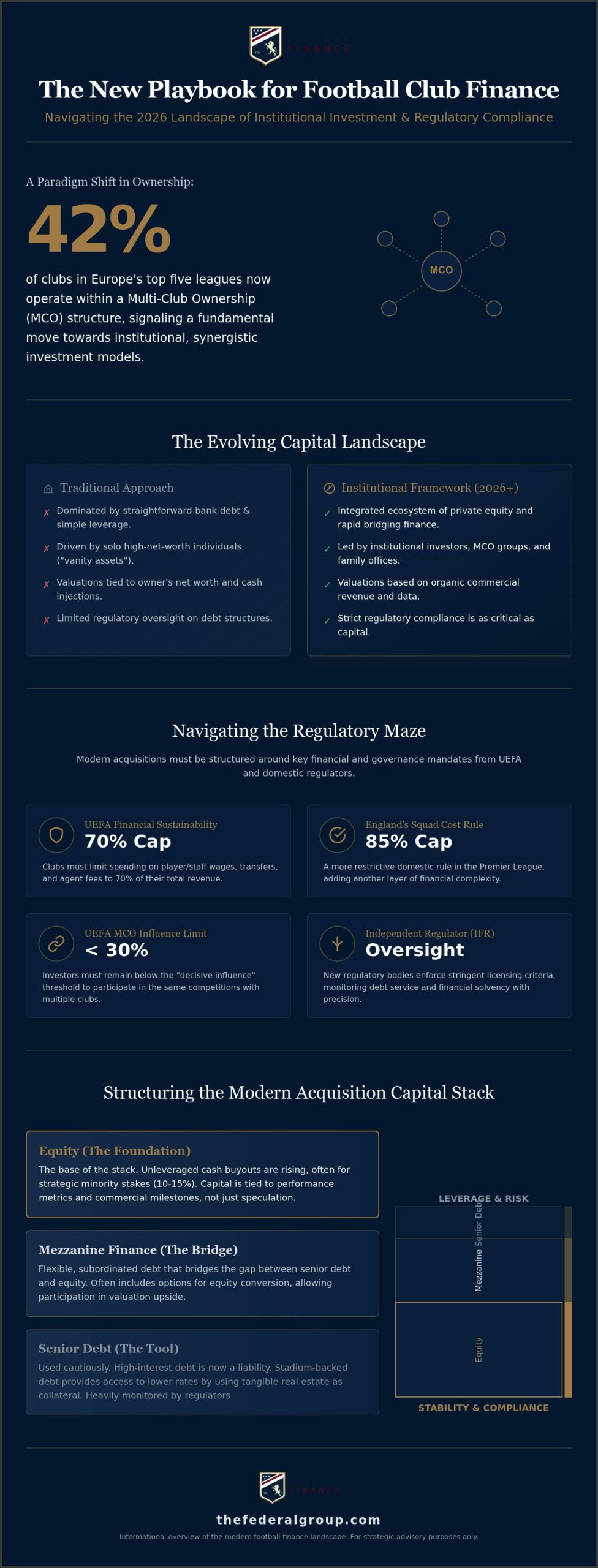
22 August 2026Nearly 42% of clubs in Europe’s top five leagues now operate within a multi-club ownership structure. This shift highlights a fundamental change in how institutional investors approach the market. Securing the necessary capital for financing a football club acquisition in 2026 is no longer a matter of simple leverage. It requires a sophisticated understanding of the Independent Football Regulator (IFR) standards and the 30% decisive influence thresholds set by UEFA. The days of straightforward bank debt are behind us; today’s deals demand an integrated ecosystem of private equity and rapid bridging finance.
You’ve likely found that the traditional paths to ownership are increasingly blocked by valuation volatility and the new Squad Cost Rule. It’s a high-stakes environment where regulatory compliance is as critical as the capital itself. This article provides a strategic framework for balancing debt and equity while maximizing the synergies of multi-club models. We’ll preview the latest UEFA sustainability regulations and identify the fast-track capital solutions necessary to navigate this complex global market with institutional confidence.
Key Takeaways
- Shift from traditional banking toward private capital to maintain flexibility under the 2026 financial sustainability regulations.
- Structure the capital stack for financing a football club acquisition by balancing strategic debt with unleveraged equity to satisfy new squad cost ratios.
- Implement multi-club ownership models to achieve operational synergies and diversify risk across multiple jurisdictions.
- Use specialized bridging loans to execute rapid acquisitions and outmaneuver competitors in time-sensitive sports M&A scenarios.
- Leverage integrated property and sports finance solutions to maximize the value of stadium infrastructure alongside the club’s core assets.
The Capital Landscape of Professional Football in 2026
The professional football market has matured into a sophisticated financial arena. Financing a football club acquisition in 2026 demands more than just deep pockets; it requires a strategic alignment with evolving regulatory mandates. We’ve moved past the era of “vanity assets” where clubs were treated as personal trophies. Now, institutional-grade sports investments dominate the landscape. Private equity firms, multi-club ownership (MCO) groups, and family offices have replaced the traditional solo billionaire as the primary drivers of capital.
Traditional bank lending has taken a backseat in this new environment. Financial institutions now classify sports assets in elevated risk categories due to regulatory volatility and valuation sensitivity. This shift has cleared the way for private capital. Private equity provides the agility required to navigate complex bidding wars and cross-border deals. These investors prioritize operational efficiency and sustainable growth over short-term trophies, treating the club as a core component of a broader commercial ecosystem.
Regulatory Frameworks Shaping Finance
The UEFA Financial Sustainability Regulations are now fully operational. For the 2026 season, clubs must limit player and staff spending to 70% of their total revenue. This cap fundamentally dictates how we structure the capital stack when financing a football club acquisition. League-specific rules, such as England’s Squad Cost Rule at 85%, add layers of complexity. Owner funding limits have also tightened, making it difficult to bridge deficits with simple cash injections. Modern club valuations now reflect a club’s ability to generate organic commercial revenue rather than its owner’s personal net worth.
The Institutionalization of Sports Assets
Investors now view professional football as a resilient alternative asset class. Its performance often remains decoupled from broader market fluctuations, offering a hedge against traditional volatility. To secure finance, clubs must demonstrate robust data-driven scouting and diversified commercial streams. These metrics provide the security that lenders previously found in physical assets. Sports Private Equity in 2026 is a specialized asset class that targets long-term capital appreciation by leveraging multi-club synergies and technological integration across the sporting ecosystem.
Debt vs. Equity: Structuring the Acquisition Capital Stack
The Leveraged Buy-Out (LBO) model, once the standard for financing a football club acquisition, has undergone a significant transformation. In 2026, the Independent Football Regulator (IFR) and UEFA’s updated sustainability mandates have made high-interest debt service a liability for club licensing. While debt remains a tool, it’s no longer the primary engine. Regulators now monitor interest coverage ratios with surgical precision to ensure that debt obligations don’t cannibalize the 70% revenue cap allocated for squad costs. This shift has forced a recalibration of the capital stack, favoring structures that prioritize long-term solvency over immediate aggressive leverage.
We’re seeing a distinct rise in unleveraged cash buyouts, particularly for minority stakes. Large institutional funds often deploy pure equity to secure 10% to 15% positions, providing clubs with immediate liquidity without adding to the balance sheet’s debt burden. When a gap exists between senior debt and pure equity, mezzanine finance has become the preferred solution. It offers the flexibility of subordinated debt with the potential for equity conversion, allowing investors to participate in the club’s valuation upside while maintaining a structured repayment schedule. For a deeper look at these structures, this Guide to Football Club Financing provides essential technical context on modern ownership models.
Equity Participation Models
Choosing between majority and minority investment is a choice between absolute control and passive capital growth. Majority owners in 2026 are increasingly adopting a “Moneyball” approach, where equity draws and further capital calls are tied strictly to performance-based metrics and commercial milestones. This ensures that every pound of invested capital drives measurable value. Exit strategies have also evolved. Equity partners are no longer looking for simple flips; they’re targeting secondary sales to multi-club ownership groups or preparing for specialized sports-focused IPOs on global exchanges.
Debt Instruments for Sports Clubs
Stadium-backed debt remains one of the most efficient ways to secure lower interest rates. By using tangible real estate as collateral, clubs can access capital that’s priced more like commercial property than high-risk sports assets. This is particularly effective when integrated with international property development finance to upgrade stadium infrastructure or develop surrounding mixed-use districts. Another emerging tool is media rights securitization. This allows clubs to sell future broadcast income for upfront capital, providing the necessary liquidity to outmaneuver competitors in the transfer market or infrastructure bidding. If you’re currently analyzing a potential entry point, our Private Equity specialists can help you structure a capital stack that satisfies both your ROI targets and the latest league regulations.
The Multi-Club Ownership (MCO) Strategy
The rise of the multi-club ownership model represents a fundamental shift in how institutional investors approach financing a football club acquisition. As of August 2026, nearly 42% of clubs in Europe’s top five leagues operate within an MCO structure. This isn’t merely about scale; it’s a strategic move to de-risk investments by creating a networked ecosystem. By centralizing commercial operations, scouting, and back-office functions, owners can achieve significant economies of scale that are impossible for standalone clubs. This integrated approach allows for more efficient capital deployment across multiple jurisdictions, especially when targeting emerging market clubs with high growth potential.
Player trading has emerged as a critical revenue stream within these integrated networks. With global agent fees reaching a record USD 1.37 billion in 2025, the ability to move talent between sister clubs reduces external leakage and preserves asset value. Investors can utilize a “feeder” system to develop prospects in lower-tier leagues before transitioning them to flagship properties. This internal circulation of talent optimizes squad costs and ensures compliance with the 70% revenue spending cap enforced by UEFA. For a deeper technical dive into these structures, the Equity Finance & Ownership Models overview provides an excellent foundation for understanding the legal nuances of these groups.
Financial Structuring for Multi-Club Ownership
Successful MCOs rely on a robust holding company structure. This parent entity manages global sports assets, allowing for centralized treasury functions and cross-border capital flow. Our financial structuring for multi-club ownership guide details how these vehicles provide the necessary agility for rapid acquisitions. Tax efficiency is a primary consideration here; by positioning the holding company in a favorable jurisdiction, groups can reinvest profits from player sales or media rights more effectively across the entire portfolio. It’s about creating a seamless financial infrastructure that supports global expansion.
Risk Mitigation via Diversification
Diversification is the ultimate hedge in the volatile sports market. An “Integrated Sports Group” can mitigate the catastrophic financial impact of relegation by maintaining clubs in multiple tiers or different national leagues. If one asset underperforms, the group’s overall valuation remains stable due to its exposure to diverse media markets and fan bases. This model transforms a football club from a singular, high-risk bet into a resilient component of a broader institutional portfolio. Under the 2026 UEFA guidelines, maintaining a “decisive influence” threshold of 30% requires precise financial monitoring, but the rewards in stability and commercial reach make it the preferred model for modern sports financiers.
Bridging Loans and Fast-Track Capital in Sports M&A
Speed is the ultimate currency in modern sports M&A. When financing a football club acquisition in 2026, the ability to demonstrate immediate liquidity often determines the winner of a bidding war. Traditional institutional debt frequently moves too slowly to meet the aggressive timelines of high-profile sales. Bridging loans have emerged as the primary tactical tool for investors who need to bypass the lengthy due diligence cycles of retail banks. This short-term capital provides the dry powder necessary to secure an exclusivity agreement or outmaneuver rival consortiums before they can finalize their own capital stacks.
Beyond the acquisition itself, fast-track capital is vital for meeting the Independent Football Regulator’s (IFR) stringent Proof of Funds requirements. Since becoming operational in May 2026, the IFR demands clear evidence of wealth and immediate liquidity from prospective owners. Bridging finance allows a buyer to place the required capital in escrow instantly, satisfying regulatory scrutiny while the long-term financing is still being structured. Once the deal is closed, these loans are typically refinanced into more permanent private equity or senior debt arrangements once the club’s post-acquisition valuation is stabilized.
Steps to Securing a Sports Bridging Loan
Securing rapid finance requires a precise valuation of both tangible and intangible assets. Lenders look at the club’s stadium, training facilities, and the projected value of the playing squad under current market rates. Structuring a clear exit strategy is paramount; the borrower must demonstrate how the bridge will be replaced by long-term institutional debt or a private equity injection. For acquisitions involving physical expansion, integrating bridging finance for land acquisition ensures that stadium-adjacent development can begin concurrently with the club’s takeover.
Maintaining Development Momentum
Bridging loans are particularly essential for distressed asset turnarounds where immediate capital is needed to prevent insolvency or squad liquidation. They allow new owners to fund critical infrastructure upgrades and stabilize the balance sheet during the high-pressure acquisition phase. In the competitive 2026 sports M&A environment, liquidity speed is the definitive barrier between a successful takeover and a failed bid. If you require rapid capital to secure a time-sensitive deal, consult our Sports Division to explore bespoke bridging solutions tailored to institutional requirements.
Integrated Solutions: The Federal Group Advantage
The Federal Group operates at the intersection of institutional finance and industrial-scale development. Financing a football club acquisition requires more than a simple credit line; it demands a partner capable of managing the entire project lifecycle. We don’t just facilitate transactions. We act as a strategic connector, bridging the gap between global capital markets and the physical infrastructure that drives long-term club value. By treating sports assets as part of a broader real estate and commercial ecosystem, we ensure that our partners achieve maximum ROI from every acquisition.
Most M&A firms provide generic advisory services that stop at the closing of the deal. Our approach is different. We recognize that a club’s stadium and training facilities are not just overhead; they are critical revenue engines. Through Federal Holdings, we deploy integrated design and build capabilities to modernize these assets concurrently with the acquisition process. This synergy allows investors to unlock new commercial streams, such as hospitality and mixed-use real estate, far faster than traditional models allow. This integrated perspective is what differentiates a standard financier from a dedicated sports investment partner.
Full Lifecycle Asset Management
Managing a professional sports asset involves navigating complex cross-border regulations and regional construction standards. The value of an integrated design and build developer in sports cannot be overstated. It eliminates the friction between financiers and contractors, ensuring that redevelopment projects stay on schedule and within budget. For international investors, this provides a single point of accountability. We handle the intricacies of capital deployment, regulatory compliance, and physical development, allowing our partners to focus on the club’s competitive and commercial performance.
Next Steps for Global Investors
As the 2026 regulatory landscape continues to evolve, the window for optimized entry points is narrowing. Successful financing a football club acquisition depends on a perfectly balanced capital stack and a clear vision for infrastructure growth. Whether you’re looking to secure a majority stake in a flagship property or are exploring multi-club expansion strategies across emerging markets, our Sports Division provides the specialized insight required for high-stakes deal-making. We invite you to Contact The Federal Group Sports Division to discuss your investment objectives and explore how our integrated capital solutions can accelerate your sports M&A goals.
Securing Your Position in the Global Sports Ecosystem
The transition of professional football into a sophisticated institutional asset class is complete. Success in this high-stakes environment requires a departure from traditional debt models in favor of integrated capital ecosystems. We’ve seen that financing a football club acquisition in 2026 demands a rigorous focus on UEFA’s financial sustainability mandates and the agility of multi-club synergies. By prioritizing private equity and rapid bridging solutions, you can secure assets that offer long-term stability and commercial growth.
Navigating these regulatory and financial hurdles alone is no longer an option for the modern investor. The Federal Group offers a dedicated Sports Division and the integrated property and finance expertise needed to optimize your capital stack. With our global capital deployment capability, we manage the cross-border complexities that define today’s sports M&A market. Partner with The Federal Group for Strategic Sports Investment to ensure your next acquisition is both compliant and commercially dominant. The opportunities for visionary stakeholders have never been more significant.
Frequently Asked Questions
What is the most common way to finance a football club acquisition in 2026?
Private equity and consortium-led structures are the most prevalent methods in the current market. As of August 2026, over 36% of clubs in Europe’s “Big Five” leagues receive backing from private equity, venture capital, or private debt firms. This shift away from traditional banking occurs because private capital offers the agility needed to navigate complex regulatory environments. Financing a football club acquisition now relies on these institutional structures to provide the flexibility required for global expansion.
How do UEFA Financial Sustainability Regulations affect acquisition finance?
These regulations mandate a strict 70% squad cost ratio for the 2026 season, limiting spending on players and staff relative to revenue. This cap forces investors to prioritize organic commercial growth over external owner injections. It fundamentally alters the capital stack by making high-interest debt less attractive, as debt service costs can pressure the club’s overall financial stability. Investors must now demonstrate a clear path to profitability to satisfy UEFA’s real-time financial monitoring systems.
Can bridging loans be used for purchasing professional sports clubs?
Bridging loans are essential tactical tools for securing time-sensitive acquisitions and satisfying the Independent Football Regulator’s Proof of Funds requirements. They provide the immediate liquidity needed to outmaneuver competitors during aggressive bidding wars. Once the takeover is finalized, these short-term facilities are typically refinanced into long-term private equity or senior debt. This speed-to-market is a critical advantage in the highly competitive 2026 sports M&A landscape where “liquidity speed” defines successful deal-making.
What are the benefits of a multi-club ownership model for investors?
The primary benefits include risk diversification and operational synergies across multiple jurisdictions. Nearly 42% of European clubs now utilize this model to hedge against relegation risk and access diverse media markets. By centralizing back-office functions and player scouting, groups achieve significant economies of scale. This structure also facilitates internal player trading, which helps clubs manage squad costs effectively while preserving asset value within the broader group ecosystem through a single investment vehicle.
How does private equity differ from traditional debt in football finance?
Private equity focuses on long-term capital appreciation and equity participation, whereas traditional debt requires regular interest payments that can strain a club’s cash flow. Banks have increasingly moved football assets into elevated risk categories, leading to more stringent due diligence and higher barriers to entry. Private equity partners often act as strategic consultants, helping clubs modernize their commercial operations. This institutional approach is better suited for the volatility and high-stakes nature of professional sports assets.
Is stadium infrastructure a viable collateral for acquisition loans?
Stadium infrastructure is an excellent form of collateral because it represents a tangible real estate asset with predictable hospitality and ticketing revenue. Lenders often price stadium-backed debt more favorably than unsecured loans because the underlying property provides a secure safety net. Integrating property finance with the club’s capital stack allows for lower interest rates and longer repayment terms. This strategy is particularly effective when the stadium is part of a larger mixed-use development project.
What due diligence is required for financing a cross-border football deal?
Due diligence for cross-border deals requires a comprehensive analysis of local tax laws, employment regulations, and league-specific financial fair play rules. Investors must verify the source of wealth to satisfy the Independent Football Regulator (IFR) in the UK or similar bodies globally. It’s also necessary to assess the club’s existing media rights contracts and sponsorship deals for any “change of control” clauses. This ensures that the projected revenue streams remain intact after the acquisition is finalized.
How does an integrated design and build approach improve club valuation?
An integrated design and build approach improves valuation by accelerating the modernization of revenue-generating facilities like hospitality suites and retail zones. By eliminating the friction between financiers and contractors, clubs can complete infrastructure projects faster and more efficiently. This efficiency leads to quicker commercial growth and a higher overall asset appraisal. Investors see a more reliable ROI when the physical development of the stadium is managed as a core component of the club’s financial strategy.