Debunking the Top 5 Myths About Property Development Investment Groups in 2026
17 August 2026What if the primary obstacle to your 2026 development pipeline isn’t the 6.75% prime rate, but the outdated structure of your capital partner? Many sophisticated investors still view the property development investment group through a lens of 20th-century myths, assuming these entities are merely high-cost lenders or passive conduits for equity. In a global market projected to reach $624 trillion this year, these misconceptions are becoming expensive liabilities that hinder institutional-scale growth.
We understand that navigating the current landscape is complex, especially as you face fragmented project management and the intricacies of cross-border regulations. You require a strategy that moves beyond the limitations of traditional retail banking and generalist lenders. This article clarifies the reality behind the modern property development investment group and explores how integrated capital solutions drive superior risk-adjusted returns in the 2026 global market. You will discover the risk mitigation benefits of the design-build-finance model, identify high-value international opportunities, and learn how to secure a long-term capital partner. We begin by dismantling five persistent myths that prevent developers from scaling their operations effectively in this new era of sophisticated finance.
Key Takeaways
- Distinguish between passive equity funds and active strategic partners to ensure your capital is managed by a group with direct execution capabilities.
- Understand how the integrated design and build model serves as a primary de-risking tool by eliminating traditional friction between financiers and construction teams.
- Discover how a specialized property development investment group utilizes cross-border expertise to identify high-value international opportunities while navigating complex regulatory landscapes.
- Prioritize risk-adjusted returns over simple yield projections to gain a more accurate assessment of long-term project viability in the 2026 market.
- Master the essential due diligence criteria for selecting a long-term capital partner that offers the scale of a corporation with the focus of a niche consultancy.
Defining the Modern Property Development Investment Group
The evolution of the property development investment group has transformed the sector from a fragmented collection of service providers into a unified, strategic ecosystem. These entities are not merely financial conduits; they represent a sophisticated synthesis of capital, deep-sector expertise, and operational execution. By bridging the gap between institutional capital and the complexities of real estate development, these groups provide a structured framework for large-scale projects. The modern group integrates diverse stakeholders, including private equity partners and dedicated design-build divisions, to ensure that every phase of the project lifecycle remains under a singular, authoritative vision. It’s a shift from passive oversight to active participation, where the group’s success is inextricably linked to the physical completion and performance of the asset.
Myth: Investment Groups Are Simply High-Interest Lenders
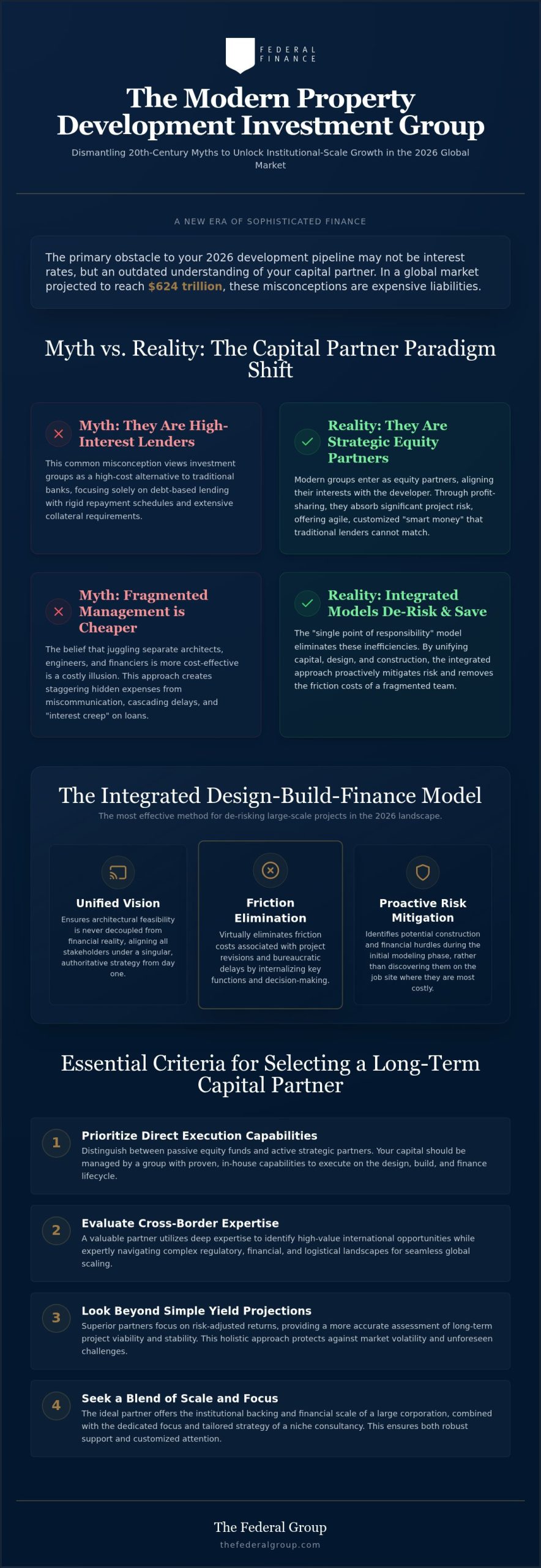
A common misconception persists that a property development investment group functions as a high-cost alternative to traditional retail banking. This view overlooks the fundamental shift from debt-based lending to equity-based partnership. While a bank provides a loan with rigid repayment schedules and extensive collateral requirements, an investment group typically enters a project as an equity partner. This means their interests are directly aligned with the developer’s success. Through profit-sharing structures, the group absorbs a significant portion of the project risk, which is a stark contrast to the shielded position of a traditional lender. Private capital offers a level of agility that institutional banks don’t match, allowing for customized financing structures that adapt to the unique needs of a high-value development in a volatile market.
The Reality of Strategic Capital Partnerships
Success in the 2026 market requires more than just liquidity; it demands “smart money” that carries the weight of industry intelligence. A strategic partnership provides the stability necessary to navigate fluctuating interest rates and rising material costs. By leveraging international property development finance, developers gain the ability to scale their portfolios across borders without the friction of navigating foreign regulatory hurdles alone. These groups act as a stabilizing force, providing the institutional backing required to secure long-term growth and secondary funding rounds. The true value lies in the integration of financial resources with a proactive management style. This holistic approach identifies and mitigates risks before they impact the bottom line, ensuring that the project moves from conception to completion with precision and speed.
De-risking Development Through Integrated Design and Build
The “single point of responsibility” model has emerged as the most effective method for de-risking large-scale projects in the 2026 landscape. Traditionally, a developer would juggle a disparate array of architects, engineers, and financiers, each with their own conflicting priorities. A sophisticated property development investment group solves this by internalizing these functions. This alignment ensures that architectural feasibility is never decoupled from financial reality. When the team providing the capital is the same team overseeing the structural engineering, the friction costs associated with project revisions and bureaucratic delays are virtually eliminated. This synergy allows for a proactive approach where potential construction hurdles are identified during the initial financial modeling phase, rather than on the job site.
Myth: Fragmented Project Management is More Cost-Effective
The belief that managing multiple third-party contractors is cheaper is a costly illusion. While individual line items might appear lower on a spreadsheet, the hidden expenses of miscommunication are staggering. Delays in one sector frequently cascade, leading to “interest creep” on construction loans and outstanding debt. An integrated design and build developer eliminates these structural inefficiencies by unifying the project’s financial and physical objectives under one command. This synchronization prevents the “budget vs. design” conflict that often stalls projects during the critical mid-development phase, ensuring that the original investment thesis remains intact throughout the build.
Leveraging Full Lifecycle Integration for ROI
True integration covers the entire project lifecycle, beginning with land acquisition. Securing the right site quickly often requires specialized bridging finance to move faster than traditional competitors who are tied to retail banking timelines. Once the site is secured, the internalized build process allows for superior margin control. In a market where the Construction Cost Index saw an annual increase of 3.1% in August 2026, every day saved in the schedule translates directly into preserved capital. Engaging a full lifecycle property developer ensures that these margin protections are built into the project structure from the initial concept rather than applied reactively. This speed-to-market advantage ensures that assets are delivered and yielding returns while competitors are still stuck in the planning phase.
By consolidating these diverse disciplines, a property development investment group moves from being a simple funder to a comprehensive execution partner. This level of oversight provides stakeholders with a sense of security that fragmented models simply can’t replicate. If you’re looking to optimize your next project, you might consider how a specialist partner can streamline your development pipeline. This integrated approach doesn’t just build structures; it builds predictable financial outcomes.
Navigating Global Markets with Cross-Border Expertise
Geographic diversification isn’t just a luxury for high-value stakeholders; it’s a strategic necessity in a world where capital is increasingly mobile. Global direct real estate investment reached $216 billion in the first quarter of 2026, an 18% increase compared to the previous year. This surge proves that the most resilient portfolios are those that look beyond their home borders. A sophisticated property development investment group leverages this global momentum to hedge against regional economic shifts. By spreading risk across different jurisdictions and asset classes, these groups provide a layer of stability that localized developers simply can’t match. They follow a “follow the capital” strategy, identifying emerging hubs where demographic trends and undersupplied sectors, such as senior housing or industrial logistics, offer the highest potential for growth.
Myth: Property Investment Groups Only Succeed in Local Markets
The belief that “local is always better” is a persistent myth that ignores the reality of modern capital flows. While local knowledge is important, the most successful groups combine local “boots on the ground” with institutional-scale expertise. They apply rigorous development frameworks and best practices from established markets to new territories, ensuring a consistent standard of execution. For instance, a group might take the efficiency of logistics development learned in the UK and apply it to the expanding suburban peripheries of the US. This cross-pollination of expertise allows global groups to identify value where local players might see only risk. It’s about having the scale to see the big picture while maintaining the specialized insight needed for local delivery.
The Power of International Capital Solutions
Navigating the complexities of cross-border transactions requires a partner with deep international real estate finance expertise. This involves more than just moving money; it requires managing currency risk, understanding varied tax environments, and navigating local regulatory hurdles. Sophisticated groups structure property development capital solutions that are specifically tailored to the legal and financial landscape of the target region. For example, in markets where new 2026 housing legislation—like the “21st Century ROAD to Housing Act”—has simplified zoning, an agile partner can use bridging loans to secure time-sensitive acquisitions before the broader market adjusts. This level of financial sophistication turns international complexity into a distinct competitive advantage for long-term partners.
Evaluating Performance: Beyond Simple Yield Projections
While many investors fixate on Internal Rate of Return (IRR), this metric provides only a partial view of a project’s actual health. In a global real estate market valued at over $624 trillion in 2026, the focus has shifted toward risk-adjusted returns. A sophisticated property development investment group evaluates performance by measuring the probability of achieving targets against the volatility of the underlying asset. This perspective is vital when structuring deals through real estate private equity, where long-term growth is prioritized over short-term liquidity. By analyzing capital preservation alongside growth, these groups ensure that high-value stakeholders aren’t just chasing numbers, but are building sustainable wealth. This is particularly relevant as the RCA Commercial Property Price Index rose 2.1% earlier this year, signaling a market that rewards precision over speculation.
Myth: The Highest Projected Return is Always the Best Investment
The belief that the highest projected yield signifies the best opportunity is a dangerous “yield trap.” Speculative developments in unproven regions often offer inflated projections to compensate for a lack of infrastructure or regulatory stability. Established groups prioritize completion certainty. They understand that a realized 8% return on a finished, high-quality build is infinitely more valuable than a theoretical 15% on a project that stalls due to financing gaps or mismanagement. A group’s track record in delivering complex, industrial-scale projects is the ultimate indicator of future performance. In 2026, the cost of capital remains a significant factor, making the ability to finish on time and on budget the most critical component of any yield calculation. Understanding how a full lifecycle property developer consolidates design, build, and finance phases is essential to protecting IRR from the erosion that fragmented models routinely produce.
Understanding Asset Class Diversification (Residential vs. Sports)
Diversification in 2026 extends beyond mixing residential and commercial units. Forward-thinking groups are now integrating niche sectors like professional sports into their portfolios. Sports multi-club ownership represents a strategic synergy between high-yield commercial assets and stable real estate holdings. Proper financial structuring for multi-club ownership allows investors to tap into a recession-resistant asset class that provides consistent cash flow and significant brand equity. This holistic approach to asset management creates a balanced ecosystem where the volatility of one sector is offset by the stability of another. It transforms a standard property portfolio into a visionary enterprise that captures value from both physical land and global media rights.
To maximize your portfolio’s resilience, it is essential to partner with a property development investment group that understands these multi-disciplinary synergies. You can explore how to optimize your capital allocation by consulting with a specialist partner today. This level of institutional oversight ensures your investments are positioned for growth regardless of broader market fluctuations.
How to Partner with a Global Integrated Group
Selecting a property development investment group in 2026 requires a rigorous assessment that goes beyond simple financial liquidity. Strategic alignment is the cornerstone of any successful high-value project. You must evaluate the group’s ability to provide not just capital, but a comprehensive execution framework. Due diligence is a bilateral process. From the investor’s perspective, this involves scrutinizing the developer’s operational history, project pipeline, and adherence to ESG-focused investment criteria. Conversely, developers should examine the group’s internal design-build capabilities and their record of providing stability during market fluctuations. This ensures the partner is a specialist entity rather than a generalist lender.
Partnership structures are rarely one-size-fits-all. Joint ventures often serve as the preferred vehicle for complex, multi-phase developments, allowing for a clear division of operational duties and financial contributions. Alternatively, equity participation models allow the group to act as a more integrated partner, providing the “smart money” required to de-risk the project’s lifecycle. Cultural alignment is equally critical; the group’s vision for long-term value must match the developer’s commitment to quality and speed-to-market. Without this shared perspective, even the most well-funded projects can face internal friction that leads to delays.
Myth: Investment Groups are Only for Institutional Giants
Many mid-sized developers believe that a global property development investment group is reserved for institutional-scale conglomerates. This is a significant misconception. In reality, these groups often seek specialized boutique partners who possess deep niche expertise in specific urban or industrial sectors. Partnering with a larger entity doesn’t mean sacrificing your brand identity. Instead, it provides you with the institutional weight needed to secure better procurement rates and navigate complex international regulations. You maintain your operational focus while leveraging the group’s global financial infrastructure and private equity resources. It’s a relationship based on complementary strengths rather than a corporate takeover.
Structuring Your Partnership for Long-Term Success
Initiating a partnership begins with a comprehensive capital requirement audit. This step ensures that the financial structure matches the project’s specific lifecycle, from initial land acquisition to final disposition. When you present a project for private equity consideration, clarity regarding the risk-mitigation strategy is paramount. You need to demonstrate how the integrated model will protect margins against the 3.1% construction cost increases reported earlier this year. For those ready to scale their operations with a strategic partner, exploring the integrated solutions at The Federal Group offers a pathway to securing a long-term capital partner. This alignment ensures that your vision is backed by the scale and sophistication required for the modern global market.
Securing Your Position in the 2026 Global Development Landscape
The evolution of the property development investment group in 2026 marks a decisive shift from fragmented service provision to integrated execution. The myth of the passive lender has been replaced by the reality of the strategic partner who manages every stage of a project’s lifecycle. By prioritizing risk-adjusted returns over speculative yields and leveraging international expertise, developers can navigate the complexities of a $624 trillion global market with confidence. The integration of design, build, and finance functions via Federal Holdings ensures that project completion remains a mathematical certainty rather than a speculative hope.
Whether you’re expanding into emerging suburban zones or exploring the synergies of sports multi-club ownership, your choice of partner determines your trajectory. You require a specialist with the scale to provide stability and the vision to identify niche opportunities before they enter the mainstream. It’s time to move beyond traditional financing and adopt a model built for the future of global industry.
Partner with The Federal Group for Integrated Global Development to leverage our expertise in international property finance and private equity. Our global reach spanning property and professional sports provides the institutional weight your next high-value project requires. Let’s build a more resilient portfolio together.
Frequently Asked Questions
What is the difference between a property investment group and a REIT?
A Real Estate Investment Trust (REIT) is typically a passive, liquid vehicle that allows investors to buy shares in income-producing portfolios. In contrast, a property development investment group is an active strategic partner focused on the entire development lifecycle. While REITs prioritize dividend yields from existing assets, investment groups drive value through physical construction, private equity structuring, and direct project execution, offering deeper integration and higher potential for capital appreciation.
How do property development investment groups manage risk in 2026?
In the current market, groups manage risk through full lifecycle integration and geographic diversification. By internalizing design and build functions, they eliminate the friction between third-party contractors and financiers that often leads to delays. They also utilize sophisticated data modeling to navigate 2026 volatility, such as the 3.1% rise in construction costs. This holistic approach ensures project completion certainty and protects the underlying investment from localized economic shocks.
Can an investment group help with land acquisition bridging loans?
Yes, a property development investment group provides specialized bridging loans to facilitate rapid land acquisition. These financial instruments allow developers to secure prime sites before the broader market can react to zoning changes or new legislation like the 21st Century ROAD to Housing Act. Unlike traditional retail banks, these groups offer the speed and flexibility required for high-stakes international acquisitions, ensuring you don’t lose time-sensitive opportunities to competitors.
What are the benefits of an integrated design and build developer?
An integrated design and build developer offers a single point of responsibility, which significantly reduces project delays and budget overruns. By aligning architectural vision with financial constraints from day one, the group prevents the budget vs. design conflicts common in fragmented models. This synergy accelerates the speed-to-market and ensures that the final asset meets the high standards required by institutional investors while maintaining strict control over development margins.
Why are investment groups moving into professional sports ownership?
Investment groups are diversifying into professional sports to capture synergies between high-yield commercial assets and stable real estate holdings. Sports multi-club ownership provides a recession-resistant revenue stream through global media rights and match-day operations. This diversification hedges against property market cycles while creating a visionary ecosystem that combines physical infrastructure with high-engagement commercial ventures, delivering superior risk-adjusted returns for sophisticated stakeholders in the 2026 market.
How do I qualify for development finance from an international group?
Qualification for development finance depends on project viability, developer track record, and strategic alignment with the group’s portfolio. You must present a comprehensive business plan that includes a capital requirement audit and a clear risk-mitigation strategy. Groups prioritize projects that demonstrate institutional scale and potential for high returns. They often require a detailed analysis of the local regulatory environment and a proven ability to deliver complex, large-scale builds.
What is the typical exit strategy for a private equity property development?
The typical exit strategy involves the disposition of the completed asset to an institutional buyer or a secondary sale to a REIT. Some groups choose to refinance the project into long-term debt and hold it for consistent rental yields. The chosen path depends on the original investment thesis and prevailing market conditions at completion. The goal is always to maximize the total return while ensuring a clean transition of the high-value asset.
Do investment groups provide funding for mixed-use commercial projects?
Yes, these groups frequently provide private equity and development finance for large-scale mixed-use projects. These developments, which combine residential, commercial, and retail spaces, are a key trend in 2026 due to their resilience and land-use efficiency. By integrating diverse asset classes, the property development investment group can spread risk and capture multiple revenue streams within a single site, making them highly attractive to international capital partners.