Strategic Real Estate Equity Partnership Models for 2026
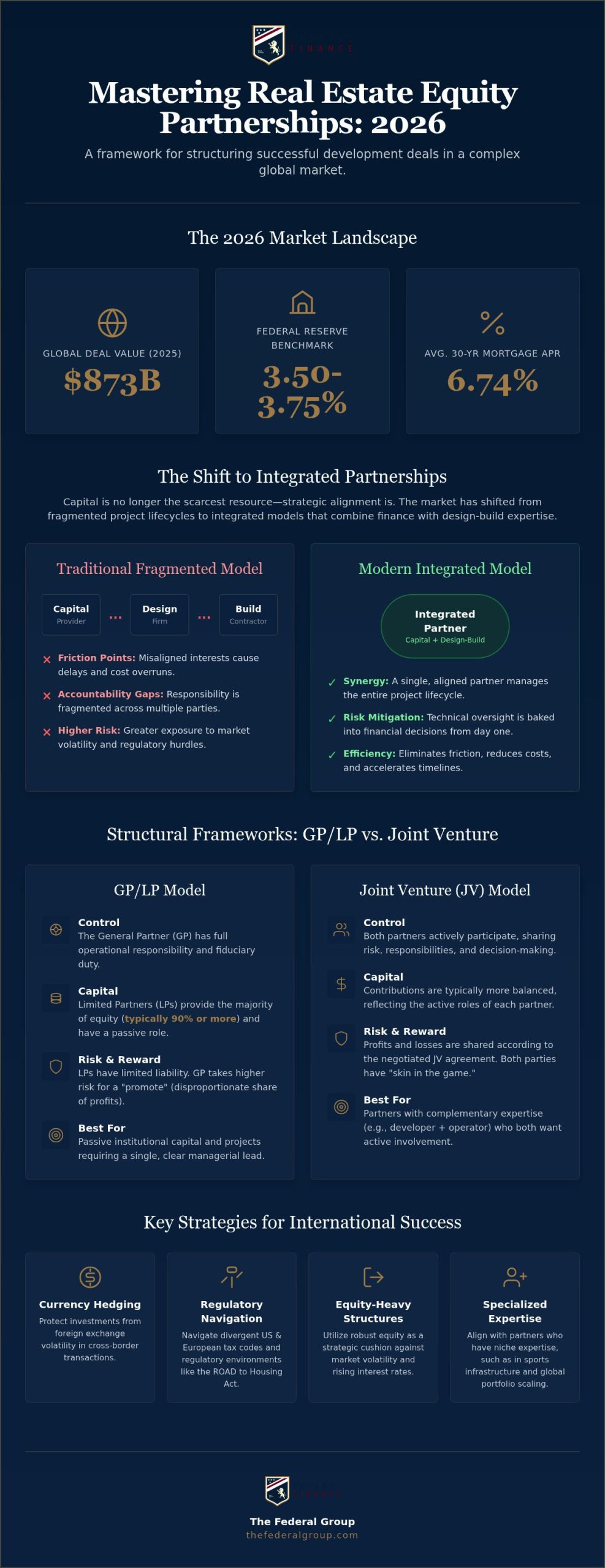
20 August 2026In 2026, capital is no longer the scarcest resource in international property development; it’s the strategic alignment of the partner providing it. While global deal values reached $873 billion last year, many developers still struggle with the friction of fragmented design-build phases and the weight of cross-border tax hurdles. You’ve likely realized that a standard real estate equity partnership often fails when interests aren’t perfectly synchronized from the first stone. Relying on capital alone is a liability in a market where the Federal Reserve benchmark rate sits between 3.50% and 3.75% and regulatory scrutiny is at an all-time high.
This article provides the framework to master complex equity structures and secure a partner that adds tangible value beyond the initial investment. You’ll gain a clear understanding of 2026 market standards for equity splits and learn how to mitigate risk in volatile international markets. We’ll explore the shift toward integrated developer-financier models, the impact of the 21st Century ROAD to Housing Act, and how to structure waterfalls that protect your vision while satisfying institutional demands.
Key Takeaways
- Analyze the structural differences between GP/LP and Joint Venture models to determine the optimal balance of institutional control and capital.
- Discover how a real estate equity partnership that integrates design-build expertise can eliminate the friction points of fragmented project lifecycles.
- Master risk mitigation strategies for international markets, including currency hedging and navigating divergent US and European regulatory environments.
- Evaluate the 2026 shift toward equity-heavy structures as a strategic response to market volatility and evolving institutional finance standards.
- Explore how to scale global portfolios by aligning with partners who possess specialized expertise in both property development and sports infrastructure.
The Evolution of Real Estate Equity Partnerships in 2026
The real estate equity partnership has matured into a sophisticated alliance that prioritizes strategic alignment over simple capital injection. In 2026, the complexity of global property markets demands more than a balance sheet. Success now depends on a synergy of capital, design expertise, and local market intelligence. This evolution marks a transition from transactional deals to long-term strategic alliances where every stakeholder is invested in the entirety of the project’s lifecycle. Partners are no longer just financiers; they’re specialist connectors of opportunity who bridge the gap between vision and execution.
As of June 2026, the Federal Reserve benchmark rate sits between 3.50% and 3.75%. This stabilization has ended the era of cheap, speculative debt, forcing developers to seek robust equity structures. These structures provide a necessary cushion against regulatory shifts, such as the 21st Century ROAD to Housing Act, which has increased scrutiny on institutional acquisitions. Institutional investors are filling the global funding gap, placing private equity real estate at the core of the modern development ecosystem. This shift ensures that projects are capitalized for resilience rather than just immediate growth.
The Shift Toward Integrated Capital Solutions
The convergence of finance and construction is redefining what developers expect from their partners. Capital providers no longer act as passive lenders. Instead, they demand “integrated” oversight to mitigate cost overruns and delays common in fragmented models. This is particularly evident in high-stakes sectors like sports infrastructure, where the complexity of multi-club ownership models requires seamless coordination between financing and build phases. “Smart money” in 2026 requires partners with technical design-build oversight and deep cross-border experience. This integrated approach ensures that design decisions are grounded in financial reality from the start. It’s a move toward a holistic ecosystem where the partner manages every stage of a project’s development.
Equity as a Catalyst for Global Portfolio Scaling
Leveraging partnership equity is the most effective way to enter new international jurisdictions. While global real estate deal values reached $873 billion in 2025, the hurdles of local tax codes and divergent regulations remain significant for solo developers. A sophisticated real estate equity partnership allows developers to share these risks with partners who possess specialized local intelligence and a global scope. In the current interest rate environment, where the 30-year fixed mortgage APR averages 6.74%, equity is often the preferred lever for growth over traditional debt. Strategic real estate equity partnerships de-risk high-value international projects by aligning long-term capital with specialized local development expertise.
Structural Frameworks: Comparing GP/LP and Joint Venture Models
Selecting the right real estate equity partnership structure is a foundational decision that governs everything from tax efficiency to operational control. In 2026, the two primary frameworks, General Partner/Limited Partner (GP/LP) and Joint Venture (JV), offer distinct pathways for institutional capital allocation. While the GP/LP model favors a clear hierarchy between capital and management, the JV model emphasizes shared risk and dual active participation. Understanding these nuances is critical for navigating the stabilized interest rate environment where the 30-year mortgage rate is projected to reach 5.9% by year end.
The GP/LP Model: Passive Capital vs. Active Management
The GP/LP structure remains the benchmark for private equity real estate. In this arrangement, the General Partner assumes full operational responsibility and fiduciary duty, managing the project’s lifecycle from site acquisition to final disposition. The Limited Partners provide the bulk of the equity, typically 90% or more, while maintaining a passive role. Understanding Real Estate Equity Partnership Structures is essential for LPs who require strict reporting, transparency, and clearly defined exit strategies.
In 2026, market standards for GP compensation frequently include acquisition fees of 1% to 2% of the total deal size. Alignment is further reinforced through the promote, where the GP receives a disproportionate share of profits once specific IRR thresholds are met. This tiered waterfall ensures the manager is incentivized to exceed performance targets while protecting the LP’s preferred return. Standard fee structures also often include disposition fees of 0.25% to 0.75%, which are layered on top of standard broker commissions.
Joint Venture Dynamics for Large-Scale Projects
A Joint Venture is often more appropriate for high-value, complex developments where both parties possess specialized expertise. Unlike the GP/LP model, a JV typically involves a “skin in the game” approach, with both partners contributing significant capital and participating in major decision-making. This structure requires a robust governance agreement to manage potential deadlocks and define major decision rights. It’s a collaborative model that relies on the synergy of both partners’ balance sheets and technical capabilities.
For developers seeking to scale international portfolios, our property development joint venture finance guide details how to navigate these collaborative frameworks. Success in a JV depends on a shared vision for the asset’s lifecycle and a clear division of design-build oversight. Managing cross-border tax implications requires establishing legal entities that shield partners from double taxation while ensuring compliance with local regulations. If you’re ready to explore how these frameworks can support your next international venture, consider how bespoke private equity solutions can align with your specific risk profile.
The Integrated Advantage: Traditional Equity vs. Design-Build Partnerships
A traditional real estate equity partnership often fails to bridge the gap between the boardroom and the job site. This fragmentation creates friction, as capital providers and construction teams operate in separate silos with divergent priorities. When the entity providing the funding has no visibility into the physical development process, timelines slip and budgets bloat. In 2026, sophisticated developers are moving away from these passive capital models. They’re seeking partners who possess a deep, “ground-up” understanding of the development lifecycle to ensure project viability from the first stone.
The Federal Group’s model represents this evolution by merging private equity with the operational strength of a design-build developer, creating a more robust real estate equity partnership. This integration ensures that the financial structure of a deal is informed by the technical realities of construction from day one. Instead of acting as a mere lender, an integrated partner manages the entire project lifecycle. This unified approach eliminates the standard hand-off delays between acquisition finance and the start of construction, providing a seamless transition that protects the project’s internal rate of return.
De-risking the Lifecycle through Integrated Design
A primary benefit of this model is the inclusion of architectural and engineering oversight directly within the equity partnership. This oversight ensures that the design phase isn’t just about aesthetics but also about financial feasibility and buildability. By streamlining the transition from acquisition to construction, developers can bypass the typical friction points that occur when third-party consultants misinterpret the financier’s constraints. You can explore more about these efficiencies in our guide on the integrated design and build developer pillar.
Achieving Operational Symmetry
Operational symmetry occurs when financial milestones and construction progress are perfectly aligned. Integrated developers maintain higher margins by leveraging internal efficiencies that fragmented teams can’t replicate. This alignment builds institutional investor confidence, as it provides a transparent and predictable path to completion. In a 2026 market characterized by regulatory shifts and stabilizing interest rates, this level of control is a significant competitive advantage. A unified project management system ensures that every dollar deployed is working toward a specific, pre-validated construction milestone, reducing the risk of capital being tied up in stalled phases.
Navigating Complexity: Risk Management in International Equity Structures
Executing a real estate equity partnership across international borders introduces a layer of volatility that domestic projects rarely encounter. High-stakes development in 2026 requires a defensive posture against currency fluctuations and the friction of divergent legal systems. While global deal values reached $873 billion in 2025, the successful repatriation of profits depends on a partner’s ability to navigate the nuances of international tax treaties. Effective risk management isn’t just about identifying threats; it’s about building a structural “moat” that protects capital from sovereign shifts and economic instability.
The regulatory landscape has become increasingly granular. In the United States, the 21st Century ROAD to Housing Act, passed in June 2026, has fundamentally altered how institutional investors approach single-family assets. Simultaneously, states like Maine and Pennsylvania have enacted strict oversight for shared-equity products. A sophisticated partner must balance these US domestic shifts with European mandates that often prioritize different compliance standards. This divergence makes a standardized due diligence checklist essential, covering everything from technological readiness to deep-tier regulatory alignment.
Cross-Border Capital Deployment Challenges
Moving capital into emerging or established international markets requires more than just a wire transfer. Developers must account for the specific mechanics of profit repatriation and the impact of local withholding taxes. Political and sovereign risks can also impact asset classes in unexpected ways, particularly in regions undergoing rapid urban transformation. Our international real estate finance partner guide provides a detailed framework for managing these multi-jurisdictional hurdles while maintaining liquidity. Aligning with a partner who understands these localized financial ecosystems is the most effective way to ensure long-term stability.
Technological Integration in Partnership Reporting
Real-time data transparency has become the new baseline for maintaining Limited Partner trust. In 2026, the adoption of blockchain and smart contracts is streamlining equity transparency by providing an immutable record of capital calls and distributions. This technological integration reduces the administrative burden of cross-border reporting and ensures that all stakeholders have a “single source of truth” regarding project milestones. Furthermore, rigorous ESG compliance has transitioned from a voluntary disclosure to a mandatory prerequisite for securing institutional equity from top-tier global pension and sovereign wealth funds.
Exit strategies must be codified long before the first shovel hits the ground. Managing liquidity in private equity real estate requires a clear understanding of the secondary markets and the specific triggers for asset disposition. Whether you’re targeting a portfolio sale or an individual asset exit, the structure of your partnership must remain flexible enough to adapt to 2026 market conditions. Secure your global development against market volatility by consulting with our team on bespoke private equity structures that prioritize both security and scale.
Scaling Global Portfolios with The Federal Group’s Equity Solutions
The Federal Group operates at the intersection of institutional finance and industrial-scale property development. We provide a real estate equity partnership that functions as a single, cohesive ecosystem. By consolidating private equity and development finance with the operational capabilities of Federal Holdings, we eliminate the inefficiencies of fragmented capital models. This integrated approach ensures that every project is managed with technical precision from acquisition to completion. It is a model built for the high-stakes environment of 2026.
Our customized equity structures are designed for high-potential international developments that require a partner with a global scope. We don’t just provide capital; we provide a platform for scaling global portfolios in a market where clarity and speed are paramount. A case study of our recent integrated financing for high-value global projects demonstrates how combining bridging loans with long-term equity can accelerate timelines by up to 20% compared to traditional banking routes. This agility allows our partners to capitalize on opportunities that traditional, slower-moving institutions might miss.
Strategic Synergy: Property and Professional Sports
The sports infrastructure sector represents a unique frontier for equity deployment. Through our specialized Sports Division, we facilitate real estate equity partnership opportunities that extend into stadium development and multi-club ownership. This creates a synergy where property value is driven by the operational success of professional sports franchises. Expanding the definition of equity to include these high-value global ventures allows for a diversified portfolio that is resilient to traditional market cycles. You can learn more about this in our discussion on the strategic role of a real estate private equity partner.
The Path Forward: Securing Your 2026 Capital Partner
Securing the right partner requires an evaluation of both financial capacity and technical expertise. The Federal Group’s investment criteria prioritize projects that benefit from our integrated design-build oversight and international reach. Whether you’re seeking private equity for a ground-up development or bridging finance to facilitate a cross-border acquisition, our consultation process is designed to identify the most efficient path forward. We invite developers and institutional stakeholders to explore how our specialized expertise can de-risk their next major venture. Partner with The Federal Group to align your vision with a heavyweight strategic ally.
Strategic Alignment for the 2026 Global Market
The landscape of international property development in 2026 rewards those who prioritize structural synergy over simple capital injection. Success now requires a real estate equity partnership that bridges the gap between institutional finance and ground-up operational reality. By moving beyond fragmented traditional models and embracing integrated design-build frameworks, developers can effectively insulate their portfolios against market volatility and regulatory shifts. Navigating cross-border hurdles demands a partner with the specialized expertise to manage the entire lifecycle of an asset, from site acquisition to final disposition.
The Federal Group provides this stability through a unique combination of global reach and localized market intelligence. Whether you’re leveraging the innovative synergy between property and professional sports markets or seeking to streamline construction through our integrated design and build division, we offer the scale of a heavyweight institution with the focus of a niche specialist. It’s time to align your project with a partner that adds value at every stage. Contact our private equity team to discuss your international development and secure the capital structure your vision deserves. The future of global development belongs to those who build with precision and strategic intent.
Frequently Asked Questions
What is the typical equity split in a real estate partnership in 2026?
In 2026, a standard real estate equity partnership typically follows a 90/10 or 95/5 split. The Limited Partner provides the vast majority of the capital, while the General Partner contributes a smaller portion as skin in the game. This structure ensures alignment of interests while allowing the developer to leverage their expertise. These splits vary based on the project’s risk profile and the specific value-add capabilities the developer brings to the international venture.
How does a real estate private equity partnership differ from a REIT?
A private equity partnership involves direct investment in specific assets or portfolios with a fixed lifecycle. Unlike a Real Estate Investment Trust (REIT), which is a publicly traded entity offering high liquidity, private equity provides greater control over development and design decisions. This model is preferred for high-stakes international projects where bespoke structures and strategic management are required to maximize returns beyond the limitations of standardized retail investment products.
What are the main risks of entering an international equity partnership?
International ventures face currency volatility, divergent regulatory environments, and political instability. In 2026, navigating the 21st Century ROAD to Housing Act in the US while managing European tax treaties requires deep localized intelligence. Currency hedging strategies are essential to protect distributions from exchange rate shifts. Without a partner who understands these cross-border complexities, developers risk profit erosion through double taxation or unforeseen compliance hurdles in emerging jurisdictions.
Can a developer maintain control in a GP/LP structure?
Developers acting as the General Partner maintain day-to-day operational control and executive authority. While the Limited Partner provides the capital, the GP manages the project’s lifecycle from acquisition to disposition. However, LPs usually retain major decision rights over significant actions like refinancing, asset sales, or budget overruns. This balance ensures that the developer’s vision drives the project while providing necessary safeguards for the institutional capital provider.
What is a “promote” in real estate private equity?
A promote is a financial mechanism that allows the General Partner to receive a higher percentage of profits after hitting specific performance hurdles. Once the Limited Partner receives their initial capital back plus a preferred return, the profit distribution shifts in favor of the GP. This tiered waterfall structure incentivizes the developer to exceed targeted internal rates of return, aligning the manager’s success directly with the project’s high-performance outcomes.
How does an integrated design-build partner improve equity returns?
An integrated design-build partner improves equity returns by eliminating the standard friction between financiers and construction teams. By managing the entire project lifecycle internally, these partners reduce timelines and prevent the budget bloat common in fragmented models. This operational symmetry allows for higher margins and faster capital recycling. In a 2026 market where time is a premium asset, unified management provides the security institutional investors require for high-value developments.
What due diligence is required for cross-border real estate equity?
Cross-border due diligence requires a comprehensive evaluation of international tax treaties, ESG compliance, and local regulatory alignment. Developers must verify the technological readiness of their partners, including the use of real-time reporting systems or smart contracts. In 2026, ensuring compliance with new federal acts and state-level home equity regulations is mandatory. This process identifies potential roadblocks in profit repatriation and ensures the real estate equity partnership is structured for maximum tax efficiency across multiple jurisdictions.
Is equity more expensive than a traditional development loan?
Equity is generally more expensive than a traditional development loan because it requires sharing a significant portion of the project’s upside. However, it provides a layer of stability that debt cannot match, especially in the 2026 environment where the 30-year mortgage APR averages 6.74%. Equity is non-recourse and does not require monthly interest payments, allowing the project to weather market volatility without the immediate pressure of debt servicing or foreclosure risk.