Maximizing ROI with Full Lifecycle Property Development: A 2026 Strategic Guide
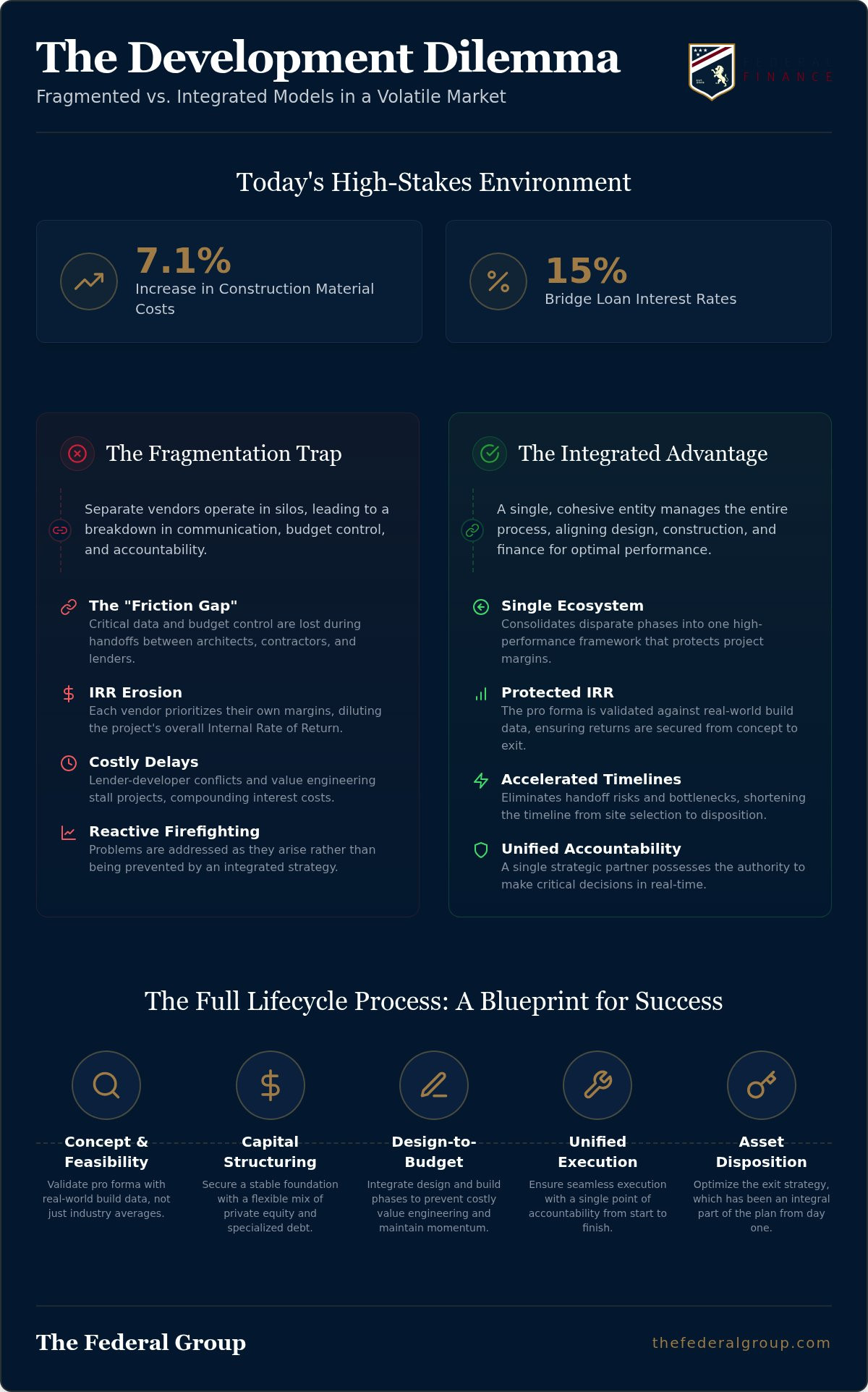
19 August 2026With construction material costs rising by 7.1% over the last year and interest rates for bridge loans reaching as high as 15%, the traditional fragmented development model has become a significant financial liability. Most institutional investors realize that the “friction gap” between separate architects, contractors, and lenders is where internal rate of return (IRR) typically erodes. Engaging a full lifecycle property developer allows you to consolidate these disparate phases into a single, high-performance ecosystem that protects margins from the initial concept.
You likely recognize the frustration of losing budget control during the handoff from design to construction or the difficulty of securing consistent funding across a volatile project timeline. It’s an exhausting cycle that often leads to stalled projects and diluted equity. This guide demonstrates how an integrated approach to design, build, and finance eliminates these operational bottlenecks to secure superior returns in global markets. We’ll examine the mechanics of lowered risk profiles, strategies for shortening timelines from concept to exit, and methods for optimizing capital stack visibility in this complex environment.
Key Takeaways
- Identify why fragmented development models fail in 2026 by analyzing the hidden costs of disconnected logic between architectural design and construction feasibility.
- Understand how a full lifecycle property developer optimizes every stage from site selection to asset disposition, ensuring the pro forma remains valid against real-world build data.
- Learn to eliminate the “Lender vs. Developer” conflict by leveraging internal capital solutions and integrated design-build frameworks.
- Discover the “Design-to-Budget” model that prevents costly value engineering and maintains project momentum during volatile market shifts.
- Establish rigorous criteria for selecting a strategic partner, focusing on institutional track records and the depth of integrated private equity and development finance.
The Fragmentation Trap: Why Traditional Property Development Models Fail in 2026
Traditional bidding processes in 2026 often devolve into reactive firefighting rather than proactive management. This systemic failure stems from “disconnected logic” where the architectural vision is divorced from construction feasibility and capital constraints. When these silos operate independently, the project suffers from a loss of critical data during the transition from procurement to execution. A full lifecycle property developer eliminates these handoff risks by unifying the design and build phases within a single strategic framework.
Fragmented models rely on a chain of independent vendors, each prioritizing their own margins over the project’s overall Internal Rate of Return (IRR). This misalignment creates a vacuum where budget logic disappears. For instance, the Producer Price Index for nonresidential construction rose 7.1% between July 2025 and July 2026. In such a volatile market, a design finalized six months ago without real-world material pricing is already obsolete. Without integrated oversight, developers are forced into costly “value engineering” that dilutes asset quality and delays market entry.
The Friction Gap and Its Impact on IRR
The “friction gap” is the period where budget control and risk data vanish during team transitions. In the high-interest environment of 2026, where bridge loan rates can reach 15%, every week of delay is a direct hit to equity. Friction often peaks during lender-developer draw approvals. When a third-party builder fails to provide precise documentation, the lender withholds capital, stalling the site and compounding interest costs. This gap is even more pronounced in the real estate development process when navigating cross-border regulatory compliance, such as the 2025 Building Energy Efficiency Standards now enforced for all new permit applications.
The Limitations of Software-Only Solutions
Many firms attempt to bridge these gaps using project management software. While tracking tools provide visibility, they don’t offer accountability. There’s a fundamental difference between “seeing” a delay on a dashboard and “preventing” one through structural integration. Software cannot resolve a conflict between an architect’s aesthetic choice and a builder’s technical constraint. Only a full lifecycle property developer possesses the authority to make those decisions in real-time. An integrated property development group solves the accountability crisis by merging the roles of financier, designer, and builder into a single, cohesive entity.
Defining the Full Lifecycle Property Developer: From Concept to Disposition
A full lifecycle property developer operates as a singular strategic partner, managing every variable from site selection and financing to design, construction, and eventual asset management. Unlike traditional firms that hand off projects between disconnected vendors, this model maintains a continuous logical thread. This integration ensures that the initial vision isn’t lost during the transition from the boardroom to the job site. By controlling the entire value chain, the developer absorbs the operational friction that typically erodes investor margins.
The process begins with Stage 1: Concept and Feasibility. Here, the developer validates the pro forma using real-world build data rather than industry averages. Given that material costs for steel and aluminum have risen significantly over the last year, this precision is mandatory for survival. Stage 2 involves structuring international property development finance to align with the project’s specific risk profile. By combining private equity and specialized debt, the developer secures a stable foundation before the first brick is laid.
Integrated Capital Structuring
Modern capital stacks must remain flexible to absorb international market shifts. Bridging loans play a critical role here, providing the liquidity needed to maintain momentum during land acquisition or unexpected regulatory delays. When a developer controls the finance arm, they eliminate the friction of third-party draw approvals. This internal synergy allows for more aggressive timelines and optimized capital visibility, which is essential for institutional stakeholders. If you’re looking to scale your portfolio, it’s worth exploring how integrated capital solutions can stabilize your next project.
Stage 3 transitions into Design and Build, where the Federal Holdings model creates architectural and construction synergy. Designers work alongside builders to ensure every aesthetic choice is technically feasible and within budget. Finally, Stage 4 focuses on Asset Management and Exit. Whether the goal is a long-term hold or a strategic disposition, the developer manages the asset to maximize its terminal value.
Specialized Asset Classes: Beyond Traditional Real Estate
Lifecycle thinking extends beyond commercial or residential towers. We apply this same rigorous integration to sports multi-club ownership and professional football clubs. These high-value assets follow cycles similar to commercial real estate, requiring specialized infrastructure development and long-term asset management. Diversifying into sports assets allows investors to leverage the same lifecycle efficiencies while accessing a unique, high-growth asset class that benefits from institutional-grade development logic.
The Integrated Advantage: Synergising Design, Build, and Capital
The “Design-to-Budget” model represents a paradigm shift in how high-stakes assets are realized. In traditional models, a developer often receives a completed architectural plan only to discover that construction costs exceed the initial pro forma, leading to the “value engineering” phase. This reactive process usually results in compromised materials or delayed timelines. A full lifecycle property developer avoids this trap by integrating construction feasibility into the earliest design sketches. This proactive alignment ensures that the project remains financially viable without sacrificing the visionary intent of the architecture.
By utilizing property development capital solutions, we eliminate the friction commonly found in the “Lender vs. Developer” dynamic. Third-party lenders often operate with rigid, risk-averse protocols that can stall a site during critical draw approvals. When capital and development are managed under one roof, the internal logic of the project dictates the flow of funds. This structural integration de-risks the project through institutional-grade due diligence at the concept stage, ensuring that every square foot is optimized for both performance and profitability.
Design and Build: A Unified Methodology
Reducing procurement errors requires more than just better software; it requires a structural alignment of architectural intent with construction reality. Federal Holdings acts as the operational engine in this ecosystem, maintaining 2026-standard sustainability and efficiency through direct oversight of the supply chain. This is particularly vital when managing the 22% increase in steel mill products and 40% rise in aluminum costs seen over the last year. The Design and Build synergy serves as a fundamental mechanism for de-risking high-value projects by ensuring that every architectural specification is pre-validated against real-time supply chain data and capital constraints.
Financial Integration and Liquidity
Speed is a primary driver of ROI in global real estate. Bridging finance for land acquisition allows a developer to secure prime sites instantly, accelerating the transition from concept to pre-development. Having a real estate private equity partner embedded in the team provides the stability required to navigate volatile market cycles. This internal liquidity is essential for managing cross-border currency and interest rate risks. It allows the team to pivot strategies without waiting for external committee approvals, maintaining momentum when competitors are forced to pause. This level of financial agility is what separates institutional-grade developers from traditional vendors.
Strategic Criteria for Selecting a Lifecycle Development Partner
Identifying a competent full lifecycle property developer requires looking beyond surface-level project management. While some competitors suggest focusing on software compatibility, institutional stakeholders prioritize the partner’s balance sheet and structural control. A true partner doesn’t just track a project; they own the risk. This ownership is only possible if the developer possesses integrated infrastructure, specifically an in-house build division. Outsourcing the construction phase reintroduces the very friction gaps that lifecycle development is designed to eliminate. An integrated partner ensures that the “Design-to-Budget” logic discussed earlier is actually executed on the job site.
Evaluating Financial Capability
Financial agility is the cornerstone of a successful lifecycle partnership. A partner must demonstrate the capital depth to provide internal development finance and private equity without relying on the slow approval cycles of external committees. This capability is evidenced by their ability to deploy bridging finance for land acquisition, ensuring that prime opportunities aren’t lost to more liquid competitors. Transparency in the capital stack is equally vital. Institutional investors require clear visibility into how funds are allocated across the project’s lifespan to ensure that IRR targets remain protected against the volatile interest rates seen throughout 2026.
Regulatory and Market Expertise
Operating across the US, UK, and global markets requires a deep understanding of shifting regulatory environments. Navigating the transition to the 2024 International Building Code or California’s 2025 energy standards requires more than just technical knowledge; it requires local market insight to prevent Stage 2 pre-development delays. A partner who understands the property development investment group landscape can effectively manage entitlements and zoning while anticipating regional supply chain bottlenecks. This global reach ensures that the developer can replicate success across different jurisdictions without compromising on the project’s logic or timeline. If you’re ready to engage with a specialist who manages every stage of the ecosystem, contact The Federal Group to discuss your next high-value development.
The Federal Group: Orchestrating the Property Lifecycle on a Global Scale
Since its establishment in 2009, The Federal Group has operated as an international property finance partner and developer with a singular mission: providing seamless capital and development integration. As a full lifecycle property developer, we recognize that the primary obstacle to superior ROI isn’t a lack of opportunity, but the erosion of value during handoffs between disconnected vendors. Our model internalizes these transitions, ensuring that the visionary intent of a project is supported by robust financial architecture and precise execution. By unifying these disciplines, we provide institutional stakeholders with the stability they require in high-stakes global markets.
Federal Holdings serves as our operational engine, delivering design and build excellence that is directly informed by our finance division’s capital logic. This synergy allows us to bridge the gap between international property finance and high-value project execution. We don’t just provide bridging loans or private equity; we manage the physical realization of the asset. This is best demonstrated through our role as a development finance lender, where our integrated case studies highlight how internalizing the lender-developer relationship protects asset performance and accelerates timelines by removing third-party friction.
A Partner for Institutional Growth
The Federal Group is the preferred partner for complex cross-border developments in the US, UK, and beyond. We understand that institutional growth requires a partner who can navigate diverse regulatory environments while maintaining transparency in the capital stack. Our approach to private equity and strategic joint ventures focuses on long-term value creation and risk mitigation. We invite high-value stakeholders to discuss their specific project requirements with our global team. Whether you’re looking to scale a commercial portfolio or optimize a single large-scale development, we provide the specialized expertise needed to navigate the 2026 economic landscape.
The Future of Integrated Development
The 2026 outlook for real estate demands a more holistic approach to asset management. Our unique investment ecosystem bridges the gap between traditional property divisions and our sports division, which specializes in professional football club investment and multi-club ownership. This cross-sector expertise allows us to apply the same rigorous lifecycle management to sports infrastructure as we do to industrial-scale real estate. As the market continues to favor integrated models, we remain committed to de-risking complexity and maximizing IRR through structural unity. Partner with The Federal Group for your next lifecycle development to ensure your capital is backed by a specialist who owns every stage of the development process.
Securing Your Development Legacy in 2026
High-stakes property development in 2026 requires more than just capital; it demands a unified strategic logic that spans the entire project timeline. By engaging a full lifecycle property developer, you eliminate the fragmentation that typically erodes IRR and gain precise control over the design, build, and finance ecosystem. We’ve explored how internalizing the lender-developer relationship and leveraging “Design-to-Budget” models can effectively de-risk complex, multi-disciplinary projects. These strategies ensure that your initial vision remains intact from the first site selection to the final asset disposition.
The Federal Group brings over 15 years of international property finance expertise to every partnership. Through Federal Holdings, our fully integrated Design and Build division, we provide the specialized US and UK market insights necessary to navigate shifting regulatory landscapes and volatile material costs. Your next high-value development deserves a partner who owns the risk and orchestrates every stage with technical precision. Don’t let operational friction compromise your terminal value. Gain the stability and ambition your portfolio requires by aligning with an established global expert.
Partner with the Global Leaders in Integrated Property Finance and Development. Let’s build a more resilient and profitable future together.
Frequently Asked Questions
What is a full lifecycle property developer?
A full lifecycle property developer is a specialized strategic partner that manages the entire real estate value chain under a single organizational logic. This includes site acquisition, capital structuring, architectural design, construction execution, and final asset disposition. By internalizing these phases, the developer eliminates the friction gaps typically found between separate vendors. This holistic approach ensures the project’s financial pro forma remains aligned with real-world construction data and market exit strategies.
How does an integrated design and build model improve ROI?
Integrated models improve ROI by aligning architectural intent with construction feasibility from the earliest concept stage. This synergy prevents the need for costly “value engineering” later in the cycle, which often delays market entry and dilutes asset quality. By controlling the supply chain and labor directly, an integrated firm can respond to material price volatility, such as the 7.1% increase in nonresidential inputs seen in 2026, effectively protecting the project’s internal rate of return.
What is the difference between development finance and bridging loans?
Development finance is a long-term capital solution structured to cover the costs of a project from ground-break to completion, typically released in stages based on construction progress. Bridging loans are short-term, high-liquidity facilities used to secure a land site quickly before permanent financing is arranged. In 2026, bridging rates can reach 15%, making them a strategic tool for financial agility rather than a permanent solution for long-term project funding.
Why is cross-border expertise important for property developers in 2026?
Cross-border expertise is essential for navigating the diverging regulatory and economic environments of global markets like the US and UK. Developers must understand local nuances, such as the 2025 California Building Energy Efficiency Standards or the adoption of 2024 International Building Codes. A developer with international reach can effectively manage currency risks and supply chain disruptions while identifying high-yield opportunities that domestic-only firms might overlook due to regulatory complexity or regional economic shifts.
How can private equity support large-scale property development?
Private equity provides the patient, high-octane capital required for large-scale developments that exceed the risk appetite of traditional retail banks. It allows for more flexible capital structuring and provides a buffer against fluctuating interest rates, which the Federal Reserve held at 3.50% to 3.75% in mid-2026. By partnering with a private equity firm, developers can secure the equity slice of the capital stack, enabling them to leverage debt more effectively and pursue ambitious projects.
What risks are mitigated by a full lifecycle development partner?
A full lifecycle property developer mitigates the “friction gap” risks associated with handoffs between architects, contractors, and lenders. This model prevents data loss during the transition from procurement to execution and eliminates the “Lender vs. Developer” conflict through internal capital solutions. By maintaining a single line of accountability, the partner reduces the likelihood of budget overruns, regulatory delays, and stalled draw approvals, which are the primary drivers of IRR erosion in complex developments.
Does The Federal Group invest in professional sports clubs?
Yes, The Federal Group operates a specialized sports division focused on multi-club football ownership and infrastructure development. We apply the same institutional-grade lifecycle management to professional sports assets as we do to industrial-scale property. This includes managing the acquisition, financing, and operational enhancement of clubs to create a unique investment ecosystem. This diversification allows our partners to access high-growth sports assets backed by the stability of our established property development and finance logic.
How does a developer manage the transition from construction to operations?
Managing the transition requires a seamless handoff from the build team to the asset management division, ensuring all technical systems meet 2026 efficiency standards. An integrated developer begins this process during the design phase by selecting systems that optimize long-term operational costs. This includes rigorous commissioning of electric-readiness features and insulation standards required by modern codes. By controlling the closeout phase, the developer ensures the asset is immediately ready for high-value occupancy or strategic disposition.