Institutional Real Estate Investment Models: 2026 Guide
21 August 2026The enactment of the 21st Century ROAD to Housing Act has fundamentally rewritten the playbook for global property markets, effectively ending the era of unrestricted single-family home acquisitions for large-scale players. As 88% of investors pivot toward AI-driven programs to maintain their competitive edge, the traditional, static approach to institutional real estate investment models is rapidly becoming a liability. You likely recognize that fragmented development lifecycles often lead to significant capital leakage, especially when navigating the complexities of cross-border regulatory shifts and alternative asset modeling.
This guide empowers you to master the complex frameworks required to evaluate, structure, and scale high-value global property portfolios in this new regulatory environment. We’ll move beyond simple cash flow projections to explore dynamic, integrated ecosystems where design and finance converge. You’ll learn to manage cross-border financial risks and identify high-growth opportunities within alternative sectors, such as sports multi-club ownership and specialized build-to-rent programs. By the end of this analysis, you’ll possess a strategic roadmap for navigating the transition from reactive asset management to proactive, industrial-scale development.
Key Takeaways
- Identify the transition from static pro-formas to dynamic lifecycle frameworks within modern institutional real estate investment models to better predict long-term cash flows.
- Compare the nuances of stabilized acquisition modeling against value-add strategies to optimize operational improvements and capital expenditure timing.
- Mitigate financial friction and compress development timelines by adopting integrated design-build models that unify finance and physical construction.
- Analyze the strategic advantages of sports multi-club ownership as a sophisticated alternative asset class designed for global scale.
- Learn how to utilize bridging loans and private equity partnerships to maintain project momentum and bridge the gap between financial modeling and execution.
What Defines Institutional Real Estate Investment Models in 2026?
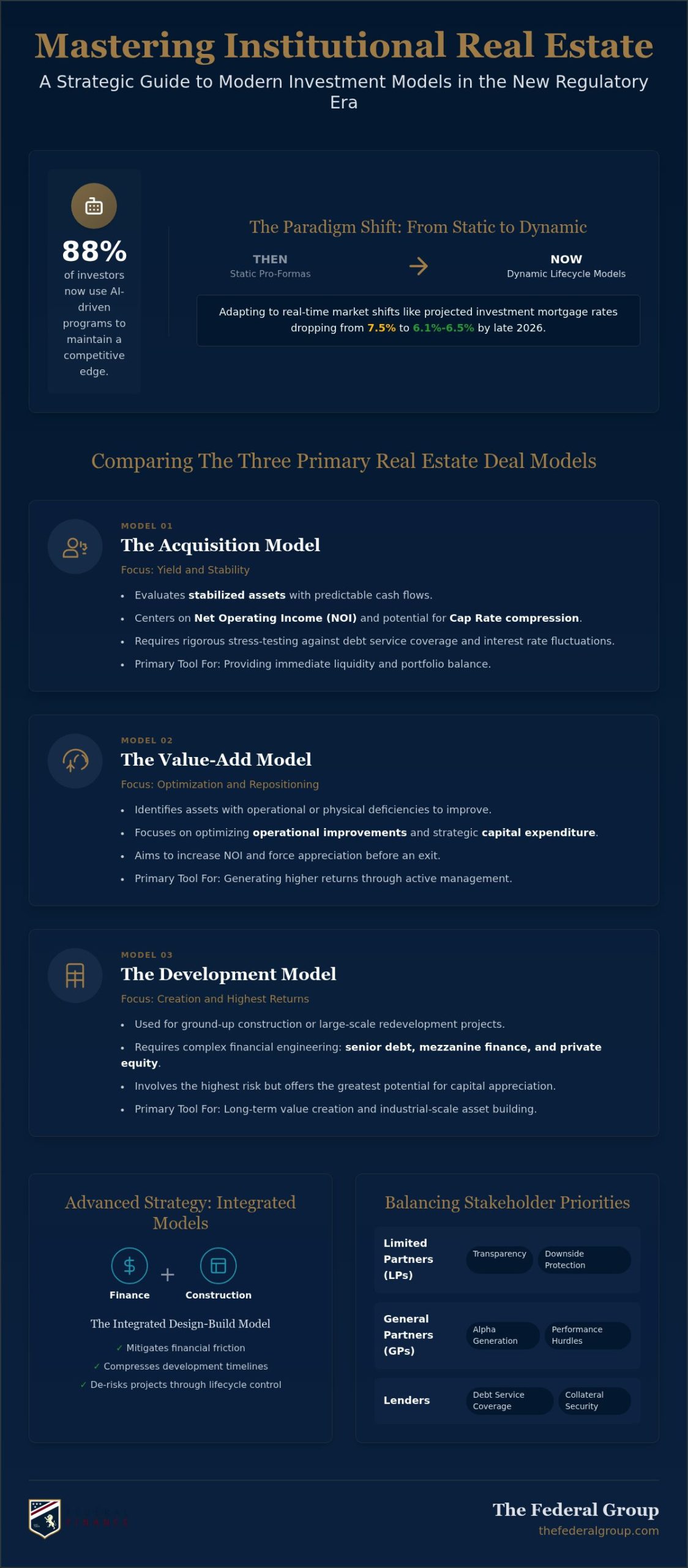
In 2026, institutional real estate investment models function as more than just calculation tools. They’re systematic frameworks designed to predict cash flows, quantify risk, and establish the ultimate viability of industrial-scale property assets. The industry has moved decisively away from “Static Pro-Formas” toward “Dynamic Lifecycle Models.” These modern frameworks adapt to real-time market shifts, such as the projected decrease in investment mortgage rates from 7.5% down to a range of 6.1% to 6.5% by late 2026. A model that doesn’t account for these shifting macro-economic variables isn’t just outdated; it’s a financial risk.
Sophisticated models must simultaneously satisfy three primary stakeholders. Limited Partners (LPs) require transparency and downside protection. General Partners (GPs) focus on alpha generation and performance hurdles. Lenders prioritize debt service coverage and collateral security. Achieving this balance requires a deep integration of international property development finance, especially when navigating the regulatory nuances of cross-border acquisitions and the limitations of the 21st Century ROAD to Housing Act.
The Core Objectives of Institutional Modeling
The primary goal of any institutional model is to identify a project’s “breaking point” before a single dollar of capital is committed. This involves rigorous sensitivity analysis on interest rates, occupancy levels, and construction costs. Optimization isn’t just about the highest number; it’s about balancing the Internal Rate of Return (IRR) with Equity Multiples and Cash-on-Cash yields to match specific investor mandates.
Effective modeling also determines the ideal capital structure. This involves layering senior debt, mezzanine finance, and private equity to maximize returns while maintaining a safe leverage profile. Many of these structures are rooted in established Private Equity Real Estate Models, which provide the blueprint for managing complex, high-stakes transactions in a volatile global market.
Evolution of Modeling Technology and Data
The era of the isolated Excel spreadsheet is ending. With 88% of investors now utilizing AI-driven programs for market analysis, institutional real estate investment models are now hosted on integrated investment management platforms. These systems ingest live global market data, allowing for instant validation of assumptions across different jurisdictions.
This technological leap reduces the margin for error in cross-border projections. However, automated data alone isn’t enough to secure capital. Technical validation from an international real estate finance partner remains essential. Human expertise is required to ensure that AI-generated outputs align with local regulatory realities, tax structures, and the practicalities of physical development. Data provides the foundation, but strategic insight provides the security.
Comparing the Three Primary Real Estate Deal Models
Institutional investors categorize assets based on risk-return profiles, which dictates which institutional real estate investment models are deployed. In 2026, the choice between acquisition, value-add, or development isn’t just about the asset type; it’s about the financial engineering required to sustain momentum. Each model serves a specific purpose in a global portfolio, from providing immediate liquidity to generating long-term capital appreciation. Mastering these institutional real estate investment models is essential for de-risking high-value portfolios in a volatile market.
The Acquisition Model: Yield and Stability
The acquisition model is the primary tool for evaluating stabilized assets with predictable cash flows. It centers on Net Operating Income (NOI) and the potential for Cap Rate compression. Current modeling must remain sensitive to interest rate fluctuations. With rates projected to reach 6.1% to 6.5% by late 2026, investors must stress-test their debt service coverage ratios. A critical component is the “Exit Cap Rate,” which determines the asset’s terminal value. Overestimating this figure can lead to significant capital leakage during the divestment phase. Sophisticated real estate operational management models often prioritize high-occupancy multifamily or industrial assets to ensure this stability.
The Development Model: Construction and Absorption
Ground-up development modeling is a high-stakes exercise in lifecycle management. It requires tracking monthly construction draws and the associated interest carry over a multi-year horizon. A development finance lender looks beyond simple IRR, focusing instead on absorption rates and the “yield on cost.” If the market cannot consume new units at the projected pace, the model’s viability collapses. To secure sites in competitive global markets, developers frequently utilize bridging finance for land acquisition. This allows for rapid site control while the full development finance package is finalized, ensuring the project starts without unnecessary delays.
Value-add modeling occupies the middle ground. It factors in significant Capex and temporary lease-up periods to reposition an asset. This strategy requires a firm understanding of operational improvements that drive rent growth. Whether you’re renovating a Class B office or repositioning a student housing complex, success depends on the synergy between design and finance. Engaging with a partner that provides integrated development finance can help you navigate these complex transitions between deal types.
The Integrated Design and Build Model: De-risking through Lifecycle Control
Fragmented development lifecycles are a primary source of capital leakage in traditional institutional real estate investment models. When developers rely on external architects and third-party contractors, information asymmetry often leads to “cost-plus” risks and schedule overruns. These inefficiencies erode the Internal Rate of Return (IRR) before the project even reaches stabilized occupancy. Federal Holdings addresses this by utilizing a fully integrated design-and-build development framework. This model eliminates the friction between creative design and financial reality, ensuring that every architectural decision is grounded in the project’s underlying economics.
The drive toward vertical integration is not limited to commercial development. As highlighted in the GAO Report on Institutional Investment in Single-Family Homes, large-scale players are increasingly seeking ways to optimize portfolios through scale and operational control. By internalizing the construction and design phases, institutional investors can capture an “efficiency premium” that is typically lost to external service providers. This approach transforms the construction phase from a high-risk liability into a controlled, value-adding component of the investment lifecycle.
Reducing Information Asymmetry
Integrated teams eliminate the gap between financial projections and construction reality. In a fragmented model, a design change might take weeks to be reflected in the budget. With an integrated approach, real-time cost feedback loops allow for immediate adjustments as the design evolves. An integrated design and build developer improves IRR through speed by compressing the time between land acquisition and first tenant move-in. This acceleration reduces interest carry and allows for faster capital recycling into new opportunities.
Operational Synergies in High-Value Projects
Streamlining the supply chain is essential for protecting development margins in 2026. Global logistics and material costs remain volatile, requiring a proactive rather than reactive management style. Integrated platforms leverage their scale to secure favorable pricing and reliable delivery schedules. This de-risks large-scale projects by unifying capital management with construction execution. Private equity plays a pivotal role here, providing the flexible capital needed to fuel these integrated development platforms and support the acquisition of specialized construction technology. This holistic ecosystem approach ensures that the financial model and the physical build remain perfectly aligned throughout the project’s life.
Alternative Institutional Models: Sports and Multi-Club Ownership
Professional sports have transitioned from vanity projects to rigorous, data-driven institutional platforms. In 2026, sophisticated investors are applying the same principles found in institutional real estate investment models to global football clubs and multi-club networks. This shift treats sports organizations as integrated entertainment ecosystems rather than isolated athletic teams. By viewing these assets through a private equity lens, investors can unlock significant value across diverse revenue streams, including broadcasting rights, commercial sponsorships, and extensive physical infrastructure.
The core of this evolution lies in the sports multi-club ownership strategy. This model mirrors traditional real estate portfolio management by diversifying risk across multiple markets and jurisdictions. Just as a property fund balances commercial, industrial, and residential assets, a multi-club network balances clubs across different tiers and geographies. This structure allows for the “Network Effect,” where talent development, scouting data, and commercial partnerships are shared across the ecosystem to drive operational efficiency and long-term capital appreciation.
Structuring Multi-Club Private Equity
Institutional investment in sports requires a sophisticated capital structure that prioritizes revenue diversification. Investors target global football markets where broadcasting valuations remain resilient and fan engagement is high. The modeling for these acquisitions utilizes many of the same metrics as institutional real estate investment models, specifically focusing on EBITDA growth and terminal exit multiples. By professionalizing the management layer and centralizing back-office functions, private equity firms can compress operational costs while scaling the commercial footprint of each club in the network.
The Real Estate Component of Sports Investment
The crossover between professional sports and traditional property development is found in the physical footprint of the club. Modern sports investment models prioritize the development of training facilities, youth academies, and stadium-adjacent commercial property. These assets provide a tangible foundation for the investment, offering predictable real estate returns alongside the more volatile athletic performance. Stadiums are increasingly designed as 365-day mixed-use destinations, incorporating retail, hospitality, and even residential units into the master plan.
Success in these large-scale infrastructure projects requires more than just athletic insight. A real estate private equity partner is essential for navigating the complexities of urban planning, construction finance, and long-term asset management. This partnership ensures that stadium developments remain financially viable, regardless of the results on the pitch. If you are looking to diversify into high-growth alternative assets, explore how The Federal Group’s Sports Division can help you structure and scale a global multi-club portfolio.
Strategic Capital Deployment: Bridging the Gap Between Model and Reality
Models are theoretical until capital is deployed. In 2026, the gap between a spreadsheet and a ground-break is often bridged by tactical financial solutions that provide immediate liquidity. Institutional real estate investment models must account for these “friction points”—the specific moments where traditional long-term debt is too slow or too rigid to capture a fleeting market opportunity. Even the most robust projections can fail if they lack the tactical funding required to secure a site or maintain momentum during a critical construction gap.
Bridging Loans: The Tactical Tool for High-Value Development
Speed is a primary metric of success in a high-stakes market. Deploying bridging finance allows developers to secure land before full planning permission or construction finance is finalized. While the interest carry is naturally higher than senior debt, the “speed premium” protects the project’s IRR by preventing acquisition delays. Modeling this cost against the benefit of an accelerated timeline is a hallmark of sophisticated institutional real estate investment models.
Utilizing bridging finance for land acquisition ensures you don’t lose prime development sites to more agile competitors while awaiting institutional loan committees. These short-term facilities also serve as critical stabilizers during construction gaps. They maintain site momentum if senior debt draws are delayed by administrative hurdles or regulatory reviews, ensuring that the physical build stays aligned with the financial model’s projected milestones.
The Future of Institutional Partnerships
Scaling global property portfolios requires more than just a lender; it requires an international real estate finance partner who understands the entire project lifecycle. Private equity structures provide the necessary flexibility to move across borders, managing regulatory risks while capitalizing on high-growth sectors like sports multi-club ownership or build-to-rent. The Federal Group’s integrated approach moves beyond transactional lending to strategic partnership, aligning Private Equity and Development Finance with the physical realities of Design & Build Development.
This integration effectively closes the loop between finance and physical execution. The data gathered from current construction projects informs the next generation of capital deployment, creating an ecosystem where finance and construction are in constant dialogue. This level of synergy allows for the rapid scaling of portfolios across diverse jurisdictions. It ensures that capital is always deployed where it achieves the highest risk-adjusted return, regardless of local market volatility. Whether you’re managing a traditional multifamily fund or a specialized alternative asset, the ability to execute the model through tactical capital defines the leaders of the 2026 market.
Future-Proofing Global Portfolios Through Integrated Modeling
The landscape of 2026 demands a departure from isolated financial projections. Success now requires a holistic approach that unifies technical precision with physical execution. By transitioning to dynamic institutional real estate investment models, you can effectively navigate regulatory shifts like the ROAD to Housing Act while capturing the efficiency premium of integrated development. Whether you’re optimizing core assets or scaling a global multi-club sports network, the ability to bridge the gap between a spreadsheet and a ground-break determines your market position.
The Federal Group stands as a strategic partner for those ready to lead this evolution. As specialists in international development finance and global sports multi-club ownership, we provide the integrated design and build expertise necessary to de-risk complex projects and maintain development momentum. Our approach ensures that every capital deployment is supported by deep technical insight and industrial-scale operational capacity.
Take the next step in optimizing your global property strategy. Partner with The Federal Group for Integrated Property Finance and Development to secure your position in the next generation of institutional investment. Your vision deserves a partner with the scale and expertise to execute it flawlessly.
Frequently Asked Questions
What are the most common real estate financial models used by institutions?
Common institutional real estate investment models include acquisition, value-add, and ground-up development frameworks. Each model targets a specific risk-return profile, from stabilized yield in core assets to high-alpha returns in construction. In 2026, these models have evolved into dynamic lifecycle systems. They integrate real-time macro-economic data and AI-driven valuation tools to provide a holistic view of the asset’s performance from the initial acquisition to the final exit.
How does an integrated design-build model impact project IRR?
An integrated design-build model improves IRR by compressing project timelines and eliminating the “cost-plus” risks associated with third-party contractors. By unifying architectural design with construction execution, developers capture an efficiency premium. This approach reduces interest carry and allows for faster capital recycling. Real-time feedback loops between the design team and financial analysts ensure that every decision remains grounded in the project’s original economic projections.
Is sports multi-club ownership considered a real estate investment?
Sports multi-club ownership is an alternative institutional asset class that relies heavily on real estate infrastructure. While the athletic performance generates broadcasting and sponsorship revenue, the underlying value is often anchored in stadiums, training academies, and adjacent mixed-use commercial developments. These physical assets provide a tangible foundation for the investment; they offer predictable property returns that complement the more volatile revenue streams inherent in professional sports.
What is the difference between development finance and a bridging loan in an investment model?
Development finance provides the long-term capital required for an entire project lifecycle, typically structured around monthly construction draws and interest carry. A bridging loan is a tactical, short-term facility used for immediate liquidity. Institutions often deploy bridging finance to secure land or close funding gaps while long-term debt is finalized. While bridging loans carry higher interest rates, they protect the model’s viability by preventing costly delays in site acquisition.
How do institutional investors model cross-border real estate risk in 2026?
Investors model cross-border risk by integrating live global data into institutional real estate investment models to account for currency volatility and local regulatory shifts. In 2026, this includes analyzing the impact of the 21st Century ROAD to Housing Act on acquisition strategies. Successful modeling requires technical validation from local partners to ensure that AI-driven projections align with specific tax structures and the practicalities of international physical development.
What role does private equity play in high-value property development models?
Private equity provides the flexible capital necessary to fuel integrated development platforms and scale global portfolios. Beyond simple lending, private equity firms act as strategic partners that manage performance hurdles and complex capital stacks. They allow developers to move beyond a single-project focus toward an ecosystem approach. This enables the acquisition of specialized construction technology and the execution of high-growth alternative strategies, such as multi-club sports networks.
Why is sensitivity analysis critical in institutional real estate modeling?
Sensitivity analysis is essential for identifying a project’s “breaking point” before capital is committed. It involves stress-testing the model against variables such as interest rate fluctuations, which are projected to reach 6.1% to 6.5% by late 2026. By adjusting absorption rates and exit cap rates, investors can quantify the impact of market volatility on the Internal Rate of Return (IRR). This process ensures that the investment remains viable under various economic scenarios.
Can bridging loans be used for international property acquisition?
Bridging loans are frequently used for international property acquisition to provide rapid site control in competitive markets. They allow investors to finalize a purchase while long-term development finance or permanent debt is being structured across different jurisdictions. This speed is a critical advantage when navigating cross-border opportunities. It ensures that the momentum of the investment model isn’t stalled by the administrative complexity of international loan committees or regulatory reviews.