Institutional Property Investment Partner: A 2026 Strategic Selection Guide
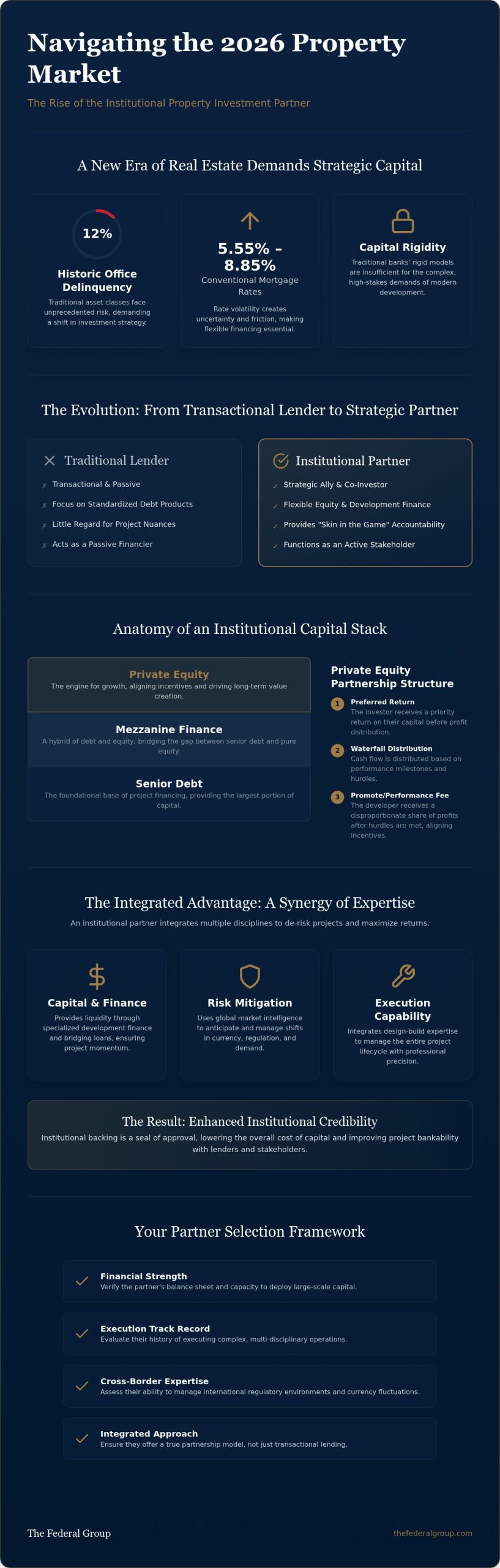
24 July 2026The traditional model of securing capital through rigid banking institutions is no longer sufficient for the high-stakes demands of 2026. As office delinquency rates reach a historic 12% and the 21st Century ROAD to Housing Act restricts single-family acquisitions, developers need more than a lender; they require a strategic institutional property investment partner with the agility to manage a volatile global environment. You’ve likely felt the friction of capital rigidity and the complexity of managing cross-border regulations while trying to maintain project momentum.
It’s clear that the gap between financier and developer has become a primary risk factor in large-scale projects. This guide provides a framework to identify partners who offer integrated equity, development finance, and design-build expertise to de-risk your portfolio. We’ll examine how to leverage private capital for alternative assets like data centers and senior housing, ensuring your next venture is backed by execution-focused intelligence rather than just a balance sheet.
Key Takeaways
- Shift your focus from transactional lending to strategic equity to navigate the 2026 property market with greater agility.
- Understand how to optimize your capital stack by leveraging private equity and flexible development finance for high-value projects.
- Discover how an integrated institutional property investment partner uses design-build expertise to significantly de-risk international developments.
- Identify the critical factors for managing cross-border regulatory environments and currency fluctuations in global real estate.
- Apply a rigorous selection framework to evaluate potential partners on their financial strength and ability to execute complex, multi-disciplinary operations.
What is an Institutional Property Investment Partner?
An institutional property investment partner is a specialized entity that delivers large-scale capital, strategic equity, and deep operational expertise for complex real estate projects. Unlike a traditional mortgage broker or a retail bank, these partners act as principal investors, integrating themselves into the project lifecycle. To understand the foundation of these entities, it’s helpful to review the definition of What is an Institutional Investor? and how they pool capital for high-stakes assets. This partnership model transcends simple lending; it creates a synergy where financial strength meets execution capability.
By July 2026, the landscape has shifted significantly. Traditional lending has become increasingly rigid as conventional commercial mortgage rates fluctuate between 5.55% and 8.85%. This volatility has forced a transition toward strategic equity partnerships. Developers now require an institutional property investment partner who brings more than just a balance sheet. They need a collaborator with the foresight to navigate a market where office delinquencies have hit an all-time high of 12% and alternative assets, such as data centers and senior housing, have become the primary focus for growth.
The distinction between retail lenders and institutional partners is stark. Retail lenders are transactional; they focus on standardized debt products with little regard for project-specific nuances. Institutional partners operate as strategic allies. They prioritize the long-term viability of the asset, offering flexible structures that retail banks cannot match. This alignment is essential for high-value developments that require cross-border expertise and sophisticated capital stacks.
Core Roles of an Institutional Partner
The primary function of an institutional property investment partner is to provide liquidity through specialized development finance and bridging loans. These tools allow developers to maintain momentum during critical project phases. Beyond capital, they act as co-investors, ensuring their interests are perfectly aligned with the developer’s success. This “skin in the game” approach fosters a higher level of accountability. Partners also provide robust risk mitigation frameworks, using global market intelligence to anticipate shifts in currency, regulation, or sector demand.
The Value of Institutional Credibility
Partnering with a heavyweight firm instantly improves project bankability. Lenders and stakeholders view institutional backing as a seal of approval, which can lower the overall cost of capital. This credibility grants access to elite global networks, including niche opportunities like sports multi-club ownership, which diversifies risk across high-value international assets. The principal investment platform model represents the 2026 standard for high-stakes property, where the partner functions as an active stakeholder rather than a passive financier. This integrated approach ensures that every stage, from initial equity to final execution, is managed with professional precision.
Mechanics of Institutional Capital: Equity vs. Debt
Successful international development relies on a precisely calibrated capital stack. It’s the structural foundation of every high-value project. Senior debt provides the base, but it’s the sophisticated layers of equity and mezzanine finance that drive completion. A reliable institutional property investment partner understands that the interplay between these layers determines a project’s internal rate of return (IRR) and overall risk profile. While recent reports on institutional investment in single-family homes illustrate the massive scale of residential market involvement, the mechanics remain equally critical in the commercial and industrial sectors where capital demands are even more intense.
Mezzanine finance occupies a unique space in this hierarchy. It offers a hybrid of debt and equity, providing the final layer of capital needed for high-value projects without diluting the developer’s ownership as deeply as pure equity. It’s a high-stakes instrument that requires a partner who understands the underlying asset value intimately. This layer is often the difference between a project that stalls and one that breaks ground on schedule. Developers navigating these complex structures can benefit from a comprehensive understanding of property development loans and institutional capital structuring to ensure every layer of the stack is optimized for maximum leverage and risk-adjusted returns.
Structuring Private Equity Partnerships
In 2026, private equity functions as the engine for long-term growth. Institutional joint ventures typically utilize a waterfall structure to distribute cash flow based on performance milestones. This includes a “preferred return” for the investor, followed by a “promote” or performance fee for the developer once specific hurdles are met. These models align incentives, ensuring that the institutional property investment partner and the developer share the same vision for asset appreciation. To optimize these structures, developers often integrate international property development finance to enhance equity efficiency. This approach allows for higher leverage on senior debt while preserving equity for new acquisitions.
Strategic Use of Bridging Finance
Speed is a competitive advantage in global real estate. Bridging loans serve as the vital link between opportunity and execution, allowing for rapid land acquisition before long-term development finance is finalized. Unlike traditional banks, which may take months for underwriting, institutional bridging providers can close deals in a fraction of the time. This agility is vital when office delinquency rates are high and developers must pivot quickly to alternative assets like data centers. The exit strategy is always clear: transition into a permanent facility once the project hits pre-defined de-risking milestones. For those managing complex portfolios, exploring a principal investment platform can provide the necessary liquidity to maintain this momentum.
The Integrated Advantage: Design, Build, and Finance
Traditional property development often suffers from a lack of cohesion between the capital source and the construction site. When financing is siloed, any delay in design or a spike in material costs triggers a bureaucratic chain reaction. This leads to cost overruns that erode the project’s margin. An institutional property investment partner that operates on an integrated model solves this by uniting architectural design, construction management, and capital solutions under one strategic umbrella. This holistic approach streamlines the lifecycle from initial site acquisition to final construction, ensuring the project remains on a steady trajectory. In 2026, developers don’t just need capital; they need a partner that understands the physical and financial constraints of the site simultaneously.
By selecting an institutional property investment partner with in-house execution capability, developers can bypass the inefficiencies of fragmented project teams. In a market where over 92% of commercial real estate companies are now implementing AI and PropTech to drive efficiency, manual and disconnected processes are a liability. Integration isn’t just a convenience; it’s a de-risking strategy. It allows for real-time adjustments to the build phase based on shifts in the financial environment, protecting the capital stack from unforeseen volatility and ensuring that exit valuations are rooted in operational reality. Developers seeking to master these complexities can benefit from a deeper understanding of property finance for high-value projects, particularly when structuring multi-phase capital solutions that must remain agile across international markets.
De-risking Through Lifecycle Management
Internalizing the supply chain allows a developer to maintain absolute control over timelines and procurement. When the design phase is coupled with financial planning, the resulting project ROI is significantly more predictable. Integrated Design & Build reduces the friction between lender and developer by ensuring that the financial constraints of the project are baked into the architectural blueprints from day one. This synergy prevents the costly redesign loops that typically plague projects when a third-party architect’s vision exceeds the financier’s budget.
Operational Synergy in Multi-Asset Portfolios
Managing mixed-use developments or large-scale alternative assets requires a single point of accountability to maintain momentum. The Federal Group exemplifies this by integrating Federal Holdings, its design and build arm, directly into its principal investment platform. This structure is particularly potent when diversifying into sectors like professional sports multi-club ownership. In these scenarios, the property asset isn’t just a building; it’s a critical component of a sports ecosystem that requires specialized design to meet specific athletic and commercial requirements. This level of specialization ensures that the asset is optimized for its specific high-value use case from the ground up.
Navigating Cross-Border and International Real Estate Finance
Operating within a single domestic market provides a certain level of comfort, but real scale is often found across international borders. Deploying capital globally introduces a complex layer of risks that can derail even the most robust projects. Currency volatility, shifting tax treaties, and divergent regulatory environments require a level of sophistication that local lenders simply don’t possess. An institutional property investment partner with a genuine worldwide scope provides the infrastructure to manage these variables. They act as a bridge between disparate financial systems, ensuring that capital deployment remains efficient regardless of the jurisdiction.
Structuring cross-border deals involves more than just moving funds. It requires a deep understanding of compliance frameworks, such as the 21st Century ROAD to Housing Act in the United States or the evolving tax structures in the UK. While conventional commercial mortgage rates in the US range from 5.55% to 8.85% as of July 2026, international developers must also weigh these against local inflation and interest rate hedges. A partner with a global footprint provides the stability needed to navigate these waters without compromising on speed or execution. This global perspective is what allows a developer to pivot from a struggling domestic office market to a high-growth industrial hub in a different region.
Evaluating Global Market Expertise
Identifying emerging trends in international real estate private equity is a prerequisite for high-value growth. It’s not enough to follow the capital; you must anticipate where it will be most effective. Verifying a partner’s track record in international jurisdictions is critical. You need to see evidence of successful project completions in environments with varying legal and financial standards. Local knowledge remains indispensable, especially when property investments intersect with global sports assets, where community and regulatory stakes are exceptionally high. This expertise ensures that your institutional property investment partner can navigate local nuances that a remote lender would overlook.
Alternative Assets: The Rise of Global Sports Investment
Institutional partners are increasingly diversifying into professional football clubs and sports multi-club ownership models. This shift isn’t merely about the prestige of the sport; it’s about the powerful synergies between property development and sports infrastructure. Stadiums, training facilities, and surrounding mixed-use developments create a stable, high-yield ecosystem. Managing risk in this global asset class requires a partner who understands both the underlying property value and the operational complexities of professional sports. To explore how to align your portfolio with these high-stakes opportunities, consider a global principal investment platform that specializes in cross-border execution.
Selecting Your Institutional Property Investment Partner
Choosing an institutional property investment partner is a decision that defines the trajectory of your portfolio for the next decade. In a market where agility is as valuable as capital, you must look beyond the balance sheet to evaluate execution capability. A partner should be assessed on their financial strength, their speed of deployment, and their specific sector expertise. Transparency in reporting and capital deployment remains non-negotiable. You require a partner who operates with the clarity of a specialist consultancy but the scale of a global corporation. The Federal Group stands as the logical choice for these complex, international projects, offering an integrated ecosystem that combines development finance with private equity and design-build expertise.
When evaluating potential partners, use this essential checklist to ensure alignment:
- Principal Status: Does the firm act as a principal investor or merely an advisor? Principal-led platforms have more skin in the game.
- Execution Speed: Can they provide bridging loans to secure time-sensitive acquisitions while long-term finance is structured?
- Integrated Capability: Do they possess in-house design and build expertise to control costs and de-risk the construction phase?
- Global Reach: Do they have a proven track record of managing cross-border regulatory and currency risks?
Alignment of Interests and Vision
A successful partnership requires an investment horizon that matches your project lifecycle. You don’t just need a lender; you need a strategic connector of opportunities. This is particularly vital when diversifying into high-value alternative assets like sports multi-club ownership. These sectors require a partner who understands the synergy between property infrastructure and commercial sports operations. Your institutional property investment partner must show flexibility during periods of market volatility, acting as a stable anchor rather than a reactive financier. This stability allows you to maintain momentum even when regional markets experience temporary shifts.
Finalizing the Partnership
The final stage of selection involves rigorous due diligence for both equity and debt components of the capital stack. It’s essential to set clear, measurable KPIs for every phase of the development and construction process. These benchmarks ensure accountability and provide a roadmap for project completion. Once you’ve verified the partner’s track record and operational synergy, the next step is initiating a formal consultation to structure bespoke capital solutions. Whether you’re seeking private equity for a mixed-use development or bridging finance for a rapid acquisition, the right partner will provide the visionary energy and financial gravity required for international success.
Future-Proofing Your Global Property Strategy
The 2026 property landscape demands a transition away from fragmented capital and toward an ecosystem of integrated execution. We’ve explored how the right institutional property investment partner does more than provide liquidity; they act as a principal stakeholder who de-risks every phase of the project lifecycle. By combining strategic private equity with in-house design and build capabilities, developers can maintain momentum despite regulatory shifts or market volatility.
Success in today’s high-stakes environment requires specialized expertise in international bridging and development finance. Whether you’re navigating the complexities of cross-border compliance or diversifying into alternative assets like professional sports, your partner’s global reach is your greatest asset. The Federal Group provides this stability through Federal Holdings, ensuring that architectural vision and financial reality remain perfectly aligned. It’s a model built for those who value precision and scale in equal measure.
Partner with The Federal Group for your next high-value international development and secure the integrated expertise your portfolio deserves. We’re ready to help you navigate the complexities of the global market with confidence and ambition.
Frequently Asked Questions
What defines an institutional property investment partner in 2026?
An institutional property investment partner is characterized by its ability to provide principal-led capital combined with integrated operational execution. These partners move beyond the role of a traditional lender by offering a holistic ecosystem that includes private equity and specialized development expertise. They prioritize long-term asset stability and act as active stakeholders throughout the project lifecycle.
How does real estate private equity differ from a standard development loan?
Real estate private equity involves taking an ownership stake in a project, whereas a development loan is a debt instrument with a fixed or variable interest rate. Private equity partners share in both the risks and the rewards through sophisticated waterfall structures. This alignment of interests provides greater flexibility during market shifts compared to the rigid repayment schedules found in traditional banking.
Why should developers consider an integrated design and build partner?
An integrated partner de-risks the investment by internalizing the construction supply chain and architectural oversight. This model eliminates the friction that typically occurs between third-party contractors and financiers. By unifying these functions, developers can control costs and maintain strict timelines, which is vital for projects in volatile sectors or alternative assets.
What are the benefits of bridging loans for land acquisition?
Bridging loans provide the speed and liquidity required to secure land acquisitions before permanent development finance is finalized. In competitive global markets, the ability to close a deal in days rather than months is a significant competitive advantage. These loans serve as a flexible short-term bridge, allowing developers to capture opportunities as they arise.
Can institutional partners help with international property projects?
Yes, a sophisticated institutional property investment partner provides the infrastructure to navigate cross-border capital deployment. They manage the complexities of divergent tax treaties, local regulations, and compliance frameworks across multiple jurisdictions. This global reach ensures that capital flows efficiently without the administrative delays common in international finance.
How do sports multi-club ownership strategies fit into a property portfolio?
Sports multi-club ownership functions as a high-value alternative asset class that offers powerful synergies with property development. These strategies involve acquiring stadiums and training facilities that anchor broader mixed-use developments. This approach diversifies a portfolio into resilient assets that are often less correlated with traditional commercial real estate cycles.
What is the typical entry point for an institutional investment partnership?
The entry point for an institutional property investment partner is typically at the pre-construction or acquisition phase for large-scale developments. Partners look for projects with clear exit strategies and high-value potential in sectors like industrial or senior housing. These partnerships are designed for stakeholders who require substantial capital and integrated execution capability.
How do cross-border property finance structures manage currency risk?
Cross-border finance manages currency risk through sophisticated hedging strategies and localized capital deployment. Institutional partners use their global footprint to offset volatility by matching liabilities with revenue in the same currency whenever possible. This methodical approach protects the project’s internal rate of return from the fluctuations of international exchange markets.