Property Finance for High-Value Projects: 2026 Guide
26 July 2026The most successful developers in 2026 have stopped looking for loans and started looking for capital architects. In a climate where U.S. commercial mortgage rates sit between 5.64% and 8.94%, simply securing a term sheet isn’t enough to guarantee a project’s viability. You’ve likely felt the friction of capital scarcity or the frustration of traditional lenders who don’t understand the nuances of a multi-phase build-lifecycle. Securing property finance for high-value projects requires more than just a balance sheet; it demands a strategic alignment between your capital stack and your development’s unique regulatory and operational hurdles.
We’re here to help you master these institutional-grade complexities and architect a financial structure that secures your global developments. You’ll learn how to bridge the gap between initial bridging loans and long-term private equity while maintaining the agility needed for international scale. This guide provides a comprehensive look at optimizing your debt-to-income ratios, leveraging specialized capital solutions, and ensuring your financing partner is as invested in the finished structure as they are in the initial numbers.
Key Takeaways
- Understand why traditional corporate lending often falls short of the scale and technical complexity required for institutional-grade property developments.
- Learn to architect a resilient capital stack that balances cost efficiency with the operational flexibility essential for securing property finance for high-value projects.
- Identify strategic frameworks for navigating cross-border regulatory hurdles and managing currency risks across international jurisdictions.
- Discover how to evaluate financing partners based on their “Development DNA” to ensure long-term alignment with your project’s specific build-lifecycle.
- Explore the advantages of an integrated “design and build” approach in de-risking complex assets and achieving global scalability.
Why High-Value Projects Demand Specialized Capital Structures
High-value projects demand a departure from conventional lending. We define property finance for high-value projects as the deployment of bespoke capital solutions for developments that exceed standard institutional thresholds, typically involving complex asset classes or multi-phase industrial builds. Corporate balance sheet lending often fails in this arena because it prioritizes historical performance and existing assets over future project viability. Large-scale developments require a forward-looking perspective that traditional retail banking simply cannot provide, especially when dealing with the technical nuances of global real estate.
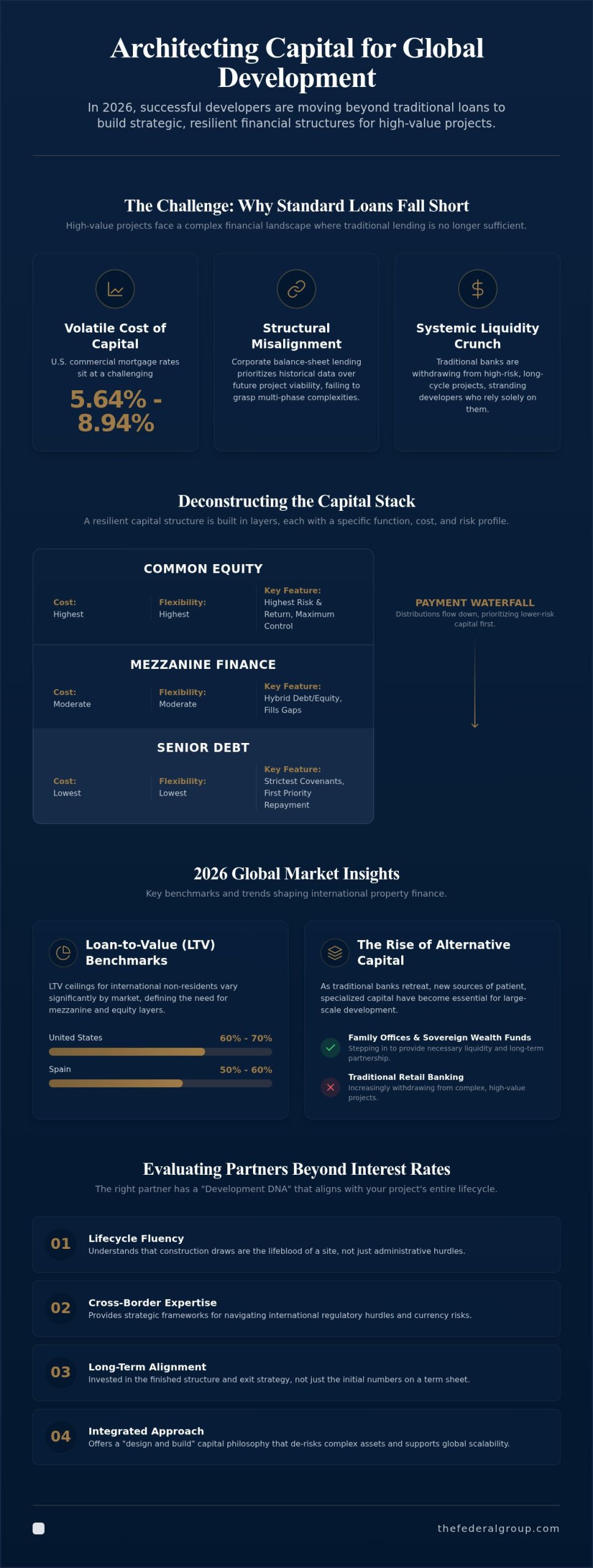
In 2026, we’ve seen a definitive shift toward alternative credit and specialized funding models. With U.S. commercial mortgage rates currently ranging from 5.64% to 8.94%, the cost of capital has forced a move toward more sophisticated private equity real estate structures. This isn’t just about borrowing money; it’s about “Capital Architecture.” This approach treats the capital stack as a structural element of the build itself. When architecting property finance for high-value projects, every layer of debt and equity must align with the project’s long-term lifecycle to ensure stability through every phase of construction.
The Threshold of Complexity: When Standard Loans Aren’t Enough
Senior debt has its limits. In multi-phase projects, a standard senior loan rarely provides the flexibility needed for shifting construction draws or land acquisition nuances. As project scale increases, risk pricing becomes more volatile, and standard lender appetite often diminishes. High-value developments require a partner who understands that construction draws aren’t just administrative hurdles; they’re the lifeblood of the site. Standard loans often lack the agility to handle the specific pressures of industrial-scale property development, leading to delays that can jeopardize the entire project’s IRR.
2026 Market Dynamics and Institutional Liquidity
Global liquidity for property development is currently characterized by a systemic “liquidity crunch.” This occurs when developers rely solely on traditional retail banking and find themselves stranded as those institutions tighten their criteria and withdraw from high-risk, long-cycle projects. In response, family offices and sovereign wealth funds have stepped into the gap. These entities offer the patient, specialized capital that high-stakes projects require. By mid-2026, these alternative sources have become essential for maintaining momentum in global developments, providing the necessary liquidity to bridge the gap left by traditional financiers.
Deconstructing the Capital Stack for Institutional-Scale Development
Success in large-scale development depends on the precision of the capital stack. It isn’t just a list of funding sources; it’s a structural hierarchy where each layer serves a specific function in the project’s lifecycle. Higher layers, such as common equity, provide the maximum flexibility needed for unforeseen site challenges but come at the highest cost. Conversely, senior debt remains the most affordable capital, though it imposes the strictest covenants. Balancing these layers requires a deep understanding of the payment waterfall, where the priority of distributions dictates the risk appetite of every stakeholder involved in property finance for high-value projects.
A significant shift in 2026 involves the integration of ESG-linked incentives within the stack. Institutional lenders are increasingly offering “green” margin reductions for projects that meet specific sustainability certifications. This de-risks the asset for long-term holders and improves the overall IRR for the sponsor. When Navigating commercial real estate markets, developers must now treat environmental compliance as a financial asset rather than a regulatory burden. This holistic view ensures that the capital architecture supports the project’s exit strategy from the outset.
Senior Debt and Mezzanine: The Foundation of the Stack
Senior debt typically forms the base of the stack, but its reach is limited. In mid-2026, Loan-to-Value (LTV) benchmarks for international non-residents have stabilized around 60% to 70% in the U.S., while markets like Spain remain more conservative at 50% to 60%. Mezzanine finance has become the tactical tool of choice to fill the resulting capital gap. It allows developers to maintain momentum without diluting their equity position prematurely. For those managing cross-border assets, understanding how these layers interact is vital, as detailed in our guide to International Property Development Finance. Developers seeking a comprehensive framework for structuring each layer of funding can also explore our dedicated resource on the capital stack for property development to optimize leverage across complex multi-phase builds.
Equity Structures: Joint Ventures and Private Equity Partnerships
Joint Venture (JV) models have evolved into sophisticated partnerships where private equity firms act as more than just passive capital. In 2026, these partners evaluate feasibility based on a minimum Debt Service Coverage Ratio (DSCR) of 1.2 to 1.3 for residential assets. “Promote” structures are now standard, ensuring that the developer’s interests are perfectly aligned with the investor’s exit goals. By utilizing preferred equity, sponsors can effectively de-risk their positions, providing a buffer that protects the core equity if market conditions shift. If you’re looking to optimize your next project’s financial structure, The Federal Group provides the specialized expertise required to navigate these institutional requirements.
Navigating International and Cross-Border Financing Hurdles
Deploying capital across international borders is the ultimate test of a capital architect’s precision. It isn’t merely a matter of moving funds; it’s about navigating the friction between disparate legal, tax, and regulatory frameworks. Securing property finance for high-value projects across borders involves managing a labyrinth of jurisdictional requirements that can stall even the most robust developments. From the strictly enforced 35% debt-to-income caps in France to the 4% property transfer fees in the UAE, every region presents unique financial hurdles that demand local expertise and global foresight.
Integrated developers play a vital role in bridging this gap. By controlling the “Design and Build” lifecycle, these partners provide a level of project de-risking that traditional lenders cannot match. They understand the reality of local construction costs and planning laws, ensuring that the capital deployment remains efficient regardless of the project’s physical location. This integrated approach allows for a seamless transition from global finance to local execution, maintaining momentum in high-stakes environments.
Regulatory Compliance and Global Tax Efficiency
International anti-money laundering (AML) and “Know Your Customer” (KYC) protocols have become significant deployment bottlenecks in 2026. High-value projects require sophisticated tax structuring to avoid double taxation and ensure capital remains liquid across borders. An Institutional Property Investment Partner mitigates cross-border friction by providing pre-vetted compliance structures that align with global standards. This proactive management of regulatory hurdles prevents administrative delays from impacting construction timelines or investor returns.
Managing Currency and Interest Rate Volatility
Currency risk management is essential when stakeholders are distributed globally. For a project funded in USD but executed in EUR or AED, even minor fluctuations can erode margins. Hedging strategies, such as forward contracts and currency swaps, are now standard requirements for property finance for high-value projects. Aligning debt service with the revenue generated in different currencies requires a methodical approach to financial planning. Flexible bridging loans serve as a critical tool here, allowing developers to time their market entries and exits to avoid the worst of currency or interest rate volatility. In the current environment, where UK rates for non-residents hover between 5.5% and 7.0%, having the agility to adjust your capital stack is a competitive necessity.
Evaluating Finance Partners: Moving Beyond Interest Rates
Headline rates often distract from the true cost of capital. While U.S. conventional mortgage rates for loans exceeding $1,000,000 range between 5.64% and 8.94% as of July 2026, the cheapest capital often proves the most expensive over a project’s lifecycle. A partner with a purely financial background may lack the “Development DNA” required to navigate a site’s technical hurdles, leading to rigid draw schedules that don’t account for real-world construction delays. When securing property finance for high-value projects, certainty of execution is the primary metric of value. A financier who can’t commit to follow-on funding for a multi-phase development creates a systemic risk that no interest rate discount can offset. The ability to move with speed during a high-value land acquisition is often the difference between a secured opportunity and a lost asset.
In the current “high but stable” interest rate environment, the focus has shifted from simply obtaining debt to ensuring that debt is agile. Lenders are prioritizing “clean” projects with strong sponsors, but the best developers are equally selective. They’re looking for partners who understand that a 1.2 or 1.3 Debt Service Coverage Ratio (DSCR) isn’t just a hurdle; it’s a baseline for long-term stability. A partner who understands the build-lifecycle will work with you to structure draws that match your project’s physical reality, rather than forcing you into a generic financial box. Developers seeking a deeper understanding of how to structure property development loans for maximum institutional leverage will find that the right capital architecture is as critical as the construction plan itself.
The Checklist for High-Value Finance Partners
Selecting a partner requires a methodical audit of their operational capabilities. You shouldn’t settle for a generic lender; you need a specialist who understands the nuances of your specific asset class.
- Sector-specific expertise: Whether your project involves industrial-scale logistics or complex sports multi-club ownership, your partner must understand the underlying revenue drivers. A financier with experience in these niche sectors can offer more flexible terms based on the asset’s specific performance profile.
- Integration of capabilities: A partner that bridges the gap between design, build, and finance provides a layer of de-risking that standalone banks cannot replicate. This integrated approach ensures that the capital architecture is perfectly synced with the construction timeline.
- Global footprint: Cross-border regulatory fluency is non-negotiable. Your partner must be able to navigate the 2026 asset-size exemption thresholds and international tax treaties without causing deployment bottlenecks.
Aligned Interests: The Value of Equity Partnerships
Sophisticated developers are increasingly looking past debt toward equity partnerships that offer strategic advisory. In 2026, an effective partner brings more than just a balance sheet; they bring a network of global connections and the foresight to navigate project roadblocks before they impact the IRR. This alignment of interests ensures that the financier is committed to the entire project lifecycle, from the first bridging loan to the final exit. By choosing a partner that understands the “Design & Build” reality, you ensure your capital stack remains resilient against market shifts. To explore how an integrated approach can de-risk your next development, partner with an institutional specialist like The Federal Group.
The Federal Group: Integrated Capital Solutions for Global Development
The Federal Group occupies a unique position in the 2026 market by operating as both a high-level financier and an integrated developer. Unlike traditional banks that view property finance for high-value projects through a purely transactional lens, we approach every deployment with the technical insight of a builder. This integrated model is executed through Federal Holdings, our dedicated division that manages the entire design and build lifecycle. By maintaining control over the physical execution of a project, we effectively de-risk the asset for all stakeholders. This dual perspective allows us to offer specialized capital solutions, including bridging loans and long-term development finance, that are perfectly calibrated to the realities of industrial-scale construction.
Beyond traditional asset classes, our Specialized Sports Division facilitates multi-club ownership opportunities. This provides institutional investors with access to niche, high-value projects that require a deep understanding of both sports management and global real estate. Our global footprint ensures that we can execute complex cross-border transactions with the same precision as domestic builds, maintaining stability in an ever-evolving regulatory environment. We don’t just provide capital; we provide the architectural framework for global scalability.
Design, Build, and Finance: The Integrated Lifecycle
Our in-house design and build expertise informs every financing decision we make. We don’t just analyze spreadsheets; we evaluate site logistics, material procurement, and planning contingencies. This single-source partnership model eliminates the friction between the lender’s expectations and the developer’s reality. By scaling global portfolios through strategic equity, we ensure that capital is deployed where it has the most impact. This integrated lifecycle approach transforms financing from a project hurdle into a strategic asset, providing the scalability needed for high-stakes international developments.
Securing Your Next High-Value Project
Engaging with The Federal Group for your 2026 development starts with a collaborative review of your project’s “Capital Architecture.” When presenting a high-value project for private equity consideration, focus on clear exit strategies and robust debt service coverage ratios. We prioritize projects with strong sponsors and a transparent build-lifecycle. Whether you require immediate bridging loans to secure a land acquisition or a comprehensive development finance package, our team provides the institutional weight and specialist insight required for success. Secure your project’s future by partnering with a capital architect that understands the reality of the build. Contact our global team today to begin your consultation.
Architecting the Future of Global Development
The landscape of property finance for high-value projects in 2026 demands a shift from passive borrowing to active capital architecture. Success hinges on a partner’s ability to navigate cross-border regulatory friction while maintaining the momentum of a multi-phase build. You’ve seen how a resilient capital stack, supported by specialized private equity and strategic bridging solutions, de-risks even the most complex international assets. This technical alignment between funding and execution is what separates a completed landmark from a stalled site. When the stakes involve industrial-scale development, your financier must be as technically proficient as your lead architect.
The Federal Group provides this stability through our integrated Design & Build expertise via Federal Holdings and our specialized knowledge in niche sectors like Sports Multi-Club Ownership. We bridge the gap between institutional finance and physical execution, ensuring your vision achieves global scale without administrative bottlenecks. Partner with The Federal Group for your next high-value project and secure a financier that understands the technical reality of the build. Your development deserves a partner with the scale to match your ambition and the specialized insight to ensure seamless completion.
Frequently Asked Questions
What qualifies as a ‘high-value’ project for development finance?
High-value projects are defined by institutional complexity and scale, typically exceeding $50 million in total development value. These assets involve multi-phase construction, specialized industrial uses, or cross-border logistics that require sophisticated property finance for high-value projects. Standard retail loans aren’t designed for the risk profiles or technical draw schedules of these industrial-scale developments.
How does project finance differ from traditional corporate finance in real estate?
Project finance utilizes the project’s own projected cash flows and assets as the primary collateral for the loan. This differs from corporate finance, which relies on the sponsor’s overall balance sheet and historical performance. This structure protects the sponsor’s other assets and allows for higher leverage on individual developments that demonstrate strong independent viability.
What is the typical LTV for international property development in 2026?
As of 2026, typical LTV ratios for international development range from 50% to 75% for non-resident borrowers. In the U.S., ratios are generally 60% to 70%, while Spain remains more conservative at 50% to 60% for non-EU buyers. The UK and Dubai markets offer up to 75% for prime borrowers, though these often require a minimum Debt Service Coverage Ratio (DSCR) of 1.2.
Can bridging loans be used for international land acquisition?
Bridging loans are frequently used for international land acquisition because they offer the speed and certainty of execution that permanent financing lacks. These short-term solutions allow developers to secure high-value sites before a full capital stack is architected. They provide a vital liquidity bridge, especially in competitive markets where sellers demand rapid closing timelines.
What are the advantages of an integrated design and build finance partner?
An integrated partner de-risks the project by syncing the financial draw schedule with the technical build-lifecycle. When a financier possesses in-house design and build expertise, they can offer more flexible property finance for high-value projects than traditional banks. This alignment ensures that capital is deployed based on physical site progress rather than arbitrary administrative deadlines.
How do high-value projects manage cross-border regulatory risks?
Developers manage cross-border risks by utilizing partners with local market fluency and pre-vetted regulatory frameworks. Navigating the 35% debt-to-income caps in France or the 4% transfer fees in the UAE requires specific jurisdictional knowledge. Sophisticated financing partners provide the AML and KYC compliance structures necessary to move capital across borders without causing deployment bottlenecks.
What role does private equity play in the 2026 property capital stack?
Private equity serves as the critical gap filler in the 2026 capital stack, providing the patient capital that traditional banks have withdrawn. These partners often take preferred equity positions to de-risk the sponsor’s core investment while participating in the project’s upside. Private equity firms evaluate projects based on long-term feasibility and the strength of the exit strategy.
How can sports-related property developments be financed?
Sports-related developments are financed through specialized divisions that understand the unique revenue drivers of multi-club ownership. These projects often utilize a mix of development finance and private equity, architecting the capital stack around broadcast rights, sponsorship, and match-day revenue. This niche expertise allows for more accurate risk pricing than generic commercial lending.