Property Development Loans: The 2026 Guide to Institutional Capital Structuring
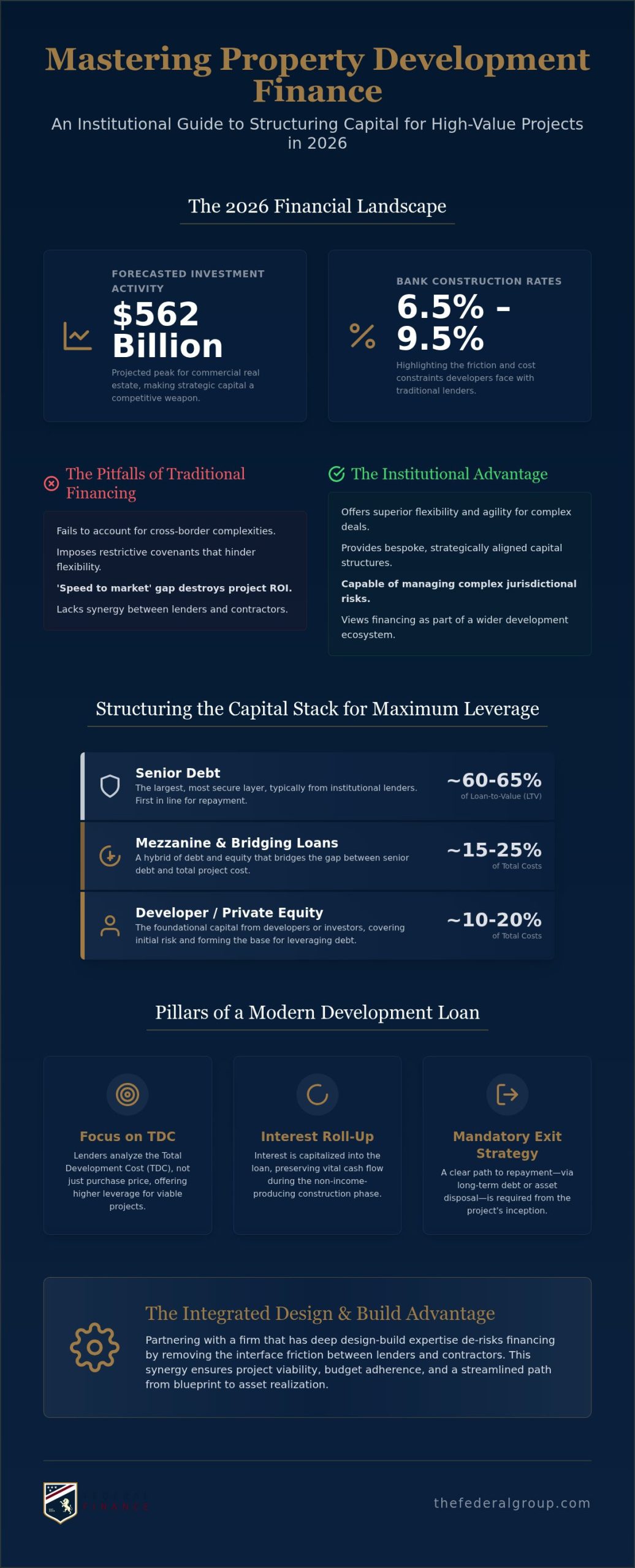
1 August 2026With commercial real estate investment activity forecasted to reach $562 billion in 2026, capital is no longer a mere commodity; it’s a competitive weapon. You’ve likely felt the friction of capital constraints in a market where bank construction rates currently sit between 6.5% and 9.5%. It’s clear that traditional funding models often fail to account for the complexities of cross-border regulations or the critical lack of synergy between lenders and contractors. Securing property development loans today requires an institutional approach that views financing as part of a wider development ecosystem.
This guide provides the framework to master high-value capital structuring and demonstrates how integrated solutions can significantly drive project ROI. You’ll learn how to optimize your capital stack for maximum leverage while maintaining the agility needed for international projects. We’ll examine the strategic use of bridging and construction finance, alongside the de-risking benefits of partnering with a firm that possesses deep design-build expertise. By the end of this analysis, you’ll have a clear roadmap for navigating the 2026 financial landscape with total confidence.
Key Takeaways
- Identify the shift toward institutional alternative lenders and why they offer superior flexibility for property development loans compared to traditional retail banks.
- Master the strategic layering of senior debt, mezzanine finance, and bridging loans to build a capital stack that maximizes project leverage.
- Evaluate the cost-benefit ratio of debt versus private equity to determine the most effective way to scale international portfolios.
- Navigate cross-border regulatory frameworks and jurisdictional risks with a hybrid local-global approach to due diligence.
- Discover how an integrated design and build model de-risks financing by removing the interface friction between lenders and contractors.
What Are Property Development Loans and How Have They Evolved in 2026?
In the context of What is real estate development?, financing serves as the engine for transformation. Property development loans are specialized capital facilities designed to fund every critical phase of a project, from initial land acquisition and pre-development through to the final construction stages. Unlike standard mortgages, these are short-term, high-stakes instruments that prioritize project viability and future value over historical asset performance. They’re built for speed and scale, providing the liquidity necessary to turn a visionary blueprint into a tangible asset.
By 2026, the landscape of development finance has shifted dramatically. Traditional retail banks have largely retreated from high-leverage positions, driven by tighter risk appetites and regulatory pressure. This vacuum has been filled by institutional alternative lenders who offer the agility required in a volatile interest rate environment. With bank construction rates averaging 6.5% to 9.5% in early 2026, developers are seeking bespoke capital structures that provide more than just cash; they need strategic alignment. For high-value, large-scale international projects, this means securing a partner capable of managing complex jurisdictional risks and multi-currency requirements.
Key Components of a Modern Development Loan
Modern property development loans are defined by three distinct pillars. First, lenders focus on the Total Development Cost (TDC) rather than just the purchase price, often providing higher leverage for experienced developers who can demonstrate a clear path to completion. Second, interest roll-up structures are now standard. This allows interest to be capitalized into the loan, preserving cash flow during the non-income-producing construction phase when capital is most needed for site works. Finally, a robust exit strategy is mandatory. Whether it’s a transition to long-term institutional debt or a strategic asset disposal, the path to repayment must be clear from the moment the first draw is made.
Why Traditional Financing Often Falls Short
The ‘speed to market’ gap is the primary reason traditional banking fails modern developers. In a market where privately owned housing starts reached 1,487,000 units in early 2026, delays in funding approvals can destroy project ROI before the first shovel hits the ground. Banks often impose restrictive covenants that hinder the flexibility needed for large-scale international projects. These institutions rarely possess the “integrated” mindset necessary to understand the nuances of industrial-scale development. To succeed, developers require a property finance for high-value projects 2026 guide approach. This methodology prioritizes rapid deployment and specialized expertise over the bureaucratic hurdles of retail banking, ensuring that visionary projects maintain their momentum without being sidelined by rigid, outdated lending criteria.
How Is the Capital Stack Structured for Maximum Leverage?
Structuring the capital stack for high-value commercial projects requires surgical precision. In a market where capital is both a catalyst and a constraint, understanding the hierarchy of funding is essential for any serious developer. Property development loans function as the primary layer of this structure, but they rarely stand alone in the 2026 financial landscape. Maximizing leverage involves a sophisticated orchestration of senior debt, mezzanine finance, and equity, all while maintaining a keen eye on Loan-to-Cost (LTC) and Loan-to-Value (LTV) ratios.
Lenders today are scrutinizing these ratios with increased rigor. While LTC focuses on the actual construction and acquisition costs, LTV looks at the projected Gross Development Value. Balancing these metrics ensures you don’t over-leverage while maintaining enough liquidity to handle unforeseen site challenges. Sophisticated developers often de-risk financing with development agreements that establish clear rights and obligations, making the project far more attractive to institutional partners who prioritize stability. For a comprehensive breakdown of how to layer each component effectively, the 2026 capital stack for property development financing guide provides an in-depth framework for optimizing leverage across complex international projects.
Senior vs. Mezzanine Debt: Finding the Balance
Senior debt provides the financial foundation, typically capped at 60% to 65% LTV in the current 2026 environment. To push leverage higher without significantly diluting internal equity, developers turn to mezzanine finance. This layer sits subordinate to senior debt but takes priority over equity, often filling the funding gap up to 85% of the total cost. Because mezzanine lenders assume a higher risk profile, they price accordingly, with rates frequently sitting in the 9% to 12% range. Finding the right balance between these two debt types is critical to ensuring the project’s debt service coverage doesn’t stifle development momentum.
The Strategic Role of Bridging Finance
A common oversight in capital structuring is the failure to use bridging as a strategic tool rather than a last resort. Acquisition bridging allows for the immediate seizure of prime sites in competitive international markets before full construction facilities are finalized. This speed is vital when new regulations, such as California’s Assembly Bill 1050, open sudden windows for residential or mixed-use conversion. Furthermore, developers can utilize bridging finance for land acquisition to maintain momentum during the complex pre-development and planning phases. If you’re looking to optimize your next project’s funding, exploring a partnership with an institutional property investment partner can provide the integrated insight needed to secure the most favorable terms across every layer of the stack.
Debt vs. Equity: Which Property Development Funding Is Right for You?
Choosing between debt and equity is the most consequential strategic decision a developer faces. While property development loans provide the necessary leverage to amplify returns, they come with rigid repayment obligations and interest costs that can pressure project cash flow. Conversely, equity financing offers a buffer against market volatility but requires a permanent share of the project’s upside. In 2026, where commercial real estate investment is forecasted to increase by 16% to $562 billion, the choice often hinges on whether you prioritize absolute control or the ability to scale rapidly across international borders.
The primary trade-off is the cost of capital versus the dilution of control. Debt is typically cheaper than equity, but it ranks higher in the capital stack. This means lenders must be paid before any profit reaches the developer. Equity is more expensive in terms of total profit share, yet it doesn’t require monthly servicing, which is vital when construction timelines extend. For high-value commercial and mixed-use projects, the “sweet spot” often involves a hybrid approach that utilizes both to optimize the weighted average cost of capital.
The Case for Private Equity Partnerships
Scaling high-value commercial projects often demands capital far beyond a developer’s internal reserves. Engaging a real estate private equity partner provides access to institutional-grade capital and specialized expertise that de-risks the entire development lifecycle. These partnerships function as a risk-sharing mechanism. If market shifts occur, an equity partner provides the financial stability to weather the downturn without the immediate threat of foreclosure associated with debt. Beyond capital, these partners offer global networks that validate project feasibility to secondary financiers and future tenants, creating an ecosystem of support that debt alone cannot provide.
When to Prioritize Debt-Only Structures
For developers with high liquidity and established track records, maintaining 100% ownership is often the preferred route. Debt-only structures, utilizing property development loans, allow you to retain total decision-making power. This path maximizes your Internal Rate of Return (IRR) because you aren’t diluting the profit pool with outside investors. To secure the most competitive rates, which currently sit between 6.5% and 9.5% for bank-led construction financing, developers must demonstrate exceptional balance sheet strength. This approach is ideal for shorter-cycle projects where the cost of debt is predictable and the developer’s internal team can manage all operational risks without external oversight. It rewards those who have the capital to stand alone but requires a disciplined approach to interest rate management.
How to Secure Property Development Loans for International Projects
Scaling a development business across international borders introduces layers of complexity that domestic lenders are rarely equipped to handle. Property development loans for cross-border projects require a deep understanding of jurisdictional risk, ranging from shifting zoning laws to varying environmental mandates. In 2026, we’ve seen total commercial real estate transaction volumes reach $136 billion in the first quarter alone, yet success remains tethered to how well a developer manages local regulatory friction. It’s no longer sufficient to rely on domestic banking relationships; you need a hybrid presence that combines global capital reach with granular, on-the-ground intelligence.
Currency risk is another critical factor. Fluctuations between the loan’s denomination and the project’s local currency can erode profit margins faster than construction delays. Institutional lenders now expect sophisticated mitigation strategies, such as forward contracts or currency swaps, to be baked into the initial financing proposal. This level of foresight demonstrates a developer’s maturity. It also directly impacts the credit terms offered by international real estate finance partners who specialize in cross-border capital deployment.
Navigating Cross-Border Legal and Tax Frameworks
International loan structures almost universally utilize Special Purpose Vehicles (SPVs) to ring-fence assets and liabilities within a specific jurisdiction. These entities are essential for tax efficiency, particularly when managing withholding taxes and the repatriation of capital across borders. Without a structured SPV, developers risk significant tax leakage that can undermine the project’s net IRR. Partnering with an institutional property investment partner is often the most effective way to navigate these local market intricacies. They provide the institutional weight needed to ensure compliance with evolving laws like Florida’s “Live Local Act” or transit-oriented development mandates in California.
The Developer’s Due Diligence Checklist
Lenders in 2026 have moved beyond simple spreadsheets. They require comprehensive feasibility studies that account for current market shifts, such as the rising rental vacancy rate which reached 7.3% in early 2026. Environmental, Social, and Governance (ESG) compliance has also transitioned from a “nice-to-have” to a mandatory lending requirement. High-quality assets that meet these standards are currently experiencing a flight to quality. To satisfy these institutional requirements, developers must present a Professional Developer Package, which is a comprehensive dossier including a verified 10-year track record of successful completions, detailed asset management plans, and audited financial statements. If you’re ready to scale your international portfolio, contact The Federal Group today to discuss your capital requirements.
The Integrated Advantage: How Design & Build Capabilities De-risk Financing
The traditional siloed approach to construction and finance is a primary driver of project friction. When the financier, architect, and contractor operate as separate entities, “interface risk” becomes a significant liability. Lenders increasingly favor the “Integrated Design and Build” model because it eliminates these communication gaps. By aligning the physical delivery of the project with the capital deployment strategy, developers can secure property development loans with more favorable terms and lower risk premiums. This synergy ensures that every architectural decision is vetted against the financial feasibility of the project in real time.
Full lifecycle management allows for a seamless transition from the initial visionary phase to the final asset disposal. In an integrated ecosystem, the friction between architectural progress and capital deployment vanishes. This alignment is particularly vital in the 2026 market, where construction loan rates for professional builders remain elevated. Lenders aren’t just looking at the asset’s value; they’re evaluating the reliability of the delivery vehicle. An integrated partner provides a single point of accountability, which significantly boosts institutional confidence during the underwriting process.
Streamlining the Capital Drawdown Process
One of the most common causes of project distress is the “funding gap” created by delayed drawdowns. In a fragmented model, a lender may wait weeks for independent surveyors to verify site progress before releasing funds. Integrated project management utilizes real-time cost monitoring to provide financiers with immediate, transparent data. This transparency leads to faster drawdowns and fewer construction delays. Industry data suggests that integrated finance and build models can save up to 15% on Total Development Cost (TDC) by reducing interest carry and eliminating the administrative overhead of multi-party disputes. It’s an efficiency gain that directly translates to a higher project ROI.
The Federal Group: Your Partner in Global Development
The Federal Group operates at this unique intersection, functioning as both an international property development finance partner and an active developer through Federal Holdings. This dual role allows us to manage every stage of a project’s lifecycle, from capital structuring to the final build. We possess specialized expertise in complex asset classes, including industrial-scale commercial projects and professional sports infrastructure. By removing the barriers between capital and construction, we provide a stable, ambitious environment for high-value stakeholders. If you’re seeking a partner who understands the gravity of institutional finance and the visionary energy of large-scale development, inquire about bespoke capital solutions for your next project and discover the power of an integrated approach.
Mastering the Future of Institutional Development Finance
The 2026 market demands a departure from fragmented financing. Success now depends on an optimized capital stack that bridges the gap between institutional debt and visionary construction. By leveraging property development loans within an integrated ecosystem, you transform capital from a simple resource into a powerful de-risking mechanism. This approach ensures that cross-border complexities and construction interfaces don’t compromise your project’s ROI.
The Federal Group stands ready as your strategic partner. We offer a unique combination of global reach in professional sports and property markets alongside fully integrated Design & Build expertise. Our model provides the stability and ambition your high-value projects deserve, supported by bespoke short-term bridging solutions and institutional-scale capital. It’s time to move beyond traditional constraints and build with a partner that manages every stage of the lifecycle.
Secure Institutional Funding for Your Development Project and lead your next venture with total confidence.
Frequently Asked Questions
What is the typical interest rate for property development loans in 2026?
Bank-led construction loan rates typically range from 6.5% to 9.5% in early 2026. For specialized or higher-risk private lending, rates often sit between 9% and 12% or higher. These figures fluctuate based on the developer’s track record, the project’s jurisdictional risk profile, and the overall complexity of the capital stack.
How much deposit do I need for a property development loan?
Developers generally require a capital contribution of 20% to 40% of the total development cost. While senior debt covers a significant portion of the construction, this equity injection is necessary to align interests and satisfy institutional Loan-to-Cost requirements. High-liquidity developers may secure better terms by providing larger upfront deposits.
Can I get a property development loan with no experience?
Institutional lenders rarely approve property development loans for individuals without a verified track record of successful completions. Inexperienced developers must typically partner with an established firm or an integrated design-and-build developer to mitigate operational risks. This partnership provides the professional validation required to satisfy stringent institutional underwriting criteria.
What is the difference between a bridging loan and a development loan?
Bridging loans provide rapid, short-term liquidity for site acquisition or debt refinancing before construction begins. They’re designed for speed and temporary coverage. Development loans are structured for the long term, specifically funding the build phase through a series of monitored, staged drawdowns that align with construction milestones.
How does mezzanine finance work in a property development project?
Mezzanine finance acts as a secondary layer of debt that sits subordinate to the senior lender but ahead of developer equity. It allows developers to increase their total leverage up to 85% of the project cost. This effectively reduces the amount of upfront equity required, though it carries a higher interest rate to reflect the increased risk.
What documents are required to apply for international property finance?
Applicants must provide a Professional Developer Package including a 10-year track record, SPV corporate structures, and detailed feasibility studies. Lenders also require proof of ESG compliance and local jurisdictional tax strategies. For cross-border projects, currency risk mitigation plans and audited financial statements are mandatory to ensure institutional-grade transparency.
How do lenders calculate the Gross Development Value (GDV)?
Lenders calculate Gross Development Value by assessing the projected market value of the asset upon completion. This valuation relies on current comparable sales data and capitalized rental income projections, often verified by independent institutional appraisers. It’s a critical metric used to determine the final loan amount and the project’s overall viability.
What happens if a property development project goes over budget?
Budget overruns typically trigger a requirement for additional developer equity or a mezzanine top-up facility to cover the gap. Lenders expect projects to maintain a built-in contingency of 5% to 10% to absorb cost fluctuations. If this contingency is exhausted, the developer must secure secondary funding to maintain construction momentum and lender confidence.