Private Equity for Construction: 2026 Developer’s Guide
23 August 2026With nearly $936 billion in commercial real estate mortgages maturing in 2026, the traditional debt market is no longer a reliable safety net for ambitious developers. You’ve likely felt the pressure of bank construction loan rates reaching up to 9%, while material tariffs of 25% continue to compress your project margins. It’s frustrating when your capital partners don’t understand the friction of cross-border deployment or the technical nuances of the design-and-build lifecycle. These misalignments often lead to stalled momentum and missed opportunities in a competitive global market.
Securing private equity for construction projects offers a sophisticated alternative to these rigid, high-cost debt structures. By aligning with a partner who operates at the intersection of institutional finance and physical development, you gain the agility needed to scale global portfolios with confidence. This guide examines how to leverage flexible equity to navigate today’s complex capital stacks. We’ll analyze the shift toward integrated development models and provide a roadmap for accessing the $43.96 billion in private real estate capital raised in the first quarter of this year alone.
Key Takeaways
- Understand the 2026 transition from traditional bank lending toward alternative capital as the primary engine for high-stakes development.
- Learn to optimize your capital stack by mastering the nuances of joint ventures and the distinct roles of General and Limited Partners.
- Discover how leveraging private equity for construction projects is most effective when paired with a partner who possesses deep sector-specific expertise.
- Explore how an integrated design-and-build model creates a single point of responsibility that significantly de-risks assets for institutional investors.
- Identify strategies for scaling international portfolios by combining flexible bridging loans with long-term equity partnerships.
The Evolution of Private Equity for Construction Projects in 2026
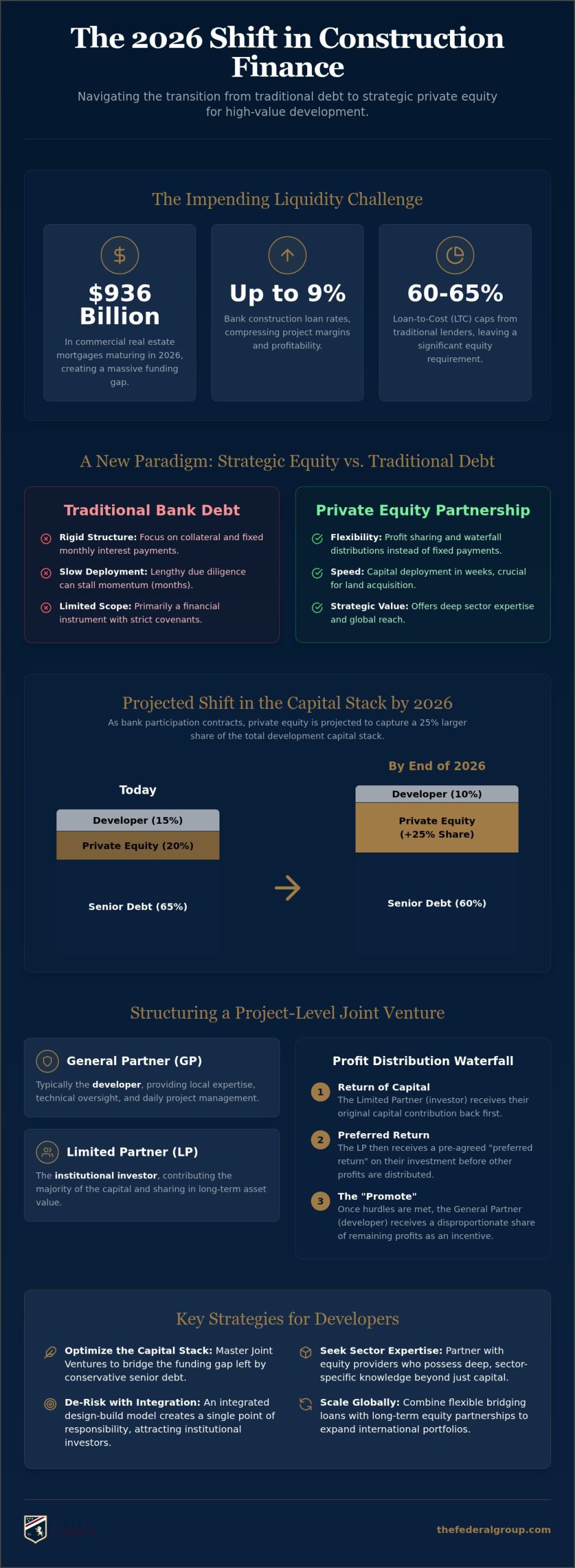
The 2026 financial environment demands a new approach to liquidity. Private equity for construction projects represents more than just a capital injection; it’s a strategic alliance between developers and institutional investors. Unlike senior debt, which focuses primarily on collateral and fixed repayment schedules, Private equity real estate strategies prioritize long term asset value and shared risk. As $936 billion in commercial mortgages reach maturity this year, developers face a significant funding gap. Traditional lenders have retreated, often capping loan to cost (LTC) ratios at 60% to 65% for multifamily projects. This contraction has positioned alternative capital as the primary engine for high value development.
Institutional capital is no longer a secondary option; it’s the bridge that allows projects to move from blueprints to groundbreaking. We distinguish between passive capital, which merely seeks a financial return, and strategic equity. Strategic partners bring more than a balance sheet to the table. They offer an integrated approach, combining financial scale with a deep understanding of the design and build lifecycle. This creates a synergy where the capital partner understands the physical risks of the construction site as clearly as the fiscal risks of the market.
Why Developers are Turning to PE Partners
Developers prioritize private equity because it bypasses the rigid covenants associated with traditional bank debt. When speed is the deciding factor in land acquisition, institutional partners can deploy capital in weeks rather than months. This agility is vital for maintaining momentum in a fast paced market.
- Flexibility: Equity structures allow for profit sharing and waterfall distributions rather than strict monthly interest payments.
- Speed: Streamlined due diligence processes enable faster project starts.
- Global Reach: Capital flows now move seamlessly across borders, allowing developers to tap into international liquidity pools.
The Macro Drivers of Construction Equity
International property development finance is increasingly shaped by a flight to quality. Investors seek stability in the built environment as a hedge against volatility in other asset classes. Global economic trends suggest that specialized expertise is becoming more valuable than generic lending. Private equity for construction projects is projected to capture a 25% larger share of the total development capital stack by the end of 2026 as bank participation continues to contract. This shift reflects a broader confidence in partners who can manage every stage of a project’s lifecycle, from initial financing to the final build.
Structuring Private Equity Deals for High-Value Development
Structuring a project-level Joint Venture (JV) requires a meticulous balance of risk and reward. In these arrangements, the developer typically acts as the General Partner (GP), providing local expertise, technical oversight, and daily management. The institutional investor serves as the Limited Partner (LP), contributing the majority of the capital. This relationship is codified within the capital stack, where private equity for construction projects often functions as the critical link between senior debt and the developer’s equity. With senior lenders frequently capping Loan-to-Cost (LTC) ratios at 60% to 65% in 2026, PE capital is essential for reaching the 80% or 90% thresholds required for ambitious international developments.
The profit distribution in these deals follows a waterfall structure designed to align interests. Initially, the LP receives their original capital back alongside a preferred return. Once these financial hurdles are surpassed, the GP receives a “promote.” This is a disproportionate share of the remaining profits that serves as a powerful incentive for the developer to exceed performance benchmarks. It’s a sophisticated mechanism that rewards the visionary energy of the developer while protecting the stability of the institutional investor.
Common Equity Partnership Models
Developers must choose between direct equity and preferred equity based on their risk appetite. Direct equity implies shared ownership and pari-passu risk, whereas preferred equity sits higher in the capital stack, offering more protection to the investor but a capped upside. We’re seeing a broader trend of vertical integration in the sector, with significant private equity targeting skilled trades to secure the supply chain for their portfolios. This ecosystem approach makes a structured real estate equity partnership an invaluable tool for developers aiming to scale global portfolios without depleting their own liquidity.
The Role of Bridging Loans in Equity Deals
Institutional committees often move slower than the pace of the real estate market. Utilizing bridging finance for land acquisition allows developers to secure prime sites while the long-term equity deal is finalized. This transition from short-term debt to permanent equity ensures project momentum isn’t lost during the due diligence phase. Before approaching a PE partner, developers should ensure their documentation is institutional-grade. A standard audit checklist includes:
- Three years of audited financial statements.
- A comprehensive project budget featuring a 10% to 15% contingency.
- Verified planning and zoning approvals.
- A documented track record of successful delivery in the specific asset class.
If you’re looking to optimize your capital stack for an upcoming project, exploring private equity and bridging options with an integrated partner can provide the necessary speed and scale.
Evaluating the Right Private Equity Partner: Beyond the Capital
The most pervasive misconception among developers is that all institutional capital is fungible. While the numbers on a term sheet might look similar, the operational reality of private equity for construction projects varies wildly between providers. Treating capital as a commodity often leads to friction during the build phase, especially when a financier lacks a fundamental grasp of the construction lifecycle. A partner who only understands spreadsheets will inevitably struggle when faced with the physical complexities of a site, such as unforeseen ground conditions or supply chain disruptions. Capital is abundant; specialized expertise is rare.
Selecting the right international real estate finance partner involves scrutinizing their technical depth as much as their liquidity. The ideal partner possesses an ecosystem view of development. They recognize that a delay in architectural sign-off is as significant as a shift in interest rates. This alignment de-risks the project by ensuring that the person holding the purse strings speaks the same language as the project manager on the ground. Governance shouldn’t be viewed as a surrender of control. High-value partnerships thrive on transparent reporting and clear decision-making frameworks that protect the asset’s IRR without micromanaging the developer’s craft.
Alignment of Interests
For a partnership to succeed, the vision for the asset’s exit must be identical from day one. Developers should seek partners who have a proven history of supporting the design and build model. This understanding allows for more flexible draw-down schedules and a more pragmatic approach to contingency management. During due diligence, you should ask a potential partner: How do you handle mid-project fluctuations in material costs? What is your internal process for approving change orders? Their answers will reveal if they are a strategic ally or merely a passive lender.
Global Reach and Cross-Border Capability
In 2026, high-value portfolios often span multiple jurisdictions. This geographic breadth introduces layers of currency risk and regulatory complexity that can paralyze a domestic-only firm. A partner with multi-jurisdictional experience provides a significant competitive advantage. They can navigate diverse tax structures and local planning laws with precision. Leveraging international property development finance expertise ensures that capital deployment remains seamless, regardless of where the project is located. This global perspective is essential for developers who view their projects not just as individual buildings, but as scalable components of an international investment strategy.
De-risking Construction Projects Through Integrated Finance
Risk is the primary friction point in private equity for construction projects. Institutional investors are historically wary of the fragmentation trap, a scenario where architects, contractors, and financiers operate in silos, leading to finger-pointing when delays occur. Transitioning to the integrated design and build developer model solves this by establishing a single point of responsibility. This structure aligns the financial interests of the private equity partner with the operational execution of the build team. When capital and construction expertise originate from the same strategic source, the project gains a level of stability that traditional, fragmented models cannot replicate.
This integration facilitates lifecycle financing, a holistic approach that manages capital from land acquisition through to the final exit. By removing operational silos, developers can proactively prevent the cost overruns that typically plague high-value projects. In an environment where material tariffs have reached 25% to 30%, this oversight is essential. Integrated teams pivot faster, adjusting designs to meet budget constraints without the weeks of committee approvals required by external lenders.
Streamlining the Development Lifecycle
The impact on project Internal Rate of Return (IRR) is direct. Frictionless capital deployment results in shorter build times, which translates to earlier revenue generation or asset disposal. Developers who utilize integrated property development capital solutions maintain a constant momentum that passive lenders simply can’t support. Integrated design de-risks large-scale projects by synchronizing financial drawdowns with physical milestones, ensuring that capital is never deployed ahead of verified progress. This synchronization protects the investor’s principal while providing the developer with the liquidity needed for complex phases.
Technological Integration and Transparency
Transparency is the currency of institutional trust. Modern private equity for construction projects relies heavily on Building Information Modeling (BIM) and real-time reporting dashboards. These tools allow partners to monitor progress down to the individual component level from any global location. Data-driven construction removes the black box of the building site, providing the granular visibility that institutional equity requires. When a developer proves project health through live data, they become a much more attractive prospect for large-scale capital deployment. This technological layer ensures that every dollar is accounted for and every milestone is backed by verifiable evidence.
If you’re ready to secure a partner who combines institutional scale with technical build expertise, contact The Federal Group to discuss your project requirements.
Partnering with The Federal Group: Global Capital Meets Integrated Expertise
The Federal Group occupies a unique position in the global market, acting as both a sophisticated financier and an expert builder. We recognize that high-value international projects require more than just a line of credit; they demand a partner who understands the gravity of the built environment. Since our inception in 2009, we’ve refined an ecosystem approach that provides both the liquidity of private equity and the technical oversight of a seasoned developer. This dual identity allows us to offer private equity for construction projects that is informed by real-world build data, reducing the risk of stalled momentum.
Our Integrated Approach to Development
Our Federal Holdings division serves as the operational heart of our firm, managing the design and build lifecycle with meticulous detail. This integration ensures that our capital solutions are comprehensive, covering everything from initial bridging loans for land acquisition to the final project exit. We don’t just provide funding; we provide a stable framework for global portfolios to scale. By managing every stage of the project’s lifecycle, we offer a level of reliability that passive lenders cannot match.
Our diversified expertise is further evidenced by our sports division, where we manage multi-club ownership through sophisticated equity structures. This ability to navigate the complexities of international sports markets translates directly to our property operations. It signals a brand that is ready for high-stakes, multi-jurisdictional challenges where institutional security is a non-negotiable requirement. Whether we’re funding a stadium or a high-rise development, our focus remains on long-term value creation and organizational symmetry.
Next Steps for Your Project
Initiating a partnership with The Federal Group begins with a rigorous evaluation of your project’s potential. We prioritize developments that demonstrate a clear alignment with our integrated model and possess a strong track record of delivery. To submit a proposal for development finance or a private equity partnership, your documentation should include a comprehensive project budget, verified planning status, and a detailed exit strategy. We value precision and transparency in every submission.
Our global finance team is prepared to analyze complex capital stacks and provide the flexible funding necessary for international scale. We seek visionary developers who require a heavyweight partner to de-risk their portfolios and accelerate their growth. To discuss your project requirements and explore how our integrated capital solutions can support your 2026 portfolio, contact The Federal Group today.
Future-Proofing Your Development Strategy
The 2026 development landscape rewards the agile and the integrated. As traditional lending continues to contract, leveraging private equity for construction projects has become the definitive strategy for developers aiming to scale global portfolios. Success in this environment depends on more than just securing liquidity; it requires a partner who understands the technical friction of the build site as clearly as the complexities of the capital stack. By adopting an integrated model that bridges the gap between finance and execution, you can effectively de-risk your assets and maintain momentum across multi-jurisdictional borders.
The Federal Group brings over 15 years of international property finance expertise and a unique Integrated Design & Build capability through Federal Holdings. Our global reach across property and professional sports sectors ensures that your projects are backed by institutional stability and visionary energy. We’re ready to help you navigate the high-stakes challenges of international development with confidence and precision. Your next project deserves a capital partner who understands the full lifecycle of your vision.
Partner with The Federal Group for Your Next High-Value Development
Frequently Asked Questions
What is the typical minimum project value for private equity investment?
Minimum project values for private equity for construction projects generally target institutional-scale developments where the capital requirement exceeds traditional bank limits. While specific thresholds vary, investors prioritize high-value assets that justify the extensive due diligence and legal structuring required. These projects typically involve complex urban regeneration, industrial hubs, or large-scale residential portfolios. Focusing on projects with significant scale ensures that the administrative overhead of the partnership doesn’t dilute the overall project returns.
How does private equity differ from a standard development loan?
Standard development loans are debt-based instruments requiring monthly interest payments and fixed repayment dates regardless of project progress. In contrast, private equity involves an ownership stake where the partner shares both the risk and the upside. This structure offers greater flexibility as it doesn’t burden the developer’s cash flow with immediate debt service. Instead, the partner is compensated through profit distributions once the project reaches specific financial milestones or final completion.
What are the main risks for a developer when taking on a PE partner?
The primary risk involves the potential for diluted control and the requirement to meet specific financial hurdles before the developer realizes significant profit. Partners often require transparent reporting and may influence major strategic decisions, such as exit timing or contractor selection. If a project underperforms, the equity partner’s preferred return could erode the developer’s final share. It’s vital to align with a partner whose technical expertise matches the project’s specific complexity.
Can private equity be used for international land acquisition?
Yes, private equity is frequently utilized for international land acquisition, particularly when paired with bridging loans to secure the site quickly. Institutional partners provide the multi-jurisdictional liquidity needed to navigate cross-border regulatory environments and currency fluctuations. This approach allows developers to move faster than competitors who rely on domestic retail banking. Securing land with an equity partner signals long-term commitment to the asset, which often simplifies the subsequent procurement of senior construction debt.
How long does the due diligence process typically take for construction PE?
The due diligence process for private equity for construction projects typically spans 60 to 90 days, depending on the complexity of the asset and the jurisdiction. This period involves a comprehensive audit of the developer’s track record, project feasibility, and architectural specifications. Specialized partners with integrated technical divisions can often streamline this timeline by conducting internal reviews of the design-and-build plans. Having institutional-grade documentation ready, including verified planning permissions and detailed budgets, is essential for a prompt closing.
What is a “waterfall” structure in construction equity?
A waterfall structure is a hierarchical method of distributing project profits among partners based on predetermined financial hurdles. It typically begins with the return of the original capital to the Limited Partner, followed by a preferred return. Once these initial thresholds are met, the developer receives a “promote,” which is a larger percentage of the remaining profits. This mechanism ensures that the developer is highly incentivized to exceed the project’s target Internal Rate of Return (IRR).
How does an integrated design and build model attract better equity terms?
Integrated design and build models attract superior equity terms because they consolidate risk into a single point of responsibility. Investors favor this structure as it minimizes the potential for disputes between architects and contractors, which are common causes of cost overruns. By demonstrating a unified chain of command, developers provide the transparency and reliability that institutional equity requires. This alignment often results in more favorable profit-sharing ratios and lower cost-of-capital requirements for the project.
Is private equity suitable for mixed-use construction projects?
Private equity is exceptionally suitable for mixed-use construction projects because these developments offer diversified revenue streams that appeal to institutional risk profiles. Combining residential, commercial, and retail components allows the partnership to hedge against volatility in a single asset class. Partners with global expertise can help optimize the tenant mix to maximize the asset’s terminal value. This versatility makes equity a preferred choice for large-scale urban projects where traditional lenders might be hesitant.