Property Development Capital Solutions: Streamlining Construction with Integrated Finance
30 July 2026The most sophisticated developers realize that capital isn’t just a line item; it’s the foundation of the entire build process. Relying on fragmented property development capital solutions often creates a disconnect between a lender’s rigid requirements and a developer’s operational reality. This misalignment leads to stalled commencements and mounting costs that erode your project’s margin. When your financier doesn’t understand the nuances of the construction lifecycle, every delay becomes a liability rather than a manageable hurdle.
You’ve likely experienced the frustration of strict banking hurdles or the difficulty of securing cross-border funding for high-value assets. It’s a common pain point in an industry where speed and precision are paramount. This article explores how to optimize your capital stack by aligning financial liquidity with technical design-build expertise. We’ll examine how integrated strategies de-risk large-scale developments, facilitate rapid land acquisition through bridging loans, and provide the global scalability required for institutional-grade projects. By the end, you’ll understand how a unified approach to private equity and development finance creates a more resilient path to completion.
Key Takeaways
- Identify why transitioning from rigid banking models to flexible property development capital solutions is crucial for maintaining project momentum in a volatile market.
- Evaluate the strategic trade-offs between private equity and debt to optimize your capital stack without unnecessary ownership dilution.
- You’ll see how integrating design and build capabilities with financing de-risks large-scale projects by aligning all stakeholders from the outset.
- Navigate the complexities of international finance by managing currency exposure and cross-border regulatory requirements effectively.
- Learn the essential components of a “shovel-ready” investment memorandum that secures high-level commitment from institutional capital providers.
What Are Property Development Capital Solutions?
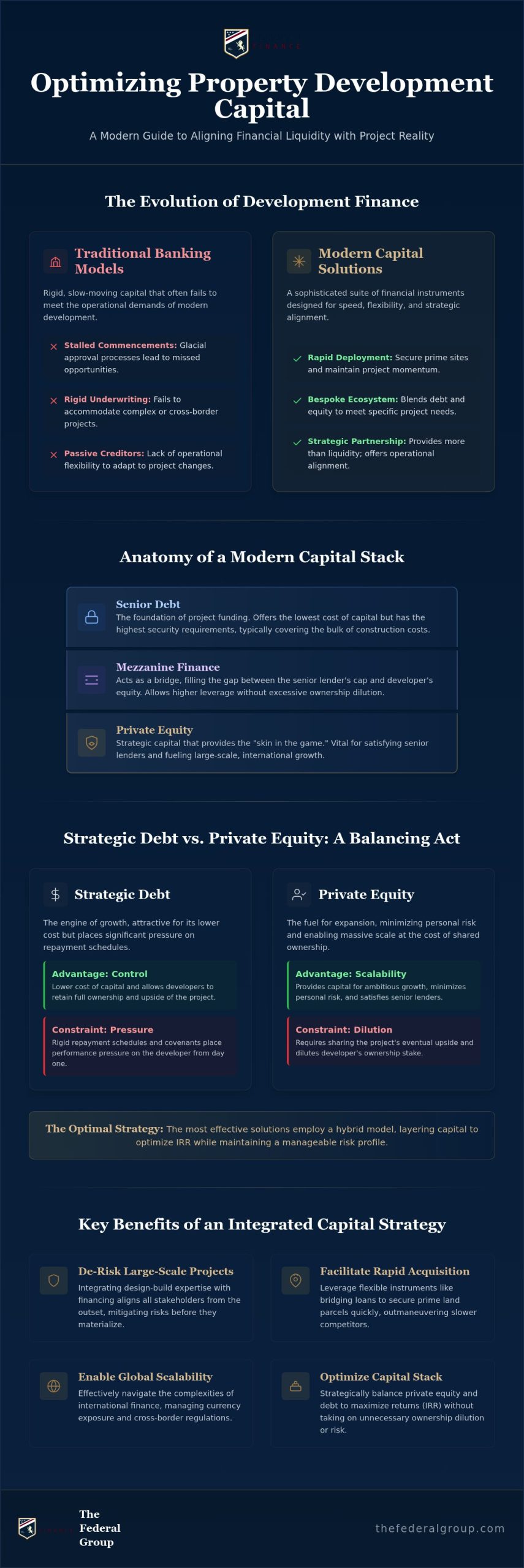
Modern property development capital solutions represent a sophisticated suite of financial instruments designed to fund the full lifecycle of a real estate asset. This encompasses everything from the initial land acquisition and architectural design to the final stages of construction and stabilization. In 2026, the financial landscape has shifted significantly. Traditional bank lending, once the undisputed engine of the industry, has become increasingly constrained by rigid regulatory frameworks and conservative underwriting. This transition has paved the way for alternative, flexible capital providers who offer more than just liquidity; they provide strategic alignment for high-stakes projects.
The term “solutions” implies a departure from the one-size-fits-all loan model. It suggests a bespoke ecosystem where senior debt, mezzanine finance, and private equity are blended to meet the specific requirements of a project. In international property markets, speed and certainty are the primary currencies. Accessing property development capital solutions that prioritize rapid deployment allows developers to secure prime sites and maintain momentum when traditional lenders would still be mired in committee reviews.
The Components of a Modern Capital Stack
A resilient project requires a calculated hierarchy of funding. This stack is built on three primary pillars:
- Senior Debt: This remains the foundation of project funding. It offers the lowest cost of capital but carries the highest security requirements, typically covering the bulk of the construction costs.
- Mezzanine Finance: This layer acts as a bridge. It fills the gap between the senior lender’s cap and the developer’s equity, allowing for higher leverage without diluting ownership excessively.
- Private Equity: Strategic capital injections are vital for large-scale developments. Equity partners provide the “skin in the game” that satisfies senior lenders while fueling ambitious, international growth.
Why Traditional Financing Often Falls Short
Mainstream banks often move at a glacial pace. Their underwriting criteria are frequently too rigid to accommodate the complexities of mixed-use developments or the nuances of cross-border acquisitions. When a project involves international stakeholders or specialized asset classes, traditional banking models often fail to quantify the risk accurately. This leads to stalled commencements and missed opportunities.
Slow approval processes are a significant liability. In a competitive market, a thirty-day delay in funding can result in the loss of a critical land parcel. Furthermore, traditional lenders lack the operational flexibility to adapt to project lifecycle changes. They act as passive creditors. Modern developers need partners who understand the build process and can adjust capital flow to match the reality on the ground. Many of the assumptions developers hold about alternative capital structures are addressed in detail when debunking common myths about the modern property development investment group and how these entities truly operate in today’s market.
Strategic Debt vs. Private Equity: Comparing Capital Solutions
Choosing between debt and equity is a high-stakes decision that dictates a project’s financial ceiling. Senior debt remains attractive due to its lower cost, yet it places significant pressure on the developer to meet rigid repayment schedules. Conversely, private equity minimizes personal risk and provides the capital necessary for massive scale, though it requires sharing the project’s eventual upside. The most effective property development capital solutions frequently employ a hybrid model. This approach layers different types of capital to optimize the Internal Rate of Return (IRR) while maintaining a manageable risk profile. It’s about finding the equilibrium where leverage is high enough to drive returns but low enough to withstand market volatility.
Strategic debt often functions as the engine of growth, while equity acts as the fuel for expansion. For developers targeting global markets, the ability to pivot between these instruments is vital. High-potential projects often start with a heavy equity component to secure the site and initial approvals, later refinancing into cheaper debt once the project is de-risked. This transition requires a partner who understands both the technicalities of the build and the complexities of the global capital markets.
Leveraging Bridging Finance for Land Acquisition
Speed is often the difference between securing a prime site and losing it to a competitor. Bridging loans serve as essential short-term capital solutions, providing immediate liquidity when traditional senior debt is still in the underwriting phase. These facilities allow developers to maintain momentum during critical windows, such as waiting for planning permissions or finalizing long-term financing. They are designed for agility. At The Federal Group, we facilitate fast-tracked bridging for international assets, ensuring that geographic borders don’t hinder your acquisition timeline. This rapid deployment of capital keeps your pipeline moving without the delays common in traditional banking.
The Strategic Advantage of Private Equity Partnerships
Private equity offers more than just a balance sheet. It provides an entry point into global market expertise and elite strategic networks that individual developers might lack. Structuring real estate equity partnerships for long-term growth ensures that interests remain aligned through co-investment models. This synergy is particularly valuable when scaling international portfolios, as it distributes risk across a broader capital base. A specialist partner brings deep sector insight that goes beyond mere funding. If you’re looking to expand your reach, consulting with an integrated finance partner can clarify which equity structure best suits your expansion goals.
De-risking Projects Through Integrated Design and Build Capital
Traditional development often suffers from a structural disconnect. Lenders view construction as a black box of risk, while contractors often view financiers as rigid hurdles. By utilizing integrated property development capital solutions, the “integrated developer” model merges these functions into a single, cohesive operation. This alignment eliminates the typical friction points that lead to project delays. When the capital provider also manages the design and build process, they possess a granular understanding of the project’s technical requirements. This transparency leads to more accurate cost projections and, ultimately, a superior ROI for all stakeholders involved.
Eliminating the “blame game” is a primary benefit of this unified model. In fragmented projects, disputes between architects and contractors often stall funding drawdowns, leading to costly interest accruals. In an integrated ecosystem, these silos disappear. The financier isn’t just a passive creditor; they’re a strategic participant with a vested interest in technical “buildability.” This deep integration allows for more favorable financing terms because the inherent project risk is significantly lower when design and execution are handled by the same entity that controls the capital flow. Developers who still view a property development investment group as a passive, high-cost lender are operating on outdated assumptions that can cost them significantly in today’s market.
Federal Holdings: A Case for Integrated Development
Operating as a fully integrated design and build developer, Federal Holdings exemplifies how to streamline project delivery. By managing architectural design through to final construction under one capital umbrella, the organization removes the need for multiple third-party layers that often have conflicting priorities. This internal synergy effectively reduces the “risk premium” typically charged by external lenders who lack direct technical oversight. It ensures that every dollar of capital is deployed with surgical precision, maintaining the momentum required for high-stakes international developments.
Streamlining Construction with Capital Alignment
Success in large-scale development depends on the harmony between financial drawdowns and real-world construction milestones. Integrated property development capital solutions ensure that funding stages are perfectly synchronized with on-site progress. Technical expertise allows for evaluating project feasibility from a builder’s perspective, not just a financier’s. This foresight prevents the common issue of funding gaps during critical phases of the build. By aligning capital deployment with the actual project lifecycle, developers can significantly reduce delivery timelines and avoid the cost overruns associated with stalled sites. This methodical approach provides the stability needed to navigate complex, multi-disciplinary operations with confidence.
Navigating Cross-Border Challenges in International Property Finance
The globalized economy of 2026 has transformed real estate into a borderless asset class. Securing effective property development capital solutions now requires a deep understanding of how capital migrates between jurisdictions. High-value projects in major hubs like London or New York often rely on a complex blend of international private equity and specialized debt. This shift offers immense opportunity but introduces layers of friction that can stall even the most visionary developments. You need a strategy that accounts for geographic distance and institutional variation.
Managing currency risk is a critical priority. A minor shift in exchange rates can erode the profit margins of a cross-border project before construction begins. Beyond currency, regulatory hurdles such as foreign investment levies and local zoning complexities vary wildly between the US and the UK. Success depends on having a partner with a physical presence or an extensive regional network. This ensures that capital deployment is sensitive to local market dynamics rather than being managed in a vacuum from a distant headquarters. You can’t manage a London development from a New York desk without local intelligence.
Structuring Finance for High-Value International Projects
Mixed-use developments in global cities demand high-level coordination. These projects often involve international stakeholders with diverse tax requirements and legal expectations. Navigating international property development finance requires a structured approach that addresses these complexities from day one. At The Federal Group, we manage global sports and property investments simultaneously. This dual focus allows us to synchronize capital flows across different asset classes while maintaining strict compliance with local international laws.
The Role of Global Sports Investment in Property Development
There’s a growing synergy between professional sports infrastructure and real estate appreciation. Stadium-adjacent developments and multi-club hubs are no longer isolated projects; they’re anchors for wider urban regeneration. Investing in professional football clubs acts as a catalyst for property value growth in the surrounding districts. Specialized property development capital solutions are required to fund these unique ecosystems. These solutions must account for the specific revenue cycles of sports assets while leveraging them to de-risk the adjacent real estate builds. This creates a resilient investment environment that benefits from both athletic success and property appreciation.
Partner with a global expert to navigate your next international development project.
How to Secure the Right Capital Solution for Your Development
Securing the ideal funding structure requires more than a simple loan application. It demands a rigorous, professional approach to documentation and a deep alignment with your chosen partner’s expertise. In a market where capital is discerning, the most successful property development capital solutions are those backed by comprehensive investment memorandums. These documents must address the nuances of both debt and equity requirements, providing a clear roadmap from acquisition to exit. Your memorandum is the first indicator of your project’s institutional quality.
Planning clarity is the primary gatekeeper for capital in 2026. Partners are increasingly prioritizing “shovel-ready” projects where the regulatory risks have been mitigated. This means having integrated design plans and a transparent timeline for commencement. You must also evaluate a capital partner’s specific track record. If your project involves complex sports infrastructure or high-density mixed-use assets, a generic lender will lack the insight to value the project accurately. You need a partner who’s navigated these specific asset classes before and understands their unique revenue drivers.
The Federal Group offers a holistic review that bridges the gap between financial theory and construction reality. We don’t just look at balance sheets; we examine the project’s design and buildability. This integrated perspective allows us to offer property development capital solutions that are more resilient and better structured for long-term success. We prioritize projects where our technical expertise can add value to the financing process.
Checklist for Professional Developers
Before approaching an institutional partner, ensure your project meets these baseline requirements for sophistication:
- Feasibility Study: A detailed project feasibility study that includes integrated design plans and realistic construction costings.
- Exit Strategy: A clear, documented exit strategy, whether it involves a direct sale, a strategic refinance, or a long-term hold for yield.
- Experience Profile: Tangible evidence of developer experience or a formal partnership with a strong integrated design and build firm.
Partnering with The Federal Group
Our “Design & Build” expertise via Federal Holdings directly informs our lending and investment decisions. We don’t operate as a distant committee; we act as a strategic partner that understands the mechanics of the build. This allows us to provide private equity and development finance that’s tailored to the actual lifecycle of your project. We’re committed to strategic equity and growth partnerships that transcend simple transactions.
If you’re ready to scale your international portfolio with a partner that understands the visionary energy of large-scale development, we invite you to start the conversation. Contact The Federal Group today to initiate a consultation for your next international development project.
The Future of Integrated Development Strategy
The evolution of the global real estate market demands a move away from fragmented funding models. Success in 2026 relies on property development capital solutions that bridge the gap between financial liquidity and technical execution. By aligning design-build capabilities with a strategic capital stack, you eliminate the traditional silos that cause delays and inflate risk premiums. Whether you’re navigating the complexities of cross-border regulations or leveraging the growth potential of stadium-adjacent developments, an integrated approach provides the certainty required for institutional-grade projects.
The Federal Group has been a trusted international partner since 2009. We offer specialized expertise in international property and professional sports markets, backed by a global investment footprint. Our Federal Holdings division provides a fully integrated design and build capability, ensuring that our capital is always informed by real-world technical insight. We don’t just provide funding; we provide a foundation for visionary growth.
Partner with The Federal Group for Integrated Capital Solutions to de-risk your next project and achieve seamless global scalability. Your vision deserves a partner with the scale to match it.
Frequently Asked Questions
How do property development capital solutions differ from traditional bank loans?
Modern property development capital solutions differ from traditional bank loans by offering a bespoke, integrated suite of financial instruments rather than a single, rigid debt product. While banks prioritize conservative underwriting and standardized criteria, these solutions incorporate private equity, mezzanine finance, and bridging loans. This flexibility allows for rapid deployment and better alignment with the specific technical milestones of a large-scale construction project.
What is the typical LTV (Loan to Value) for a bridging loan in 2026?
Typical LTV limits for bridging loans in 2026 generally range between 65% and 75% of the asset’s current market value. These limits vary depending on the jurisdiction, the liquidity of the local market, and the project’s overall risk profile. For high-value international assets, lenders often adjust these figures based on the developer’s experience and the clarity of the project’s planning permissions.
How does an integrated design and build model impact the cost of capital?
An integrated design and build model reduces the cost of capital by lowering the “risk premium” typically charged by external lenders. When the financier has direct oversight of the architectural and construction phases, they possess greater certainty regarding project timelines and budget adherence. This transparency allows for more competitive interest rates and favorable terms compared to fragmented projects where silos often lead to delays.
Can The Federal Group provide capital solutions for international sports ventures?
Yes, The Federal Group provides specialized capital solutions for international sports ventures through its dedicated Sports Division. We facilitate funding for stadium-adjacent real estate, training facilities, and infrastructure that supports global sports ecosystems. These solutions are designed to synchronize the unique revenue cycles of professional sports with the long-term appreciation of real estate assets in major international hubs.
What is the minimum project value for private equity property development?
Minimum project values for private equity involvement typically target institutional-scale developments where the capital requirements necessitate a strategic partner. While specific thresholds vary by region, these solutions are generally reserved for large-scale residential, commercial, or mixed-use projects. This ensures that the technical oversight and strategic resources provided by the equity partner are commercially viable for all stakeholders involved.
How quickly can a bridging loan be secured for land acquisition?
Bridging loans can often be secured within a matter of days or weeks, provided the project’s planning status and feasibility studies are clear. This speed is a primary advantage over traditional senior debt, which often requires months of administrative reviews. For land acquisition where timing is critical, these facilities provide the immediate liquidity needed to secure a site before long-term financing is finalized.
What are the benefits of mezzanine finance for large-scale construction?
Mezzanine finance allows developers to achieve higher leverage on a project without the significant ownership dilution associated with additional equity partners. It effectively bridges the gap between the senior lender’s maximum LTV and the developer’s own capital contribution. This structure is particularly beneficial for large-scale construction where maintaining a high Internal Rate of Return (IRR) is a primary objective.
Does The Federal Group invest in professional football clubs as part of their capital strategy?
The Federal Group actively invests in professional football clubs as a core component of its global investment strategy. This multi-club ownership model creates significant synergy with local property development, as sports infrastructure often acts as a catalyst for urban regeneration and property value growth. These investments are managed through a specialized division that understands the intersection of professional sports and international real estate.