Sports Club Private Equity: The 2026 Multi-Club Ownership Trend Analysis
28 July 2026The era of the “trophy asset” has officially ended; professional sports has entered the age of the institutional ecosystem. As we look toward 2026, the deployment of sports club private equity is no longer about individual prestige but about building scalable, multi-jurisdictional platforms. You’ve likely noticed that the traditional path to sports ownership often feels hindered by opaque valuation metrics and a fragmented global market. It’s a high-stakes environment where regulatory hurdles can stall even the most ambitious capital, making entry feel more like a gamble than a calculated investment.
This analysis clarifies the transition from isolated club management to the sophisticated multi-club ownership (MCO) model. You’ll discover how institutional capital is reshaping the industry by linking sports assets directly to high-yield real estate and infrastructure development. We’ll analyze the current regulatory landscape, evaluate the risk-reward profile of professional football investments, and demonstrate how an integrated approach mitigates the volatility of the pitch. By the end, you’ll understand why the most successful portfolios are those that view a stadium not just as a venue, but as the anchor of a broader commercial district.
Key Takeaways
- Understand the shift from passive vanity assets to active operational management within the sports club private equity sector.
- Identify how the Multi-Club Ownership (MCO) model creates global synergies through centralized scouting and commercial infrastructure.
- Learn how “Stadium 2.0” developments transform match-day venues into 365-day revenue engines through integrated real estate projects.
- Navigate complex regulatory hurdles, including UEFA Article 5, to ensure competitive integrity across international portfolios.
- Evaluate the risk-mitigation benefits of an integrated investment approach that combines institutional finance with design and build expertise.
The Institutionalization of Global Sports: From Vanity Assets to Strategic Private Equity
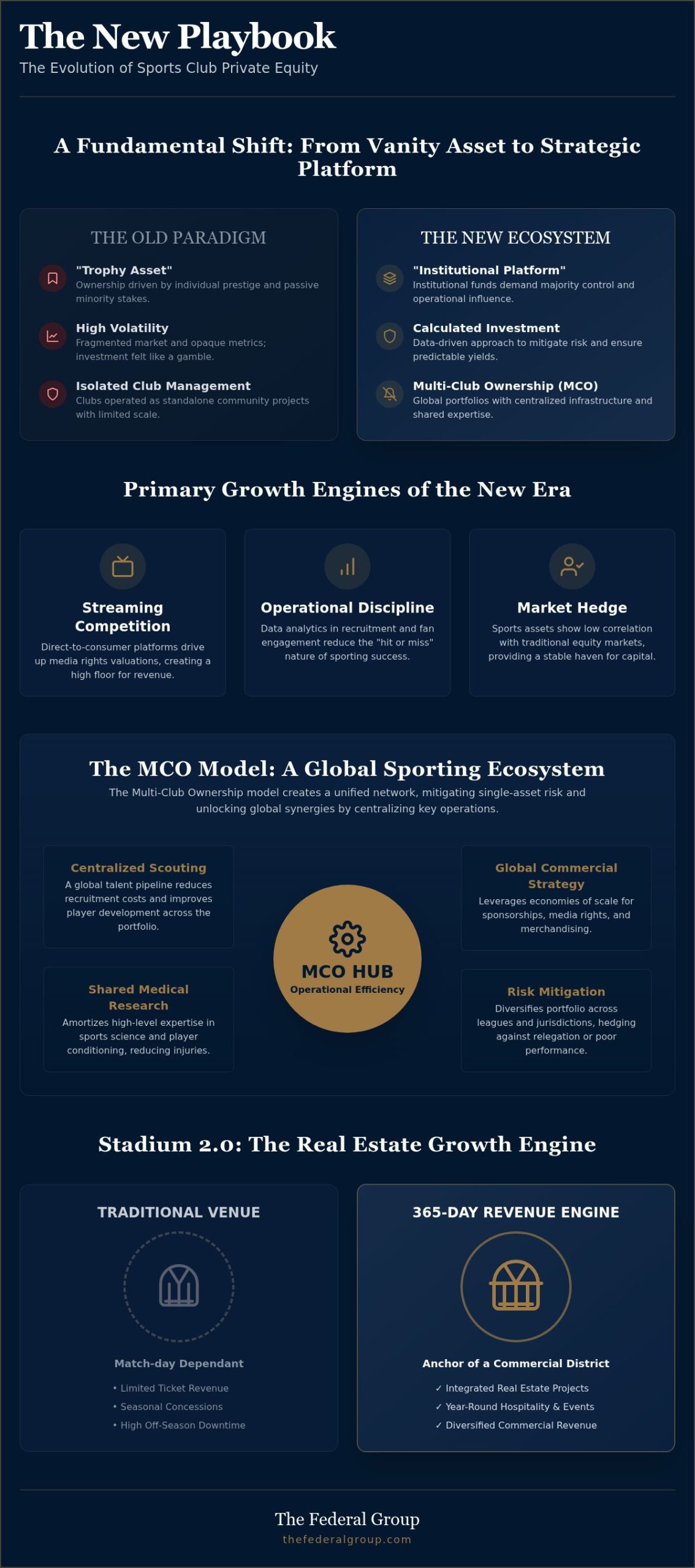
The professional sports landscape has undergone a fundamental structural transformation. By 2026, the deployment of sports club private equity has transitioned from a peripheral investment interest into a core strategy for institutional funds seeking resilient, non-correlated returns. Passive minority stakes are largely a relic of the past. Today’s investors demand majority control or significant operational influence, treating clubs as sophisticated global entertainment platforms rather than local community projects. This shift reflects a broader recognition that professional sports assets possess a unique combination of scarcity and brand loyalty that few other industries can match.
Institutional capital is flooding the market because “Tier 1” assets are finite. There are only a limited number of clubs in the top tiers of European football or major North American leagues, creating a natural supply cap that protects valuations. Investors now view sports clubs through the lens of “Sports as Infrastructure.” The underlying cash flows from broadcasting, global sponsorship, and match-day ticketing are increasingly viewed as predictable yields. These assets function similarly to utilities; they provide essential content for the global attention economy and generate long-term revenue streams that remain resilient even during economic downturns.
The Driving Factors Behind the 2026 Investment Surge
The expansion of global media rights remains the primary engine for growth. The entry of major streaming platforms into the live sports market has decoupled content from traditional cable bundles, sparking intense competition for broadcasting exclusivity. Beyond media, the professionalization of club management has been revolutionary. Clubs now utilize data-driven performance metrics for everything from player recruitment to fan engagement. This scientific approach reduces the volatility historically associated with sports. Key drivers include:
- Streaming Competition: Direct-to-consumer platforms are driving up the floor for media rights valuations.
- Operational Discipline: Data analytics minimize the “hit or miss” nature of sporting success.
- Market Hedge: Sports assets show a low correlation with traditional equity markets, providing a stable haven for capital.
Evolving Ownership Structures: Beyond the Billionaire Owner
The era of the individual billionaire “sugar daddy” is yielding to the rise of institutional fund structures. Private equity firms bring a level of financial discipline that was historically absent in professional sports. They implement rigorous cost controls, optimize commercial departments, and leverage economies of scale across portfolios. Crucially, the involvement of real estate private equity partners allows clubs to unlock the dormant value of their physical footprints. By redeveloping stadium precincts into mixed-use hubs, investors can clean up balance sheets and diversify revenue away from the unpredictability of the pitch. This professionalized approach ensures that the club’s commercial viability isn’t solely dependent on winning trophies.
The Rise of Multi-Club Ownership (MCO): Synergies in Global Football
The Multi-Club Ownership (MCO) model has emerged as the definitive structural response to the volatility of single-asset investment. By acquiring multiple clubs across diverse jurisdictions, sports club private equity groups create a unified sporting ecosystem that functions as a single corporate entity. This model mitigates the binary risk of promotion and relegation while providing a platform for unprecedented operational efficiency. Centralized departments for scouting, medical research, and commercial strategy allow for the amortization of high-level expertise across the entire portfolio, significantly reducing the per-club overhead that often cripples independent organizations.
This systemic approach transforms a collection of clubs into a global network. Investors no longer view a club as an isolated community asset; it’s a node in a broader commercial and athletic pipeline. Through this lens, the sports multi-club ownership model provides a hedge against the hyper-inflation of the transfer market and the unpredictability of league performance. Strategic partners like The Federal Group specialize in identifying these high-potential assets to build resilient, integrated sports portfolios.
Building the Talent Pipeline: The Core Value Driver
The primary economic advantage of the MCO model lies in talent optimization. Institutional investors utilize feeder clubs in emerging markets, such as South America and West Africa, to secure early-stage prospects before they reach the hyper-inflated European market. These players are then moved through a structured hierarchy of clubs, ensuring they receive the appropriate level of competition for their current development stage. Internal transfer value represents the unrealized capital appreciation of an athlete as they transition through a multi-club hierarchy, effectively reducing external acquisition costs. This internal mobility maximizes the eventual exit value or transfer fee when the player is sold to a third-party club outside the network.
Centralized Commercial Operations and Global Branding
Commercial scale is the second pillar of the MCO strategy. Selling a global platform is inherently more lucrative than selling a single local club. By offering sponsors access to multiple markets through a single partnership agreement, MCOs create a “Network Effect” that attracts blue-chip global brands. This centralization extends to digital transformation; a unified fan data platform allows the group to monetize a global audience with precision. Benchmarks like the City Football Group and the Red Bull ecosystem have demonstrated that a standardized identity and shared methodology create a more stable and attractive product for broadcast partners and sponsors alike. The result is a diversified revenue stream that remains robust regardless of the performance of any single club in the network.
Stadium Real Estate and Infrastructure: The Private Equity Growth Engine
The physical footprint of a professional sports organization often represents its most undervalued asset. While earlier sections analyzed the strategic benefits of multi-club ecosystems, the individual stadium remains the primary anchor for localized capital appreciation. Modern sports club private equity strategies now treat the stadium not merely as a venue, but as the centerpiece of a “Stadium 2.0” model. This approach focuses on transforming assets that traditionally sat dormant for 340 days a year into 365-day revenue engines. By integrating mixed-use developments directly into the stadium precinct, investors create a self-sustaining economic hub that operates independently of the team’s weekend performance.
This transition from a match-day facility to a year-round destination is a core driver of institutional ROI. It’s a strategy that fundamentally de-risks the investment by diversifying income streams away from broadcast rights and ticket sales. This vertical integration ensures that sports club private equity allocations are protected through efficient construction timelines and reduced vendor fragmentation.
The Mixed-Use Development Synergy
The “District Model” represents the pinnacle of this evolution. Institutional investors are increasingly converting expansive stadium parking lots and adjacent brownfield sites into high-value residential, retail, and hospitality clusters. This strategy provides a crucial buffer against the volatility of sporting results. A well-executed sports district attracts foot traffic through year-round entertainment, dining, and workspace offerings. The long-term yield on sports-anchored real estate frequently outperforms traditional commercial property due to the guaranteed “anchor tenant” effect provided by the club’s brand and loyal fan base. It’s a method of capturing the “halo effect” of a professional team and crystallizing it into tangible property value.
Financing the Future of Sports Infrastructure
Securing the capital for these large-scale transformations requires a sophisticated, multi-layered approach. Many funds utilize bridging loans to rapidly secure land for stadium expansion or elite training facilities before traditional long-term financing is finalized. Private equity also plays a vital role in Public-Private Partnerships (PPP), filling the funding gap for municipal projects that local governments can no longer afford to finance alone. Navigating these complexities is significantly easier when leveraging specialized international property development finance to structure the acquisition. Integrated design and build developers like Federal Holdings reduce project friction by managing the transition from capital allocation to physical completion under a single operational umbrella. This ensures that “smart stadium” technologies, such as high-density 5G and automated fan-experience systems, are integrated into the initial infrastructure rather than retrofitted at a higher cost.
Risk Mitigation and Regulatory Navigation in Sports Private Equity
Regulatory scrutiny is the primary friction point for institutional capital entering the stadium. As sports club private equity moves from passive minority stakes to active majority control, governing bodies are tightening rules to preserve competitive integrity. The most significant hurdle remains UEFA Article 5. This regulation prohibits any entity from having “decisive influence” over more than one club participating in the same European competition. Investors must navigate these waters with precision; they often utilize non-voting shares or independent management boards to satisfy integrity requirements while maintaining their economic interest in the club’s growth.
The 2026 landscape for North American leagues is shifting just as rapidly. The NFL, long the final holdout against institutional ownership, is evolving its stance as franchise valuations surpass the liquidity of even the wealthiest individual owners. This opening provides a massive opportunity for funds to enter a “closed” ecosystem where the risk of relegation doesn’t exist. However, this entry requires a delicate balance. Firms must drive commercial growth without alienating fan bases that view the club as a community heritage asset. Successful firms position themselves as strategic partners that provide the capital necessary for world-class infrastructure and talent development rather than mere asset strippers.
Navigating Cross-Border Regulatory Environments
Investing across jurisdictions requires a deep understanding of local governance and cultural expectations. In Germany, the “50+1” rule ensures that club members retain a majority of voting rights, effectively capping the level of control a private equity firm can exercise. This contrasts sharply with the US franchise model, where ownership is centralized and protected by league bylaws. To succeed, investors need specialized legal and financial frameworks that account for these structural variances. For a comprehensive breakdown of how these compliance requirements interact with portfolio construction, our 2026 strategic framework for the sports multi-club ownership model provides detailed guidance on satisfying UEFA’s decisive influence thresholds across multiple jurisdictions. If you’re looking to navigate these complex international markets, you can consult with our sports investment specialists to ensure your portfolio remains compliant across all borders.
Exit Strategies and Liquidity in a Niche Asset Class
Liquidity remains a challenge in an asset class traditionally built on long-term hold periods. Private equity firms typically operate on three-to-seven-year cycles, which can clash with the generational timeline of a sports club. To manage this, secondary markets for sports PE stakes are maturing. These markets allow funds to exit or rebalance their portfolios without triggering a full club sale. We’re also seeing the early stages of MCO public listings and IPOs, which provide a path to liquidity while allowing the club to remain part of a larger, diversified ecosystem. These structures ensure that capital can be recycled efficiently without destabilizing the club’s long-term sporting objectives.
The Federal Group’s Sports Division: A New Paradigm in Multi-Club Investment
The Federal Group operates at the specialized intersection of institutional finance and large-scale physical development. While traditional sports club private equity focuses primarily on media rights and player trading, our Sports Division identifies value through a more holistic architectural lens. We recognize that the true potential of a professional football club often lies within its dormant real estate assets. By integrating our private equity capabilities with dedicated design and build expertise, we transform underperforming sports organizations into diversified commercial ecosystems. This approach ensures that every acquisition is supported by a tangible physical strategy, securing the investment against the inherent volatility of on-pitch results.
Identifying high-potential assets requires a global perspective and a deep understanding of local market dynamics. Our team specializes in uncovering clubs where the “hidden” real estate value exceeds the current sporting valuation. We don’t just invest in a team; we invest in the future of the surrounding district. This commitment to building sustainable, commercially viable sports platforms positions us as a strategic partner for stakeholders who prioritize long-term stability and institutional-grade returns. We provide the capital and the construction expertise to turn a community club into a global IP brand.
Integrated Solutions for Global Sports Assets
The lifecycle of a sports asset is managed with precision through Federal Holdings. We oversee every stage of the process, from the initial design of elite training facilities to the final construction of mixed-use stadium precincts. This vertical integration eliminates the friction typically associated with multi-vendor projects. To facilitate rapid movement in competitive markets, we utilize specialized bridging finance to secure assets and initiate turnaround projects before traditional funding structures are finalized. This agility allows our partners to capitalize on distressed or high-potential opportunities that require immediate capital injection. By linking global football assets with international property finance expertise, we create a defensive investment structure that thrives across economic cycles.
Partnering for Growth in the 2026 Sports Market
The Federal Group is currently expanding its portfolio of strategic equity partnerships within the professional sports sector. We invite high-value stakeholders to engage with our Sports Division to explore bespoke investment opportunities that leverage our unique integrated model. Our approach isn’t merely reactive; it’s proactive and visionary, ensuring that every project we touch is optimized for both sporting excellence and commercial ROI. Whether you’re seeking to enter the multi-club ownership space or optimize an existing sports-anchored real estate portfolio, our team provides the specialized insight and global reach necessary to succeed in this complex market. Contact The Federal Group to discuss sports multi-club ownership strategies.
Capitalizing on the Next Evolution of Global Sports
The professional sports landscape has transitioned from isolated vanity plays to integrated, multi-club ecosystems. Investors who recognize the synergy between athletic performance and real estate infrastructure are best positioned for the 2026 market. As the deployment of sports club private equity becomes more institutionalized, the ability to navigate cross-border regulations while optimizing stadium precincts will define the industry leaders. Success now requires a move beyond the pitch, focusing on the “District Model” to ensure year-round commercial viability.
Navigating this high-stakes environment requires a partner with both financial precision and physical development capabilities. The Federal Group provides a distinct advantage through our specialized Sports Division and the integrated design and build expertise of Federal Holdings. We help you identify undervalued football assets and transform them into resilient, diversified revenue engines. Explore Multi-Club Ownership Strategies with The Federal Group to secure your position in the future of professional sports. The opportunity to reshape the global game is here; let’s build the next generation of sports excellence together.
Frequently Asked Questions
Why is private equity suddenly interested in sports clubs in 2026?
Institutional interest is driven by the scarcity of “Tier 1” assets and the resilience of live media rights in a fragmented digital economy. These organizations offer a unique hedge against market volatility. Fan loyalty remains consistent regardless of broader economic shifts. By 2026, the professionalization of club management has further de-risked these investments. This makes them attractive for long-term capital allocation.
What is the Multi-Club Ownership (MCO) model in football?
The MCO model involves a single entity owning multiple clubs across different leagues to create a unified sporting ecosystem. This structure allows for centralized scouting and commercial operations. Such integration significantly reduces overhead through economies of scale. It also facilitates a talent pipeline where players move through a hierarchy, maximizing development and eventual transfer value within a controlled network.
How does sports club private equity impact the local fan base?
Private equity investment typically results in modernized stadium infrastructure and enhanced match-day experiences for the local fan base. While fans often fear a loss of club heritage, institutional capital provides the funding necessary for elite training facilities. Successful firms balance commercial growth with community engagement. This ensures the club’s long-term sustainability doesn’t compromise its historical identity or its deep local roots.
Can private equity firms own majority stakes in all professional sports leagues?
No, ownership rules vary significantly by league and jurisdiction. While North American leagues like the NBA and MLS have opened their doors to institutional stakes, the NFL has historically restricted ownership to individuals. In Europe, Germany’s “50+1” rule prevents external investors from holding a majority of voting rights. Navigating sports club private equity requires a deep understanding of these specific regulatory frameworks and integrity requirements.
What are the primary risks associated with investing in professional sports?
The primary risks include the threat of relegation in European leagues, which can lead to a drastic reduction in broadcast revenue overnight. Regulatory shifts regarding multi-club ownership and financial fair play also introduce uncertainty. Additionally, the binary nature of sporting success means that commercial value is tied to on-pitch performance. The “Stadium 2.0” model aims to mitigate this volatility through diversified real estate.
How does stadium real estate development improve the ROI of a sports club investment?
Stadium real estate development transforms a match-day venue into a 365-day revenue engine by integrating residential, retail, and hospitality elements. This “District Model” diversifies the club’s income. It makes the investment less dependent on seasonal results or broadcast cycles. By creating a year-round destination, private equity firms can capture steady yields from property assets that complement the more volatile sporting revenue streams.
What is the typical exit strategy for a private equity firm in the sports sector?
Exit strategies typically involve a sale to a larger strategic investor, a public listing, or a trade within the secondary market for sports stakes. As the asset class matures, more funds are exiting through initial public offerings (IPOs) of multi-club networks. These secondary markets allow firms to realize gains or rebalance portfolios. They do this without necessitating a complete change in club ownership.
How does The Federal Group integrate property development with sports investment?
The Federal Group utilizes Federal Holdings to manage the entire lifecycle of sports infrastructure from design through to final construction. We link specialized bridging finance with our sports club private equity expertise to facilitate rapid acquisitions. This integrated approach ensures that the physical development is aligned with commercial objectives. It allows for a seamless transition from capital allocation to physical asset optimization.