Analyzing the Sports Multi-Club Ownership Model: A 2026 Strategic Framework
9 August 2026Nearly 42% of clubs across Europe’s top five leagues now operate within shared ownership structures. This data point marks a definitive shift; the sports multi-club ownership model is no longer a peripheral scouting experiment but a core requirement for institutional capital. For many investors, the traditional single-club acquisition feels like an unnecessary gamble against performance volatility and stagnant local revenue. You’re likely aware that scaling an isolated sports asset in 2026 requires navigating a web of complex cross-border regulations and fierce competition for commercial dominance.
This guide provides a strategic framework for using the ecosystem approach to de-risk your portfolio and drive global synergies. You’ll discover how private equity firms are extracting value through centralized data analytics and integrated talent pipelines. We’ll examine the critical March 1, 2026, UEFA compliance deadline and the 30% revenue threshold that defines decisive influence. By the end, you’ll have a clear roadmap for evaluating sports assets as part of a sophisticated, risk-managed network that prioritizes capital efficiency and long-term stability.
Key Takeaways
- Understand how the sports multi-club ownership model transforms volatile single-club investments into stable, institutional-grade portfolios through strategic risk diversification.
- Identify operational economies of scale by centralizing back-office functions and establishing vertical talent pipelines across multiple global markets.
- Unlock commercial value by leveraging network-wide sponsorship packages and monetizing a unified international fan base through integrated digital platforms.
- Navigate the rigorous 2026 regulatory landscape, including UEFA’s “decisive influence” thresholds and the March 1 compliance deadline for European competitions.
- Gain insight into deploying private equity and specialized bridging finance to secure club assets rapidly within high-potential, undervalued leagues.
The Evolution of the Sports Multi-Club Ownership Model in 2026
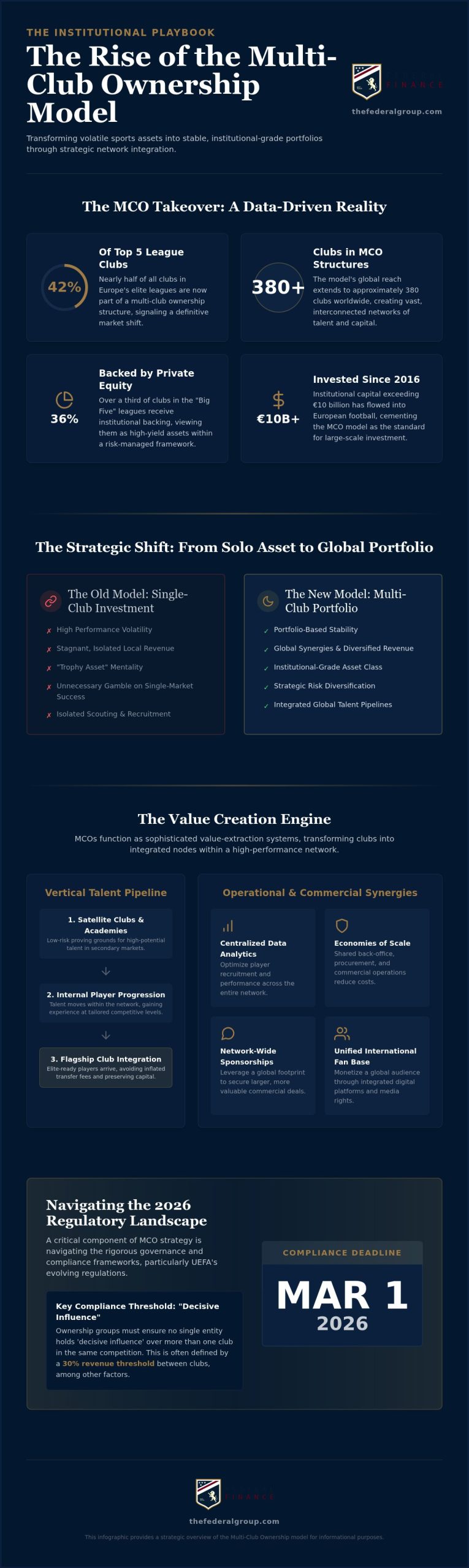
In 2026, the global sports landscape has transitioned from a collection of isolated assets into a sophisticated, interconnected marketplace. The sports multi-club ownership model serves as the primary engine for this transformation, moving beyond simple common shareholding to create deeply integrated operational ecosystems. This year marks the maturity of the institutional sports investment era. As of early 2026, approximately 380 clubs worldwide are part of an MCO structure, including nearly 42% of clubs in Europe’s top five leagues. This shift isn’t merely about prestige; it’s a calculated move to replace the high volatility of single-club investments with portfolio-based stability.
From Vanity Projects to Institutional Asset Classes
The profile of the typical club owner has undergone a radical shift. The era of the individual “trophy asset” owner is largely over, replaced by private equity firms and institutional fund managers who prioritize data-driven valuation and long-term capital preservation. More than 36% of clubs in Europe’s “Big Five” leagues now receive backing from private equity, venture capital, or private debt firms. These investors view clubs as high-yield assets within a broader risk-management framework. By applying ecosystem thinking, these groups can:
- Centralize data analytics to optimize player recruitment and performance.
- Distribute financial risk across multiple jurisdictions and leagues.
- Leverage economies of scale in procurement and commercial operations.
This institutional approach ensures that a poor season for one club doesn’t jeopardize the entire investment. Private equity firms and fund managers have invested over €10 billion in European football since 2016, proving that the sports multi-club ownership model is now the standard for large-scale capital deployment. Understanding the full scope of professional football club investment as a data-driven discipline is essential for any institutional investor entering this space.
The Global Reach of Modern Football Networks
Modern networks now span continents, linking academies in South America and Asia to elite competition in Europe. The City Football Group remains the benchmark for this strategy, demonstrating how a unified global identity drives commercial value. Expanding these networks requires sophisticated financial architecture, often involving cross-border partnerships to develop club infrastructure. Secure capital deployment is essential for rapid expansion. Many groups utilize specialized bridging loans for land acquisition to secure training grounds or stadium sites before competitors can move. Ultimately, the sports multi-club ownership model is a strategic capital deployment framework designed to maximize asset utility through geographic and operational integration.
Strategic Mechanics: How Multi-Club Networks Drive Value
The sports multi-club ownership model functions as a sophisticated value-extraction engine. It transforms isolated sporting entities into integrated nodes within a high-performance network. This structure allows investors to mitigate the high cost of failure traditionally associated with club management. By utilizing a network approach, ownership groups can optimize their balance sheets through coordinated player movement and shared intellectual property. The goal is to move beyond mere participation and toward a model where every club enhances the valuation of the others.
The Talent Pipeline as a Competitive Advantage
Vertical integration represents the most visible mechanic of value creation. Satellite clubs in secondary markets serve as low-risk proving grounds for high-potential talent. This ladder system allows players to develop in competitive environments tailored to their current skill level while remaining under the group’s control. It effectively eliminates the scouting blind spots that plague independent clubs.
The efficiency of the Red Bull pipeline, specifically the movement from Red Bull Salzburg to RB Leipzig, demonstrates this perfectly. By moving talent internally, the group avoids the transfer fee inflation that occurs when a top-tier club acquires a breakout star from an external competitor. This internal movement acts as a balance sheet optimization tool. It preserves capital within the ecosystem while ensuring the flagship club maintains its competitive edge. Groups don’t just buy players; they manufacture them through a controlled, multi-stage process.
Operational Efficiencies and Shared Services
Beyond the pitch, the MCO model drives EBITDA growth through aggressive economies of scale. Centralizing back-office operations allows for significant overhead reduction. Groups can consolidate medical, nutritional, and performance data into a single proprietary database. This ensures that best practices are implemented across every club in the portfolio without duplicating costs.
Global procurement strategies further reduce expenses. When a network manages multiple clubs, it negotiates with kit manufacturers and technology providers from a position of immense strength. Developing shared training infrastructure is a capital-intensive endeavor that requires specialized support. Many sophisticated investors rely on international real estate finance to fund the construction of world-class facilities that serve as regional hubs for the entire network. Coordinating these complex financial and operational threads is essential for maximizing the return on investment. If you’re looking to scale your portfolio through strategic acquisitions, partnering with an expert in sports multi-club ownership can provide the necessary capital and oversight to drive these synergies.
Commercial Synergies and Economies of Scale
The sports multi-club ownership model redefines the commercial ceiling of a professional club by decoupling revenue from local market limitations. In 2026, the most successful networks treat their clubs as a unified media and marketing platform. This shifts the value proposition from selling a single team’s local history to selling a global audience. By aggregating fan bases across different jurisdictions, ownership groups create a powerful data ecosystem that independent clubs simply cannot match.
Unified Global Brand Partnerships
Blue-chip sponsors increasingly prioritize multi-club networks because they offer unparalleled geographic reach and operational simplicity. A single partnership agreement can secure visibility in Europe, the Americas, and Asia simultaneously. This standardization of commercial inventory across different leagues allows for more efficient contract management and higher premium pricing. Private equity involvement has been instrumental here, professionalizing commercial departments that were previously fragmented. These firms apply rigorous financial structuring for multi-club ownership to ensure that brand equity is maximized across the entire portfolio. Cross-border finance facilitates these acquisitions, allowing groups to enter new territories and aggregate local fan bases into a single, monetizable digital ecosystem.
Real Estate and Infrastructure Development
Beyond sponsorship, the physical footprint of a club represents a significant opportunity for asset appreciation. Modern sports investment strategies integrate stadium and training ground development as central pillars of the business plan. By utilizing an integrated design and build developer, ownership groups can execute complex multi-use commercial projects that drive year-round revenue. This infrastructure often includes:
- Hospitality and retail hubs that capitalize on match-day footfall.
- Elite training facilities that enhance player valuation through better performance data.
- Digital infrastructure that supports unified fan engagement platforms.
In an MCO context, infrastructure ROI is amplified because training methodologies and commercial activations can be replicated across the network, reducing the marginal cost of each new development. This holistic approach ensures that real estate assets contribute as much to the balance sheet as the talent on the pitch. By centralizing the development phase, investors ensure that every facility meets a global standard of excellence while maintaining local relevance.
Navigating Governance: Regulatory Constraints in 2026
The rapid expansion of the sports multi-club ownership model has triggered a sophisticated response from global governing bodies. Regulatory frameworks are no longer reactive; they’re now primary drivers of investment structure. For any institutional investor, the March 1, 2026, deadline for UEFA Article 5 compliance represents a critical hurdle. Failing to meet these standards doesn’t just result in fines. It can lead to the forced exclusion of clubs from lucrative European competitions, directly impacting asset valuation and investor exit strategies.
The ‘Decisive Influence’ Test
Governing bodies now utilize a strict “decisive influence” test to maintain competitive integrity. As of 2026, holding 30% of a club’s shares or providing 30% of its total revenue serves as the primary indicator of control. This threshold is a non-negotiable barrier for ownership groups aiming to have multiple clubs participate in the same UEFA competition cycle. To navigate this, sophisticated investors are restructuring their boards to ensure zero overlap in personnel between clubs.
Effective compliance strategies often involve appointing independent management teams for satellite clubs. This creates a functional firewall that satisfies the Independent Football Regulator (IFR) in the UK and similar bodies across Europe. Recent rulings in early 2026 have shown that UEFA is willing to permit multi-club participation in the Champions League only when the parent entity can prove a total absence of shared operational control. Investors must pivot toward a “passive portfolio” model in these instances, sacrificing some operational synergies to preserve the asset’s ability to compete at the highest level.
Ethical Considerations and Community Integration
Maintaining the delicate balance between global capital efficiency and local sporting heritage is essential for long-term stability. Fans are increasingly wary of the “feeder club” label, which can lead to significant reputational risk and decreased local commercial engagement. Successful MCOs prioritize local brand autonomy while implementing global performance standards behind the scenes. This involves preserving club colors, historical crests, and community outreach programs that define the club’s “soul.”
Addressing fan sentiment requires a transparent communication strategy. When a club enters a network, the narrative must focus on the benefits of elite data analytics and financial security rather than just the movement of talent to a flagship asset. Strategies for community integration include appointing local heritage directors and ensuring that stadium developments serve the broader municipality. Managing these complex regulatory and social dynamics requires specialized expertise. If you’re looking to structure a compliant and community-aligned investment, contact The Federal Group to discuss our strategic advisory services for professional sports acquisitions.
Deploying Capital: The Private Equity Perspective
Private equity firms view the sports multi-club ownership model as a tool for aggressive capital preservation and yield generation. Unlike the individual owners of the past, institutional investors identify high-potential clubs in undervalued leagues where the cost of entry is low but the growth ceiling is significant. These “Tier 2” leagues often provide the best entry points for building a network’s foundation. In these markets, the objective isn’t just to win trophies; it’s to acquire assets that can be professionalized through superior management and then integrated into a global commercial ecosystem. This strategy transforms a speculative sporting venture into a predictable financial instrument. For a comprehensive overview of how this discipline has evolved, the 2026 strategic explainer on professional football club investment outlines the modern revenue drivers and operational synergies that sustain valuation growth.
Acquisition Finance and Bridging Solutions
Speed of execution remains the primary competitive advantage in high-stakes sports M&A. When a target club in an emerging market becomes available, the window for closing the deal is often narrow. Investors must move faster than traditional retail banks can operate. Utilizing bridging loans for land acquisition allows ownership groups to secure essential club assets and surrounding stadium real estate simultaneously. This prevents competitors from blocking development plans or inflating prices once the acquisition is public knowledge.
Structuring debt and equity correctly during these early stages is vital to minimize dilution as the network expands. Institutional investors navigating high-stakes takeovers must also contend with UEFA squad cost rules and Premier League revenue-to-spending limits, making it essential to understand the full landscape of football club acquisition finance before committing capital. The Federal Group facilitates these high-value market entries by providing the liquidity required for rapid deployment. We help partners navigate the complexity of international finance, ensuring that capital is available exactly when the opportunity arises. By securing the physical infrastructure alongside the club’s license, investors lock in a tangible asset base that supports the overall valuation of the MCO network.
The Future of Sports as an Alternative Asset Class
The 2026 landscape suggests that the MCO model is rapidly expanding beyond football. We’re seeing the early stages of this transition in the NBA, IPL, and even F1, where ownership groups apply ecosystem logic to maximize media reach and sponsorship inventory. The convergence of sports club private equity and media rights is the next frontier. Networks that own multiple clubs across different time zones can offer sponsors 24/7 visibility, creating a continuous revenue stream that independent clubs can’t replicate.
Exit strategies are also maturing. While secondary sales to larger consortiums were once the only viable path, the scale of modern networks makes them prime candidates for specialized IPOs or long-term yield management. The resilience of the multi-club structure lies in its ability to absorb the shock of a single club’s poor performance through the collective strength of the portfolio. This diversification is what makes sports a viable alternative asset class for the next decade of institutional investment.
Capitalizing on the Networked Era of Professional Sports
The shift toward the sports multi-club ownership model represents a permanent evolution in how professional sports assets are valued and managed. By 2026, the industry has moved past the era of the trophy asset. Investors now prioritize the stability of integrated talent pipelines and the massive reach of global sponsorship networks. Success in this high-stakes landscape requires a meticulous balance between centralized efficiency and local heritage, all while navigating a complex regulatory environment that demands specialized oversight.
To lead in this sector, you need a partner with the scale and specialized insight to manage every stage of the project lifecycle. Partner with The Federal Group for Strategic Sports Investment and Finance to leverage our specialized Sports Division and global private equity expertise. We provide integrated design, build, and finance solutions that turn complex international challenges into secure, high-yield opportunities. The future of sports investment is interconnected; it’s time to build your network with confidence.
Frequently Asked Questions
What is the primary advantage of the sports multi-club ownership model?
The primary advantage is the mitigation of investment risk through asset diversification. By managing a portfolio of clubs, investors reduce the financial impact of a single team’s poor performance or relegation. This structure creates a stable ecosystem where shared data, centralized costs, and coordinated talent movement provide a safety net that independent clubs lack. The sports multi-club ownership model effectively transforms volatile sports assets into a more predictable institutional asset class.
Can two clubs with the same owner play in the same UEFA competition?
Two clubs with shared ownership can participate in the same UEFA competition provided the parent entity proves a lack of “decisive influence” over both. As of 2026, UEFA evaluates this based on a 30% threshold in shareholding or total revenue. Owners must often restructure boards or move to a passive investment model to comply with Article 5 regulations before the strict March 1, 2026, compliance deadline.
How do multi-club networks improve player development?
Multi-club networks improve development by providing clear, controlled pathways for talent across different competitive levels. Satellite clubs act as proving grounds where young players gain experience in high-performance environments tailored to their current stage. This vertical integration reduces the cost of talent acquisition. It ensures that a group’s footballing philosophy is consistent throughout its global academy network, allowing for seamless transitions between clubs in the portfolio.
Is private equity a major driver in the multi-club ownership trend?
Private equity is a dominant force in this shift, with over 36% of clubs in Europe’s top five leagues receiving institutional backing as of the 2025-26 season. These firms bring the capital and specialized expertise required to scale commercial operations rapidly. They view the sports multi-club ownership model as a high-yield alternative asset class, prioritizing data-driven valuations and long-term capital efficiency over traditional vanity ownership.
What are the biggest risks associated with the MCO model?
The biggest risks involve regulatory volatility and the potential loss of local brand identity. Governing bodies like UEFA and the UK’s Independent Football Regulator frequently update “decisive influence” rules, which can force costly restructuring. Additionally, ownership groups face significant reputational risk if local fan bases perceive their club as merely a “feeder” entity. This perception can damage long-term commercial engagement and the underlying brand equity of individual assets.
How does the multi-club model impact a club’s commercial value?
The model increases commercial value by allowing groups to sell “network” sponsorship packages rather than single-club deals. This provides blue-chip partners with multi-continent reach and simplified contract management. By monetizing a unified global fan base through integrated digital platforms, MCOs drive higher revenue per fan. They achieve economies of scale in marketing and procurement that isolated clubs simply cannot match in a competitive global market.
What role does real estate play in a multi-club ownership strategy?
Real estate serves as a critical pillar for asset appreciation and year-round revenue generation. Ownership groups utilize the physical footprint of stadiums and training grounds for multi-use commercial developments, such as retail hubs and hospitality centers. Integrating these projects into a sports master plan ensures that infrastructure contributes to the balance sheet independently of match-day performance. This provides a tangible, land-backed foundation for the overall investment.
How do investors choose which clubs to add to a multi-club network?
Investors prioritize clubs in undervalued leagues that offer high growth potential and strategic geographic locations. Selection criteria often include the quality of existing youth academies, the potential for stadium revitalization, and the club’s ability to serve as a bridge to elite competition. The goal is to identify assets that fill specific gaps in the network’s talent pipeline or provide access to new, commercially lucrative fan demographics.