Common Mistakes in Property Development Financing: The 2026 Developer Guide
23 September 2026Headline interest rate shifts don’t kill major property developments; structural capital stack mismatches do. While broader economic volatility dominates industry headlines, analyzing the common mistakes in property development financing reveals that catastrophic project failures usually stem from within the capital stack itself. Every experienced developer recognizes the acute strain of sudden cost overruns, stringent lender covenants triggering technical defaults during phased construction delays, and the paralyzing cash dry-ups that occur between site acquisition, planning approvals, and initial senior debt drawdowns.
You don’t have to leave your equity exposed to conventional banking rigidity or unpredictable timelines. This 2026 guide provides the framework to master essential capital structuring strategies and avoid the fatal financial pitfalls that derail major property development projects. We explore how to accurately align loan-to-cost (LTC) with loan-to-gross-development-value (LTGDV) metrics, de-risk your deployment schedules against construction shocks, and assemble resilient senior debt, bridging loans, and private equity tranches from flexible institutional partners.
Key Takeaways
- Identifying the common mistakes in property development financing early allows sponsors to engineer dynamic capital stacks that withstand sudden cost inflation and valuation compression.
- Aggressive borrowing without stress-testing against restrictive facility covenants leaves your equity vulnerable to technical defaults during routine project delays.
- Project insolvency stems primarily from operational cash depletion between milestone-certified drawdowns rather than long-term balance-sheet deficits.
- Establishing dual-track exit facilities and structured refinancing bridges protects assets from punitive default interest rates when sales absorption slows.
- Partnering with integrated capital and delivery providers bridges the operational divide between rigid conventional banking and active construction site realities.
Underwriting Deficits: Flawed Feasibility and Miscalculating the Capital Stack
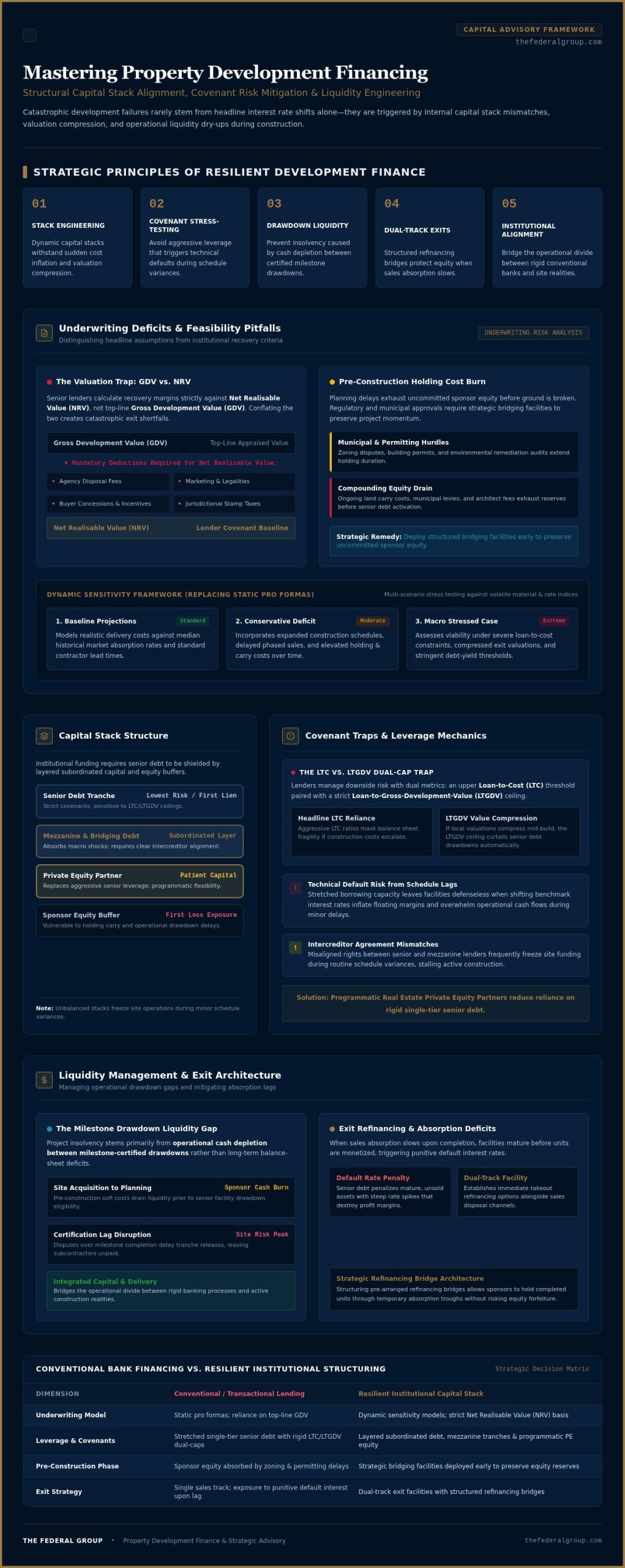
Flawed capital stack structuring occurs when sponsors model debt facilities using static financial assumptions rather than multi-scenario stress tests. Capital stack misallocation is the leading cause of early-stage developer insolvency. While retail brokers often fixate on maximum headline leverage, institutional funding requires senior debt to be shielded by layered subordinated capital, mezzanine tranches, or equity buffers capable of absorbing macro volatility. Navigating complex ventures requires institutional discipline; securing resilient international property development finance demands rigorous sensitivity testing across extended planning and procurement lifecycles to insulate equity from structural failure.
Understanding these dynamics requires deconstructing the wider real estate development process, where initial underwriting assumptions dictate downstream solvency. Without institutional rigor, small forecasting errors compound into critical balance-sheet deficits before construction even breaks ground.
Underestimating Pre-Construction Holding Costs and Permitting Delays
Holding expenses escalate rapidly whenever municipal zoning approvals, environmental remediation audits, or complex building permits stall. Carrying land costs, architect fees, and municipal levies will exhaust uncommitted sponsor equity long before site preparation begins. Deploying strategic bridging facilities preserves project momentum, maintaining liquidity when regulatory planning windows stretch beyond initial timelines.
Conflating Gross Development Value with Net Realisable Value
One of the most common mistakes in property development financing is conflating Gross Development Value (GDV) with Net Realisable Value (NRV). Top-line GDV figures ignore agency disposal fees, marketing legalities, buyer incentives, and jurisdictional stamp taxes. Senior lenders calculate their recovery margins against net asset proceeds. Overestimating completion values creates an immediate capital shortfall if final delivery appraisals compress exit valuations below debt thresholds.
Relying on Outdated Static Pro Formas in Volatile Markets
Static financial models fail to reflect rapid shifts in material indices and variable debt margins. Sophisticated sponsors utilize dynamic sensitivity frameworks to isolate operational risks:
- Baseline Projections: Modeling realistic delivery costs against median historical market absorption rates.
- Conservative Deficit Scenarios: Incorporating expanded construction schedules and higher carry costs.
- Macro Stressed Cases: Assessing project viability under severe loan-to-cost constraints and compressed debt-yield requirements.
Stress testing loan covenants against multi-variable shifts ensures facilities remain compliant during volatile market cycles, eliminating the common mistakes in property development financing that jeopardize project execution.
Debt Structuring Errors: Over-Leveraging and Restrictive Covenants
Maximizing leverage without scrutinizing facility covenants creates acute existential exposure. Stretched borrowing capacity leaves projects defenseless when shifting benchmark interest rates inflate floating margins and overwhelm operational cash flows. Misaligned intercreditor agreements between senior lenders and mezzanine tranches frequently freeze site operations during minor schedule variances. To mitigate this structural friction, developers often evaluate a qualified real estate private equity partner to replace aggressive senior debt layers with patient, programmatic capital.
The Loan-to-Cost Versus Loan-to-Gross-Development-Value Trap
Aggressive headline Loan-to-Cost (LTC) figures often disguise underlying balance-sheet vulnerability. Lenders protect their downside by imposing dual-cap metrics: an upper LTC threshold alongside a strict Loan-to-Gross-Development-Value (LTGDV) ceiling. If local asset valuations compress during vertical construction, the LTGDV ceiling automatically curtails credit availability. Borrowers who don’t model both metrics simultaneously face sudden mandatory equity calls to rebalance loan ratios before subsequent draws receive clearance.
Disregarding Debt Yield Requirements and Interest Rate Covenants
Debt yield metrics provide credit committees with an unvarnished measure of operating returns independent of prevailing market rates. Overlooking these underwriting thresholds is one of the most common mistakes in property development financing. If completed net operating income projections soften, failing to hit prescribed debt yield hurdles locks developers out of takeout refinancing facilities. Hedging instruments, interest rate caps, and operational liquidity buffers must be factored into financial models to prevent debt servicing triggers from forcing an operational standstill.
The Danger of Restrictive Cross-Default and Acceleration Clauses
Standard facility agreements regularly incorporate cross-default and acceleration mechanisms that tilt legal control toward the lender:
- Cross-Default Contamination: These clauses link independent projects, ensuring a schedule breach on one site triggers automated default notices across a developer’s entire corporate portfolio.
- Acceleration Traps: Acceleration covenants permit senior lenders to demand immediate, full principal repayment following technical milestone delays.
- Balance-Sheet Insulation: Sponsors must negotiate non-recourse carve-outs and explicit cure windows to safeguard parent entities from localized disruptions.
When structuring complex facilities, partnering with an established institutional firm like The Federal Group provides flexible capital alignment that insulates development assets from rigid banking covenants.
Liquidity and Cash-Flow Mismanagement: Phased Construction Drawdowns
Development insolvency typically stems from operational cash depletion rather than asset balance-sheet insolvency. On paper, a scheme may project healthy net margins, yet site progress halts instantly if cash runs dry between scheduled disbursements. Capital facility agreements disburse funds retrospectively based on certified milestones, not real-time contractor invoicing. Working capital reserves serve as the vital operational buffer protecting active projects from mid-cycle liquidity dry-ups. Managing these friction points demands specialized bridging finance for land acquisition and phased construction funding lines that sync capital deployment with site realities.
Misaligning Contractor Billing Milestones with Lender Draw Schedules
General contractors submit invoices on rigid thirty-day billing schedules, whereas lender-appointed monitoring surveyors take weeks to inspect, audit, and verify completed works. This standard three-to-six-week inspection lag represents one of the most disruptive common mistakes in property development financing. When cash flow stalls, trade contractors demobilize from the job site. Developers must maintain revolving working capital credit facilities to bridge verification intervals and protect delivery schedules.
Inadequate Contingency Allocations for Escalating Hard Costs
Allocating minimal contingency budgets leaves schemes defenseless against sudden supply-chain price shocks and unforeseen ground conditions. Institutional financiers expect hard cost contingency buffers strictly calibrated to structural complexity and site risk profiles. Unfunded cost overruns trigger immediate stop-work orders from primary lenders protecting their recovery position, leaving sponsors scrambling to inject punitive rescue equity.
Retainage Trap and Subcontractor Cash Flow Paralysis
Lenders hold back completion retainages until snagging lists are resolved and statutory occupancy certifications finalize completely. Sponsors who fail to plan for intermediate trade obligations face critical cash bottlenecks:
- Subcontractor Mechanic Liens: Unpaid trade contractors file statutory liens that immediately trigger technical default clauses under senior debt agreements.
- Defect Rectification Delays: Subcontractors often refuse to return for warranty or snagging works if intermediate retainage distributions are withheld.
- Contractual Alignment: Project contracts must harmonize trade retainage obligations directly with the primary funder’s final release schedule to avoid these common mistakes in property development financing.
Exit Strategy Pitfalls: Refinancing Hurdles and Absorption Lags
Securing high-leverage debt without verified primary and secondary exit routes invites asset forfeiture. Bridging maturities, construction delays, and slow sales absorption frequently trap developers inside punitive default interest rates. Today, credit committees demand verified takeout mechanisms before issuing initial capital commitments on large-scale schemes. Failing to stress-test your terminal capitalization is one of the costliest common mistakes in property development financing. Sophisticated sponsors mitigate this exposure early by pairing structured debt facilities with programmatic private equity takeout commitments.
Timing Lags Between Practical Completion and Sales Velocity
Asset sales cycles often decouple from project timelines during market shifts. Carrying expensive construction facilities past practical completion burns liquidity and rapidly erodes developer return on equity. To prevent capital bleed, sponsors deploy specialized development exit finance. These bespoke bridging instruments refinance maturing construction loans at practical completion, granting sales teams the runway required to achieve target pricing without facing forced liquidation.
Relying on Uncommitted Institutional Takeout Guarantees
Conditional letters of intent and soft term sheets offer zero balance-sheet protection. When macro underwriting requirements tighten, uncommitted forward-funding partners routinely attempt to renegotiate, demanding substantial valuation discounts if completion dates slip. Sponsors must secure contractually binding forward-purchase commitments governed by clear, objective due diligence benchmarks and strict closing timelines.
Underestimating Debt Extension Penalties and Default Interest Rates
Approaching loan maturity without an executed takeout plan exposes developers to aggressive default interest rates and punitive extension fees. These capital charges compound monthly, quickly wiping out projected profit margins during final negotiations:
- Extension Charges: Lenders often impose upfront percentage-based penalties simply to grant a short-term maturity waiver.
- Default Spikes: Technical maturity defaults trigger immediate interest rate step-ups that divert project cash flow directly to debt servicing.
- Advance Refinancing: Institutional developers initiate formal takeout and refinancing discussions at least six months prior to scheduled facility expiration.
To eliminate maturity bottlenecks and protect project equity against slow absorption windows, structure resilient exit facilities with The Federal Group.
Strategic Capital Alignment: Moving Beyond Transactional Lending
Transactional lenders focus strictly on debt recovery covenants, routinely leaving sponsors exposed whenever complex market obstacles emerge. These institutions assess risk through spreadsheets, detached from the physical realities of ground-up construction. Navigating these challenges requires capital partners who unite dynamic, high-yield funding with genuine operational delivery capability. Partnering with an integrated design and build developer establishes vital synergy between capital deployment and site execution, systematically preventing the common mistakes in property development financing that stall projects.
The Operational Risks of Rigid Commercial Banking Debt
Traditional clearing banks rely on bureaucratic credit committees that lack experience with real-world development friction. Minor design changes or supplier adjustments often trigger weeks of formal committee reviews. This administrative paralysis halts site momentum, inflates carrying costs, and threatens pre-sale commitments. Modern private capital providers assess situations pragmatically, approving necessary operational adjustments quickly to keep active developments progressing on schedule.
Integrating Design, Execution, and Financing into Unified Structures
Fragmented project structures divide architects, general contractors, and debt providers into competing silos. This separation drives disputes, unexpected change orders, and prolonged financing friction. Integrating financing with execution transforms delivery dynamics:
- Direct Engineering Alignment: Value engineering and technical feasibility sync directly with financial draw schedules and lender covenants.
- Contractual Friction Removal: Eliminating finger-pointing between design consultants and building contractors gives capital partners complete balance-sheet transparency.
- Compressed Deployment Cycles: Construction milestones, draw schedules, and structural cash outlays coordinate under a single operational umbrella.
Structuring Resilient Capital Solutions with The Federal Group
Avoiding the common mistakes in property development financing requires an institutional partner capable of moving beyond rigid lending criteria. The Federal Group delivers structured capital solutions, real estate private equity, and agile short-term bridging facilities across prime international property markets. Through Federal Holdings, the firm pairs specialized cross-border finance with fully integrated design-and-build capabilities. This dual capability allows capital facilities to be tailored around actual site timelines, protecting developer equity and ensuring seamless execution across complex development assets.
Future-Proofing Your Development Pipeline Against Financial Shocks
Protecting project equity doesn’t happen by accident; it demands rigorous capital structuring from day one. Successfully sidestepping the common mistakes in property development financing requires architecting a capital stack that anticipates phased draw lags, covenant restrictions, and extended absorption horizons. When sponsors replace rigid underwriting assumptions with dynamic stress-testing, schemes withstand unexpected shocks without jeopardizing developer balance sheets.
Long-term development resilience demands capital partners who understand physical site realities. Backed by a global track record funding complex, institutional-scale real estate projects, The Federal Group combines specialized capital deployment across private equity, bridging loans, and development finance with fully integrated design-and-build operational capabilities. This unified approach eliminates structural friction between lenders and site contractors, giving your schemes the stability needed to execute with complete confidence. Partner with The Federal Group for integrated development capital to build a resilient financial foundation for your international pipeline.
Frequently Asked Questions
What is the single most common mistake in property development financing?
The single most destructive error is capital stack misallocation caused by over-leveraging senior debt while neglecting operational liquidity. Sponsors often optimize for low headline borrowing rates without structuring adequate equity buffers or flexible mezzanine tranches. When unforeseen planning hold-ups or contractor draw lags emerge, this structural rigidity quickly starves the project of working capital and leads straight to technical default.
How do lenders calculate Loan-to-Cost (LTC) versus Loan-to-Gross-Development-Value (LTGDV)?
Lenders calculate Loan-to-Cost by dividing the total credit facility by the aggregate development budget, encompassing site acquisition, professional fees, and hard build expenditures. In contrast, Loan-to-Gross-Development-Value measures total loan exposure against the appraiser’s projected end completion value. Institutional financiers typically enforce a dual-cap mechanism, restricting total borrowing to whichever parameter generates the lower advance figure.
What happens if a developer breaches a debt covenant during construction?
A covenant breach triggers an immediate event of default under standard credit agreements. The senior lender reserves legal rights to freeze subsequent drawdowns, impose steep default interest rate margins, or demand instantaneous principal repayment via acceleration clauses. In severe scenarios, intercreditor remedies allow senior debt holders to step into project governance, replace the general contractor, or force asset liquidation to recover capital.
Why is a static pro forma dangerous for high-value development projects?
Relying on a static pro forma ignores the fluid macroeconomic volatility that characterizes modern construction cycles. Fixed financial assumptions fail to account for moving benchmark interest rates, extended procurement delays, or material price increases. Failing to model dynamic sensitivity tests across multiple market scenarios remains one of the costliest common mistakes in property development financing, leaving schemes unable to absorb operational cost overruns.
How much contingency reserve should be budgeted in a development capital stack?
Institutional development models require dedicated hard and soft cost contingencies structured into the primary facility. Complex brownfield schemes and urban ground-up developments generally necessitate a hard cost contingency allocation between 5% and 10% of total construction outlays. Lenders also mandate dedicated interest reserves and operational liquidity lines sufficient to absorb multiple months of statutory permitting or planning delays.
How does development exit finance protect sponsor equity upon practical completion?
Development exit finance replaces expensive construction facilities with lower-rate, short-term bridging capital once a project achieves practical completion. This liquidity bridge removes the pressure of imminent senior loan maturity dates, protecting developer margins from punitive lender extension penalties while sales or pre-leasing teams execute disposal campaigns to hit targeted gross asset realisations.
What is the advantage of working with an integrated finance and build partner?
Partnering with an integrated finance and build firm unites institutional capital allocation with active physical construction management. The Federal Group combines specialized development finance, bridging loans, and private equity with complete design-and-build capabilities through Federal Holdings. This structure eliminates finger-pointing between architects, builders, and lenders, establishing aligned draw schedules and pragmatic underwriting based on genuine construction insight.