Challenges in Securing Development Finance: Navigating the 2026 Market
17 September 2026In 2026, the primary barrier to large-scale construction isn’t a lack of global liquidity, but the widening gap between traditional lending structures and new regulatory realities. You’ve likely noticed that even as base rates like the 30-Day SOFR stabilize around 3.65%, the path to a closed deal feels more restricted than ever. Navigating the current challenges in securing development finance requires more than just a solid balance sheet. It now demands a sophisticated understanding of the March 2026 Basel III re-proposals and the resulting shifts in bank capital charges that are redefining institutional risk appetite.
We understand that maintaining project momentum is difficult when construction costs and cross-border complexities fluctuate. This article identifies the critical regulatory and macroeconomic hurdles facing developers today and provides strategic frameworks to secure high-value capital. We’ll examine how integrated design-and-build models de-risk projects for lenders, why tactical bridging loans are essential for liquidity, and how to align with 2027 compliance standards. By the end of this guide, you’ll have the insights needed to maintain stability and project velocity despite a volatile global market.
Key Takeaways
- Understand the 2026 pivot from traditional banking toward private credit and alternative capital providers to maintain project liquidity.
- Identify how to navigate the specific challenges in securing development finance created by Basel IV/V regulations and increasing capital buffer requirements.
- Discover how an integrated design and build model eliminates operational friction and significantly de-risks projects for institutional lenders.
- Learn to structure a resilient capital stack by leveraging mezzanine finance, private equity, and family office partnerships.
- Utilize tactical bridging loans as a specialized tool to maintain development momentum while long-term institutional funding is finalized.
The Evolving Landscape of Global Development Finance in 2026
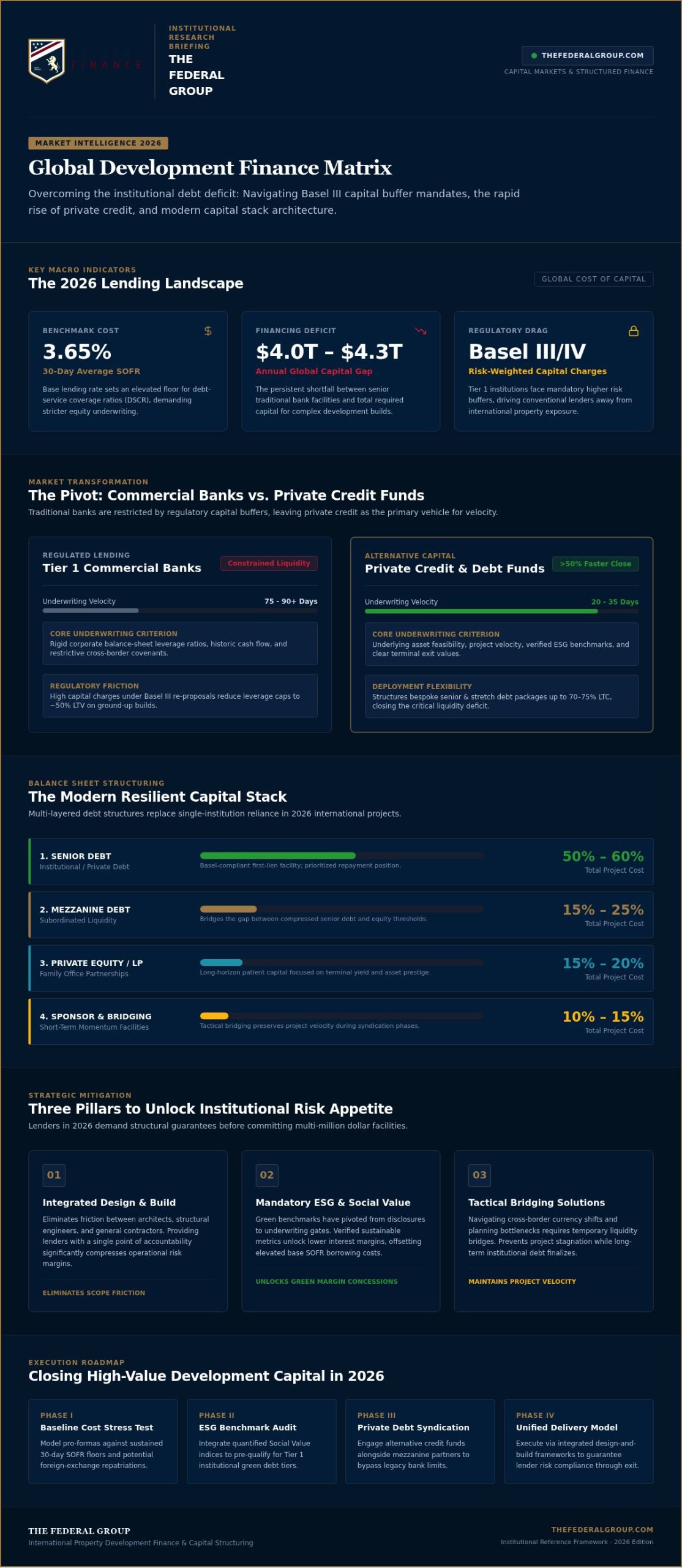
Traditional banking is no longer the primary engine for high-value development. Institutional lenders have shifted their focus, creating significant challenges in securing development finance through legacy channels. In 2026, liquidity is flowing toward alternative providers and private credit funds that operate with greater speed and flexibility. This evolution is a direct response to the March 2026 Basel III re-proposals, which continue to influence how global banks allocate capital to real estate assets.
Project feasibility now hinges on navigating a landscape where the 30-Day Average SOFR sits at 3.65%. While this is lower than the peaks of 2024, it’s high enough to demand more efficient capital stacks. Developers are finding that capital is increasingly concentrated in “Tier 1” projects that integrate advanced technology and meet the highest sustainability standards. Institutional backing is often contingent on demonstrating “Social Value,” a metric that quantifies a project’s impact on local ecosystems and economies. Without these elements, securing the necessary risk capital becomes an uphill struggle.
The Rise of Private Credit in Property
Non-bank lenders have become a dominant force in the high-value sector because they prioritize project viability over rigid balance sheet ratios. The speed of deployment is the primary differentiator; private credit can often close a transaction in less than half the time required by a commercial bank. This agility allows developers to maintain momentum during critical acquisition phases. The liquidity gap in 2026 is the persistent deficit between traditional senior debt limits and the actual capital required to fund complex, international builds.
ESG and Sustainability as Mandatory Criteria
Environmental, Social, and Governance (ESG) criteria have transitioned from optional disclosures to non-negotiable lending requirements. Many development finance institutions and private equity funds now use green benchmarks to filter their pipelines. Projects that don’t meet these standards face punitive interest rates or a total lack of appetite from secondary market buyers. However, green-financing incentives provide a strategic advantage, often offering lower margins that help offset the broader cost of capital. By linking sustainability to long-term asset value, developers ensure their projects remain attractive for exit liquidity in an increasingly climate-conscious market.
Macroeconomic and Regulatory Hurdles for International Projects
International projects face a unique layer of complexity that domestic builds rarely encounter. The March 2026 Basel III re-proposals have tightened the grip on Tier 1 banks, forcing them to maintain higher capital buffers against real estate loans. This shift directly impacts developer margins by increasing the cost of institutional debt. Navigating these systemic shifts highlights the specific challenges in securing development finance for large-scale assets, where lenders are now prioritizing liquidity over long-term yield. A proactive strategy is required to manage these regulatory shifts before they stall a project’s capital deployment.
The global development financing gap, currently estimated between $4 trillion and $4.3 trillion annually, underscores the scarcity of institutional capital for complex builds. Beyond regulation, currency volatility presents a persistent threat to cross-border capital repatriation. With SOFR-linked debt service costs remaining elevated, fluctuating exchange rates can quickly erode the feasibility of projects relying on international funding. Navigating the specific international property development finance requirements for these projects requires a structure that anticipates both macroeconomic shifts and local fiscal policies.
Cross-Border Regulatory Friction
Compliance isn’t a static target in 2026. Developers must manage varying standards across the US, UK, and European markets simultaneously, which often leads to “regulatory creep.” Local planning and zoning bottlenecks in high-density urban markets frequently delay projects long enough for new financial regulations to take effect mid-cycle. Specialized legal counsel has become essential to structure international projects in a way that remains resilient to these multi-year policy shifts. It’s no longer enough to meet today’s rules; you’ve got to anticipate the 2027 compliance landscape to ensure long-term funding stability and avoid sudden capital calls.
Inflationary Pressures and LTGDV Calculations
Lenders have become increasingly conservative regarding Loan-to-Gross Development Value (LTGDV) ratios. Fluctuating construction material costs and labor shortages have made traditional appraisals less reliable, prompting financiers to demand higher contingency buffers that often exceed 15% of the total project cost. These inflationary pressures contribute to the primary challenges in securing development finance, as they increase the equity requirement for the developer. Rising interest burn during planning delays further complicates the exit strategy, making accurate LTGDV recalculations a weekly necessity to maintain lender confidence and project momentum.
Risk Mitigation: De-risking Through Integrated Development
Lenders in 2026 prioritize certainty over projected yields. One of the most persistent challenges in securing development finance is the inherent fragmentation of the project lifecycle, which creates multiple points of failure for a financier. Adopting an integrated design and build developer model addresses this directly by consolidating accountability under a single entity. This structure eliminates the friction between architects and contractors, ensuring that design intent and budgetary constraints remain aligned from inception to completion. When the entity designing the project is also responsible for its delivery, the risk of a funding gap caused by misaligned cost estimates is significantly reduced.
Transparency has become the primary currency for private equity partners. Utilizing Building Information Modeling (BIM) and real-time supply chain data allows developers to provide the granular financial clarity that institutional backers require. This level of operational visibility is essential for mobilizing private capital in a market where traditional banks have retreated. When a lender can see a direct, data-backed link between construction progress and capital drawdowns, their confidence in the project’s eventual exit liquidity increases. This audit trail is a powerful tool for overcoming the skepticism of modern credit committees.
The Efficiency of Full-Lifecycle Management
Shortening the time-to-market is critical for maintaining ROI in a high-interest environment. By unifying the design and construction phases, developers reduce the likelihood of costly mid-build revisions that typically drain contingency funds. Unified management ensures that value engineering happens at the start, not as a desperate measure during construction. Lenders prefer projects with a single point of accountability because it removes the multi-party disputes that frequently trigger default clauses or delay interest payments. This streamlined approach directly improves the project’s internal rate of return by accelerating the transition from construction to revenue generation.
Strategic Use of Bridging Finance
Securing high-value sites requires a level of agility that traditional long-term debt cannot always provide. Utilizing bridging finance for land acquisition allows developers to capitalize on market opportunities immediately, preventing site loss to better-funded competitors. This short-term capital serves as a tactical tool while the more complex long-term development loan is structured. Managing a bridge-to-exit strategy in 2026 requires a precise understanding of interest burn. Developers must ensure that the transition to permanent finance occurs quickly to prevent refinancing costs from eroding the project’s net margin. This strategic layering of capital is a hallmark of sophisticated, high-stakes development.
Strategic Capital Raising: Beyond Traditional Lending
The retreat of traditional institutional lenders has forced a fundamental redesign of how projects are funded. One of the primary challenges in securing development finance today is bridging the equity gap that has widened as banks lower their Loan-to-Value (LTV) thresholds. To maintain project velocity, developers are moving toward a multi-layered capital stack that combines senior debt with mezzanine finance and preferred equity. This diversification doesn’t just provide liquidity; it creates a resilient financial structure capable of withstanding the market shifts discussed in previous chapters.
Family offices have emerged as pivotal players in this environment. Unlike commercial banks, these private entities often provide patient capital with a longer-term horizon, making them ideal partners for complex, international builds. Joint Venture (JV) structures are also gaining traction, allowing developers to trade equity for the certainty and scale required to break ground on high-value assets. Securing a real estate private equity partner is often the final piece of the puzzle, providing the institutional credibility needed to unlock the remaining layers of the stack.
Structuring the Capital Stack for 2026
- Step 1: Core Debt Identification. Establish the maximum senior debt available under current LTV limits, typically factoring in the 3.65% SOFR environment to ensure debt service coverage remains viable.
- Step 2: Layering Mezzanine Finance. Utilize mezzanine debt to fill the gap between senior lending and developer equity, reducing the need for high-cost capital calls.
- Step 3: Cost-Benefit Evaluation. Analyze the weighted average cost of capital (WACC) by comparing the dilution of preferred equity against the interest burn of high-leverage debt.
The Rise of Niche Asset Classes
Capital is increasingly flowing toward specialized assets that offer defensive yields in a volatile market. Sports multi-club ownership models, life sciences hubs, and data centers are attracting significant interest from global private equity funds due to their high barriers to entry and long-term lease structures. These sectors require more than just capital; they demand a partner who understands the specialized infrastructure requirements and the unique operational risks involved. Attracting global capital to these localized high-growth hubs requires a sophisticated narrative that aligns project delivery with institutional ESG and performance mandates.
Explore how our private equity and development finance solutions can strengthen your capital stack and secure your project’s future.
Partnering with Global Finance and Development Specialists
In the 2026 market, the gap between a financier’s expectations and a developer’s operational reality is a primary source of friction. A development finance lender must possess a technical understanding of the build process to accurately price risk. When lenders lack this insight, they often impose restrictive covenants that ignore the nuances of industrial-scale property development. Overcoming the challenges in securing development finance requires a partner who views the project as a holistic ecosystem rather than just a series of balance sheet entries. This specialized expertise ensures that capital deployment remains synchronized with construction milestones.
Preparing a “lender-ready” prospectus for 2026 demands a sophisticated narrative that includes real-time BIM data and 2027 compliance projections. It’s no longer enough to present a static financial model; you must demonstrate how the project remains resilient across multiple macroeconomic scenarios. A specialist partner helps bridge this gap by translating complex construction data into the risk-mitigation language that institutional credit committees demand. This technical alignment is the foundation of a successful, high-value capital raise.
The Value of an International Finance Partner
High-value developments often require access to off-market capital and private institutional networks that aren’t visible through traditional retail banking channels. Navigating the cross-border tax and legal implications of these transactions requires a partner with a truly global footprint. It’s about more than just securing a rate; it’s about structuring a vehicle that remains efficient across different jurisdictions. Maintaining project momentum often depends on flexible bridging solutions that can fill temporary liquidity gaps while long-term institutional funding is finalized. This agility is what separates visionary projects from those stalled by regulatory friction.
The Federal Group: A Unified Vision
The Federal Group provides an integrated approach that bridges the gap between capital and construction. Through Federal Holdings, our design-and-build capabilities ensure that every stage of the project lifecycle is managed with institutional precision. This integrated model is a key differentiator, as it directly addresses the challenges in securing development finance by reducing lender anxiety through a single point of accountability. Our specialized Sports Division further extends this expertise into global asset management, offering unique multi-club ownership models that attract specialized private equity. We invite you to consult with our strategic partners to refine your capital raising strategy and secure the backing your next high-value project deserves.
Securing the Future of High-Value Assets
The 2026 landscape has redefined the relationship between risk and capital. Success in this environment requires a departure from fragmented development models and a move toward institutional-grade transparency. By mastering the new capital stack and utilizing integrated frameworks, developers can bridge the liquidity gap despite tightening regulatory buffers. Overcoming the challenges in securing development finance now demands a partner who understands both the intricacies of global credit markets and the technical realities of the build site.
The Federal Group provides this specialized expertise. Since 2009, we’ve delivered strategic capital solutions across international property and professional sports markets. Through Federal Holdings, we offer a fully integrated design and build approach that de-risks projects for our partners and ensures long-term asset stability. It’s time to elevate your financial structure and maintain project momentum in an evolving global economy. Partner with The Federal Group for your next high-value development and secure the certainty your vision requires.
Frequently Asked Questions
What are the biggest challenges in securing development finance in 2026?
The primary challenges in securing development finance in 2026 stem from the widening liquidity gap between traditional bank risk appetite and project capital requirements. Elevated base rates, such as the 30-Day SOFR at 3.65%, have increased debt service costs significantly. Additionally, developers must navigate a complex regulatory environment where institutional lenders demand higher equity contributions and more stringent ESG compliance. Securing high-value capital now requires a sophisticated capital stack that integrates private equity and alternative credit sources.
How has Basel IV affected property development loans for commercial projects?
Basel III and IV regulatory standards have forced commercial banks to maintain larger capital buffers, which directly reduces the volume of available property development loans. The March 2026 re-proposal in the U.S. provided some relief by rescinding the 19% aggregate capital increase, but banks remain cautious ahead of 2027 compliance dates. This caution translates to lower Loan-to-Value ratios and higher margins for developers. Consequently, projects that once qualified for institutional bank debt now frequently require mezzanine or private equity layers.
Can bridging finance be used for large-scale international land acquisition?
Bridging finance is an essential tactical tool for securing high-value international land sites before long-term development loans are finalized. These short-term facilities allow developers to capitalize on off-market opportunities with speed, preventing site loss to competitors. In the 2026 market, bridging loans provide the necessary liquidity to maintain momentum during the planning and regulatory approval phases. Once the project is de-risked and shovel-ready, developers typically transition from the bridge facility into a more permanent, long-term capital structure.
What is the typical Loan-to-Gross Development Value (LTGDV) lenders expect today?
Lenders in 2026 typically expect a Loan-to-Gross Development Value (LTGDV) between 60% and 65%, though this can tighten significantly for complex international builds. Conservative appraisals are now the standard as financiers account for fluctuating material costs and potential labor shortages. Many institutional partners demand higher contingency buffers, often exceeding 15% of total costs. To secure a higher LTGDV, developers must present a robust lender-ready prospectus that includes real-time BIM data and a clearly defined exit strategy.
How does an integrated design-and-build model help in securing better finance terms?
An integrated design-and-build model directly addresses the challenges in securing development finance by establishing a single point of accountability for both architectural intent and final construction. Lenders prefer this structure because it eliminates the typical friction between contractors and designers, which often leads to cost overruns and delays. By unifying these phases, developers provide financiers with greater budgetary certainty and shorter time-to-market. This operational efficiency often results in more favorable interest margins and a smoother capital drawdown process.
What role does ESG play in the approval process for development finance?
ESG criteria have transitioned into a non-negotiable requirement for institutional approval in 2026. Lenders and private equity partners now use Social Value metrics and green benchmarks to determine a project’s long-term viability and exit liquidity. Projects that fail to meet these standards face limited appetite in the secondary market or punitive borrowing costs. Conversely, high-performance sustainable builds can access specialized green-financing incentives. These incentives often provide lower margins that help offset the generally higher cost of modern capital.
Why are private equity partnerships becoming more common for developers?
Private equity partnerships are becoming essential as developers look to fill the equity gap left by the retreat of traditional retail banking. These partners provide the patient capital and institutional credibility needed to unlock larger senior debt facilities. Joint Venture structures allow developers to trade equity for the scale and certainty required for high-value international projects. Private equity also brings strategic global networks, which are vital for navigating the cross-border tax and legal complexities inherent in modern industrial-scale development.
How can I secure funding for a sports-related property development project?
Securing funding for sports-related development requires a partner with specialized expertise in niche asset classes and multi-club ownership models. The Federal Group’s dedicated Sports Division focuses on professional football clubs and related infrastructure on a global scale. These projects often rely on a blend of private equity and specialized development finance to manage unique operational risks. Success depends on aligning the project’s commercial potential with the specific risk appetites of institutional investors who prioritize defensive, high-barrier-to-entry assets.