High Value Bridging Finance: Strategic Capital Structuring in 2026
24 September 2026Institutional bridge facilities aren’t defensive stopgaps; they’re tactical acquisition instruments engineered to capture complex, high-stakes opportunities before the broader market reacts. When competing for premier commercial or residential assets, deploying high value bridging finance enables sponsors to bypass retail credit inertia, secure time-critical positions, and control prime opportunities without forfeiting project equity.
You already know that conventional institutions move too slowly for off-market transactions. Standard banking channels consistently stall when evaluating cross-border collateral, complex SPVs, or offshore holding structures, creating acute liquidity friction right when agility matters most.
This guide provides the framework to master high value bridging finance across international portfolios. You’ll discover how to structure multi-layered collateral across foreign corporate vehicles, deploy institutional non-bank capital within compressed execution windows, and secure predictable exit pathways into senior development debt or strategic disposals. Here is how leading sponsors orchestrate bespoke bridge capital in 2026 to preserve equity and accelerate project velocity.
Key Takeaways
- Institutional high value bridging finance functions as a tactical acquisition weapon, unlocking rapid, multi-million non-bank liquidity where conventional retail lenders fail to execute.
- Sophisticated underwriting frameworks accommodate cross-border collateral, multi-jurisdictional SPVs, and offshore holding structures across key financial centres without deal-breaking delays.
- Strategic capital deployment accelerates high-stakes land assembly and secures vital planning gains between conditional acquisition and full zoning approval.
- Defensible, pre-structured exit pathways protect sponsor equity by guaranteeing seamless transitions into permanent development finance or timely asset disposals.
- Partnering with an integrated capital and delivery partner removes structural broker friction and unifies asset underwriting with active construction execution.
Defining High Value Bridging Finance: Institutional Capital Architecture
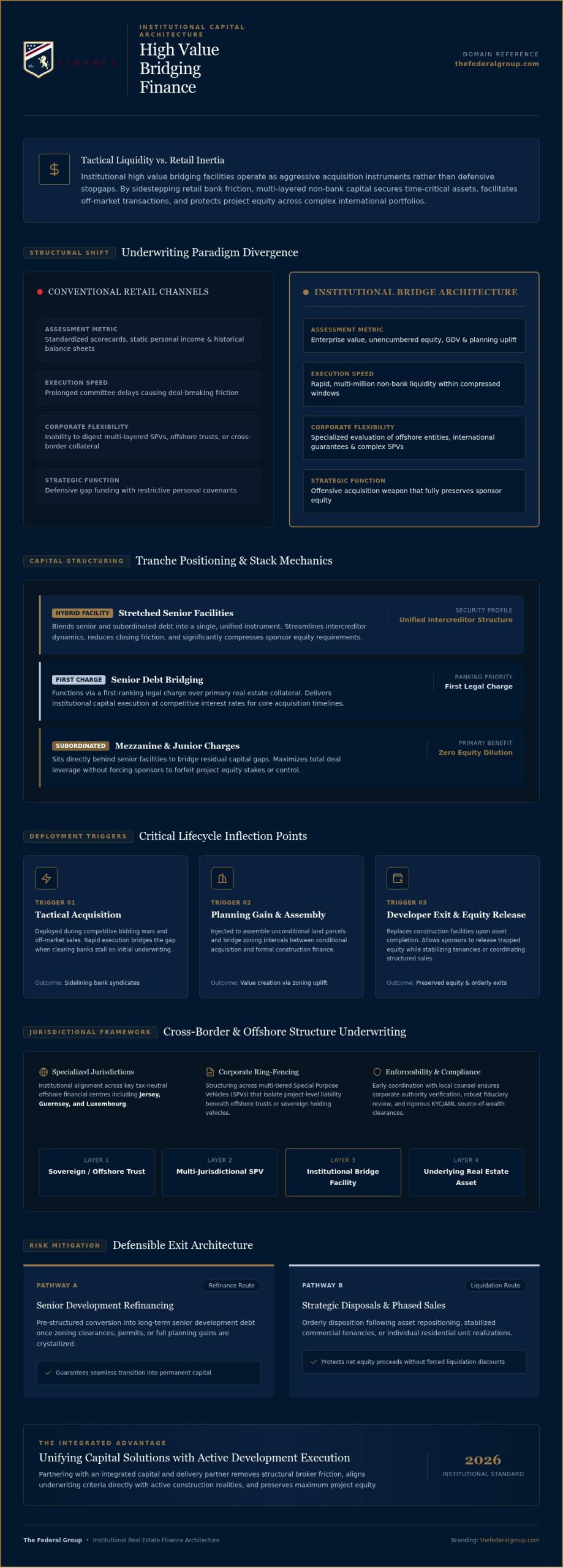
High value bridging finance represents bespoke, multi-million non-bank liquidity engineered for complex real estate transactions. While standard consumer credit models rely on standardized scorecards, institutional bridging operates via tailored covenants, structural flexibility, and non-standard security packages. While a conventional bridge loan often serves as consumer gap funding, institutional facilities function as aggressive tactical tools. They empower sponsors to capture mispriced assets, execute competitive tender acquisitions, and secure strategic positioning before institutional clearing banks can process initial paperwork.
Unlike traditional retail lenders fixated on static personal income or historical balance sheets, private institutional lenders evaluate asset-level enterprise value. Underwriting prioritizes existing unencumbered equity, planning enhancement upside, and gross development value (GDV). This shift enables developers to execute high-stakes capital structuring without diluting long-term equity stakes.
Capital Stack Position: Senior Debt, Mezzanine, and Stretched Facilities
Positioning short-term capital within a broader capital structure dictates both leverage capability and equity preservation across major asset acquisitions:
- Senior Debt Bridging: Functions via a first-ranking legal charge over primary real estate collateral, offering competitive capital costs for immediate asset execution.
- Mezzanine and Junior Charges: Sits behind senior facilities to bridge residual funding gaps, maximizing overall leverage without forcing sponsors to forfeit project ownership.
- Stretched Senior Facilities: Blends senior and subordinated debt into a single, unified instrument with streamlined intercreditor dynamics, reducing closing friction and sponsor equity demands.
Strategic Deployment Triggers: Acquisition, Refinance, and Planning Gain
Sophisticated developers deploy high value bridging finance across distinct inflection points within an asset lifecycle. In competitive bidding wars or distressed off-market sales, speed dictates transaction success; bridge facilities execute closings within compressed schedules that sideline traditional bank syndicates.
Similarly, land assembly plays demand strategic capital injection to acquire unconditional parcels, bridge zoning intervals, and capture planning enhancements before formal construction financing takes over. Finally, developer exit facilities enable sponsors to bridge asset completion, pay off initial development debt, and release equity while stabilizing commercial tenancies or completing structured unit sales.
Underwriting Complex Cross-Border Collateral and Offshore Entities
Mainstream banking syndicates regularly fail when confronted with multi-layered corporate architecture. Securing high value bridging finance across cross-border portfolios requires specialized non-bank underwriters capable of evaluating non-traditional holding structures, international guarantees, and overseas title registries. Rather than forcing clients into rigid retail underwriting molds, institutional capital providers assess the complete commercial ecosystem. This evaluation balances asset viability, corporate balance sheets, and verified sponsor execution track records.
Executing transactions across premier offshore jurisdictions like Jersey, Guernsey, and Luxembourg demands proactive legal alignment. Institutional underwriters coordinate specialized local counsel early to verify corporate authority, clear fiduciary hurdles, and confirm cross-border enforceability. Coupled with thorough Know Your Customer (KYC), Anti-Money Laundering (AML), and source-of-wealth documentation, this legal infrastructure ensures rapid underwriting without bureaucratic stalling.
SPVs, Offshore Trusts, and Multi-Tier Corporate Structuring
Developers routinely employ Special Purpose Vehicles (SPVs) to isolate project-level liability from corporate parent balance sheets. In multi-million transactions, these entities often sit beneath tax-neutral offshore trusts or sovereign holding vehicles. Specialized lenders structure bespoke security agreements around these entities rather than demanding structural overhauls:
- Balance Sheet Ring-Fencing: Direct non-recourse or limited-recourse debt protects wider group assets while focusing underwriting on asset-level cash flow.
- Cross-Border Enforceability: Dual-jurisdiction legal opinions confirm equitable charges, share pledges, and local register filings are legally unassailable.
- Corporate Governance Compliance: Articles of association and trust deeds undergo prompt legal review to prevent fiduciary deadlocks during facility drawdowns.
Cross-Collateralization and Multi-Asset Pledging Frameworks
Maximizing facility scale across complex holdings often requires cross-collateralization. Institutional sponsors frequently pledge secondary charges across unencumbered commercial real estate portfolios, portfolio debentures, or uncalled fund capital commitments to compress equity requirements. Structuring debt across diverse jurisdictions also requires proactive currency hedging. Multi-currency borrowing tranches insulate sponsors from foreign exchange volatility during the bridging term, protecting equity returns against currency swings.
Aligning these multifaceted elements demands an experienced international property finance partner that underwrites dynamic enterprise value rather than static collateral. This structural agility allows borrowers to preserve liquidity and secure institutional acquisitions seamlessly.
Commercial Real Estate and Land Assembly: Tactical Bridge Applications
Strategic deployment of high value bridging finance unlocks transactions where timing generates immense value arbitrage. Institutional sponsors frequently deploy short-term capital to reposition underperforming commercial assets, renegotiate anchor leases, or fund substantial capital expenditure upgrades ahead of permanent financing. In brownfield conversions and adaptive reuse projects, securing prime commercial real estate with speed often decides whether a developer captures an off-market discount. Bespoke bridging facilities establish immediate asset control, allowing sponsors to navigate planning applications, zoning uplifts, and initial strip-out works without clearing bank delays.
Land Assembly and Phased Site Acquisitions
Consolidating fragmented property parcels into a single master-planned development footprint requires surgical precision. A leaked acquisition strategy or a delayed closing can trigger ransom strip demands that threaten an entire scheme. Utilizing high value bridging finance ensures rapid, confidential parcel acquisitions through custom facility tranches aligned with site options and bilateral completions.
Structuring phased drawdowns preserves working capital while maintaining the discretion required to acquire contiguous titles quietly. Aligning these credit lines with proven strategic bridging finance for land frameworks ensures that corporate vehicles accommodate vendor option notices, unconsented plots, and interim holding periods without placing undue strain on sponsor reserves.
Development Exit Facilities: Releasing Capital and Mitigating Carry Costs
At the tail end of the project lifecycle, strategic pressures shift toward sales execution and capital recycling. Retaining high-leverage construction debt once a contractor secures practical completion creates unnecessary interest drag. A dedicated development exit facility provides a measured capital transition:
- Refinancing Construction Debt: Retires senior building facilities immediately upon practical completion, restructuring liabilities into lower-friction holding terms.
- Protecting Asset Value: Provides sponsors sufficient sales runway to negotiate commercial leases or finalize residential sales without forced price concessions.
- Equity Recapitalization: Unlocks trapped development profit and invested capital before final disposals close, allowing developers to seed subsequent acquisitions without interruption.
Structuring Defensible Exit Strategies: Transitioning from Bridge to Permanence
A short-term debt facility without an airtight exit is simply an uncalculated risk. In institutional underwriting, the exit mechanism serves as the primary pillar determining credit sanction and facility sizing. Sophisticated sponsors don’t rely on single-path liquidity events. Instead, they structure defensible dual-track exits, balancing forward-sale asset commitments against institutional debt refinancing to insulate project equity from shifting macroeconomic cycles.
Executing this transition effectively requires early capital alignment. Converting site acquisition debt into full-scale delivery requires close coordination with an international property development finance partner capable of pre-underwriting the construction phase alongside initial bridge deployment. This unified approach eliminates the re-underwriting friction and diligence duplication that routinely stall development programs.
Refinancing into Primary Development and Construction Debt
Bridging facilities deployed for land acquisition or zoning enhancements must synchronize precisely with shovel-ready delivery milestones. Underwriters examine the critical path required to clear reserved matters, discharge planning conditions, and finalize fixed-price building contracts. Deploying high value bridging finance allows accrued value uplifts to roll directly into senior construction debt equity requirements, maximizing developer leverage while keeping groundbreak schedules intact.
Capital Markets, Institutional Placement, and Asset Disposals
For commercial repositioning and completed development assets, exit execution pivots toward institutional capital takeouts:
- Forward-Commitment Disposals: Pre-negotiating forward sales or forward-funding structures with sovereign wealth funds or institutional pension capital secures guaranteed takeouts upon stabilization.
- Private Debt and Securitized Takeouts: Transitioning completed commercial schemes into commercial mortgage-backed securities (CMBS) or institutional private debt locks in permanent, lower-cost leverage.
- Debt Service Reserves: Structuring structured interest reserve accounts provides sponsors necessary liquidity to manage leasing programs without balance sheet strain during international marketing cycles.
To insulate your portfolio from sudden liquidity contractions, structure your strategic bridge facility and permanent exit pathway with an integrated partner that underwrites complete project lifecycles.
The Integrated Advantage: Combining Capital Solutions with Development Execution
Traditional property finance operates in disconnected silos. Intermediary brokers chase origination commissions, remote credit committees impose arbitrary covenants without understanding construction realities, and independent contractors absorb project friction. This fragmentation creates severe execution drag on complex transactions. Partnering directly with an institutional development finance lender that pairs balance sheet capabilities with practical construction delivery removes this systemic friction. When capital providers underwrite real-world buildability rather than just static balance sheets, high value bridging finance transforms from a stopgap into a high-precision strategic catalyst.
Eliminating Friction Between Financiers and Construction Lifecycle
Conventional non-bank lenders rely heavily on third-party project monitoring surveyors, external legal panels, and detached quantity surveyors. Each layer introduces administrative friction, billing overhead, and protracted drawdown delays that jeopardize site progress. Pairing credit analysts with in-house design and engineering teams accelerates technical diligence, streamlines drawdowns, and eliminates adversarial monitoring disputes. Working alongside experienced integrated design and build developers ensures that capital disbursement synchronizes seamlessly with physical procurement milestones on site.
Deploying Flexible Capital Solutions Across Global Asset Classes
Large-scale transactions rarely fit into monolithic debt structures. Institutional sponsors require agile capital stacks that adapt as asset risk evolves from initial land control to structural delivery. By blending high value bridging finance with mezzanine tranches, senior construction facilities, and strategic private equity allocations, integrated partners structure complete lifecycle solutions under unified governance:
- Prime Commercial Real Estate: Unlocks immediate liquidity for off-market acquisitions, heavy repositioning programs, and anchor tenant restructuring.
- Mixed-Use Masterplans: Aligns phased multi-tranche funding directly with civil infrastructure milestones and zoning conditions.
- Sports and Entertainment Assets: Delivers sophisticated structural liquidity for stadium infrastructure, franchise acquisitions, and sports multi-club ownership models.
Operating internationally across prime property markets since 2009, The Federal Group provides the balance sheet strength and integrated delivery execution required to navigate high-stakes acquisitions and build generational value.
Institutional Precision: Accelerate Your Capital Strategy
Capturing premier international acquisitions requires capital architecture that moves at transaction speed. High value bridging finance provides the decisive link between opportunity and execution, deploying substantial non-bank liquidity across complex cross-border SPVs and multi-parcel assemblies without equity dilution. By replacing conventional banking delays with bespoke asset underwriting, sponsors maintain operational control while de-risking their transition to permanent debt or asset realization.
Operating internationally across prime property markets since 2009, The Federal Group unifies comprehensive capital solutions across senior debt, mezzanine finance, and private equity with fully integrated design and build delivery through Federal Holdings. This integrated framework eliminates friction between capital syndication and physical site reality, ensuring continuous momentum across every development phase.
Take command of your next acquisition window. Structure Your High-Value Capital Solution with The Federal Group to secure institutional agility across your global portfolio.
Frequently Asked Questions
What qualifies as high value bridging finance in institutional property markets?
High value bridging finance refers to bespoke, multi-million debt facilities structured specifically for institutional real estate transactions, corporate acquisitions, and large-scale site assemblies. Unlike retail bridging products capped at consumer thresholds, institutional facilities feature tailored covenants, flexible debt tranche configurations, and non-standard collateral structures. Underwriters evaluate dynamic asset metrics, planning upside potential, and sponsor delivery capability rather than relying on static consumer debt-to-income models.
How quickly can high value bridging facilities be deployed for time-sensitive acquisitions?
Institutional bridge capital can deploy within days to weeks, depending on the legal complexity of the borrowing vehicle and asset diligence. Because specialist balance sheet lenders bypass bureaucratic credit committees, decisions occur rapidly. Pre-underwritten credit approvals and expedited title reviews allow sponsors to compete effectively in time-critical auctions, off-market tender environments, or distressed vendor scenarios where conventional clearing banks move too slowly to close.
Can high value bridging loans be secured against cross-border or offshore assets?
Yes, specialist non-bank lenders routinely structure high value bridging finance against cross-border real estate, offshore Special Purpose Vehicles (SPVs), and fiduciary trusts. Collateral frameworks accommodate primary and secondary charges registered across premier offshore jurisdictions such as Jersey, Guernsey, and Luxembourg. Institutional lenders pair international legal opinions with bespoke corporate debentures, uncalled capital pledges, and multi-currency accounts to secure multi-jurisdictional portfolios without administrative delay.
What are the standard acceptable exit strategies for multi-million bridging facilities?
Acceptable institutional exits include refinancing into long-term commercial mortgages, transitioning into comprehensive development finance, or executing an outright asset disposal. Underwriters require clear, defensible execution milestones rather than speculative horizons. Sponsors frequently present dual-track liquidity exits, balancing forward-commitment institutional sales or tenant stabilization refinancing with structured contingency options to protect project equity across shifting macroeconomic cycles.
How do specialist lenders underwrite land without planning permission?
Lenders evaluate unconsented land by assessing current baseline market value, local zoning precedents, and achievable development density rather than existing commercial cash flows. Specialist underwriters analyze planning policy frameworks, environmental feasibility studies, and the developer’s historical planning track record. This approach allows capital providers to fund strategic land assembly and zoning enhancements while retaining sufficient structural security across the underlying freehold title.
What is the difference between direct balance sheet lending and debt brokerage?
Direct balance sheet lenders deploy their own proprietary capital and maintain complete discretion over credit approvals, legal terms, and loan modifications. Intermediary debt brokers simply package loan applications and pitch them to third-party institutions for an origination fee. Working directly with a principal balance sheet lender eliminates intermediary commission friction, speeds up decision-making, and provides direct access to decision-makers throughout the loan lifecycle.
Can high value bridging facilities be rolled directly into development finance?
Yes, integrated capital partners can seamlessly transition acquisition bridge loans into senior development finance facilities once planning consents and building contracts finalize. This unified approach rolls the equity created through planning uplifts directly into the developer’s required equity contribution. It eliminates the duplicated valuation fees, re-underwriting friction, and closing delays typically encountered when switching between disconnected lenders.