High-Value Commercial Mortgages: Strategic Financing for Global Developers in 2026
27 August 2026In the 2026 credit market, a high-value mortgage isn’t just a liability. It’s a strategic capital instrument that determines the ultimate ROI of a global landmark. You’re likely feeling the pressure of interest rate volatility and the friction of cross-border regulations as you plan your next major project. Securing $50M+ for a stadium or an industrial hub requires more than just a high credit score; it demands a partner who understands the complexities of commercial property development loans on a global scale.
We recognize that traditional lending models often fail to meet the needs of visionary developers who require speed and high-leverage flexibility. This guide promises to help you master the complexities of institutional-grade debt while learning how to structure high-value mortgages for large-scale international projects. We’ll explore how to integrate debt with private equity for a seamless capital stack, analyze current SOFR spread averages for Tier 1 assets, and provide a roadmap for fast execution on international land acquisitions, ensuring your portfolio remains resilient against market shifts.
Key Takeaways
- Identify the transition from traditional retail banking to institutional private debt for projects exceeding $20 million in the current 2026 market.
- Master the calibration of LTV and LTC ratios to ensure your project meets the stringent DSCR requirements preferred by global institutional lenders.
- Unlock specialized financing structures for complex, niche assets including integrated mixed-use developments and professional sports multi-club ownership models.
- Streamline the underwriting process for commercial property development loans by preparing for rigorous cross-border tax compliance reviews and sponsor track record audits.
- Synchronize high-value mortgages with private equity and bridging finance to create a resilient, integrated capital stack that maintains project momentum.
What Defines a High-Value Commercial Mortgage in 2026?
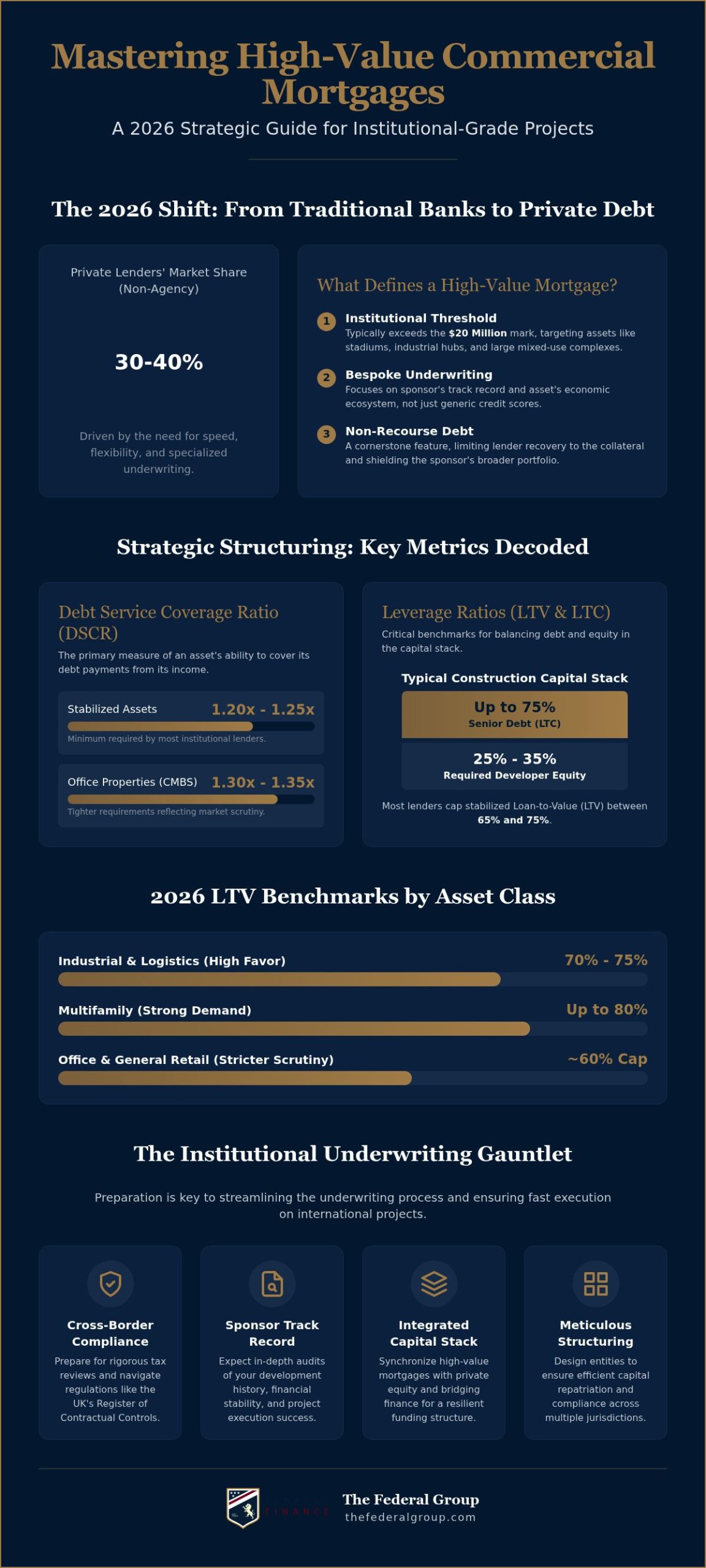
In the current financial ecosystem, a high-value commercial mortgage represents more than just a loan; it’s a strategic partnership. These debt instruments typically exceed the $10 million to $20 million threshold, secured by prime income-producing assets or large-scale development sites. Unlike standard retail banking products, these structures are designed for institutional-grade projects where complexity is the norm and the stakes are global.
The landscape for commercial property development loans has shifted significantly. Private lenders now command 30% to 40% of the non-agency market, reflecting a migration away from traditional banking. This change is driven by the need for speed and specialized underwriting that automated systems cannot provide. High-value debt requires a bespoke approach, focusing on the sponsor’s track record and the asset’s specific economic ecosystem rather than generic credit scores or localized appraisals.
Non-recourse debt remains a cornerstone for protecting developer interests in 2026. In projects of this scale, lenders often limit their recovery to the collateral itself, shielding the sponsor’s broader portfolio from project-specific volatility. This alignment of risk is essential for visionaries managing $50 million plus international acquisitions, where the capital stack must remain resilient against unforeseen market shifts.
The Institutional Threshold for Commercial Debt
The entry point for institutional-grade financing begins where standard commercial loans end. While small business lending focuses on localized retail or office space, high-value debt targets industrial hubs, sports stadiums, and mixed-use complexes. This high-value tier is the intersection of corporate credit and asset-backed security, requiring a balance of rigorous data and strategic foresight that traditional banks often lack. It’s a space where financing is tailored to the project’s lifecycle, from initial land assembly to stabilized operations.
Global Market Dynamics and Cross-Border Flows
Effective international property development finance dictates the terms of modern mortgages. With the 10-Year Treasury yield hovering around 4.27% in early 2026, developers must account for global interest rate benchmarks that influence pricing across borders. Navigating US-UK cross-border financing involves managing specific regulatory hurdles, such as the UK’s Register of Contractual Controls that went live in March 2026. These transparency requirements demand meticulous entity structuring to ensure efficient capital repatriation and compliance for commercial property development loans operating in multiple jurisdictions.
Strategic Structuring: Navigating LTV, LTC, and DSCR at Scale
High-stakes development hinges on the precision of your capital stack. In the 2026 market, institutional lenders prioritize stability through the Debt Service Coverage Ratio (DSCR), typically requiring a minimum of 1.20x to 1.25x for stabilized assets. For office properties, these requirements have tightened further, with CMBS lenders often seeking 1.30x to 1.35x. While programs like the SBA 504 loan program offer a path for smaller owner-occupied assets, global developers require a more sophisticated blend of senior debt and mezzanine layers to achieve optimal leverage.
Differentiating between Loan-to-Value (LTV) and Loan-to-Cost (LTC) is critical when securing commercial property development loans. Most lenders cap LTV between 65% and 75%, though multifamily assets can occasionally reach 80%. However, during the construction phase, LTC becomes the primary benchmark. Lenders typically fund up to 75% of the total project cost, requiring developers to contribute 25% to 35% in equity. Mezzanine debt frequently fills this gap, allowing visionaries to preserve liquidity while maintaining control over $50M+ international projects.
Leverage Metrics for Commercial Developers
Benchmarking leverage in global hubs requires a sector-specific lens. Industrial and logistics assets currently enjoy the highest favor, with LTVs holding steady at 70% to 75%. Conversely, office and general retail are under stricter scrutiny, often capped at 60%. Balancing these metrics involves more than just hitting a number; it’s about proving that the projected income can comfortably cover interest payments even if market absorption slows. For those managing high-value portfolios, integrated development finance provides the flexibility needed to navigate these shifting thresholds.
Interest Rate Strategies: Fixed, Floating, and Caps
The 2026 outlook for debt pricing remains tied to the SOFR benchmark. Bank pricing for construction is frequently quoted as SOFR plus a spread of 250 to 400 basis points. In a market where the Federal Funds Rate sits between 3.50% and 3.75%, hedging is no longer optional. Strategic developers use interest rate caps to protect against volatility during long-term builds. Interest-only periods are also highly utilized during the first 24 to 36 months of a project. This allows the developer to focus capital on construction and lease-up activities before the full debt service kicks in, ensuring the project’s cash flow remains positive during its most vulnerable phase.
Financing Specialized Assets: From Mixed-Use to Professional Sports
Standard lending models often falter when applied to non-traditional assets. While standard office or retail properties rely on predictable lease structures, specialized assets like sports stadiums and integrated mixed-use complexes require a more nuanced evaluation of operational cash flow. In the 2026 market, securing commercial property development loans for these niche sectors demands a lender with deep sector-specific expertise. Valuation methodologies have shifted; lenders now prioritize purpose-driven development and the property’s ability to generate diversified revenue streams rather than relying solely on the underlying land value.
For specialized use cases, LTV thresholds are typically more conservative, often ranging between 60% and 65%. This caution reflects the unique operational risks associated with hospitality or leisure-driven assets. However, institutional partners are increasingly attracted to projects that demonstrate clear demand drivers, such as healthcare-integrated residential hubs or life sciences facilities. These assets require bespoke debt structures that account for longer stabilization periods and complex technical requirements.
Sports Infrastructure and Acquisition Finance
The 2026 financial landscape has seen professional sports evolve into a distinct institutional asset class. Securing high-value debt against stadium revenues or broadcast rights involves complex financial structuring for multi-club ownership. Lenders in this space analyze the synergy between clubs, the global reach of the brand, and the stability of match-day income. High-value mortgages for sports infrastructure aren’t just about the physical build; they’re about financing an ecosystem that spans international borders and multiple fan bases. This level of complexity requires a partner who manages every stage of the project lifecycle, from initial acquisition to facility management.
Mixed-Use Projects and Full Lifecycle Funding
Integrated mixed-use developments present a unique risk profile due to their multi-disciplinary nature. Developers can significantly de-risk these projects by adopting an integrated design and build developer approach. This model provides a unified point of accountability, which institutional lenders favor when approving commercial property development loans for $50M+ projects. By managing the transition from land acquisition to final construction within a single entity, developers can maintain tighter control over timelines and costs. This structural efficiency often leads to more favorable mortgage terms, as the integrated approach reduces the friction typically found between architects, contractors, and financiers, ensuring a seamless capital stack through the full project lifecycle.
The Underwriting Process for Institutional-Grade Debt
Institutional underwriting for high-value mortgages is an exhaustive, multi-layered marathon that prioritizes risk mitigation over simple asset value. Unlike retail banking, which relies on automated credit scoring, the process for commercial property development loans in 2026 demands a deep-dive analysis of global variables. It’s a strategic audit designed to ensure that every component of the project, from the sponsor’s history to the final exit strategy, aligns with institutional stability requirements.
The process generally unfolds in three distinct phases. Phase 1 initiates with a granular audit of the sponsor’s global track record and a deep-dive valuation of the underlying asset. Phase 2 moves into the mechanics of entity structuring, where lenders conduct a rigorous cross-border tax compliance review to optimize capital flows. Finally, Phase 3 involves aggressive debt-service stress testing. Lenders simulate various market shocks, including interest rate spikes and absorption delays, to ensure the project remains viable under extreme economic duress. A successful application relies on a meticulously organized virtual data room containing detailed financial projections, environmental reports, and a comprehensive breakdown of the capital stack.
Sponsor Requirements and Entity Structuring
The sponsor’s global experience acts as a primary risk mitigator in high-value debt requests. Lenders prioritize developers who have successfully navigated complex cycles across multiple jurisdictions, viewing organizational depth as a safeguard for their capital. Structuring the borrowing entity, typically through a Special Purpose Vehicle (SPV), is essential for isolating risk and ensuring legal efficiency in international markets. Transparent corporate governance provides the final layer of security, assuring institutional partners that the project is managed with corporate-level rigor and accountability. To navigate these requirements effectively, you can access specialized development finance solutions that align your corporate structure with institutional expectations.
Technical Due Diligence in 2026
Technical site audits and design-build feasibility studies are now foundational to the loan agreement rather than mere checkboxes. In 2026, lenders analyze the long-term viability of the physical asset, including its adaptability to future technological shifts and climate resilience. All mortgages exceeding $50 million in 2026 now require documented ESG compliance to satisfy institutional risk committees. This shift reflects a broader market trend where environmental and social metrics are directly tied to capital availability and pricing. Securing commercial property development loans at scale now requires a proactive approach to sustainability that proves the asset’s value will endure for decades, not just the duration of the loan term.
Beyond Debt: The Federal Group’s Integrated Capital Solution
For large-scale projects, debt is only one piece of the puzzle. Securing commercial property development loans often requires a foundation of rapid acquisition and strategic agility. This is where bridging finance for land acquisition becomes essential. It allows developers to secure prime sites before the long-term mortgage is even finalized, maintaining the momentum necessary for $50 million plus projects. By integrating this with our design and build expertise, we offer institutional lenders a de-risked profile that traditional brokerages simply can’t match.
The real power lies in the unified capital stack. When you align your debt with a real estate private equity partner, you eliminate the friction between competing interests. This synergy ensures that every dollar, whether it’s senior debt or equity, works toward the same project lifecycle milestones. It positions your development for global institutional investment by presenting a clean, professional financial structure that’s ready for scale. This unified approach is especially critical for niche assets like sports stadiums, where the complexity of the asset requires a financier who understands the operational ecosystem.
Debt and Equity Synergy
A single partner for both debt and equity drastically reduces execution risk. Friction between lenders and investors can stall a project at critical junctures, particularly during cross-border acquisitions. The Federal Group acts as an international real estate finance partner, providing a “fully integrated” model that covers development finance and private equity. This approach signals to the market that the project is backed by a heavyweight partner with both technical and financial skin in the game. It’s an ecosystem approach that moves beyond the limitations of standard commercial property development loans by managing every stage of the project lifecycle.
Next Steps for Global Developers
Initiating a high-value capital request requires a partner who understands the vision behind the numbers. Whether you’re navigating professional sports investments or large-scale mixed-use complexes, the first step is a strategic consultation to audit your capital stack and project feasibility. We provide the stability and expertise needed for complex, international challenges, ensuring your portfolio remains resilient against market shifts. Partner with The Federal Group for your next high-value project to master the complexities of institutional debt and secure the leverage your vision demands.
Mastering Global Capital for the 2026 Development Landscape
The transition toward institutional private debt marks a definitive era for visionary developers. Success in this high-stakes environment requires a technical mastery of complex leverage metrics and a deep understanding of specialized asset classes like professional sports and integrated mixed-use hubs. By moving beyond traditional banking silos, you can secure commercial property development loans that offer the flexibility and scale required for $50M+ international acquisitions. This strategic approach ensures your portfolio remains resilient against global interest rate volatility while maintaining the momentum needed for rapid land assembly.
The Federal Group serves as a specialist in $20M+ international capital solutions, combining integrated Design & Build expertise with Private Equity to de-risk your most ambitious projects. Our global footprint across property and professional sports ensures your capital stack is as robust as the landmarks you create. Secure High-Value Capital with The Federal Group today to align your vision with institutional-grade stability. Your next landmark project deserves a partner who’s ready to match your ambition with technical precision and global scale.
Frequently Asked Questions
How do high-value commercial mortgages differ from standard business loans?
High-value mortgages focus on institutional-grade assets and complex underwriting rather than simple credit scores. They involve non-recourse structures and bespoke terms for projects exceeding $20 million. Standard business loans typically target smaller, localized operations with automated approvals. High-value debt requires a deep audit of sponsor track records and global market dynamics. This ensures the capital stack remains resilient against the high-stakes volatility inherent in large-scale international developments.
What is the typical minimum loan amount for institutional-grade commercial debt?
Institutional-grade debt generally starts at the $10 million to $20 million threshold. Below this level, financing usually falls into the category of retail or small business banking. Large-scale commercial property development loans often target the $50 million plus range, where lenders seek high-stakes projects like industrial hubs or sports stadiums that offer significant scale and institutional stability. This tier requires a level of underwriting depth that standard banks cannot provide.
Can high-value mortgages be used for international property acquisitions?
Yes, high-value mortgages are frequently structured for cross-border acquisitions and developments. These loans require specialized entities, such as Special Purpose Vehicles (SPVs), to manage international tax compliance and legal friction. Success depends on a partner who understands the regulatory environment in both the source and destination markets. This ensures efficient capital repatriation and long-term project security across global jurisdictions while navigating the complexities of different legal frameworks and currency risks.
What are the 2026 interest rate benchmarks for commercial real estate?
In mid-2026, the Federal Funds Rate target sits between 3.50% and 3.75%. Most conventional commercial mortgage rates range from 5.28% to 12.75%, depending on the asset class and lender type. Construction lending is frequently priced against SOFR, with bank spreads typically ranging from 250 to 400 basis points. These benchmarks reflect a stabilizing market after a period of significant tightening, providing a clearer roadmap for long-term project financing and valuation.
How does a bridging loan integrate with a long-term commercial mortgage?
A bridging loan provides the speed necessary to secure land or distressed assets before permanent financing is finalized. Once the project reaches a specific milestone, such as planning approval or initial construction phases, the bridge is refinanced into a long-term commercial mortgage. This sequence allows developers to maintain momentum without waiting for the exhaustive underwriting process required for institutional-grade development debt. It acts as a critical tool for rapid acquisition in competitive global markets.
What role does ESG play in securing high-value financing in 2026?
ESG compliance is now a mandatory requirement for most institutional risk committees. Mortgages exceeding $50 million require documented sustainability metrics to satisfy global capital requirements. Lenders prioritize assets with high energy efficiency and climate resilience, as these factors directly impact the property’s long-term value. Projects failing to meet these standards often face higher interest rates or restricted access to Tier 1 capital. Sustainability is no longer a choice; it’s a financial necessity.
Are non-recourse loans common for high-value commercial property?
Non-recourse structures are the standard for high-value institutional debt. These agreements limit the lender’s recovery to the specific collateral asset, protecting the sponsor’s broader portfolio from project-level risks. While lenders may require “bad boy” carve-outs to prevent fraud or gross negligence, the non-recourse nature of commercial property development loans is essential for developers managing high-stakes, large-scale international projects. It aligns the interests of both the financier and the visionary developer while maintaining portfolio stability.
How can an integrated design and build model improve mortgage terms?
An integrated model reduces the friction between construction and finance, providing lenders with a unified point of accountability. Institutional partners favor this structure because it minimizes cost overruns and timeline delays. By combining design, construction, and financing expertise, developers can present a de-risked project profile. This often results in more favorable interest rates and higher leverage compared to projects managed through fragmented third-party consultants. It ensures the project remains on track from inception to completion.