Hospitality Development Finance: 2026 Strategic Guide
28 August 2026In 2026, the traditional search for a hotel loan has become a secondary concern for sophisticated developers. You likely recognize that the true challenge lies in the fragmentation of the project lifecycle, where high capital costs and shifting cross-border regulations can erode margins before the first guest checks in. Securing a competitive rate is only half the battle when fragmented delivery models lead to cost overruns that outpace your projected RevPAR growth. This guide provides the strategic framework to master hospitality development finance by utilizing integrated finance-and-delivery models that de-risk every phase of your project.
We understand that navigating a landscape with LTV caps between 50% and 65% requires more than just a lender; it requires a strategic partner who understands the physical construction as deeply as the capital stack. You’ll learn how to structure complex deals that balance high interest rates with long-term ROI. We’ll preview the mechanisms for minimizing risk during the transitional bridge phase and show you how to leverage C-PACE and private debt funds to achieve a 75% loan-to-cost ratio. By the end of this guide, you’ll have the blueprint to transform your development from a high-stakes gamble into a stabilized institutional asset.
Key Takeaways
- Master the sophisticated strategies required for hospitality development finance in 2026, focusing on higher interest rates and stricter lender underwriting.
- Structure a balanced capital stack that combines senior debt, mezzanine, and equity to maximize leverage for international hotel portfolios.
- De-risk complex projects by adopting an integrated design and build model that aligns financial capital with physical construction delivery.
- Navigate the unique regulatory and currency challenges of cross-border developments, including specialized stadium-integrated hospitality assets.
- Learn how to position your project for institutional-grade funding by partnering with a firm that provides both private equity and specialized development finance.
Navigating the 2026 Hospitality Development Finance Landscape
Hospitality development finance represents a specialized subset of commercial real estate capital, specifically tailored to the unique operational complexities of the hotel sector. In 2026, this field demands a level of precision that transcends traditional lending. Understanding Development Finance in this context requires a firm grasp of how private equity and debt structures must align with the volatile nature of hospitality income. With the federal funds rate stabilized between 3.50% and 3.75%, institutional developers are moving away from fragmented funding models. They’re shifting toward integrated financing solutions that unify capital and delivery to maintain margins in a high-stakes environment.
Hospitality vs. Traditional Commercial Real Estate
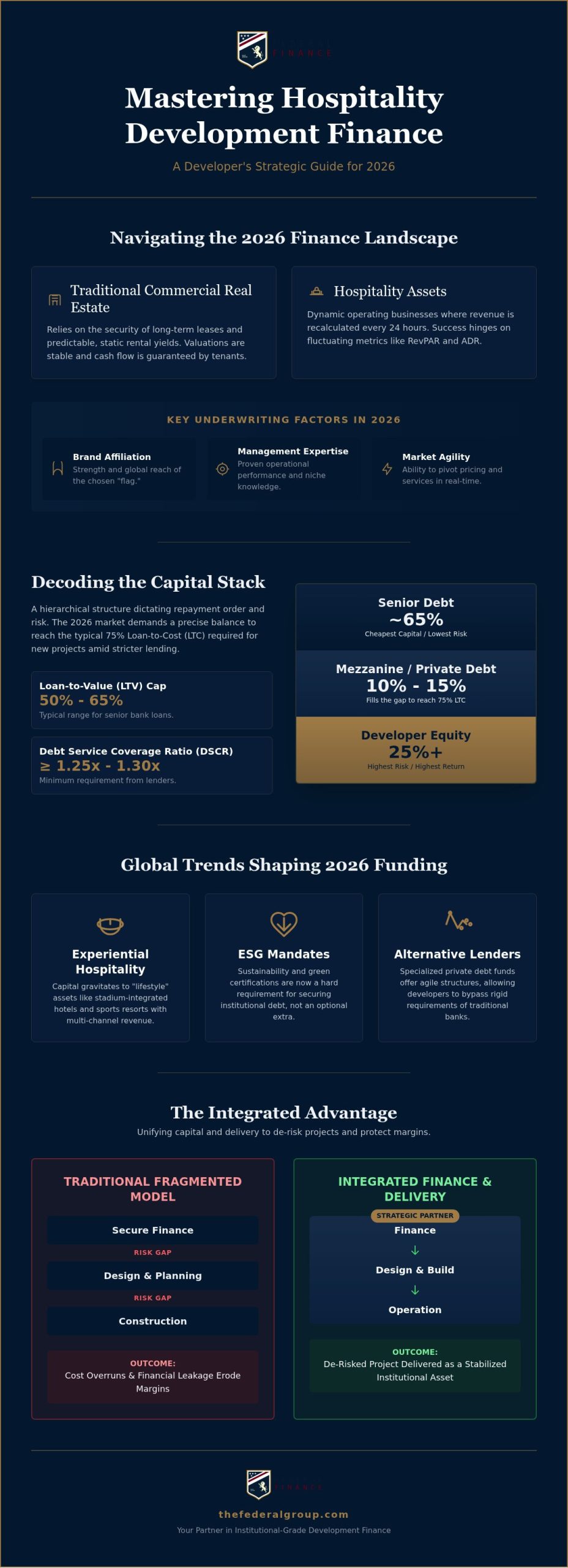
Traditional commercial assets rely on the security of long-term leases and static rental yields. Hospitality assets, by contrast, are dynamic operating businesses where revenue is recalculated every 24 hours. Success depends on Revenue Per Available Room (RevPAR) and Average Daily Rate (ADR), metrics that fluctuate based on market sentiment and seasonal demand. Lenders categorize hospitality as a higher-risk asset class because there’s no “tenant” to guarantee cash flow. Consequently, 2026 underwriting places immense weight on:
- Brand affiliation: The strength and global reach of the chosen “flag.”
- Management expertise: Proven historical operational performance and specialized niche knowledge.
- Agility: The ability to pivot pricing strategies and guest services in real-time to meet shifting demand.
Global Trends Shaping Hospitality Funding in 2026
Global capital flows are increasingly gravitating toward “lifestyle” and “experiential” hospitality. Private equity firms now prioritize assets that offer more than just a bed; they seek stadium-integrated hotels and sports resorts that provide recurring, multi-channel revenue. Sustainability is no longer a peripheral concern. ESG mandates are now a hard requirement for securing institutional debt, with many lenders requiring specific green certifications before finalizing the capital stack.
The rise of alternative lenders has also changed the landscape. Agile investors are turning to specialized debt structures from private debt funds to bypass the rigid requirements of traditional banks. In this environment, the most successful developers are those who leverage integrated models to streamline the transition from design to operation. This approach minimizes the financial leakage often found in traditional, siloed project lifecycles. By merging the finance and delivery phases, developers can secure more favorable terms and ensure the physical asset is optimized for the 2026 market from day one.
Decoding the Hospitality Capital Stack: Debt, Equity, and Mezzanine
The capital stack for a hotel development is a hierarchical structure that dictates the order of repayment and the level of risk for each stakeholder. In 2026, mastering international property development finance is essential for developers looking to scale across borders where local liquidity may vary. Current trends show that bank hotel loans are averaging around 60% to 65% LTV, a tightening from previous years. This leaves a significant gap that must be filled by mezzanine debt or equity to reach the 75% loan-to-cost (LTC) often required for ground-up projects. High-stakes hospitality development finance requires a precise balance between these layers to ensure the project remains viable under stricter underwriting standards.
Senior Debt and Mezzanine Finance
Senior debt remains the foundation of the stack, typically provided by institutional banks or CMBS conduits. For top-tier borrowers in 2026, conventional bank rates start at approximately 6.75%, while CMBS issuance provides an alternative with rates ranging from 6.5% to 9.0%. A Guide to Hospitality Loans highlights that while senior debt is the cheapest capital, it also carries the most rigid requirements. Lenders currently demand a Debt Service Coverage Ratio (DSCR) of at least 1.25x to 1.30x, with CMBS conduits often requiring 1.40x or higher for full-service resorts.
Mezzanine finance acts as the critical bridge when senior debt alone cannot meet the development’s needs. It sits behind the senior lender but ahead of the sponsor’s equity. While this layer is more expensive, it allows developers to maintain control while maximizing leverage. Market conditions in 2026 mean mezzanine providers focus heavily on “yield-on-cost,” ensuring the project’s stabilized income justifies the total debt load before the transition to long-term financing.
The Role of Private Equity in Hospitality
As traditional lenders tighten their criteria, developers are increasingly seeking a real estate private equity partner to provide the necessary “dry powder” for large-scale acquisitions. Private equity offers more flexibility than debt, though it comes at the cost of profit participation. Partners typically choose between “blind pool” funds, which offer ready capital for multiple assets, and project-specific partnerships tailored to a single flagship development.
Equity partners in 2026 prioritize the sponsor’s track record above all else. They look for deep operational capabilities and a history of navigating complex market cycles. Such scrutiny is particularly intense for specialized assets like sports-related hospitality or luxury lifestyle hotels. If you’re looking to optimize your capital structure, exploring bespoke private equity solutions can provide the stability needed for visionary projects. This alignment of interests ensures that both the financier and the developer are committed to the long-term success of the physical asset.
Strategic Financing for High-Value International Hospitality Projects
Global expansion in 2026 requires more than liquid capital. It demands a sophisticated understanding of how hospitality development finance interacts with diverse regulatory environments. Developers scaling into new territories must manage currency fluctuations and differing tax jurisdictions that can quickly erode the internal rate of return (IRR). International institutional property investment groups now require a level of transparency and risk mitigation that local lenders often overlook. Success in this arena depends on the ability to mobilize capital across borders while maintaining a lean, efficient delivery structure.
Securing prime real estate in high-demand markets often depends on speed. Utilizing bridging finance for land acquisition allows developers to lock in strategic sites before competitors can finalize long-term institutional funding. This agility is vital when competing for limited urban plots or high-growth coastal regions. Once the land is secured, the focus shifts to structuring a deal that satisfies the rigorous due diligence of global investors, who prioritize ESG compliance and long-term asset stability over short-term gains.
Cross-Border Capital Deployment Strategies
Logistical hurdles often arise when capital is sourced in one jurisdiction but deployed in another. Local legal frameworks and withholding tax requirements vary significantly between markets. Partnering with an international property finance expert ensures that the capital flow remains compliant while minimizing leakage. Cross-border hospitality finance is the mobilization of global capital for localized asset development. This strategy allows developers to tap into deep liquidity pools in stable markets to fund visionary projects in emerging hospitality hubs.
Specialized Hospitality: Sports and Stadium-Integrated Assets
The convergence of professional sports and hospitality has created a high-value niche for institutional developers. Stadium-integrated hotels and sports resorts benefit from a built-in demand cycle driven by match days and international events. Multi-club ownership strategies are now driving the need for specialized hospitality infrastructure that serves both fans and corporate stakeholders. This dual-purpose model creates a resilient revenue stream that persists even during off-peak tourist seasons.
Underwriting these specialized projects requires a unique approach. Lenders must evaluate not only the hotel’s RevPAR but also the synergy with the venue’s event calendar and the ownership group’s broader sports portfolio. This “ecosystem” approach to hospitality development finance provides a level of diversification that traditional hotel models lack. By integrating the hospitality asset directly into the sports infrastructure, developers create a high-barrier-to-entry product that commands premium rates and attracts institutional-grade debt.
The Integrated Advantage: Merging Design, Build, and Finance
In the high-stakes environment of 2026, the traditional siloed approach to development is increasingly viewed as an institutional risk. Silos between the architect, the general contractor, and the lender create friction points where capital leakage and timeline delays often occur. Adopting the model of an integrated design and build developer is the most effective strategy to de-risk complex hospitality projects. By unifying these disciplines, developers ensure that the architectural vision remains financially viable from the first sketch to the final brick.
The Federal Holdings approach exemplifies this synergy. It manages the entire project lifecycle, from initial conceptual design to the final deployment of hospitality development finance. This end-to-end oversight gives lenders and private equity partners a higher degree of confidence in project completion. When the entity managing the construction is also structuring the capital, the risk of mid-build funding gaps is significantly neutralized. This alignment of interests is essential for maintaining momentum in large-scale international ventures.
De-risking the Development Lifecycle
Cost overruns in traditional hospitality development typically stem from misaligned incentives between separate consultants. An integrated model allows for real-time adjustments to the capital plan as construction conditions evolve. If material costs or labor availability shift, the financial structure can be recalibrated instantly without the need for lengthy tripartite negotiations. This single point of accountability provides high-value stakeholders with the stability they require. It eliminates the “blame game” that often plagues fragmented project teams when timelines slip or budgets tighten.
Maximizing ROI Through Seamless Execution
Time is the most expensive variable in any development. Shorter construction timelines directly improve the internal rate of return (IRR) by accelerating the move toward operational cash flow. Integrated developers can optimize the capital stack based on specific construction milestones, ensuring that debt is drawn down only when necessary and mezzanine layers are utilized efficiently. Integrated hospitality development is the convergence of capital solutions and physical delivery to maximize asset value. By removing the friction between finance and the field, developers can capture market opportunities faster than their competitors.
If you’re ready to streamline your next venture, partner with an integrated specialist who understands the intersection of finance and construction.
Securing Institutional-Grade Hospitality Funding with The Federal Group
The Federal Group occupies a unique position in the 2026 market as a heavyweight partner for complex hospitality ventures. We aren’t merely a source of capital; we’re a strategic architect of the entire development lifecycle. As a premier development finance lender, we offer an integrated ecosystem that bridges the gap between visionary design and institutional-grade completion. Our expertise in hospitality development finance allows us to navigate the complexities of international property markets and specialized sports infrastructure with a level of precision that traditional lenders cannot match. We provide the stability and global reach required to transform ambitious concepts into stabilized, high-yield assets.
Our Global Capital Solutions
Speed often determines the success of high-value hospitality acquisitions. We provide agile bridging loans that allow developers to secure prime locations and initiate construction while long-term institutional structures are finalized. This rapid-response capital is essential in a landscape where LTV caps are tightening and competition for strategic sites is fierce. Beyond traditional debt, our private equity arm actively seeks strategic partnerships for high-potential projects, particularly those involving stadium-integrated hotels or multi-club sports portfolios. We act as a proactive connector, linking deep global liquidity with localized development expertise to ensure project stability from the initial land acquisition through to the grand opening.
Partnering for the Long Term
We reject the “off-the-shelf” funding model in favor of bespoke capital solutions. Every hospitality venture requires a structure that accounts for its specific RevPAR projections, ESG mandates, and geographic regulatory hurdles. Our approach is defined by a quiet confidence that comes from managing every stage of the project’s physical and financial birth through Federal Holdings. This integrated oversight ensures that the capital stack remains optimized as the project evolves from architectural vision to operational reality.
Developers who partner with us gain access to a sophisticated financial ecosystem designed to maximize leverage while neutralizing the risks inherent in fragmented delivery models. To initiate a high-value inquiry, stakeholders are invited to submit their project feasibility studies and site control documentation for a confidential review by our global investment committee. We look for partners who share our commitment to excellence and our vision for the future of the international hospitality landscape. Secure your project’s future by contacting our investment team to discuss your 2026 development objectives.
Mastering the Future of Global Hospitality Assets
The 2026 landscape demands a departure from fragmented project delivery. You’ve seen how a structured capital stack and the synergy of integrated design and build models are essential for neutralizing the risks of cost overruns and regulatory shifts. Success now rests on your ability to secure hospitality development finance that aligns with the physical construction timeline. By merging finance with delivery, you ensure that your high-value hotel or sports-integrated resort moves from vision to stabilized asset with institutional precision.
The Federal Group provides the scale and specialized expertise required to navigate these high-stakes international challenges. Since 2009, we’ve delivered global capital solutions backed by a fully integrated Design & Build developer division. Our deep knowledge of international property and global sports markets makes us a heavyweight partner for developers who refuse to settle for siloed service providers. It’s time to elevate your strategy and secure the future of your portfolio. Partner with The Federal Group for Integrated Hospitality Development Finance and transform your vision into a world-class destination.
Frequently Asked Questions
What is the typical LTV for hospitality development finance in 2026?
Top-tier lenders currently cap Loan-to-Value (LTV) ratios between 60% and 65% for stabilized hospitality assets. Conventional providers and CMBS conduits often maintain stricter caps at 50% for high-value developments. To reach the 75% loan-to-cost (LTC) threshold required for ground-up construction, developers frequently utilize mezzanine debt or private equity. This conservative lending environment in 2026 ensures that sponsors maintain significant equity skin in the game, stabilizing the broader institutional market.
How does hospitality development finance differ from standard commercial loans?
Hospitality development finance differs from standard commercial loans because it’s underwritten on the performance of a dynamic operating business rather than a static lease agreement. Traditional commercial loans rely on long-term tenant contracts for cash flow security. Hotels, however, recalculate revenue daily through Average Daily Rate (ADR) and RevPAR. This daily volatility makes lenders prioritize management expertise and brand strength over the mere physical footprint of the real estate asset.
Can bridging loans be used for hotel land acquisition?
Yes, bridging loans are a critical tool for securing prime hospitality sites before long-term construction funding is finalized. These short-term facilities allow developers to act with speed in competitive markets, locking in land titles or distressed assets. Rates for renovations and land bridges in 2026 typically range between 8% and 14.5%. This agility is essential for maintaining a project’s momentum during the high-risk transitional phase before ground-up development begins.
What are the benefits of an integrated design and build model for hotel financing?
An integrated design and build model minimizes financial leakage by unifying the architect, contractor, and financier under a single point of accountability. This structure reduces timeline friction, which is the primary cause of cost overruns in complex hospitality projects. Lenders gain greater confidence when a single entity manages the physical delivery and the capital deployment. Shorter construction cycles improve the internal rate of return, making the project more attractive to institutional investors.
Do lenders require a hotel brand affiliation to approve development funding?
Most institutional lenders in 2026 prioritize projects with a major brand affiliation because it provides a proven reservation system and global marketing reach. While independent lifestyle hotels can secure funding, they face higher scrutiny regarding management expertise and historical performance. A strong flag often results in more favorable interest rates and higher LTV caps. Lenders view the brand as a secondary guarantee that the asset will achieve its projected RevPAR targets.
How do high interest rates in 2026 affect hospitality capital stacks?
High interest rates in 2026, with conventional bank loans starting around 6.75%, have forced developers to restructure their capital stacks. Debt Service Coverage Ratio (DSCR) thresholds have tightened, often requiring 1.25x to 1.40x coverage. This shift pushes developers to seek more mezzanine finance or private equity to bridge the gap left by lower senior debt amounts. Higher borrowing costs demand a more efficient delivery model to preserve the project’s overall profitability and exit strategy.
What role does private equity play in international hospitality development?
Private equity serves as the essential dry powder that fills the funding gap between senior debt and the sponsor’s capital. In international hospitality development finance, equity partners provide the flexibility needed to navigate cross-border regulatory hurdles and currency risks. These partners often prioritize lifestyle or experiential assets that offer higher growth potential. By aligning with a private equity partner, developers can scale global portfolios more rapidly than by relying solely on traditional debt markets.
Is finance available for stadium-integrated hotel projects?
Specialized finance is readily available for stadium-integrated hotel projects due to their resilient, event-driven demand cycles. These assets are viewed as high-barrier-to-entry products that benefit from built-in synergy with professional sports ventures. Underwriting for these projects involves analyzing both the hospitality RevPAR and the broader event calendar of the venue. This integrated approach creates a diversified revenue stream that is highly attractive to institutional investment groups and specialized debt funds.