Hotel Development Financing in 2026: A Strategic Guide to Mixed-Use Capital Solutions
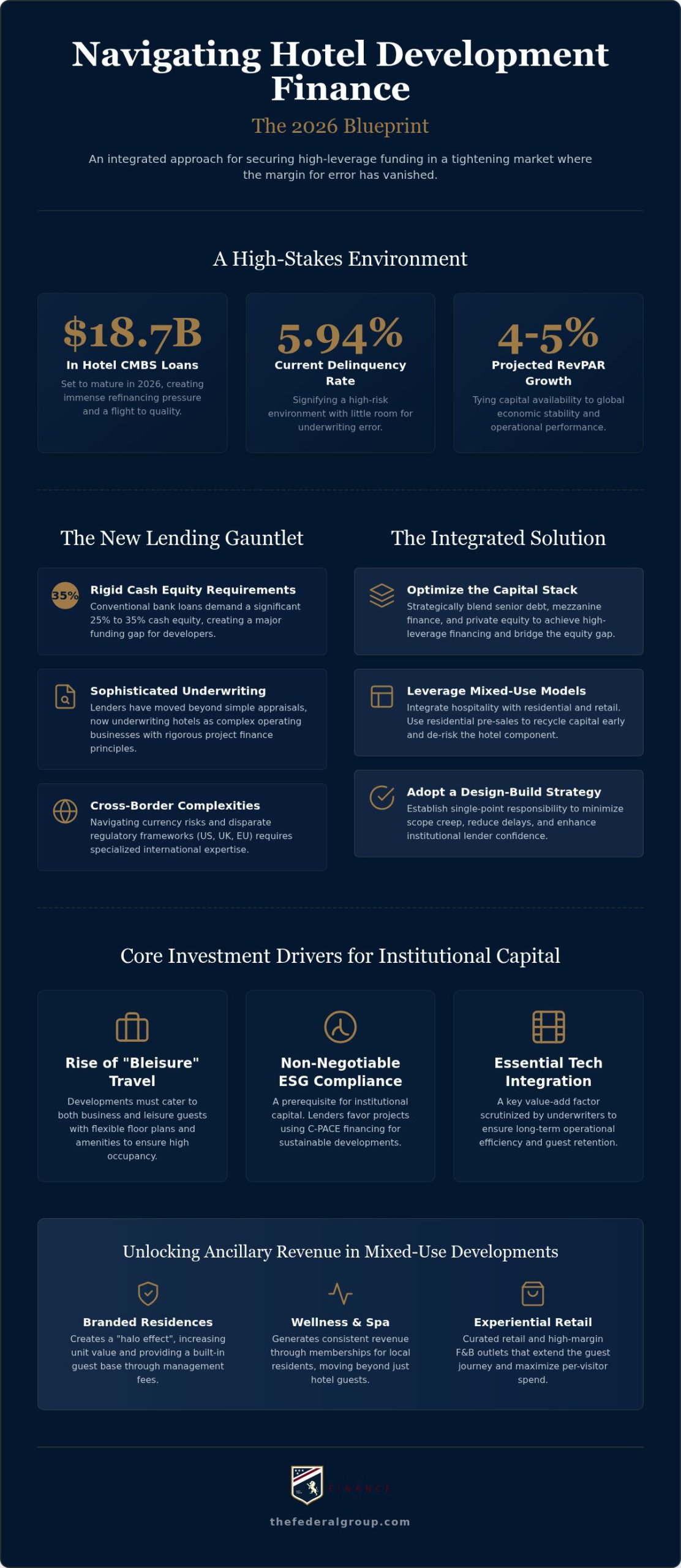
12 August 2026With $18.7 billion in hotel CMBS loans set to mature in 2026, the margin for error in hotel development financing has effectively vanished. You’re likely facing the friction of rigid lending requirements and the technical difficulty of underwriting mixed-use revenue streams while delinquency rates sit at 5.94%. It’s a high-stakes environment where traditional siloed approaches to capital often lead to coordination gaps between your lenders, architects, and builders. These inefficiencies don’t just delay timelines; they erode your projected returns.
We understand that securing high-leverage funding requires more than just a strong balance sheet; it demands a sophisticated, integrated strategy. This guide provides the blueprint to master modern hospitality funding by aligning debt and equity with a design-build model that actively de-risks your investment from the outset. We’ll examine how to navigate international capital markets and leverage specialized structures to turn complex mixed-use challenges into institutional-grade opportunities that satisfy even the most conservative underwriters.
Key Takeaways
- Adapt to the 2026 shift toward specialized international property finance to access broader capital pools and mitigate domestic lending volatility.
- Navigate the complexities of mixed-use underwriting by bifurcating revenue streams across hospitality, residential, and retail components for more precise valuation.
- Optimize your capital stack using a strategic blend of senior debt and mezzanine layers to secure high-leverage hotel development financing.
- Leverage integrated design-build strategies to establish single-point responsibility, a move that minimizes scope creep and enhances institutional lender confidence.
- Accelerate the transition from term sheet to groundbreaking by refining your investment memorandum to meet rigorous international due diligence requirements.
The Landscape of Hotel Development Financing in 2026
The capital markets for hospitality have fundamentally shifted. Traditional local lending is no longer the default path for large-scale projects. Instead, savvy developers are increasingly turning toward specialized international property development finance to secure the leverage necessary for hotel development financing in a tightening market. With approximately $18.7 billion in hotel CMBS loans maturing in 2026, the refinancing pressure is driving a flight to quality. Lenders have moved beyond simple fee-simple appraisals. They now apply rigorous project finance principles, underwriting the hotel as a complex operating business rather than just a physical asset.
Capital availability remains tied to global economic stability and RevPAR growth projections, which currently sit between 4% and 5%. While conventional bank construction loans offer yields around 6.25% to 7.25%, the rigid 25% to 35% cash equity requirements have created a significant funding gap. Private equity real estate partners are filling this void. They provide the flexible capital structures needed to move projects from the planning phase to groundbreaking, often accepting higher risk profiles in exchange for preferred returns.
Key Drivers of Hotel Investment in 2026
The rise of bleisure travel has forced a total re-evaluation of development underwriting. Projects must now demonstrate floor plans and amenities that cater to both corporate and leisure guests to maintain high occupancy. Simultaneously, ESG compliance has become a non-negotiable prerequisite for institutional capital. Lenders are favoring projects that utilize C-PACE financing, which offers fixed rates in the high 6% to 7% range for sustainable developments. Technological integration is no longer a luxury; it’s a value-add factor that underwriters scrutinize to ensure long-term operational efficiency and guest retention.
Navigating Cross-Border Financing Challenges
Managing currency risk is a primary concern for international hotel projects. Fluctuations can erode returns before a project even stabilizes. Additionally, regulatory compliance across the US, UK, and EU markets requires a sophisticated legal and financial framework. For instance, California’s Senate Bill 362 now mandates specific disclosures for commercial financing offers. Developers must partner with firms that understand the nuances of international property development finance to navigate these regional hurdles effectively. This expertise ensures that hotel development financing remains stable even when local markets face volatility.
Structuring Development Finance for Mixed-Use Hotel Projects
Hospitality-led mixed-use has become the gold standard for institutional development. By 2026, the most successful projects integrate luxury hotels with branded residences and experiential retail. This model doesn’t just diversify risk; it fundamentally alters the capital stack. Traditional hotel development financing often hits a ceiling with loan-to-cost (LTC) limits. However, incorporating residential pre-sales allows developers to recycle capital early, effectively reducing the total equity required for the hotel component. Pre-sales change everything. They provide a layer of liquidity that standalone hospitality assets simply cannot match.
Underwriting these projects requires a dual-lens perspective. Lenders evaluate the hotel through cash-flow principles, focusing on Debt Service Coverage Ratios (DSCR) and RevPAR. Conversely, they view branded residences through a sales-velocity prism. Maximizing ancillary revenue streams bolsters the overall DSCR, making the project more attractive to senior debt providers. Key revenue drivers in 2026 include:
- Wellness and medical-spa memberships for local residents.
- Branded residential management and concierge fees.
- Curated experiential retail and high-margin F&B outlets.
Underwriting Hospitality-Led Mixed-Use Assets
Branded residences serve as a powerful catalyst for securing funding. They provide a “halo effect” that increases the per-square-foot value of the residential units while offering the hotel a built-in guest base. In the post-ecommerce era, retail components must be experiential, serving as an extension of the guest journey rather than mere storefronts. Developers should consult our guide on development finance for mixed-use projects to understand how these varied asset classes are weighted in modern underwriting models.
Risk Mitigation in Multi-Asset Developments
Phased funding models are essential for aligning capital draws with construction milestones. This approach ensures that residential pre-sale deposits are utilized strategically without over-leveraging the hospitality wing. Cross-collateralization remains a standard requirement, but sophisticated developers negotiate carve-outs that allow for the individual release of residential units upon sale. The debate between “hotel-first” and “residential-first” construction often settles on a synchronized approach. Opening the hotel early establishes the brand’s lifestyle promise, which often triggers the final wave of residential sales at a significant premium. If you’re navigating these structural complexities, The Federal Group can help harmonize your capital stack with your construction timeline.
Comparing Capital Solutions: Senior Debt, Mezzanine, and Private Equity
Senior debt remains the bedrock of hotel development financing. In 2026, conventional bank construction loans typically require 25% to 35% cash equity, offering loan-to-value (LTV) ratios between 65% and 75%. These lenders prioritize stability and predictable cash flows, often demanding a Debt Service Coverage Ratio (DSCR) of at least 1.35x. For developers, this creates a significant capital gap that requires additional layers of funding to achieve the necessary leverage for large-scale projects. While senior debt provides the lowest cost of capital with all-in yields currently between 6.25% and 7.25%, its rigid requirements can limit a developer’s agility. Understanding how to structure your full capital stack is essential, and our construction finance for developers strategic guide provides a comprehensive framework for navigating these tightening credit conditions in 2026.
Mezzanine financing fills this void, sitting strategically between senior debt and borrower equity. With interest rates ranging from 11.00% to 14.00%, it’s a more expensive instrument but essential for maximizing returns on equity. However, the most sophisticated developers are moving beyond simple debt instruments. They’re engaging with private equity real estate partners who act as strategic co-investors rather than mere lenders. This partnership approach provides more than just capital; it offers a global network and operational expertise that de-risks the project in the eyes of senior debt providers. It’s a move from transactional lending to strategic alignment.
The Role of Private Equity in Scaling Portfolios
Private equity firms provide the institutional weight necessary to scale hospitality portfolios across international borders. These partners often prefer an integrated approach, favoring private equity for design-build developers to ensure cost-efficiency and project control. By aligning with a private equity partner, a developer can access larger tranches of capital while sharing development risk. This alignment is particularly valuable for complex, high-value projects where lender scrutiny is highest. It signals to senior lenders that the project has professional oversight and a robust exit strategy, which is critical for securing the initial term sheet.
Bridging Finance for Land Acquisition
Speed is a critical competitive advantage when securing prime hospitality sites. Traditional hotel development financing can take months to finalize, which often leads to lost opportunities in fast-moving global markets. Bridging loans provide the rapid liquidity needed to close land acquisitions or fund pre-development costs while permanent financing is structured. Utilizing bridging finance for land acquisition allows developers to secure the asset immediately, maintaining momentum during the critical planning and permitting phases. These short-term solutions, typically lasting 12 to 24 months with interest rates between 8.5% and 10.8%, serve as a vital bridge to the stabilized construction loan. They empower developers to move with the agility of a local player while leveraging the scale of an international financier.
The Integrated Advantage: Design-Build Financing Strategies
Lenders view fragmentation as a primary risk factor in hospitality projects. Traditional models, where architects and builders operate in silos, often lead to the “blame game” when budgets expand or timelines slip. Integrated design-build (D&B) models offer a superior alternative by establishing single-point responsibility. This structure eliminates coordination gaps, providing the cost certainty that institutional underwriters demand in 2026. When your development partner manages both the design and the execution, hotel development financing becomes significantly more accessible. Lenders are more likely to offer higher leverage when they know a single entity is accountable for the project’s delivery.
Synchronizing capital deployment with architectural milestones is critical for maintaining liquidity. In a D&B model, the transition from architectural planning to physical construction is seamless. This allows for a more efficient draw schedule, reducing the interest carry on unused funds. It also accelerates the timeline from the initial term sheet to groundbreaking. By removing the friction of a traditional bidding process, developers can hit the market faster, capturing RevPAR growth projections before the competitive landscape shifts. It’s a strategic alignment of physical delivery and financial obligation.
De-risking Construction through Federal Holdings
Early-stage cost certainty is the most powerful tool for negotiating favorable loan terms. Through Federal Holdings, our integrated approach allows for real-time cost feedback during the design phase, preventing the scope creep that often derails hotel development financing. We manage the supply chain as a financier-developer, securing long-lead items early to insulate the project from inflationary spikes. This level of oversight provides a “completion guarantee” feel that traditional developers can’t match. Explore the efficiency of the integrated design and build developer to see how this model protects your margins.
Financing the Design-Build Lifecycle
Raising capital for a D&B project requires a nuanced understanding of the entire lifecycle, from soft costs to stabilization. Soft cost financing for architectural planning is often the most difficult to secure, yet it’s the most vital for setting a project’s trajectory. We specialize in transitioning projects from initial bridging loans into full construction finance without losing momentum. This continuity ensures that the vision established during design is the one that’s eventually funded and built. For a deeper look at these structures, read our guide on financing a design-build project. Secure your project’s future by partnering with The Federal Group for an integrated capital and construction solution.
Securing Your Funding: From Term Sheet to Groundbreaking
The transition from a preliminary term sheet to a binding loan commitment represents the most rigorous phase of hotel development financing. It requires a transition from visionary planning to granular, institutional-grade documentation. In 2026, lenders have intensified their scrutiny, demanding a comprehensive investment memorandum that serves as a single source of truth for the project’s financial and operational viability. This document must go beyond simple projections. It must articulate a clear exit strategy, particularly for bridge-to-permanent structures, to satisfy underwriters who are increasingly wary of the $18.7 billion maturity wall facing the hospitality sector this year.
Navigating international due diligence is a complex undertaking that separates professional developers from the rest of the market. This process involves auditing cross-border tax structures, verifying local regulatory compliance, and ensuring the project meets global ESG benchmarks. Negotiating covenants is equally critical. In a volatile economic environment, developers must secure flexible extension options and manageable Debt Service Coverage Ratio (DSCR) thresholds. These protections provide the necessary breathing room to reach stabilization without triggering technical defaults during the first 24 months of operation.
Essential Documentation for Hotel Loans
Lenders require a robust package of documentation to move from credit approval to the first capital draw. This package typically includes:
- Feasibility Studies: Independent reports validating the 4% to 5% RevPAR growth projections required for 2026 underwriting.
- Architectural Plans: Detailed schematics accompanied by fixed-price construction cost guarantees to mitigate inflationary risk.
- Management & Franchise Agreements: Signed operator contracts and “comfort letters” from recognized global brands, which provide lenders with demand certainty.
Partnering with The Federal Group
Securing high-leverage capital for a complex hospitality asset requires a partner that understands both the bricks and the balance sheet. Since 2009, The Federal Group has acted as a strategic connector, leveraging an international network to provide bespoke hotel development financing solutions. We don’t just facilitate loans; we manage the entire lifecycle of the development, ensuring that your capital structure is perfectly aligned with your architectural milestones. Our integrated approach de-risks the project for all stakeholders, providing the stability needed for large-scale international projects. To begin structuring your next high-value development, contact us for an initial consultation and leverage our specialized expertise in hospitality-led capital solutions.
Mastering the Future of Hospitality Capital
Success in 2026 requires more than just identifying prime locations; it demands a total alignment of your capital stack with your construction lifecycle. We’ve explored how bifurcated underwriting for mixed-use assets and the use of integrated design-build models effectively de-risk projects for institutional lenders. By moving away from siloed financial structures, you’re better positioned to navigate the current maturity wall and secure the high-leverage hotel development financing required for large-scale international projects.
The complexity of modern development requires a partner that possesses both the technical insight of a builder and the strategic depth of a global financier. We offer an ecosystem that combines a fully integrated design and build division with global expertise in high-value property finance and strategic private equity partnerships. This holistic approach ensures your project remains viable from the initial term sheet through to stabilization. It’s about creating certainty in an environment that rewards precision and scale.
Partner with The Federal Group for Integrated Hotel Development Finance to transform your vision into a stabilized, institutional-grade asset. Your next groundbreaking achievement starts with a sophisticated capital strategy.
Frequently Asked Questions
What is the typical LTV for hotel development financing in 2026?
Typical loan-to-value (LTV) ratios for conventional hotel development financing in 2026 range between 65% and 75%. While SBA 7(a) programs may offer up to 90% LTV for flagged properties, most institutional lenders require a 25% to 35% cash equity contribution. These benchmarks ensure a significant skin-in-the-game requirement, reflecting the increased scrutiny from lenders regarding borrower profiles and hospitality operating expertise in the current high-interest environment.
How does mixed-use development affect hotel loan interest rates?
Mixed-use components generally lower the risk profile of a project by diversifying revenue streams across hospitality, residential, and retail asset classes. This diversification can lead to more competitive interest rates as lenders gain confidence in the project’s overall stability. By bifurcating the underwriting, developers can leverage residential pre-sales to reduce equity requirements, which often allows for better pricing on the senior debt portion of the capital stack compared to standalone hotel assets.
Can I use bridging finance for international hotel land acquisition?
Yes, bridging loans are a primary tool for securing prime international sites before permanent financing is finalized. These facilities provide the speed necessary to close land acquisitions in competitive global markets, typically offering terms of 12 to 24 months. Interest rates for these short-term solutions currently range between 8.5% and 10.8%. This strategy maintains development momentum during the critical planning and permitting phases, ensuring the site is secured while the long-term capital stack is structured.
What are the benefits of an integrated design-build financing model?
An integrated design-build model establishes single-point responsibility, which significantly enhances lender confidence. This structure eliminates the coordination gaps common in traditional siloed approaches, effectively reducing scope creep and cost overruns. By synchronizing architectural milestones with capital draws, developers can accelerate the timeline from term sheet to groundbreaking. This efficiency often results in more favorable loan terms, as underwriters perceive the project as having a lower execution risk and higher cost certainty.
How do lenders underwrite branded residences within a hotel project?
Lenders underwrite branded residences using a sales-velocity prism rather than the cash-flow principles applied to the hotel component. They scrutinize the absorption rates of the local residential market and the strength of the associated hotel brand to drive premiums. These residences often serve as a catalyst for hotel development financing by providing early liquidity through pre-sale deposits, which lenders view as a critical de-risking mechanism that reduces the developer’s total equity requirement.
What ESG requirements do institutional lenders have for hotels in 2026?
Institutional lenders now treat ESG compliance as a prerequisite for capital, with a specific focus on energy efficiency and sustainable construction. Many developers utilize C-PACE financing, which offers fixed rates in the high 6% to 7% range for projects meeting strict environmental criteria. Underwriters evaluate the project’s long-term operational costs and carbon footprint, favoring developments that integrate green technologies to ensure the asset remains competitive and compliant with evolving global sustainability regulations.
Is mezzanine debt necessary for large-scale hospitality projects?
Mezzanine debt is often essential for large-scale projects to fill the gap between senior debt limits and available borrower equity. While interest rates for mezzanine layers sit between 11% and 14%, they allow developers to achieve higher total leverage and preserve their own capital for other opportunities. In a market where conventional lenders have tightened LTC requirements, mezzanine financing provides the necessary flexibility to complete the capital stack and move the project toward groundbreaking.
How long does the approval process take for international property development finance?
The approval process for international property development finance typically spans 90 to 120 days, depending on the complexity of the cross-border structure. This timeline includes rigorous due diligence, feasibility study audits, and the negotiation of local regulatory compliance. While bridging loans can be closed more rapidly to secure land, the full construction facility requires a methodical underwriting process to align the global capital network with the specific legal and financial requirements of the target market.