Construction Finance: 2026 Strategic Guide for Developers
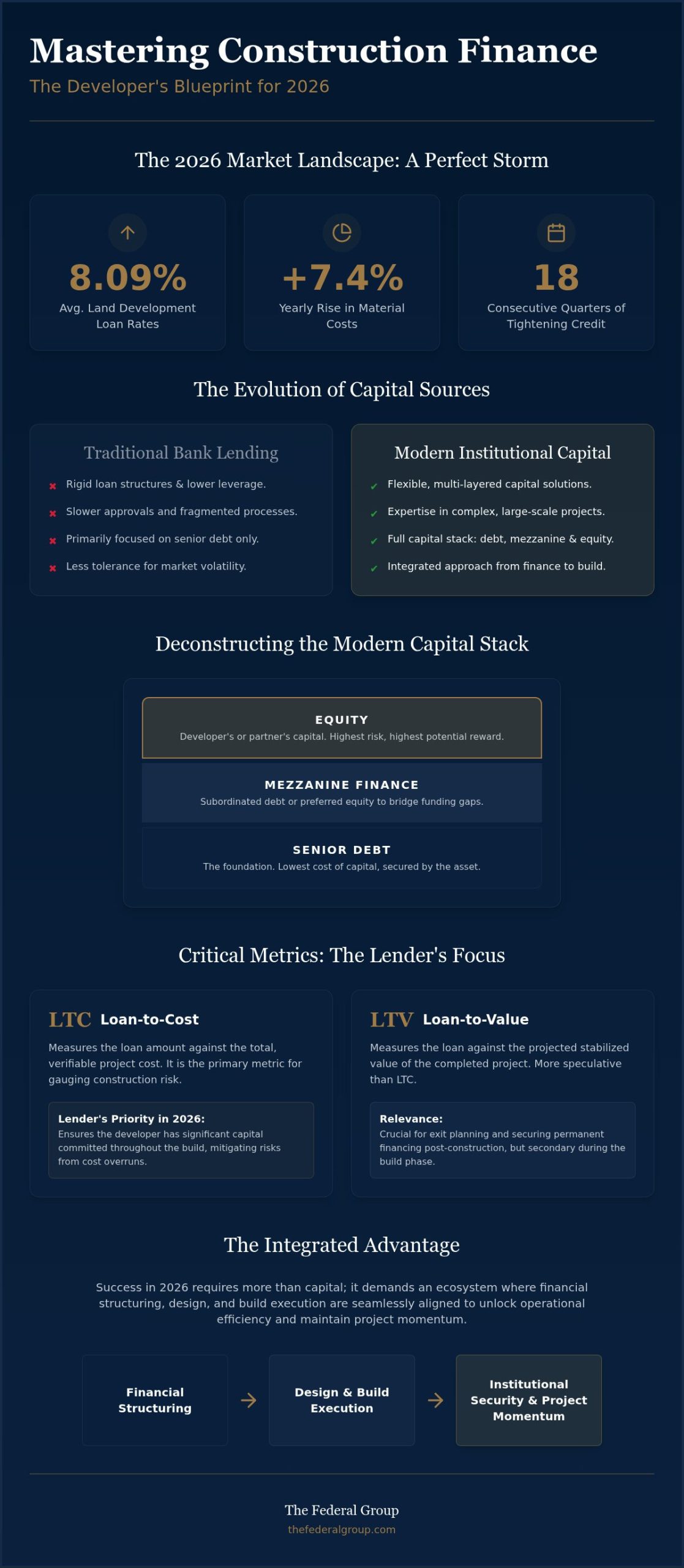
14 August 2026In 2026, a fragmented approach to capital is no longer a mere operational hurdle; it’s a fundamental threat to project solvency. As land development loan rates climb toward 8.09% and credit conditions tighten for the eighteenth consecutive quarter, the margin for structural inefficiency has vanished. You recognize that securing construction finance for developers in this climate requires navigating a labyrinth of cross-border regulations and volatile material costs that rose 7.4% on a yearly basis as of July 2026.
This strategic guide empowers you to master the complexities of the modern capital stack. We’ll move beyond transactional lending to explore a holistic ecosystem where bridging and development finance work in tandem. You’ll gain a clear framework for the 2026 market, from managing the 5% retention caps mandated by legislation like California’s SB 61 to leveraging the advantages of an integrated design-build partner. By the end of this analysis, you’ll possess the blueprint to maintain project momentum and institutional security in a high-stakes global environment.
Key Takeaways
- Understand the transition from conventional bank lending to sophisticated institutional capital when securing construction finance for developers in a high-interest environment.
- Gain technical precision in balancing LTC and LTV ratios to optimize capital stacks and protect project valuations.
- Explore the strategic role of private equity and joint ventures in providing the scale and stability required for multi-jurisdictional mega-projects.
- Navigate the complexities of international risk management, including currency fluctuation hedges and cross-border regulatory compliance.
- Unlock the operational efficiencies of an integrated ecosystem that aligns financial structuring with design and build execution.
Understanding the 2026 Landscape of Construction Finance for Developers
Construction finance is no longer a simple loan agreement; it has evolved into a sophisticated, multi-layered capital solution that sustains a project through its entire lifecycle. In the current market, construction finance for developers functions as a strategic ecosystem, balancing immediate liquidity needs with long-term valuation goals. This approach ensures that capital is not just available, but optimized for the specific risk profile of high-value assets.
Traditional bank lending has receded following eighteen consecutive quarters of tightening credit conditions. This vacuum has been filled by alternative institutional capital, private equity firms, and specialized credit funds that offer the flexibility required for high-value developments. High-stakes projects demand more than a standard senior debt facility. They require a partner capable of navigating volatile material costs, which rose 7.4% annually by mid-2026, and managing the complexities of globalized supply chains.
The Evolution of Property Development Funding
Market volatility in 2026 has fundamentally redefined lender risk appetite. With land development loan rates reaching an average of 8.09% in the second quarter, success depends on “integrated” finance. Capital providers must now possess a deep understanding of the build process and supply chain pressures. While domestic funding remains localized, international property development finance introduces complexities like currency hedging and cross-border regulatory compliance. This globalized approach allows developers to tap into diverse liquidity pools, ensuring stability even when local markets fluctuate.
Senior Debt vs. The Full Capital Stack
Senior debt remains the foundation of any capital arrangement. It typically offers the lowest cost of capital but rarely covers the full scope of modern mega-projects. For large-scale acquisitions, senior debt alone is insufficient. Developers must construct a robust capital stack that incorporates multiple layers to bridge the gap between institutional limits and total costs:
- Senior Debt: The primary, lower-cost foundation secured by the asset itself.
- Mezzanine Finance: Subordinated debt that provides additional leverage beyond senior limits.
- Equity: The developer’s or partner’s capital, carrying the highest risk and the greatest share of the rewards.
The structure of this stack directly influences the project’s internal rate of return (IRR). By utilizing sophisticated project finance techniques, developers can optimize leverage without overextending their balance sheets. Effective construction finance for developers ensures that every layer of the stack is synchronized. This prevents the delays often caused by fragmented financing sources and transforms capital allocation from a hurdle into a competitive advantage.
Core Mechanics: How High-Value Construction Loans are Structured
High-value construction finance for developers requires more than a simple credit line. It demands a sophisticated architecture where capital is released in alignment with physical milestones. The mechanics of these loans are governed by specific ratios that determine both the developer’s equity requirement and the lender’s security. In a market where credit conditions have tightened for eighteen consecutive quarters, precision in these structures is the difference between a stalled site and a successful completion.
Critical Financial Metrics for Developers
LTC is the primary metric for construction risk because it measures the loan against actual project expenditure rather than speculative future value. While Loan-to-Value (LTV) remains relevant for exit planning, lenders in 2026 prioritize LTC to ensure developers maintain sufficient capital commitment throughout the build. This shift is a direct response to the rising Cost of Credit for Builders, which saw land development rates climb to an average of 8.09% in the second quarter of 2026. For mixed-use assets, calculating the Debt Service Coverage Ratio (DSCR) is equally vital. It ensures the projected income from completed units can comfortably service permanent debt once the construction phase concludes.
Pre-construction costs often represent the highest initial capital hurdle. These ‘soft costs’ are frequently excluded from senior debt facilities, requiring developers to deploy equity or mezzanine layers early in the lifecycle. Efficient drawdown schedules are essential to manage this. A well-structured schedule ensures capital is available exactly when needed, preventing expensive delays while minimizing interest accrual on undrawn funds. Interest reserves also play a key role, allowing interest to be rolled into the loan facility to preserve operational cash flow during the non-income-producing construction phase.
The Strategic Role of Bridging Finance
Speed is a competitive advantage in land acquisition. Many developers utilize bridging finance for land acquisition to secure prime sites before a full development facility is underwritten. This short-term capital acts as a catalyst, allowing for immediate site control while the more complex senior debt stack is finalized. Understanding the nuances of development finance vs bridging loans is critical for tactical flexibility. While development finance covers the entire build, bridging loans offer the agility needed for rapid-turnaround acquisitions or planning gain strategies.
Exit strategies must be defined at the term sheet stage. Whether the plan involves refinancing to permanent debt or asset disposal upon completion, the loan structure must accommodate the transition. For those managing complex portfolios, partnering with an integrated financial specialist ensures these mechanics are synchronized with the project’s physical progress, providing stability from groundbreaking to exit.
Strategic Capital Allocation: Private Equity and Joint Ventures
High-growth developers are increasingly moving beyond debt-only models to fuel their expansion. Securing real estate private equity partners allows for a level of scaling that traditional credit facilities simply cannot support. In the first half of 2026, the U.S. market alone saw 3,999 private equity transactions completed, with approximately $314 billion in capital deployed. This massive liquidity pool represents a vital pillar of construction finance for developers who are targeting international mega-projects and complex urban regenerations.
Structuring these Joint Ventures (JV) requires a precise balance of control and capital. In most institutional arrangements, the developer acts as the General Partner (GP), providing local expertise and operational management. The institutional investor serves as the Limited Partner (LP), providing the bulk of the capital. This synergy allows developers to undertake projects far larger than their own balance sheets would typically permit, effectively using private equity as a catalyst for global portfolio growth.
Equity Partnership Models in 2026
Profit distribution in these partnerships is governed by a ‘Waterfall’ structure. This mechanism ensures that stakeholders receive returns in a specific order, often rewarding the GP with a ‘promote’ or carried interest once the LP achieves a predetermined hurdle rate. Within the capital stack, developers must distinguish between preferred and common equity. Preferred equity occupies a lower-risk position, receiving distributions before common shareholders, which makes it an attractive tool for de-risking high-value builds. Furthermore, utilizing private equity for design-build developers provides an added layer of security. Lenders and partners view the integration of finance and execution as a significant risk mitigant, often leading to more favorable terms.
Alternative Asset Classes: Sports and Mixed-Use
The 2026 market has seen a surge in non-traditional asset classes that blend real estate with operational businesses. Multi-club ownership in professional sports is a prime example of this synergy. Financing a hotel development within a complex mixed-use masterplan often requires the same level of financial sophistication as managing professional football club assets. These projects demand specialized construction finance for developers who understand how to monetize the intersection of hospitality, retail, and sports infrastructure. Diversifying into these high-barrier-to-entry sectors provides a defensive hedge against traditional residential or commercial cycles, positioning the developer as a visionary institutional partner.
Navigating Risks in International Construction Finance
Executing high-value projects across the US and UK requires more than just capital; it demands a sophisticated approach to multi-jurisdictional risk. When securing construction finance for developers, the ability to manage currency fluctuations is paramount. A sudden shift in the GBP/USD exchange rate can erode profit margins faster than physical delays on site. Institutional developers don’t leave these factors to chance. They utilize forward contracts and currency swaps to lock in rates for multi-year drawdowns, ensuring that capital remains stable regardless of market volatility.
Geopolitical shifts in 2026 have introduced new complexities, particularly regarding trade conflicts and tariffs. These external pressures directly influence material costs and supply chain reliability. Compliance is another critical pillar. International real estate finance requires rigorous adherence to Anti-Money Laundering (AML) standards and cross-border regulatory frameworks. Selecting an international real estate finance partner with deep expertise in both markets ensures that capital flows remain transparent and uninterrupted. It’s a foundational step that protects the project from institutional scrutiny and legal delays.
Cross-Border Capital Deployment
Transparency is the foundation of institutional trust. Most international developments utilize Special Purpose Vehicles (SPVs) to ring-fence assets and provide legal clarity for stakeholders. These structures simplify the tax implications of repatriating profits, which can be complex when operating across different tax regimes. Sovereign risk represents the potential for a project’s value to be impacted by political instability or changes in a foreign government’s policy. While the US and UK markets are generally stable, understanding the nuances of local legislation is essential for maintaining project solvency. It’s also vital to account for withholding taxes and local compliance costs that can impact the net IRR of a foreign project.
Mitigating Construction and Execution Risk
Supply chain volatility remains a primary threat to project timelines. By July 2026, iron and steel prices had increased by 17.6% annually, making forward-funded contracts a necessity for price certainty. Performance bonds also play a vital role in international construction finance for developers. These instruments provide a financial guarantee that the project will be completed even if a primary contractor faces insolvency. Maintaining liquidity throughout the multi-year development lifecycle requires a partner who understands the “build” as well as the “finance.” If you’re ready to structure your next global project with a partner that offers institutional scale and specialized expertise, connect with The Federal Group today.
The Integrated Advantage: Finance Meets Design and Build
Traditional property development often separates capital acquisition from physical construction. This siloed approach creates significant friction. When construction finance for developers is treated as a separate entity from the build, information asymmetry occurs. Lenders don’t fully grasp the intricate site risks; contractors don’t understand the capital constraints. This misalignment frequently leads to the “cost of delay,” where interest accrues on idle sites while stakeholders resolve disputes. The efficiency of the integrated design and build developer model lies in its ability to synchronize these two disciplines, ensuring that capital and construction move in lockstep.
By housing finance and execution under one roof, a developer eliminates the back-and-forth between third-party architects, lenders, and builders. This holistic ecosystem transforms the project lifecycle from a series of hand-offs into a single, streamlined operation. It provides the visionary energy required for large-scale development while maintaining the stability of institutional finance. This integration is the hallmark of a partner that manages every stage of a project’s lifecycle, positioning the developer to capture value that fragmented teams often lose.
De-risking the Project Lifecycle
Early-stage architectural integration allows for a more precise financial model from the outset. When the design team works alongside the capital team, the gap between ‘planned cost’ and ‘actual spend’ narrows significantly. This precision is vital. In a market where nonresidential construction input prices rose 7.2% yearly as of July 2026, even minor miscalculations can jeopardize the capital stack. Financing a design-build project through a single partner ensures that the drawdown schedule is perfectly calibrated to physical milestones. This prevents liquidity gaps and ensures that every dollar deployed is working toward project completion without the friction of fragmented financing sources.
Partnering for Success in 2026
The landscape of 2026 demands a shift from transactional lending to strategic capital partnership. Developers shouldn’t settle for just a check; they should seek an institutional partner that understands the nuances of niche sectors. Whether it’s the specialized requirements of professional football club assets or the operational complexities of hospitality, an integrated partner provides a defensive hedge against market volatility. This approach transforms construction finance for developers from a mere transaction into a competitive advantage. It allows for the scale of a large corporation with the focused insight of a niche consultancy, ensuring security for high-value stakeholders. Explore Integrated Development Solutions with The Federal Group.
Mastering the Future of High-Value Development
Navigating the 2026 market demands a departure from fragmented, transactional financing. Success depends on your ability to construct a resilient capital stack while managing the complexities of international risk and regulatory shifts. By integrating design and build execution with strategic capital, you eliminate the friction that often stalls high-value projects. This holistic approach ensures that your project remains solvent and your internal rate of return stays protected against the volatility of global material costs and tightening credit conditions.
Securing effective construction finance for developers is about more than just liquidity; it’s about building an authoritative partnership. The Federal Group provides the global reach across property and sports markets required for large-scale expansion. Our fully integrated design-build-finance capabilities and expertise in complex capital stack structuring provide the stability and visionary energy your stakeholders demand. It’s time to move beyond simple lending toward an ecosystem designed for completion.
Partner with The Federal Group for Integrated Development Finance to secure the future of your international portfolio and drive your next landmark project toward a successful exit.
Frequently Asked Questions
What is the typical LTC ratio for construction finance in 2026?
Typical LTC ratios in 2026 fluctuate between 65% and 80% for institutional grade assets. Lenders prioritize this metric over LTV to ensure developers maintain a significant equity stake throughout the build. This focus protects the capital stack against the 7.4% annual rise in material costs observed in mid-2026. A higher LTC is usually reserved for developers with a proven track record of delivering complex, high-value projects on schedule.
How do bridging loans differ from traditional construction debt?
Bridging loans provide immediate liquidity for land acquisition or site preparation, whereas traditional construction debt is structured for the entire build lifecycle. The primary differentiator is speed; bridging facilities can often be secured within weeks to capitalize on time-sensitive opportunities. Unlike long-term construction finance for developers, bridging loans are typically repaid or refinanced once a full development facility or planning permission is secured.
Can international developers secure funding for projects in both the US and UK?
Developers can secure funding for projects in both the US and UK by utilizing a partner with multi-jurisdictional expertise. This requires navigating distinct regulatory environments, such as the 5% retention caps in California or specific UK planning gain requirements. Success hinges on a robust cross-border strategy that accounts for currency hedging and ensures compliance with international AML standards across both major markets.
What are the advantages of using private equity for property development?
Private equity offers a strategic alternative to traditional lending by providing the scale necessary for mega-projects. It allows developers to undertake larger acquisitions by acting as a Limited Partner (LP) alongside the developer’s General Partner (GP) role. This partnership model de-risks the project for the developer while providing the institutional capital required to expand a global property portfolio into high-barrier-to-entry markets.
How does an integrated design and build model affect financing terms?
An integrated design and build model often results in more competitive financing terms and higher leverage. Lenders view the synchronization of design, build, and finance as a primary risk mitigant. By reducing the friction between separate contractors and architects, the developer minimizes the “cost of delay.” This operational efficiency instills greater confidence in institutional partners, often leading to streamlined drawdown schedules and reduced contingency requirements.
What documentation is required for a large-scale construction finance application?
Application requirements for large-scale projects include a comprehensive development appraisal, fixed-price construction contracts, and verified planning consents. Lenders also require a detailed breakdown of the capital stack, including the source of equity and any mezzanine layers. Documentation must demonstrate a clear exit strategy, whether through refinancing or asset disposal, supported by current market valuations and a proven management track record in similar jurisdictions.
Is mezzanine finance necessary for every high-value project?
Mezzanine finance is not mandatory but serves as a vital tool for optimizing the capital stack in high-value projects. It allows developers to increase their total leverage beyond the limits of senior debt, typically covering the 10% to 20% gap between senior facilities and equity. Utilizing mezzanine layers in construction finance for developers preserves internal liquidity, enabling the pursuit of multiple concurrent projects without overextending the balance sheet.
How do sports club investments fit into a property development portfolio?
Sports assets function as high-barrier-to-entry operational real estate that provides both operational revenue and significant real estate synergy. Financing these assets within a broader development portfolio allows for the creation of mixed-use ecosystems that blend hospitality, retail, and professional sports infrastructure. This diversification offers a defensive hedge against traditional property cycles, as sports assets often command high-yield returns and possess unique institutional appeal in globalized markets.