2026 Property Development Capital Stack: Financing Guide
2 August 2026Over $3 trillion in commercial real estate debt is set to mature between 2026 and 2028, creating a high-stakes environment where traditional financing no longer guarantees project viability. You’ve likely noticed that the cost of senior debt has stabilized at elevated levels, with bank rates for professional builders often ranging between 6.5% and 9.5%. Coordinating a complex capital stack for property development across international borders is increasingly difficult, especially when you’re trying to balance heavy debt service against the threat of excessive equity dilution.
We understand that securing funding in this climate requires more than a standard application; it demands a visionary approach to financial engineering. This guide provides the strategic framework you need to optimize leverage and secure institutional-grade funding for large-scale projects. You’ll learn how to layer private equity, mezzanine debt, and integrated design-and-build models to de-risk your position and satisfy the market’s current “flight to quality.” We’ll break down the precise mechanics of modern capital placement to ensure your next development is both resilient and highly profitable.
Key Takeaways
- Understand how the hierarchy of a capital stack for property development dictates the risk-return profile for every stakeholder involved in a 2026 project.
- Learn to utilize mezzanine finance and private equity to protect developer equity as senior lenders tighten loan-to-cost (LTC) requirements.
- Master the “First-In, Last-Out” waterfall mechanism to navigate default risks and prioritize capital returns in a shifting interest rate environment.
- Discover how the “Integrated Premium” of a design-and-build model simplifies access to capital for high-value international developments.
- Identify strategic opportunities to partner with global specialists for customized capital solutions that bridge the gap between traditional debt and project completion.
Decoding the Capital Stack for Property Development in 2026
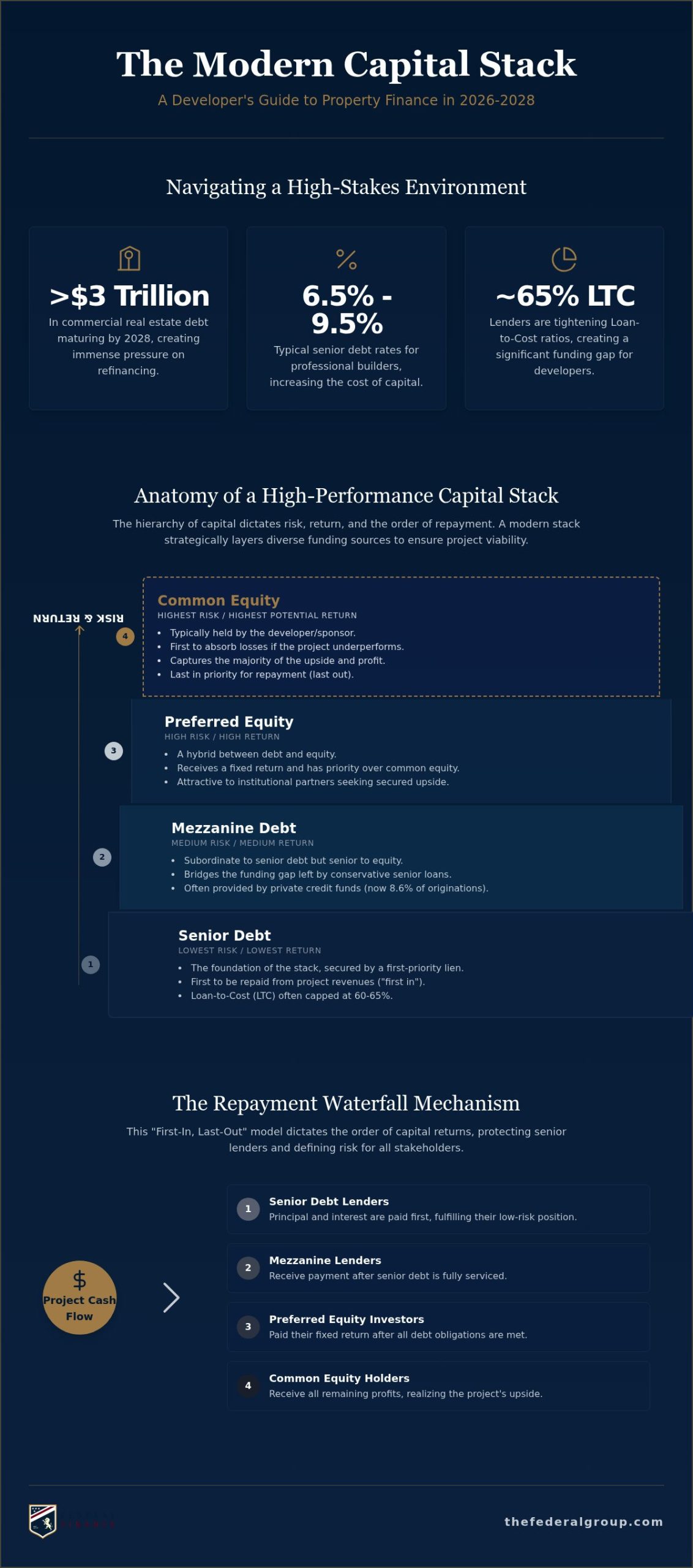
The capital stack for property development represents the structural hierarchy of all financial sources deployed to fund a project from inception to completion. It defines the order of repayment, the level of security, and the risk-return profile for every stakeholder involved. In 2026, the stack has evolved from a simple bank-loan-plus-equity model into a complex ecosystem of institutional debt and private credit. For developers, understanding capital structure is no longer just a financial exercise; it’s a strategic necessity to ensure project feasibility as over $3 trillion in commercial real estate debt matures through 2028.
The order of priority within the stack determines who gets paid first and who carries the most risk. Senior lenders sit at the bottom of the stack, enjoying the highest security but lowest returns. Conversely, equity holders at the top are the last to receive distributions but capture the majority of the project’s upside. This hierarchy isn’t just about payment order; it dictates the overall cost of capital. By strategically layering different types of financing, developers can optimize their returns while maintaining a risk profile that satisfies institutional requirements.
The Four Essential Layers of Modern Real Estate Finance
A high-performance capital stack typically utilizes four distinct layers to balance leverage and liquidity. Senior debt remains the foundation, secured by a first-priority lien on the asset. In the current market, banks have tightened their requirements, often capping loan-to-cost (LTC) ratios to manage their exposure to regional bank volatility. Mezzanine finance sits above the senior debt, bridging the gap between the primary loan and the developer’s equity. This layer offers higher yields to lenders and is increasingly provided by private credit funds, which now account for 8.6% of originations.
Preferred equity serves as a hybrid layer, offering fixed returns and priority over common equity. It’s a favored tool for institutional partners who want a more secure position than common equity but higher returns than mezzanine debt. Finally, common equity is the layer usually held by the developer. It’s the most junior position in the stack, meaning it’s the first to absorb losses if the project underperforms. However, it’s also the layer that benefits most from successful project execution and value creation.
The Interplay of Leverage and Risk
The configuration of these layers directly impacts the weighted average cost of capital (WACC). While increasing leverage through mezzanine or preferred equity can amplify returns on the developer’s common equity, it also increases the debt service burden. With senior debt rates for professional builders currently ranging from 6.5% to 9.5%, the cost of servicing high leverage is a critical feasibility factor. 2026 market conditions demand a disciplined approach to the “capital cushion.” This cushion, formed by the equity and mezzanine layers, protects senior lenders from asset value fluctuations. A thicker cushion makes a project more attractive to traditional lenders, even in a climate where some institutions face commercial real estate exposure exceeding 300% of their equity.
The Anatomy of a High-Performance Capital Stack
Building a resilient capital stack for property development in 2026 requires a precise understanding of how senior debt, mezzanine finance, and equity interact. As banks manage their exposure to commercial real estate, which in some regional institutions exceeds 300% of their equity, the “flight to quality” has become the defining trend. Lenders have recalibrated their risk appetite, frequently lowering loan-to-cost (LTC) ratios to 60% or 65%. This shift forces developers to seek alternative layers to maintain project momentum without over-leveraging the primary asset.
Senior debt remains the most cost-effective capital source, though its availability is increasingly tied to sponsor track records. HUD 221(d)(4) loans are currently sitting in the mid-to-high 5% range, while traditional bank construction loans hover between 6% and 7% for top-tier projects. To bridge the resulting funding gap, sophisticated developers utilize preferred equity and mezzanine finance. Preferred equity often includes “kickers” or conversion features that allow institutional partners to participate in the project’s success while maintaining a priority position over common equity. This structure ensures that the project remains feasible even as senior lenders tighten their requirements.
Structuring Mezzanine and Bridging Solutions
Mezzanine debt serves as a surgical tool for preserving developer equity during the construction phase. It sits behind senior debt but ahead of equity, typically carrying rates between 9% and 12% in the current market. Before the full stack is finalized, many developers utilize bridging finance for land acquisition to secure prime sites and complete pre-development work. These short-term solutions are critical in competitive markets where speed of execution is a prerequisite for success. Successful integration of these layers depends on robust intercreditor agreements that define the rights of each lender during potential default scenarios, ensuring a stable financial foundation for the project’s lifecycle.
Equity Partnerships and Joint Ventures
Common equity represents the developer’s “skin in the game” and serves as the ultimate signal of project conviction to institutional lenders. When internal capital is insufficient, a real estate private equity partner provides the necessary “gap” equity to complete the structure. These partnerships are governed by waterfall distributions that specify hurdle rates and “promotes” for the developer upon achieving certain IRR targets. Recent developer insights on capital stacks highlight that aligning these interests is paramount, especially when navigating the regulatory complexities of 2026. If you are looking to refine your project’s financial architecture, exploring bespoke development finance options can provide the necessary flexibility to scale your international portfolio.
Assessing Risk and Priority: The Waterfall Mechanism
The distribution of project revenue follows a rigid “First-In, Last-Out” principle that defines the operational reality of any capital stack for property development. Senior lenders are the first to fund and the first to exit, while common equity holders provide the final layer of capital and are the last to receive distributions. This hierarchy creates a structural buffer for institutional lenders, but it also means the developer carries the highest risk of loss. In 2026, with over $3 trillion in commercial real estate debt set to mature, the precision of this mechanism is under intense scrutiny from both sponsors and financiers.
Shifting interest rates have recalibrated default risks across every layer. Senior debt, once considered the safest position, now faces pressure from declining asset values and the high exposure of regional banks. This volatility is why securing property development loans now requires a more robust equity buffer than in previous cycles. A thin equity layer leaves the project vulnerable to foreclosure, especially as the 2026 regulatory landscape, including new FinCEN transparency rules and FHFA fee recalibrations, alters the legal framework for capital priority and lender rights.
Key Financial Ratios for Capital Structuring
Lenders have shifted their focus from Loan-to-Value (LTV) toward Loan-to-Cost (LTC) as the primary metric for construction feasibility. In 2026, LTC matters more because it measures the lender’s exposure relative to actual hard and soft costs rather than speculative future appraisals. A healthy Debt Service Coverage Ratio (DSCR) is equally critical. With bank financing rates for professional builders reaching up to 9.5%, projects must demonstrate they can support senior obligations through projected net operating income. Lenders also prioritize Debt Yield, which provides a clear view of the lender’s return if they were forced to take over the asset in the current market.
The Payment Waterfall Explained
The waterfall mechanism dictates the flow of cash once the project generates revenue or reaches a liquidity event. At the invisible top of the stack sit operating expenses, insurance, and property taxes; these are non-negotiable and must be satisfied before any capital provider is paid. Next comes debt service. Senior interest payments take priority, followed by principal amortization and any mezzanine obligations. Only after all debt layers are satisfied can equity distributions begin. This real estate capital stack guide illustrates how preferred equity receives its preferential returns before common equity holders can initiate their “catch-up” or “promote” phases. This disciplined progression ensures that risk is compensated fairly across the entire structure.
Strategic Structuring for International and Integrated Projects
Managing a capital stack for property development across multiple jurisdictions introduces a layer of complexity that domestic projects rarely face. Currency fluctuations and varying international tax treaties can quickly erode the efficiency of a well-structured stack if not managed with technical precision. For developers operating in high-value markets, the challenge lies in coordinating diverse capital sources while mitigating the risks associated with cross-border transfers and jurisdictional legal shifts. This environment is why property finance for high-value projects is becoming increasingly accessible to those who employ integrated models.
The “Integrated Premium” refers to the enhanced financing terms available to developers who control both the design and construction phases. The Federal Group utilizes this model to reduce “leakage,” the financial inefficiency caused by fee stacking and miscommunication between disconnected contractors and financiers. By internalizing these functions, developers provide lenders with a transparent, unified point of accountability. Navigating the jurisdictional complexities of international property development finance requires this level of integration to ensure that capital is deployed and returned without friction, regardless of the project’s location.
Integrated Design and Build: The Ultimate De-risking Tool
Senior lenders in 2026 prioritize certainty over almost any other factor. An integrated design-and-build model serves as a powerful de-risking tool by eliminating the adversarial gap that often exists between architects, contractors, and financial partners. When the entity managing the capital also manages the construction site, the risk of cost overruns and timeline slippage is significantly reduced. This end-to-end management improves transparency for private equity partners, who can monitor project milestones with greater accuracy. The result is often a lower cost of senior debt and a more stable equity layer, as the fundamental construction risks are mitigated from the outset.
Alternative Financing Trends in Global Markets
As traditional banks retreat from complex international deals, family offices and sovereign wealth funds are filling the void within the mezzanine layer. These capital providers often seek long-term alignment and are increasingly attracted to projects that leverage green financing and ESG incentives. By meeting specific sustainability benchmarks, developers can lower their weighted average cost of capital (WACC) through subsidized “green” loans. Additionally, unique asset classes like sports multi-club ownership are emerging as sophisticated components within the global capital stack. These ventures require specialized structuring to balance the operational needs of the sports entity with the underlying property asset’s value, a discipline now led by the global sports investment group redefining athletics as a data-driven, institutional-grade asset class. Working with a dedicated international real estate finance partner ensures that cross-border capital flows are structured efficiently and that complex multi-jurisdictional deals are managed with the precision they demand. If you are looking to optimize a complex international project, The Federal Group provides the specialized expertise needed to structure high-performance capital solutions.
Navigating Complex Capital Solutions with The Federal Group
The transition from a standard developer to a global market leader requires more than just access to funds; it demands a strategic partner capable of engineering a resilient capital stack for property development. As traditional banking institutions continue to pull back from complex, international deals, The Federal Group fills the void by providing an integrated ecosystem of financial and operational expertise. We don’t merely offer capital. We provide a structured pathway to project completion, leveraging our deep understanding of institutional debt and private credit to optimize every layer of your project’s financial architecture.
Our position as a specialist partner allows us to navigate the high-stakes environment of 2026 with quiet confidence. By utilizing the Federal Holdings integrated design-and-build model, we address the primary concerns of institutional lenders: transparency and execution risk. This integration ensures that the financial structure is perfectly aligned with the physical development lifecycle, reducing the “leakage” and adversarial gaps that often plague disconnected projects. Whether you are managing a high-value residential project or a complex commercial asset, our global reach provides the stability and ambition required for international success.
Our Approach to Development Finance and Private Equity
The Federal Group offers bespoke bridging loans designed for rapid land acquisition, allowing developers to secure prime sites before the broader capital stack is finalized. In an environment where speed is a premium asset, these short-term solutions provide the necessary momentum to move projects from concept to construction. For larger ventures, our private equity partnerships offer the “gap” capital needed to scale high-potential developments without excessive dilution of the sponsor’s position. We prioritize transparency and stability, ensuring that every stakeholder understands the waterfall mechanism and the path to liquidity.
Partnering for the Long Term
We support developers through the entire project lifecycle, from initial design and capital structuring to the final disposal of the asset. This holistic approach allows our partners to access institutional-grade capital that is typically reserved for the largest global corporations. By working with a specialist firm that understands the technical precision required for cross-border finance, you ensure your development is positioned for long-term profitability. Our expertise in niche asset classes, including sports multi-club ownership, further demonstrates our ability to manage complex, multi-disciplinary operations with ease. If you are ready to master the complexities of modern finance, consult with our capital structuring experts at The Federal Group to optimize your international portfolio.
Securing the Future of Global Development Finance
Structuring a resilient capital stack for property development in 2026 requires a fundamental shift from traditional debt models to integrated, multi-layered financial engineering. We’ve explored how a disciplined waterfall mechanism and a “flight to quality” in senior debt define current project feasibility. Success now depends on your ability to coordinate cross-border capital while mitigating construction risks through end-to-end management. It’s no longer enough to simply secure a loan; you must engineer an ecosystem of stability.
The Federal Group stands ready as your strategic partner, offering the global expertise and technical precision required for high-stakes international ventures. By leveraging our integrated design and build capabilities via Federal Holdings, you gain a unique advantage in de-risking senior debt and attracting institutional-grade private equity. From bespoke bridging loans to complex sports investments, our proven track record ensures your portfolio is built on a foundation of stability and ambitious growth.
Partner with The Federal Group for Your Next High-Value Development and secure the capital solutions your vision deserves. We’re prepared to help you navigate the complexities of the modern market with confidence and scale.
Frequently Asked Questions
What is the ideal capital stack ratio for property development in 2026?
The ideal ratio in 2026 typically features a senior debt layer capped at 60% to 65% loan-to-cost (LTC). This conservative foundation is often supplemented by a 10% to 20% layer of mezzanine finance or preferred equity, leaving the remaining 15% to 25% as common equity. This structure ensures a sufficient capital cushion to satisfy institutional lenders who are increasingly sensitive to market volatility and regional bank exposure.
How does mezzanine debt differ from preferred equity in a real estate deal?
Mezzanine debt is a loan secured by a pledge of the developer’s equity interests in the property owning entity, whereas preferred equity represents an actual ownership stake. In the event of a default, mezzanine lenders can quickly foreclose on the equity to take control of the project. Preferred equity holders instead rely on their priority position in the payment waterfall to receive fixed returns before common equity distributions occur.
Why is common equity considered the highest risk layer in the capital stack?
Common equity carries the highest risk because it occupies the “first-loss” position at the top of the capital stack for property development. This layer is the last to receive distributions in the payment waterfall and the first to be eroded if project costs exceed the budget or asset values decline. It represents the developer’s primary exposure, ensuring their interests remain aligned with the project’s successful completion and eventual disposal.
Can I use bridging loans as part of my capital stack structure?
Bridging loans are frequently used as short-term components of a capital stack to secure land or maintain project momentum during pre-development. These facilities provide the speed necessary for rapid acquisition before a more permanent, lower-cost senior debt facility is finalized. In 2026, bridging finance serves as a critical bridge between the initial site control and the full capitalization of the project’s construction phase.
How does an integrated design and build model affect my ability to get financing?
An integrated design and build model significantly improves financing accessibility by reducing the execution risk for senior lenders. When the developer manages both the design and construction through a unified entity like Federal Holdings, it eliminates the adversarial gaps that lead to cost overruns. Lenders often offer more competitive terms or higher leverage to projects that demonstrate this level of operational transparency and end-to-end accountability.
What are the risks of a “top-heavy” capital stack with high leverage?
A “top-heavy” stack with excessive leverage increases the debt service coverage ratio (DSCR) pressure and heightens the risk of default. If the mezzanine and senior debt layers are too large, even a minor shortfall in net operating income can prevent the project from meeting its interest obligations. This fragility is particularly dangerous in a shifting interest rate environment where refinancing options may be limited for highly leveraged assets.
How do international regulations impact cross-border capital stacking?
International regulations, such as the 2026 FinCEN transparency rules and evolving tax treaties, introduce significant reporting requirements for cross-border capital. These rules impact how equity is sourced and distributed, requiring developers to account for jurisdictional legal shifts and potential currency risk. Navigating these complexities is essential for maintaining the efficiency of a capital stack for property development that involves international institutional partners.
What role does a private equity partner play in a property development project?
A private equity partner provides the “gap” equity necessary to complete the capital structure while offering institutional credibility to senior lenders. Beyond capital, these partners often bring global market expertise and strategic oversight to high-value projects. Their involvement allows developers to scale larger ventures and access sophisticated financial engineering that would be unavailable through traditional bank financing alone.