2026 Strategic Guide: Commercial Real Estate Funding
2 September 2026Total U.S. commercial real estate investment volume climbed 19% to $117.3 billion in the first quarter of 2026, yet traditional lenders remain more risk-averse than ever. You’ve likely found that while the market is recovering, the gap between securing land and breaking ground is widening due to rigid bank criteria and complex cross-border regulations. Understanding how to secure funding for commercial real estate in this climate requires more than a simple loan application; it demands a strategic, integrated capital ecosystem.
We recognize that high-stakes development requires a partner who sees beyond the balance sheet to the project’s visionary potential. This guide provides an expert framework to master the complexities of high-value finance, covering development capital, bridging loans, and private equity. We’ll explore how to structure capital for maximum ROI, navigate 2026’s shifting debt maturities, and leverage flexible, high-leverage funding to de-risk your project’s lifecycle. By the end of this guide, you’ll have the tactical insight needed to partner with financiers who truly understand the global development environment.
Key Takeaways
- Learn how to secure funding for commercial real estate by shifting your focus from traditional retail banks toward specialized institutional lenders.
- Understand how to utilize bridging loans and development finance to maintain momentum throughout the entire project lifecycle.
- Identify the specific DSCR and LTV benchmarks that global financiers require in the current 2026 economic environment.
- Professionalize your capital requests with multi-scenario financial modeling that demonstrates clear, risk-adjusted ROI to potential partners.
- Discover how an integrated design and build approach serves as a powerful tool to de-risk projects and unlock more flexible capital.
Navigating the 2026 Commercial Real Estate Funding Landscape
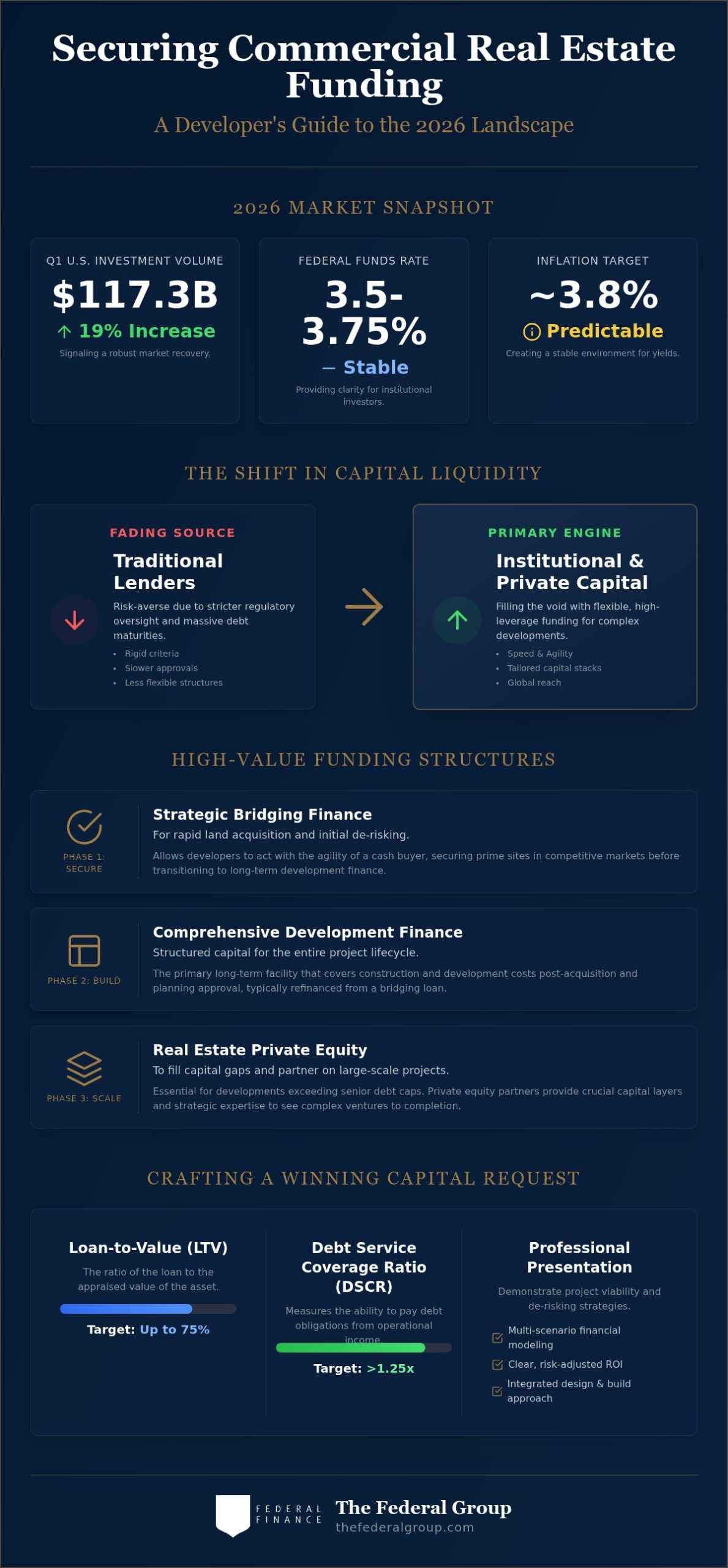
The stabilization of global interest rates in mid-2026 has fundamentally reshaped capital flows. With the Federal Reserve holding the funds rate steady between 3.50% and 3.75%, institutional investors have found the clarity needed to re-enter the market with conviction. Total U.S. investment volume reached $117.3 billion in the first quarter alone, signaling a robust recovery. However, the path to capital isn’t what it used to be. Static, one-size-fits-all models have failed. Modern developers now prioritize dynamic, integrated solutions that adapt to the project lifecycle. This shift is particularly evident in the US and UK markets, where cross-border capital is filling the void left by domestic retail banks. Understanding commercial mortgage basics remains essential, but the real challenge is navigating the move toward private, institutional liquidity.
Macroeconomic Trends Influencing CRE Finance
Inflation targets for 2026 have settled near 3.8%, creating a predictable environment for long-term commercial yields. This stability has encouraged private equity firms to move beyond primary hubs, seeking higher returns in secondary and tertiary global markets. It’s a strategic migration driven by the hunt for yield in a maturing cycle. Digital transformation has also played a critical role; AI-driven platforms now streamline the due diligence process for high-value loans. This reduces the time between initial inquiry and capital deployment, which is vital when you’re determining how to secure funding for commercial real estate in a fast-moving market. Speed is now a competitive advantage, not just a convenience.
Institutional vs. Private Capital: Where is the Liquidity?
Liquidity has migrated away from regional banks. Stricter regulatory oversight and the massive wave of debt maturities scheduled between 2026 and 2028 have forced traditional lenders to tighten their criteria. Consequently, private equity partners have emerged as the primary engine for growth capital. These entities offer the flexibility that institutional banks lack, especially for complex, large-scale developments. For those operating on a global scale, the strategic importance of international property development finance cannot be overstated. It provides the necessary bridge between local vision and global capital. If you’re planning a project that spans jurisdictions, identifying how to secure funding for commercial real estate through private institutional channels is the most viable path to completion. This ecosystem rewards transparency, integrated planning, and a deep understanding of risk-adjusted returns.
High-Value Funding Structures for Sophisticated Developers
For institutional-grade developers, the standard retail banking model is insufficient. High-value projects require a layered approach to capital that mirrors the complexity of the development itself. Development finance offers a structured solution for the entire project lifecycle, but it’s rarely the starting point for large-scale ventures. Most sophisticated players begin with specialized bridging loans to secure assets before transitioning to long-term debt. This prevents project stagnation and allows for rapid deployment. While a Beginner’s Guide to CRE Loans provides a foundation, institutional success depends on capital stack optimization and the strategic use of equity layers.
Strategic Bridging Finance for Land Acquisition
Securing prime development sites requires speed. Traditional bank approvals often take months, which can lead to lost opportunities in competitive global markets. Using bridging finance for land acquisition allows developers to act with the agility of cash buyers. It’s a short-term catalyst that maintains momentum during the planning and permitting phases. Once the site is de-risked through planning approvals, the exit strategy typically involves refinancing into a lower-cost development facility. This transition is a critical component of how to secure funding for commercial real estate without diluting equity too early in the cycle.
The Role of Real Estate Private Equity
Large-scale developments often exceed the lending caps of senior debt providers, creating a capital gap that can stall a project. This is where a real estate private equity partner becomes essential. Unlike traditional lenders who focus solely on debt coverage, private equity firms act as strategic allies. They understand industrial-scale risks and provide the growth capital necessary for portfolio scaling. Choosing between mezzanine debt and preferred equity is a high-stakes decision that directly impacts your ultimate ROI. Equity partnerships also help distribute risk across complex international projects, making them indispensable for cross-border ventures.
Joint Venture (JV) finance further refines this approach by aligning interests between the developer and the financier. It creates a shared commitment to the project’s long-term success. Determining how to secure funding for commercial real estate at this level involves presenting a transparent, multi-layered financial model that accounts for every contingency. If you’re ready to explore these sophisticated structures, partnering with a specialist financier can provide the institutional weight and flexibility your project requires to reach completion.
Essential Qualifications: Navigating LTV, DSCR, and Global Risk
Securing capital in 2026 requires a financial profile that survives rigorous institutional scrutiny. Lenders look closely at Loan-to-Value (LTV) and Loan-to-Cost (LTC) to gauge a developer’s skin in the game. While LTV measures debt against appraised value, LTC focuses on actual construction outlays. Conventional LTVs currently sit between 65% and 75%, though strong properties can push toward 80%. This capital commitment ensures the developer remains fully aligned with the financier’s objectives. It’s about demonstrating stability before the first stone is laid.
Defining the 2026 Debt Service Coverage Ratio (DSCR)
The Debt Service Coverage Ratio (DSCR) represents the relationship between a property’s Net Operating Income and its total debt service obligations. Lenders in 2026 have moved beyond static assessments, prioritizing “stressed” DSCR calculations that simulate market volatility or sudden occupancy shifts. For industrial and retail sectors, a 1.25x ratio remains the benchmark for prime pricing. Conversely, the office sector often demands a 1.35x ratio to mitigate higher perceived risks. Mastering these metrics is a prerequisite for anyone determining how to secure funding for commercial real estate in the current institutional environment.
Cross-Border Risk Assessment
International developments introduce layers of complexity that domestic projects don’t encounter. Currency fluctuations can silently erode margins unless the capital structure includes robust hedging strategies. Regulatory due diligence has also intensified, with Anti-Money Laundering (AML) and Know Your Customer (KYC) requirements becoming standard for global capital deployment. These protocols protect the integrity of the investment. Leveraging the expertise of international real estate finance partners allows developers to navigate these hurdles with precision. Local market expertise de-risks the application and signals a level of sophistication that institutional financiers value.
Lenders also perform a global cash flow analysis. They look past the individual project to the developer’s entire financial ecosystem. High-value funding often mandates specific net worth and liquidity thresholds to protect against cost overruns. This holistic evaluation ensures the sponsor has the capacity to perform throughout the project’s entire lifecycle. Knowing how to secure funding for commercial real estate means preparing for this level of deep-dive transparency. It’s a high-stakes environment where precision in your qualifications is just as important as the quality of your development.
Step-by-Step: Crafting a Winning Capital Request
Securing institutional capital requires more than a standard pitch deck; it demands a comprehensive narrative of risk mitigation and financial transparency. Determining how to secure funding for commercial real estate at a global scale involves assembling an executive summary that prioritizes strategic value over mere asset descriptions. Lenders want to see a clear path to ROI, supported by a team that possesses the integrated expertise to navigate market volatility. This process begins with a meticulous assembly of your project’s fundamentals, ensuring every projection is defensible under institutional scrutiny.
The Power of the Integrated Pro-Forma
Static spreadsheets are no longer sufficient for high-stakes finance. Modern capital requests must feature dynamic financial models that account for multiple economic scenarios. Your pro-forma should explicitly detail soft costs, robust contingency funds, and current 2026 construction material trends. While inflation has stabilized near 3.8%, the cost of specialized labor and sustainable materials continues to fluctuate. An integrated design-build perspective improves pro-forma accuracy by aligning real-world construction costs with financial projections from the outset. This level of detail demonstrates to financiers that your projections are rooted in operational reality rather than optimistic estimates.
Securing Institutional Trust
Institutional trust is built on the foundation of a proven track record. For developers targeting specialized sectors, such as professional sports venues or large-scale multi-use developments, proving capability through past performance is non-negotiable. Specialized lenders look for integrated expertise, where the developer manages the lifecycle from design through to completion. Utilizing third-party feasibility studies is another critical step; these studies validate market demand and provide an objective layer of security for the lender. It’s about proving that the asset will perform as expected once it enters the stabilized phase.
A winning request also highlights site selection and permitting status. Proving that you have a clear path to project commencement, with necessary zoning and environmental clearances already in sight, significantly de-risks the deal. If your team is ready to professionalize your capital request and engage with a partner that understands the intricacies of industrial-scale development, consult with The Federal Group to discuss your project’s financial structure. This proactive approach ensures you’re positioned as a high-value partner rather than just another applicant.
Scaling with Integrated Finance and Private Equity Partners
Scaling a global portfolio requires a shift from isolated transactions to a holistic capital ecosystem. When you’re evaluating how to secure funding for commercial real estate on an industrial scale, the primary hurdle isn’t just the interest rate; it’s the fragmentation between design, construction, and finance. Integrated models solve this by aligning capital solutions with architectural excellence. This approach provides lenders with a clear line of sight from the initial vision to the final certificate of occupancy. Future-proofing these developments also means integrating ESG metrics and advanced building technologies, as institutional investors now view these as mandatory requirements for high-value funding.
The Efficiency of the Integrated Developer
The traditional separation of architects, contractors, and financiers creates friction that often leads to cost overruns and delays. By working with integrated design and build developers, you eliminate the gap between the architectural dream and the financial reality. This model serves as the ultimate de-risking tool for lenders because it centralizes accountability. Developers gain direct access to capital through development finance lenders who specialize in these integrated case studies. It’s a streamlined path that ensures the project remains viable even as market conditions shift.
Effective scaling in 2026 involves several key pillars:
- Strategic Equity Partnerships: Accessing private equity to provide the growth capital necessary for portfolio expansion.
- Regulatory Agility: Navigating global AML and KYC protocols with localized expertise to ensure seamless capital deployment.
- Integrated Project Management: Combining design, build, and finance into a single workflow to reduce friction and improve ROI.
Conclusion: Securing Your Project’s Future
The 2026 funding environment rewards speed, flexibility, and deep integration. As we’ve explored, understanding how to secure funding for commercial real estate involves more than just hitting a DSCR benchmark; it requires a strategic partnership that spans the entire project lifecycle. Whether you’re navigating cross-border regulations or seeking high-leverage bridging loans for land acquisition, the choice of financier determines your ultimate success. Choosing a partner with global reach and localized insight allows you to navigate 2026’s shifting debt maturities with confidence. The Federal Group remains committed to providing the institutional scale and specialized insight necessary for visionary developments. Reach out to our specialists to structure your next high-value project with a partner that understands the gravity of global finance.
Mastering the Future of Institutional Capital
Success in the 2026 market depends on your ability to transcend traditional lending limitations and embrace an integrated capital ecosystem. You’ve seen that understanding how to secure funding for commercial real estate now requires a balance of technical precision, multi-layered financial modeling, and a deep awareness of cross-border risk. By prioritizing flexible bridging loans for acquisition and leveraging private equity for scale, you position your development for long-term stability in a recovering global economy. It’s no longer enough to simply present a project; you must present a de-risked lifecycle.
The Federal Group has operated as a specialist in international property finance since 2009. We provide fully integrated design and build capabilities that serve as a powerful de-risking tool for high-value stakeholders. As strategic partners in global sports and property markets, we understand the gravity of institutional finance and the visionary energy required for industrial-scale development. Partner with The Federal Group for Your Next Global Development to align your project with a heavyweight financier. Your vision deserves a capital structure that matches its ambition.
Frequently Asked Questions
What is the typical LTV for commercial real estate development in 2026?
Typical LTV for institutional development projects in 2026 ranges from 65% to 75%, though high-quality assets in prime markets can reach 80%. These ratios ensure developers maintain significant equity in the deal, aligning their interests with the financier’s risk profile. While government-backed programs might offer higher leverage, sophisticated developers often prefer the flexibility of institutional capital. It’s a standard requirement that reflects the conservative underwriting environment of the current market.
How do bridging loans differ from traditional commercial mortgages?
Bridging loans are short-term catalysts designed for speed and flexibility during the acquisition or planning phases of a project. They differ from traditional commercial mortgages, which are long-term facilities intended for stabilized, cash-flowing assets. Bridging finance allows you to secure a site quickly before transitioning to a permanent debt structure. It’s an essential tool for maintaining momentum when you’re determining how to secure funding for commercial real estate without waiting for long bank approval cycles.
Can I secure funding for international property projects through a single partner?
Yes, you can secure funding for global projects through a single strategic partner with international reach. Working with a financier that operates across the US, UK, and global markets eliminates the friction of managing multiple local lenders. This integrated approach simplifies cross-border regulations and currency management. It ensures that your capital structure remains consistent across your entire international portfolio, providing a seamless experience from initial acquisition through to final project completion.
What documentation is required for a private equity partnership in CRE?
Private equity partnerships require extensive documentation that proves both project viability and developer capability. You’ll need to provide an integrated pro-forma with multi-scenario financial modeling and detailed soft cost projections. High-value partners also scrutinize your track record and global cash flow. Third-party feasibility studies and clear site-selection data are mandatory to validate market demand. This transparency is the foundation of how to secure funding for commercial real estate through institutional equity channels.
How does the integrated design and build model affect my ability to get funding?
The integrated design and build model significantly improves your ability to secure funding by serving as a primary de-risking tool. Lenders favor this approach because it centralizes accountability and reduces the gap between architectural vision and construction reality. It eliminates the friction typically found between separate contractors and architects. This synergy provides financiers with greater confidence in the project’s timeline and budget, often leading to more flexible and high-leverage capital solutions.
What are the minimum requirements for institutional-grade commercial funding?
Institutional-grade funding requires a sponsor with a proven track record and a robust financial profile. Minimum requirements typically include a Debt Service Coverage Ratio (DSCR) between 1.25x and 1.35x, depending on the asset class. Lenders also mandate specific net worth and liquidity thresholds to ensure the developer can handle potential cost overruns. High-value institutional funding is reserved for projects that demonstrate transparent, risk-adjusted returns and professional management across the entire project lifecycle.
Is it possible to finance professional sports facilities through CRE loans?
Financing professional sports facilities is possible through specialized divisions that understand the unique economics of global sports ventures. These projects often involve multi-club ownership structures or mixed-use developments that combine stadium infrastructure with retail or hospitality components. Unlike standard commercial loans, sports finance requires a partner who can navigate the complexities of international sports markets. It’s a niche area where institutional scale meets specialized industry insight to drive athletic and commercial success.
How long does the approval process take for high-value development finance?
The approval process for high-value development finance typically takes between 30 and 90 days, depending on the project’s complexity and the jurisdiction. Specialized bridging finance can often be secured much faster, providing the agility needed for rapid site acquisition. Institutional partners use AI-driven digital transformation to streamline due diligence, but the thoroughness of your documentation remains the primary factor in speed. A well-prepared capital request is essential for a timely closing.