Debt vs Equity for Property Development: 2026 Guide
4 September 2026In a 2026 market where the federal funds rate holds steady at 3.50% to 3.75%, the difference between a high-yield exit and a forced liquidation often rests on a single decision made before the first shovel hits the ground. Many developers find themselves paralyzed when comparing debt vs equity financing for property development, fearing either the weight of high-interest debt servicing or the permanent loss of project control through equity dilution. It’s a high-stakes balancing act where the wrong leverage ratio can erode years of potential profit in a volatile global economy.
You likely recognize that yesterday’s financing models no longer serve the complexities of modern, cross-border deployment. We understand that protecting your developer equity while scaling an international portfolio requires more than just capital; it requires a strategic architecture for your capital stack. This guide provides a clear framework to help you choose the right path to maximize ROI through strategic leverage. We’ll explore how to navigate the 2026 regulatory environment, including the permanent 100% bonus depreciation, and identify why an integrated finance and development partner is the ultimate tool for institutional-grade success.
Key Takeaways
- Understand the fundamental mechanics of the capital stack; identify how debt prioritizes project control while equity facilitates aggressive portfolio expansion.
- Master the strategic decision-making process when comparing debt vs equity financing for property development to ensure leverage ratios align with 2026 market conditions.
- Learn to utilize tactical tools like bridging loans to maintain development momentum and bridge capital gaps without compromising long-term equity stakes.
- Leverage 2026 tax provisions, such as permanent 100% bonus depreciation, to enhance project feasibility and optimize net investor returns.
- Discover the risk-mitigation benefits of partnering with an integrated design and build developer to streamline cross-border capital deployment and project execution.
Understanding the Core: Debt vs Equity in Property Development
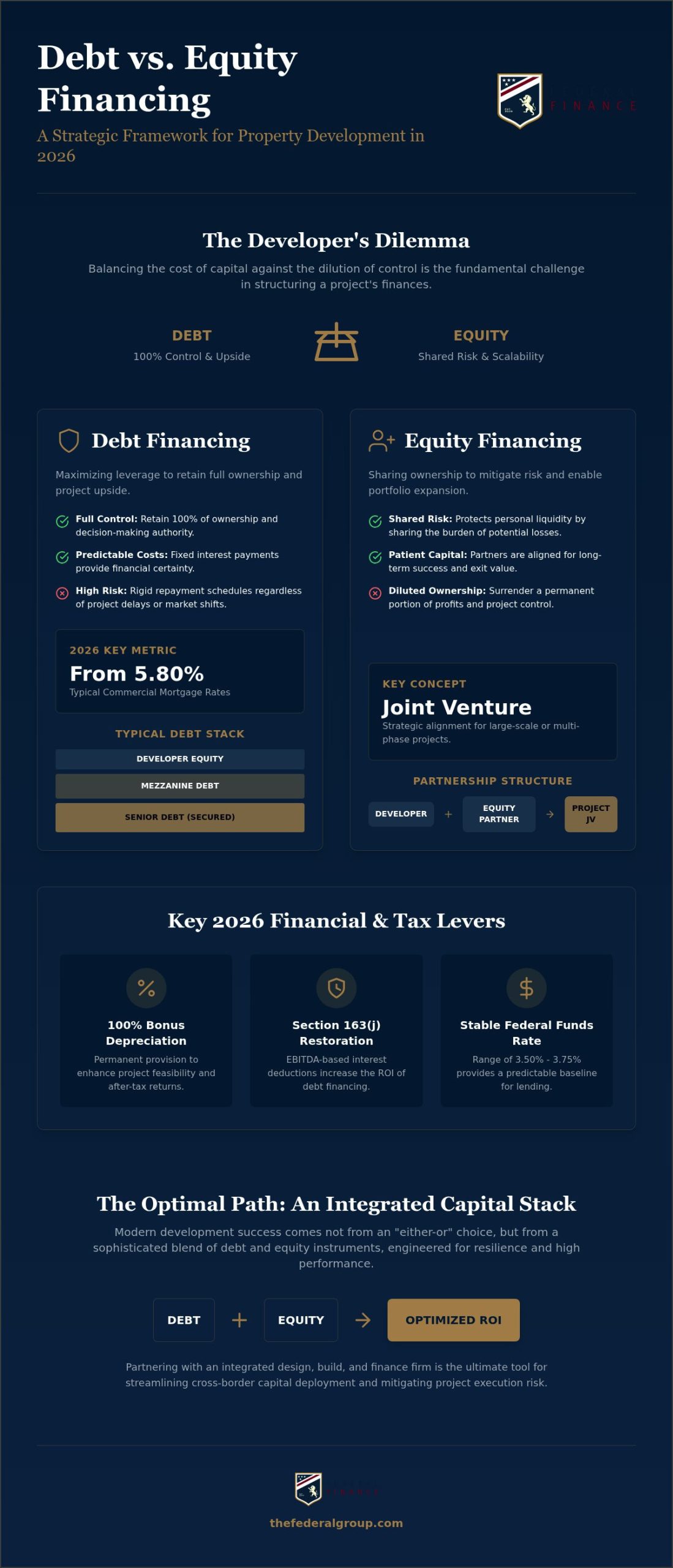
Every large-scale project begins with a fundamental decision regarding the capital stack. Debt represents a fixed contractual obligation; it’s a sum of capital provided with the expectation of repayment plus interest over a defined term. Equity is an ownership stake where capital is exchanged for a share of the project’s eventual profits. When comparing debt vs equity financing for property development, you’re essentially choosing between the certainty of a loan’s cost and the shared risk of a partnership. This choice dictates the project’s financial ceiling and its floor.
The “Developer’s Dilemma” centers on balancing the cost of capital against the dilution of control. High-leverage debt allows you to retain 100% of the project upside, but it carries a rigid repayment schedule that doesn’t care about construction delays or market cooling. Equity protects your personal liquidity by sharing the burden of loss, yet it requires you to surrender a portion of your decision-making authority. In 2026, market conditions have moved beyond siloed funding models. Successful developers now favor integrated capital solutions that blend these two instruments to create a resilient, high-performance financial structure.
The Mechanics of Development Debt
Debt financing is hierarchical. Senior debt typically sits at the base of the stack, secured by a first charge on the asset. It offers the lowest cost of capital because it’s the first to be repaid. Mezzanine finance sits above it, filling the gap between the senior loan and the developer’s equity. While mezzanine debt is more expensive, it’s a vital tool for maximizing leverage. Within international property development finance, these structures must navigate different cross-border tax treaties and Loan-to-Cost (LTC) mandates. A high LTC ratio can amplify returns, but it leaves less room for error if interest rates or material costs fluctuate during the build.
The Nature of Private Equity Partnerships
Equity is about more than just money; it’s about strategic alignment. For industrial-scale or multi-phase projects, real estate private equity partners provide the patient capital necessary to weather long development cycles. These partnerships often take the form of Joint Ventures (JVs) where interests are perfectly aligned. Unlike a lender who only cares about debt service coverage, an equity partner is focused on the final exit value. When Understanding the Capital Stack, it’s clear that institutional equity brings a level of credibility that can actually make securing senior debt easier and more affordable. This synergy is why comparing debt vs equity financing for property development is no longer an “either-or” proposition, but a sophisticated exercise in financial engineering.
Debt Financing: Maximizing Leverage and Maintaining Control
Debt is the engine of developer autonomy. By choosing debt over equity, you ensure that the rewards of a successful exit remain entirely within your firm. When comparing debt vs equity financing for property development, debt stands out as the preferred instrument for those who possess the liquidity to service a loan but want to avoid the permanent dilution of their ownership stake. It’s about maintaining a clear, unencumbered path to the project’s terminal value without inviting outside partners into the boardroom.
The 2026 financial landscape offers specific advantages for debt-heavy structures. With the federal funds rate held at 3.50% to 3.75%, commercial mortgage rates starting around 5.80% provide a manageable cost of capital for institutional-grade projects. The permanent restoration of EBITDA-based interest deductions under Section 163(j) further enhances the after-tax ROI of debt-financed developments. If you’re looking to optimize your current project’s leverage, our team can help you structure development finance that aligns with your long-term exit strategy.
Predictability is another cornerstone of the debt model. While floating-rate loans based on the Secured Overnight Financing Rate (SOFR) offer flexibility, many developers are currently shifting toward fixed-rate financing to hedge against interest rate volatility. With the 10-year Treasury yield hovering near 4.6%, locking in a fixed rate provides a stable line item in your construction budget, protecting your margins from sudden shifts in the global economy.
Bridging Loans for Strategic Acquisition
Speed is a currency in high-demand international markets. Utilizing bridging finance for land acquisition allows you to secure prime sites before full development funding is finalized. These short-term facilities, with rates starting at 9.00%, provide the agility to close deals in days rather than months. The goal is a seamless transition; once planning is secured and the project is de-risked, you can exit the bridge into a traditional senior development loan with lower carrying costs.
Managing the Risks of High Leverage
High leverage requires disciplined management. Lenders in 2026 remain selective, focusing heavily on Debt Service Coverage Ratios (DSCR) and Loan-to-Value (LTV) limits. You must navigate strict covenants that may restrict further borrowing or mandate specific construction milestones. With many loans originated during the 2019-2021 period hitting a “maturity wall” this year, refinancing risk is a critical consideration. Planning for the end of the loan term during the construction cycle is no longer optional; it’s a prerequisite for project stability.
Equity Financing: Strategic Scaling and Risk Mitigation
While debt offers autonomy, equity provides the foundation for ambitious, industrial-scale expansion. When comparing debt vs equity financing for property development, the primary differentiator is the transfer of risk. Equity is not merely patient capital; it is a strategic buffer that protects your liquidity and personal financial exposure. By inviting an equity partner, you transition from a solo operator to an institutional-scale developer, accessing project sizes and complexities that would remain out of reach through traditional senior debt alone.
This partnership model offers an “Expertise Premium” that capital alone cannot buy. Institutional partners bring global networks, rigorous strategic oversight, and established relationships with Tier 1 lenders. In the eyes of a senior debt provider, a project backed by a significant equity base is inherently more creditworthy. This often results in more favorable terms for the debt portion of the capital stack, effectively lowering the overall weighted average cost of capital (WACC) and improving the project’s total viability.
The Joint Venture (JV) Model
Profit splits and waterfall distributions in 2026 are increasingly structured to reward performance through “catch-up” provisions and promoted interests. Success in these high-stakes environments requires clear governance. Identifying who holds the “Golden Share” for critical decisions, such as capital calls or asset disposal, is vital to maintaining project momentum. Engaging an international real estate finance partner ensures that these cross-border JV structures are optimized for both tax efficiency and operational control. This alignment of interests ensures that all parties are incentivized toward a successful, high-value exit.
Private Equity for Global Portfolio Expansion
Private equity is particularly effective during the pre-development phase, where traditional debt is often unavailable or prohibitively expensive. It allows developers to secure planning permissions and finalize designs without the immediate pressure of interest payments. This flexibility is essential for scaling from single-asset developments to diversified multi-city portfolios. For visionary developers, this includes high-potential asset classes like sports multi-club ownership, where the integration of property development and commercial sports operations creates unique value. Equity allows you to move beyond the constraints of a single build, constructing a global ecosystem of assets that can weather localized market shifts.
The Decision Matrix: Debt vs Equity for Property Cycles
The choice between funding sources is rarely binary; it’s situational. In the 2026 “higher for longer” interest rate environment, the decision matrix must account for a federal funds rate holding at 3.50% to 3.75%. This reality forces a re-evaluation of the point where debt becomes a liability. If your Debt Service Coverage Ratio (DSCR) tightens significantly, the risk of technical default outweighs the benefits of leverage. Comparing debt vs equity financing for property development in this cycle requires a layered approach. You’re not just choosing a product; you’re engineering a capital stack that balances senior debt, mezzanine finance, and equity to protect your margins.
Timing is everything. During the high-risk pre-development phase, equity acts as a shield, absorbing the costs of planning and design without the pressure of monthly interest. Once a project is “shovel-ready” and de-risked, transitioning to senior debt becomes the logical move to drive momentum. To build a capital stack that withstands these market shifts, explore our bespoke private equity solutions.
Comparing the Quantitative Impact
The Internal Rate of Return (IRR) is often the primary metric for equity partners, but developers must look deeper at the equity multiple and cash-on-cash returns. While debt can amplify your IRR by reducing your initial capital outlay, the cost of servicing that debt in a 2026 market where bridge rates start at 9.00% can erode your actual cash flow. In the context of 2026 development equity, the hurdle rate is the specific internal rate of return that must be achieved before the developer begins to participate in the project’s promoted interest or “carried interest” distributions.
Qualitative Factors in Financing Choice
Your track record dictates your options. Institutional lenders in 2026 remain highly selective, favoring sponsors with a proven history of delivering through volatile cycles. Project complexity also plays a decisive role. High-value, mixed-use developments with international stakeholders often require the strategic oversight and global networks that only a sophisticated equity partner can provide. If your long-term vision is to hold the asset for yield, lower-leverage debt might be preferable to maintain cash flow stability. Conversely, if you’re developing for an immediate sale, a more aggressive blend of mezzanine debt and equity can maximize your exit multiples.
Navigating the Capital Stack with an Integrated Partner
The fragmentation of traditional development models often creates a disconnect between the source of capital and the site of execution. When comparing debt vs equity financing for property development, the missing variable in many equations is the execution risk of the physical build. The Federal Group bridges this gap by operating as a fully integrated partner, combining high-level institutional finance with the technical precision of Federal Holdings, our dedicated design and build division. This ecosystem approach eliminates the funding gaps that occur when lenders and contractors operate in silos. It provides a seamless transition from capital deployment to project completion, ensuring that the financial architecture is as robust as the physical structure itself.
By streamlining the funding process through a single institutional point of contact, developers can avoid the friction of managing multiple stakeholders with competing interests. We understand that time is a premium asset. Our integrated model allows for faster decision-making and more agile capital deployment, which is essential when navigating the complexities of cross-border property portfolios. This stability instills confidence in high-value stakeholders and signals a readiness for the most complex, international challenges.
De-risking Through Integrated Lifecycle Management
Lenders and equity partners prioritize certainty. An integrated design and build developer de-risks a project by providing granular cost-certainty before the capital stack is finalized. Because Federal Holdings manages every stage of the lifecycle, we offer lenders a level of transparency that traditional developers cannot match. This transparency often leads to more favorable debt terms and higher Loan-to-Cost (LTC) ratios. It also ensures that the project remains viable even if material costs fluctuate. This synergy is vital in specialized asset classes like sports multi-club ownership, where stadium-anchored real estate requires a sophisticated blend of private equity and industrial-scale construction expertise to maximize commercial potential.
Securing Your 2026 Development Partner
Securing a partner in 2026 requires looking beyond the term sheet. You should assess the track record of your development finance lender through the lens of global market insight and cross-border agility. Since 2009, The Federal Group has maintained an international footprint, navigating the complexities of tax treaties and local regulatory shifts. Our experience was recently demonstrated in a high-value international project where our ability to integrate bridging loans with long-term equity saved the development from a mid-cycle funding shortfall. This integrated approach allowed the developer to maintain momentum when traditional lenders were pulling back. When comparing debt vs equity financing for property development, the most powerful tool is a partner that understands both the capital and the concrete. Contact The Federal Group to discuss your 2026 capital requirements and optimize your project’s trajectory.
Optimizing Your Capital Stack for Institutional Growth
Success in the 2026 property market demands a move beyond binary financing models. You’ve seen how comparing debt vs equity financing for property development is a strategic exercise in balancing autonomy with institutional scale. Whether you’re preserving upside through structured debt or mitigating risk via private equity partnerships, the objective remains the same: maximizing ROI while protecting your developer equity.
The Federal Group provides a unique advantage by combining global institutional expertise in US and UK markets with an integrated Design & Build division. This ecosystem de-risks high-value assets and ensures your capital deployment is as efficient as your construction lifecycle. It’s time to elevate your portfolio with specialized solutions built for the complexities of modern development. We provide the stability needed to navigate volatile markets while maintaining the visionary energy required for large-scale success.
Partner with The Federal Group for Integrated Property Finance to secure your next project’s success. Your vision deserves a heavyweight partner ready for the most demanding international challenges.
Frequently Asked Questions
What is the primary difference between debt and equity financing for property developers?
The primary difference lies in ownership and obligation. Debt is a contractual loan where the developer must repay the principal and interest regardless of project success. Equity involves exchanging an ownership stake for capital, allowing the developer to share risk with partners. When comparing debt vs equity financing for property development, debt offers lower costs but higher risk of default, while equity provides stability at the cost of profit dilution.
Can a developer combine both debt and equity in a single project?
Combining both instruments is standard practice in institutional-scale projects and is known as structuring the capital stack. A typical stack includes senior debt at the base, mezzanine finance in the middle, and developer or partner equity at the top. This layered approach allows developers to optimize their weighted average cost of capital. By blending these sources, you can maximize leverage while maintaining enough liquidity to weather market fluctuations.
How does equity financing impact a developer’s control over a project?
Equity financing necessarily involves a trade-off between capital access and operational autonomy. Institutional partners typically require a seat at the table for major decisions, such as asset disposal or significant changes to the build program. While this dilutes your absolute control, a sophisticated partner brings strategic oversight and global networks. This expertise premium often helps de-risk complex projects, providing a layer of security that traditional debt-only structures simply cannot offer.
Is debt financing cheaper than equity financing in 2026?
Debt financing remains the more cost-effective option in 2026 because interest rates, currently starting around 5.80% for commercial mortgages, are significantly lower than the profit shares expected by equity partners. However, debt carries the rigid burden of servicing costs. Equity is expensive because it claims a portion of the project’s upside, but it doesn’t require monthly interest payments. This makes equity a vital tool for managing cash flow during high-risk phases.
What is mezzanine finance and where does it sit in the capital stack?
Mezzanine finance is a form of subordinated debt that fills the gap between senior debt and the developer’s equity. In the capital stack, it sits above senior debt, meaning it’s repaid only after the primary lender is satisfied. Because it’s higher risk, it carries higher interest rates than senior loans. It’s an essential tool for developers who want to increase their total leverage without surrendering the ownership stakes required by traditional equity partners.
How do lenders view projects that have a high percentage of equity?
Lenders view high-equity projects with significant favor because a larger equity cushion provides a safety net against market volatility. When a developer or private equity partner commits substantial capital, it signals project viability and aligns the interests of all stakeholders. This increased security often allows lenders to offer more competitive interest rates and favorable loan-to-cost ratios. It effectively lowers the project’s risk profile, making it easier to secure senior debt.
What are the tax implications of choosing equity over debt for international projects?
International tax implications vary based on cross-border treaties and the restored EBITDA-based interest deductions available in 2026. Debt interest is often tax-deductible, which can lower a project’s overall tax liability. Equity distributions, conversely, are typically paid from after-tax profits and may be subject to withholding taxes depending on the jurisdiction. Navigating these complexities requires a partner who understands the specific tax landscapes of global markets like the US and the UK.
How does bridging finance differ from traditional development debt?
Bridging finance is a tactical, short-term tool designed for speed and agility, whereas traditional development debt is structured for the full construction lifecycle. Bridging loans allow you to secure land or maintain momentum while long-term funding is finalized. They offer faster deployment but carry higher interest rates, often starting at 9.00% in the current market. Once the project is de-risked or planning is secured, developers typically exit the bridge into a senior loan.