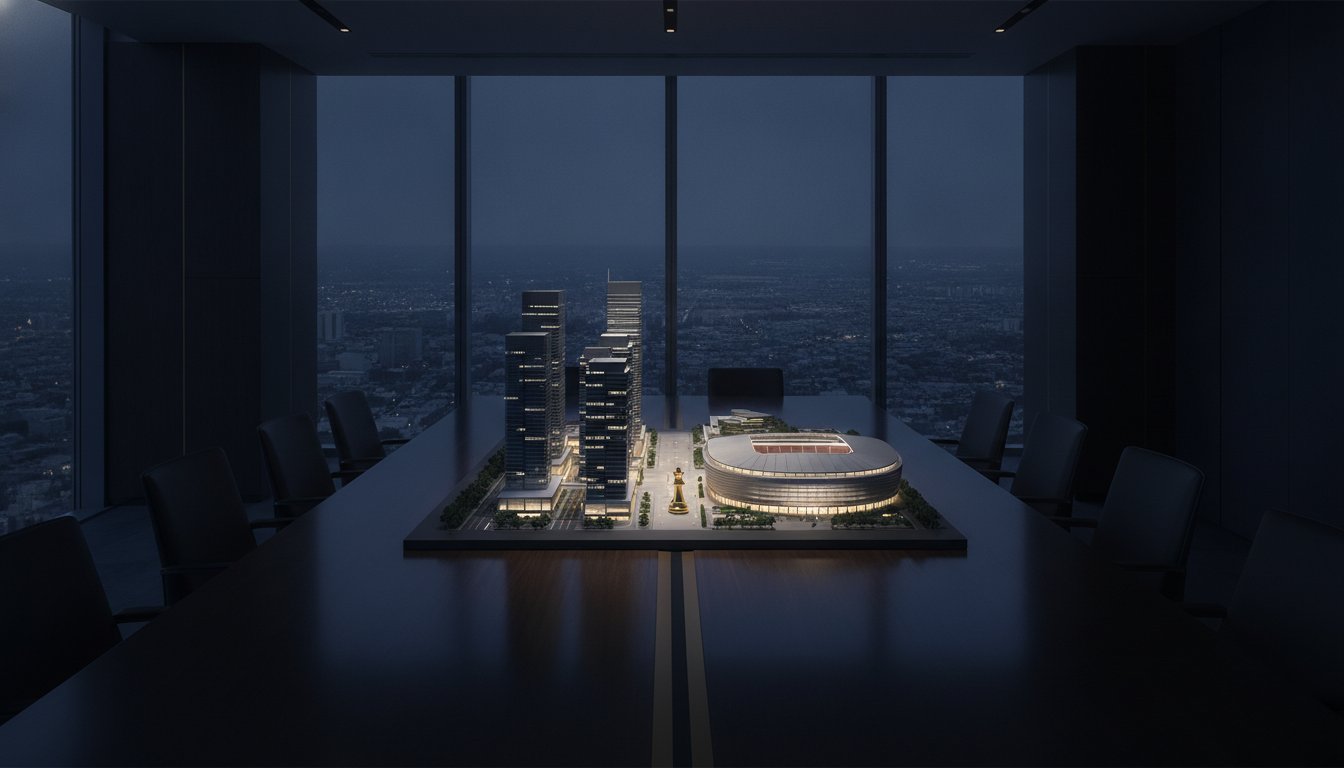
Family Office Real Estate Investment: The 2026 Strategic Guide to Direct Allocation
25 August 2026The era of passive allocation to opaque real estate funds has reached its expiration date. While institutional funds once offered a convenient path to property exposure, they now frequently leave sophisticated investors trapped in rigid exit cycles. You’ve likely felt the frustration of watching high-potential family office real estate investment opportunities slip away due to slow-moving financing or complex regulatory hurdles that traditional partners aren’t equipped to handle. It’s clear that maintaining control over the asset lifecycle is the only way to ensure true long-term wealth preservation in 2026.
This strategic guide demonstrates how modern family offices are reclaiming that control by integrating development finance with private equity and design-build expertise. We’ll explore the impact of the restored 100% bonus depreciation, the institutionalization of sports multi-club ownership, and the methods for deploying capital efficiently into commercial and sports-related real estate. From managing the 3.5% federal funds rate to leveraging bridging loans for rapid land acquisition, this is your blueprint for direct, high-value property ownership.
Key Takeaways
- Transition from passive REITs to direct development projects to secure transparency and control over asset exit timelines.
- Mitigate operational risks through integrated design and build models that align financial objectives with construction delivery.
- Optimize the 2026 capital stack for family office real estate investment by navigating the 3.5% federal funds rate and leveraging bridging finance for land acquisition.
- Evaluate the potential of sports multi-club ownership, a market projected to reach $600 billion, as a high-alpha real estate asset class.
- Deploy capital efficiently by partnering with integrated private equity specialists who handle international regulatory and financing complexities.
The Evolution of Family Office Real Estate Investment in 2026
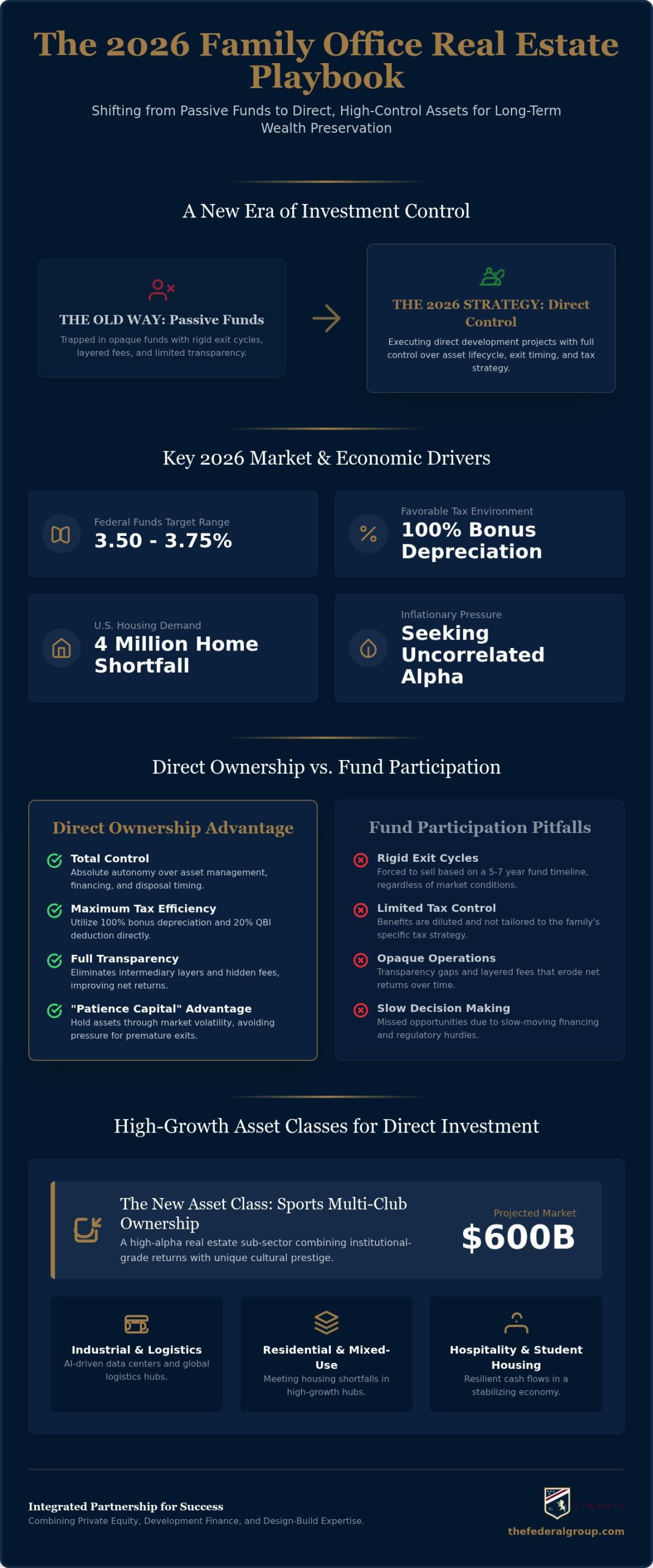
In 2026, the strategy for a Family office has moved beyond simple capital allocation. The transition from liquid Real Estate Investment Trusts (REITs) to tangible, direct development projects marks a fundamental change in how wealth is preserved. This evolution is driven by a need for high-control assets that offer more than just yield. Direct family office real estate investment allows for a bespoke approach to risk management, ensuring that the underlying property aligns with the family’s broader multi-generational objectives.
Current market dynamics reinforce this shift. With the federal funds target range sitting at 3.50% to 3.75% as of mid-2026, investors are aggressively seeking uncorrelated alpha to outpace inflation. Tangible assets provide a reliable hedge against currency volatility and global economic shifts. Unlike institutional funds that operate on rigid five to seven-year cycles, family offices possess the “patience advantage.” They don’t face the same pressure to exit during market downturns. This allows them to wait for optimal conditions, often outcompeting institutional players for prime assets by ignoring short-term liquidity pressures.
Direct Ownership vs. Fund Participation
Traditional real estate funds often suffer from transparency gaps and layered fee structures that erode net returns. Direct equity positions eliminate these intermediaries. Investors gain absolute control over asset management decisions and disposal timing. This level of autonomy is vital for sophisticated estate planning. By holding assets directly, families can utilize the 100% bonus depreciation restored in 2025 and the permanent 20% QBI deduction to optimize their tax exposure. It’s a move from being a passenger to being the pilot of the investment vehicle.
Asset Class Diversification in 2026
Portfolio construction has broadened significantly. While residential demand remains high, with a projected U.S. housing shortfall of four million homes by 2029, family offices are looking toward specialized sectors. Mixed-use developments and industrial logistics hubs are seeing heavy inflows. Hospitality and student housing also remain attractive due to their resilient cash flows in a stabilizing economy. Perhaps the most notable trend is the rise of sports-related infrastructure. By treating sports facilities as high-value real estate sub-sectors, family office real estate investment strategies are capturing a new tier of “trophy” assets that combine institutional-grade returns with unique cultural prestige.
Core Strategies for Direct Real Estate Allocation
Direct allocation requires a sophisticated understanding of the risk-reward spectrum. In 2026, value-add strategies focus on stabilizing underperforming assets through operational efficiency and modern upgrades. Opportunistic strategies involve ground-up development or the total repositioning of distressed properties. Both require a precise capital structure. With commercial mortgage rates starting at 5.68% as of August 2026, the cost of debt necessitates a higher emphasis on equity-heavy entries or specialized financing solutions that protect margins.
Geographic focus remains a critical component of successful family office real estate investment. The U.S. continues to struggle with a housing shortfall of four million homes, making multifamily developments in high-growth hubs a priority. Simultaneously, the UK and EU markets offer unique opportunities in logistics and AI-driven data center infrastructure. Successfully capturing these requires more than just capital; it demands a real estate private equity partner capable of navigating local zoning and regulatory environments.
The current climate favors “patience capital.” Unlike institutional funds that must return capital within fixed windows, family offices can hold assets through volatility. This allows them to acquire distressed properties at a discount and wait for market stabilization or redevelopment opportunities. This long-term perspective is the defining advantage of modern family office real estate investment. It transforms market distress into a generational wealth-building tool.
The Private Equity Partnership Model
Family offices often choose between acting as a General Partner (GP) or a Limited Partner (LP). In a GP role, the office takes an active hand in management and execution. In an LP role, they provide capital while a specialist partner manages the project lifecycle. Joint ventures are the preferred vehicle for these deals. They ensure that the interests of the capital provider and the development expert are perfectly aligned. When evaluating a partner, look for a proven track record in complex international markets and a deep understanding of the 2026 interest rate environment.
De-risking International Development
Cross-border investments introduce complexities like currency fluctuations and varied legal frameworks. Local market intelligence is non-negotiable for site selection and navigating environmental regulations. To maintain momentum, many offices utilize international property development finance. This bridges the gap between land acquisition and long-term stabilization. Managing these variables requires an integrated approach. If you’re looking to scale your portfolio globally, engaging with an integrated private equity specialist can provide the necessary institutional-grade oversight.
The Integrated Advantage: De-risking via Design and Build
The primary threat to family office real estate investment isn’t market volatility. It’s execution risk. When finance, design, and construction teams operate in silos, the principal bears the cost of every miscommunication. Budget overruns and timeline slippage are almost guaranteed when a lender doesn’t understand the architectural constraints. Similarly, builders often aren’t aligned with the financial exit strategy. This friction erodes the alpha that direct allocation is supposed to capture. Most investors are tired of managing multiple vendors who point fingers at each other when projects stall.
An integrated design and build developer solves this by consolidating the entire project lifecycle. This model replaces the traditional relay race with a synchronized ecosystem. The Federal Group merges institutional-grade finance with deep architectural and construction expertise. It’s a proactive strategy that ensures every design choice is financially viable from the start. By managing the project from land acquisition to completion, we remove the operational burden from the family office. This allows principals to focus on high-level strategy while we handle the technical execution.
Streamlining the Development Lifecycle
Speed is a currency in 2026. By eliminating the lag between architectural concepts and final construction, projects reach the market faster. Traditional third-party consulting often introduces weeks of delay for every minor revision. Integrated teams provide real-time cost control. When the design team and the construction team are the same entity, fee overruns are minimized. This alignment improves project ROI by reducing capitalized interest and accelerating the timeline to cash flow. It’s about precision and momentum. We don’t just plan; we execute with a focus on the final valuation.
Case Study: High-Value Integrated Projects
Complex mixed-use developments require a nuanced approach to capital. As a specialized development finance lender, The Federal Group uses integrated financing to support these projects. For example, the strategic use of bridging loans allows family offices to secure high-value sites before institutional competitors can mobilize. This speed, backed by construction certainty, transforms family office real estate investment into a managed industrial process. Integrated partners ensure that the capital stack and the construction schedule work in harmony, protecting the family’s equity throughout the build.
Structuring Capital for International Real Estate Projects
Success in family office real estate investment depends on the precision of the capital stack. In 2026, with the federal funds rate at 3.50% to 3.75%, the cost of capital has redefined what constitutes a viable project. Sophisticated principals must balance senior debt, which currently starts at 5.68%, with mezzanine finance and internal equity. Avoiding the over-leveraged traps that have ensnared many institutional funds requires a disciplined approach to liquidity. While institutions often struggle with rigid debt-to-equity ratios, family offices can use their “patience capital” to maintain lower leverage, protecting the asset from interest rate shocks.
Structuring international real estate finance for cross-border projects adds layers of complexity. You’re not just managing a build; you’re managing currency risk and disparate legal frameworks. Effective capital allocation involves using local senior debt where possible while centralizing equity control. This hybrid approach ensures that the project remains agile. It allows the office to respond to market shifts without the bureaucratic delays common in large-scale institutional partnerships. It’s about maintaining a balance between aggressive growth and capital security.
The Role of Bridging Loans in 2026
Speed often outweighs the cost of capital in competitive markets. Using bridging finance for land acquisition allows family offices to secure prime sites instantly. While bridge rates can reach up to 15% in 2026, the opportunity cost of losing a site to a faster competitor is far higher. The strategy isn’t to hold the bridge loan long-term. Instead, it’s a tactical tool used to maintain momentum before transitioning into lower-cost development loans or permanent financing once the project is de-risked. This transition is a critical milestone in the development lifecycle.
Equity Partnership and Capital Raising
Deploying internal equity offers maximum control, but “Club Deals” are gaining traction. These allow multiple family offices to pool resources for larger, high-alpha projects without the fee-heavy structures of private equity funds. This collaborative model spreads risk while maintaining the direct ownership benefits that define the asset class. Whether you’re targeting a long-term hold for generational wealth or a rapid exit upon stabilization, your capital structure must reflect your specific liquidity needs. If you’re ready to optimize your next allocation, consult with our international finance specialists to build a resilient capital stack.
The New Asset Class: Sports Multi-Club Ownership as Real Estate
Professional football clubs represent the ultimate fusion of cultural prestige and tangible asset value. In 2026, sophisticated principals view these clubs not merely as sports franchises, but as complex real estate ecosystems. The valuation isn’t just in the squad; it’s in the stadium, the high-performance training facilities, and the surrounding commercial precincts. This “Sports City” model integrates retail, hospitality, and residential developments into a single high-alpha asset. For many, this is the final frontier of family office real estate investment, where traditional property development meets global brand equity.
The synergy between sports asset management and traditional property development is profound. Upgrading a stadium or developing a commercial hub around a club requires the same design-build expertise discussed in previous sections. However, the regulatory and financial hurdles are unique. Mastering the financial structuring for multi-club ownership is essential to managing these risks. It allows families to professionalize club operations while securing institutional-grade returns from the underlying land and infrastructure.
The Multi-Club Strategy Explained
Diversification is the primary driver of the multi-club model. By owning clubs across different global leagues, a family office de-risks its exposure to any single market’s economic or competitive fluctuations. This strategy leverages private equity expertise to professionalize operations and scale commercial revenues. The commercial potential of integrating hospitality and residential units within a stadium precinct creates a year-round revenue stream. It transforms a match-day venue into a 365-day commercial destination. This integrated approach ensures that the real estate works as hard as the athletes on the pitch.
Next Steps for the Visionary Family Office
Transitioning into direct, high-value developments requires an honest assessment of internal capacity. Most offices lack the in-house architecture and construction teams needed to manage a “Sports City” project or a cross-border commercial development. Identifying an international real estate finance partner who also possesses integrated development capabilities is the most efficient path forward. It’s about finding a heavyweight partner who can navigate the complexities of 2026 global markets while you maintain strategic oversight.
Positioning your family office real estate investment strategy for the next decade requires a shift from passive participation to proactive ownership. By merging institutional finance with visionary development, you don’t just preserve wealth; you build a tangible legacy. The opportunities in 2026 are vast for those ready to embrace the integrated model. It’s time to move beyond traditional funds and secure the high-alpha assets that define the modern era of global property ownership.
Securing the Future of Global Direct Allocation
The landscape of family office real estate investment has fundamentally shifted toward direct, integrated ownership. Success in 2026 requires more than just capital. It demands a sophisticated alignment of institutional-scale finance with technical execution. By internalizing the development lifecycle and moving beyond traditional fund structures, family offices can capture the full value of high-alpha assets while de-risking through integrated design and build capabilities. This proactive approach ensures that every allocation is protected from the friction of siloed construction and finance teams.
Whether you’re targeting mixed-use commercial hubs or exploring the visionary potential of sports multi-club ownership, the “patience advantage” of family capital is your greatest asset. The key is to partner with an entity that provides the necessary breadth of expertise to manage international regulatory and financing hurdles. The Federal Group offers the stable, heavyweight partnership required to navigate these complex global markets with confidence and scale.
Partner with The Federal Group for your next international development project. Our specialized global sports division and integrated capital solutions ensure your wealth is deployed with precision. It’s time to build your generational legacy through tangible, high-value assets.
Frequently Asked Questions
What is the primary benefit of direct family office real estate investment over REITs?
Direct ownership provides absolute control over exit timelines and asset management decisions. Unlike liquid REITs, which are subject to public market volatility and rigid fund cycles, direct allocation allows principals to leverage their patience capital. This autonomy is essential for sophisticated estate planning and maximizing tax advantages, such as the 100% bonus depreciation restored in 2025. It moves the investor from a passive participant to a strategic owner who controls the entire asset lifecycle.
How do family offices manage the risks of international property development?
Risk mitigation is achieved through a combination of local market intelligence and integrated financing structures. Offices often partner with private equity specialists who understand cross-border legal frameworks and currency hedging. By using specialized bridging loans for rapid land acquisition and transitioning into long-term development finance, they maintain liquidity. This approach ensures that international projects aren’t stalled by the regulatory complexities that often hinder siloed institutional funds or traditional banking partners.
Why is a bridging loan often preferred for family office land acquisition?
Bridging loans offer the speed necessary to secure high-value sites before institutional competitors can mobilize. In a market where commercial mortgage rates start at 5.68% as of August 2026, the flexibility of short-term finance outweighs the higher interest costs. These loans act as a tactical bridge, allowing the office to close deals in days rather than months. Once the land is secured and the project de-risked, the debt is typically refinanced into long-term development loans.
What does an ‘integrated’ design and build developer offer to family offices?
An integrated developer consolidates finance, architecture, and construction into a single operational ecosystem. This model eliminates the traditional friction between siloed teams, which often leads to budget overruns and timeline delays. By merging institutional finance with design-build capabilities, the developer reduces execution risk for the principal. This alignment ensures that every architectural choice is financially viable, accelerating speed-to-market and protecting the family’s equity throughout the build, from land acquisition to final project stabilization.
Can family offices invest in professional football clubs as a real estate play?
Yes, professional football clubs are increasingly viewed as high-potential real estate ecosystems. The investment focuses on the club’s tangible assets, including the stadium, training facilities, and surrounding commercial precincts. Through family office real estate investment, principals can develop mixed-use Sports Cities that integrate retail, hospitality, and residential units. This strategy professionalizes club operations while generating year-round revenue from the underlying infrastructure and land, offering returns that outpace traditional commercial properties.
What are the common pitfalls of cross-border real estate private equity?
The most frequent pitfalls include lack of transparency in fee structures and difficulty navigating international regulatory hurdles. Many offices struggle with currency fluctuations and the reinstatement of EBITDA-based interest limitations. Without an integrated partner, siloed construction and finance teams often cause project delays that erode alpha. Successful offices avoid these traps by using structured capital stacks and ensuring they have direct oversight of the asset lifecycle rather than relying on opaque third-party funds.
How much capital do family offices typically allocate to direct real estate?
While allocations vary, real estate remains a top-three holding for most ultra-high-net-worth portfolios. In 2026, many sophisticated offices are increasing their direct exposure to capitalize on the 20% QBI deduction and permanent Opportunity Zone incentives. The focus is shifting toward high-value commercial and sports-related infrastructure. By deploying institutional-scale capital into tangible assets, they achieve long-term wealth preservation that is uncorrelated with the volatility of public equity markets and traditional banking products.
What is the typical investment horizon for family office real estate projects in 2026?
The typical horizon spans ten to twenty years, reflecting the generational nature of family office real estate investment. Unlike institutional funds restricted by five-year exit cycles, family offices ignore short-term market pressures. This allows them to hold assets through volatility, redevelopment, and stabilization phases. This long-term perspective is a competitive advantage, enabling the acquisition of distressed assets for redevelopment into high-value properties that serve as cornerstones for family wealth across multiple generations.