Financing a Design-Build Project: Strategic Capital Solutions for 2026
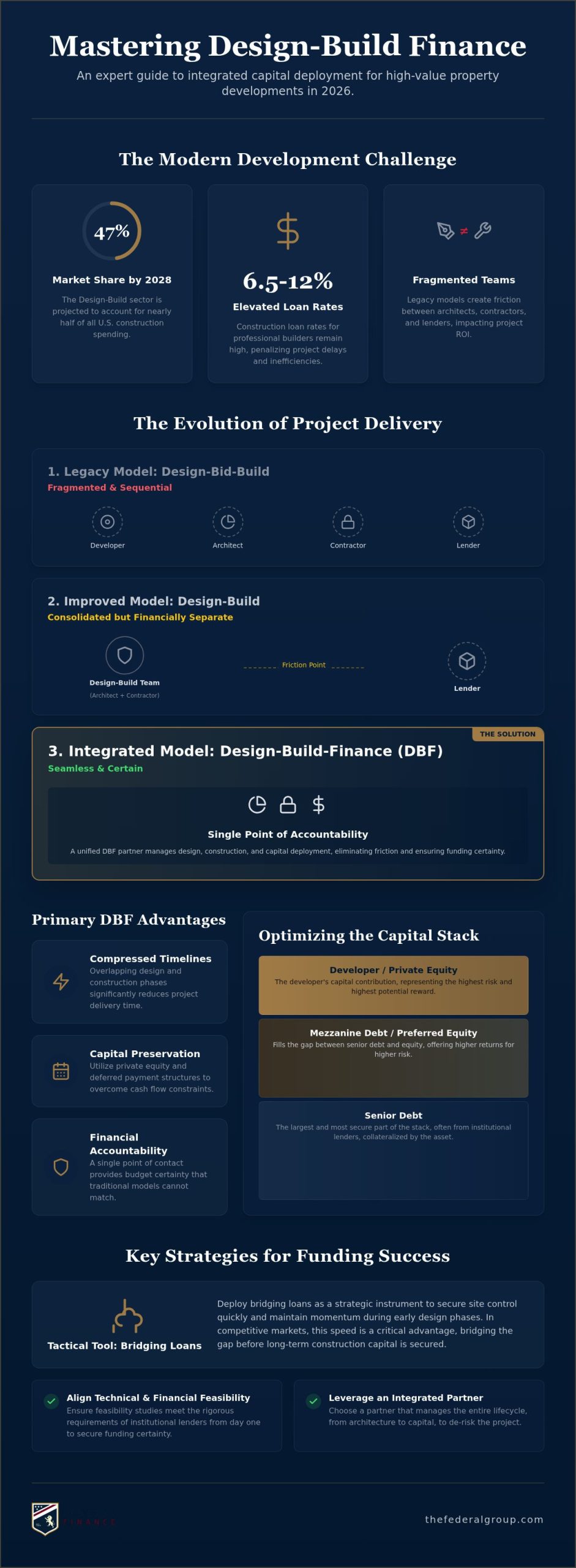
3 September 2026By 2028, the design-build sector is projected to account for 47% of all U.S. construction spending, yet many developers still struggle with the nuances of financing a design build project through fragmented legacy models. You’ve likely experienced the frustration of capital tied up in protracted cycles while managing the friction between architects, contractors, and institutional lenders. It’s a structural inefficiency that directly impacts project ROI, especially as construction loan rates for professional builders remain elevated between 6.5% and 12% in 2026.
Success in the current market requires a shift from reactive borrowing to proactive capital deployment. This expert guide ensures you master the complexities of integrated property developments by utilizing structures that align design, construction, and capital from day one. You’ll learn how to achieve a compressed project lifecycle and secure absolute certainty of funding from initial concept to final completion. We will explore the strategic use of private equity, the mechanics of the design-build-finance model, and the specific capital solutions necessary to optimize your stack for high-value international projects.
Key Takeaways
- Transition to the Design-Build-Finance (DBF) model to eliminate structural friction between architectural vision and capital procurement.
- Optimize the capital stack for high-value international developments by strategically balancing private equity with structured debt.
- Deploy bridging loans as a tactical instrument to secure site control and maintain momentum during the early design phases.
- Secure certainty of funding for financing a design build project by aligning technical feasibility studies with the rigorous requirements of institutional lenders.
- Leverage the de-risking advantages of an integrated partner that manages the entire lifecycle from architectural execution to final capital deployment.
Defining the Design-Build-Finance (DBF) Model in 2026
The Design-Build-Finance (DBF) model represents the ultimate integration of project delivery. While the traditional Design-Build Model consolidated the architect and contractor into a single point of contact, DBF adds the crucial third pillar: the capital provider. In 2026, this model has moved from a niche public-sector tool to a dominant strategy for private international developers. It eliminates the friction between creative vision and financial feasibility by ensuring the entity designing the structure is also the one managing the capital deployment.
The shift from the legacy Design-Bid-Build method is driven by necessity. Fragmented delivery models often result in “value engineering” that occurs too late, destroying project ROI. By contrast, financing a design build project through an integrated partner allows for real-time cost modeling. With construction loan rates for professional builders ranging from 6.5% to 12% as of late 2026, the cost of delays is too high to permit the silos of the past. Developers now prioritize structures that offer a seamless transition from short-term construction capital to long-term facility debt.
The Core Responsibilities of the DBF Partner
A DBF partner manages the entire ecosystem of development. They don’t just draft plans; they ensure every line drawn is constructible within the established budget. Crucially, they facilitate bridging loans to cover the high-risk period between site acquisition and the commencement of the main construction phase. By assuming the majority of project risk in exchange for delivery speed, the DBF partner allows the stakeholder to focus on high-level asset strategy rather than managing a dozen conflicting vendors.
Primary Motivations for Choosing DBF
Speed and certainty are the primary drivers in today’s high-stakes environment. When capital is expensive, the ability to compress the timeline between investment and occupancy is the most effective way to protect margins. Primary motivations include:
- Compressed Timelines: Overlapping the design and construction phases can reduce project delivery time significantly compared to sequential models.
- Capital Preservation: Leveraging private equity and deferred payment structures helps developers overcome immediate cash flow constraints during the capital-intensive early stages.
- Financial Accountability: A single point of contact for both design and financing a design build project provides a level of budget certainty that traditional retail lenders cannot match.
This integrated approach is particularly effective for complex projects where market volatility requires a partner capable of making rapid, data-driven adjustments to the capital stack without halting construction progress.
Capital Structures for High-Value Design-Build Developments
High-value developments require a sophisticated blend of instruments that go beyond standard construction loans. Relying solely on local retail banking often limits the scale of global portfolios. Instead, sophisticated developers utilize international property development finance to tap into deeper liquidity pools. This approach is essential when financing a design build project that spans multiple jurisdictions or requires high-leverage ratios. While the public sector often looks to the Design-Build-Finance (DBF) procurement model for infrastructure, private developers adapt these principles to manage balance sheet health through deferred payment structures.
Structuring the capital stack for mixed-use and high-value residential projects involves a delicate balance between debt and equity. In 2026, the rise of mezzanine debt and preferred equity has provided developers with more flexibility to minimize their own capital outlay. This allows for a more aggressive expansion of portfolios without over-leveraging the parent company. The integration of financing into the design-build lifecycle ensures that every dollar spent is aligned with the eventual exit strategy, whether that involves a long-term hold or a strategic divestment.
Bridging Loans and Land Acquisition
In competitive markets, the ability to close on a prime site quickly is often the difference between a successful project and a missed opportunity. Utilizing bridging finance for land acquisition provides the necessary speed to secure assets before long-term construction funding is finalized. These short-term facilities allow developers to maintain momentum during the critical early-stage design and permitting phases. A well-structured exit strategy typically involves rolling this debt into a senior construction loan once the project reaches shovel-ready status; this ensures a seamless transition of capital without stalling progress.
Private Equity and Strategic Partnerships
Large-scale mixed-use developments often demand equity injections that exceed the capacity of a single developer. Engaging a real estate private equity partner brings more than just capital. It introduces institutional-grade governance and de-risking mechanisms. Joint venture models align the interests of the developer and the financier, creating a unified front that is highly attractive to senior debt providers. This alignment is vital when financing a design build project, as it ensures that capital deployment is synchronized with construction milestones. For developers looking to scale, these partnerships provide the foundational stability required for ambitious, international builds.
Managing the impact of these structures on a developer’s balance sheet requires a proactive approach. Deferred payments to the design-build entity can significantly improve short-term liquidity, allowing capital to be recycled into new opportunities faster. To explore how these instruments can be tailored to your specific portfolio, consider reviewing our specialized development finance solutions.
Comparing Debt vs. Equity in Integrated Project Delivery
Choosing between debt and equity when financing a design build project is a strategic decision that dictates both the cost of capital and the level of operational control. In the 2026 market, traditional bank debt remains the least expensive option, with rates for established developers typically ranging from 6.5% to 9.5%. However, these loans often come with rigid covenants and slow approval cycles that can stifle momentum. Private equity, while more expensive, provides the agility required for visionary developments. It allows stakeholders to maintain liquidity while shifting the burden of project risk to a partner with deep pockets and specialized expertise.
The “Integrated Advantage” occurs when the design-build entity also provides a portion of the equity. This alignment ensures the builder has significant skin in the game, which naturally de-risks the project for senior debt providers. Risk allocation in this model is distinct; the integrated partner often assumes the burden of cost overruns in exchange for a share of the project’s success. This structure is supported by the Federal Highway Administration on Design-Build-Finance, which highlights how transferring risk to the private partner can drive efficiency. For private developers, this means fewer disputes and a more predictable path to completion.
Traditional Construction Finance for Developers
Retail banking services often fall short in the world of industrial-scale property development. Their underwriting processes are frequently too narrow for cross-border projects, leading to delays that can erode a project’s ROI. Specialized development loans or “hard money” structures, despite higher rates of 9% to 12% or more, offer the flexibility needed for complex builds. In 2026, lenders are maintaining a disciplined focus on Loan to Cost (LTC) and Loan to Value (LTV) ratios. Developers must present rigorous feasibility studies to secure high LTC ratios, especially in markets where regulatory changes, such as California’s 5% cap on retention under Civil Code Section 8811, impact project cash flows.
The Role of Mezzanine Debt and Preferred Equity
Mezzanine debt and preferred equity serve as the vital bridge between senior debt and the developer’s own capital. This layer of the capital stack is essential for those looking to scale multiple international projects simultaneously without overextending their balance sheets. While mezzanine capital is more expensive than senior debt, its impact on overall ROI is often positive because it allows for higher leverage and greater project volume. Balancing this leverage with financial stability is the hallmark of a sophisticated capital deployment strategy. It ensures that the project remains resilient even if market conditions shift during the construction cycle.
Strategic Steps to Secure Funding for Large-Scale Projects
Securing capital for high-stakes developments is not a reactive process; it is a calculated deployment of resources. Developers must establish a comprehensive capital strategy that maps out every phase of the project’s lifecycle, from initial architectural concepts to the final divestment. Central to this is the preparation of an Investment Memorandum that meets the rigorous standards of institutional stakeholders. This document must present a data-heavy narrative that highlights the project’s ROI while demonstrating a deep understanding of the 2026 economic environment. Aligning with an international real estate finance partner during the earliest design stages ensures that the project’s financial architecture is as robust as its physical structure.
Deep-dive feasibility studies are the foundation of this process. Lenders in 2026 are increasingly focused on real-time data, requiring developers to provide granular insights into market demand and construction logistics. When financing a design build project, these studies must prove that the integrated model will successfully mitigate the risks associated with the current 7.4% year-over-year rise in nonresidential construction input prices. Demonstrating this level of foresight instills confidence in private equity stakeholders and senior debt providers alike.
Early-Stage Financial Planning and De-risking
Identifying potential funding gaps before breaking ground is essential for maintaining project momentum. Sophisticated developers secure pre-construction commitments early to lower the overall cost of senior debt. This proactive approach signals to the market that the project is financially viable and professionally managed. Integrated design significantly reduces constructibility risk, which is a primary concern for financiers who fear that architectural vision may exceed the practicalities of the budget. By resolving these conflicts on paper, the developer de-risks the entire capital stack. It’s a method that prioritizes certainty over speculation.
Navigating Cross-Border Legal and Regulatory Hurdles
Managing global developments requires a specialized understanding of currency risk and international tax implications. Local market insight is indispensable when securing regional development finance, as regulatory environments can shift rapidly. In 2026, cross-border capital deployment refers to the strategic movement of institutional funds across international boundaries to capture yield while navigating complex, multi-jurisdictional compliance frameworks. This complexity demands a partner with a global footprint and localized expertise. To ensure your next international development is structured for success, we invite you to consult with our specialists at The Federal Group.
The Federal Group: Integrated Capital and Construction Solutions
The Federal Group bridges the gap between visionary architecture and institutional capital. By operating as an integrated design and build developer, we ensure that every project is financially viable from the first sketch. This model solves the primary pain point of modern development: the fragmentation between those who design and those who fund. When the architect, contractor, and lender operate within the same ecosystem, the risk of a project stalling due to misaligned interests disappears. It’s a holistic approach that prioritizes momentum and certainty.
Our approach to financing a design build project relies on this internal synergy. We don’t merely provide capital; we provide a constructible financial strategy. By managing the full lifecycle, we’ve successfully de-risked high-value projects across international borders, ensuring that construction milestones and capital drawdowns are perfectly synchronized. This level of oversight is critical for scaling global portfolios in an environment where time is the most expensive commodity. We act as a heavyweight partner, providing the stability required for ambitious, high-stakes builds.
Federal Holdings: Design, Build, and Fund
The traditional friction between a lender’s caution and a builder’s ambition often leads to delays. Federal Holdings eliminates this bottleneck. We offer custom capital solutions tailored to the specific demands of high-potential property, providing stakeholders with direct access to private equity and bridging finance through a single relationship. This integration allows for rapid decision-making. If a design change is required to meet a local regulatory shift, the capital adjustment happens simultaneously. There’s no need for weeks of re-negotiation with third-party banks; the solution is handled internally.
Partnering for Future Growth
Engaging with The Federal Group provides more than just a service; it secures a strategic partner for long-term expansion. We specialize in high-stakes sectors, including industrial-scale property and the burgeoning global sports multi-club ownership market. This specialized knowledge allows us to identify and fund opportunities that traditional lenders might overlook. Whether you’re looking for a development partner to manage a project from concept to completion or an equity stakeholder to bolster your capital stack, our integrated model provides the stability and ambition required for success. Our global footprint ensures we can support cross-border initiatives with localized insight and institutional-grade security.
The complexities of 2026 demand a partner who understands the gravity of institutional finance and the vision of large-scale development. To see how our model performs in practice, we invite you to consult with a development finance lender from our team to structure your next design-build project.
Architecting the Future of Integrated Development
The 2026 development landscape demands a departure from fragmented procurement silos. Success now hinges on the seamless alignment of architectural vision and institutional capital from the earliest project stages. By centralizing these functions, developers eliminate the structural friction that historically eroded project ROI. Mastering the strategic nuances of financing a design build project allows for a compressed lifecycle and absolute budget certainty, even in volatile global markets.
The Federal Group provides the stability and specialized expertise required to navigate these high-stakes international challenges. With international property finance expertise since 2009, we offer a unique ecosystem through our fully integrated Federal Holdings division. Our capabilities include specialized sports and property private equity, ensuring your capital stack is optimized for maximum impact. It’s time to elevate your development strategy with a heavyweight partner. We invite you to secure specialized funding for your next design-build project with The Federal Group.
Position your global portfolio for sustained growth with a partner that delivers both the vision and the capital.
Frequently Asked Questions
What is the difference between Design-Build and Design-Build-Finance?
Design-Build consolidates design and construction into a single contract. Design-Build-Finance (DBF) adds a third pillar: the provision of capital. In a DBF model, the developer gains a single point of accountability for both the physical build and the financial lifecycle. This integration eliminates the friction that typically occurs when coordinating between separate architectural firms, general contractors, and external institutional lenders during the development process.
How much does it cost to finance a design-build project compared to traditional methods?
Costs depend on the capital stack, but the integrated approach typically reduces total expenditure through timeline compression. While construction loan rates currently range from 6.5% to 12% in 2026, the DBF model minimizes soft costs and prevents expensive delays. By overlapping design and construction phases, developers don’t have to service debt for as long. This efficiency significantly improves the project’s overall return on investment.
Can bridging loans be used for the design phase of a project?
Yes, bridging loans are tactical instruments designed to maintain momentum during a project’s early stages. They provide immediate liquidity for land acquisition and initial architectural fees before long-term construction funding is finalized. This speed’s a competitive advantage in high-demand international markets where securing prime sites requires rapid capital deployment. Bridging facilities are typically refinanced into senior debt once the project’s reached a shovel-ready state.
What are the primary risks for a developer in an integrated DBF model?
The primary risk’s the concentration of responsibility within a single entity. If the DBF partner faces financial or operational distress, the entire project lifecycle’s impacted. However, it’s mitigated by selecting partners with robust balance sheets and proven track records. Developers must also manage scope risk by ensuring the initial financial architecture’s flexible enough to accommodate design adjustments without halting construction progress on the site.
How do institutional investors view design-build-finance projects?
Institutional investors favor DBF projects due to the de-risking provided by integrated delivery. The model offers superior transparency and budget certainty, which are priorities for pension funds and sovereign wealth funds. Having a single point of financial and operational accountability allows these investors to accurately predict cash flow requirements and exit timelines. This makes financing a design build project an attractive option for large-scale, international infrastructure and commercial developments.
Is private equity a viable option for mid-sized design-build developers?
Private equity’s a viable solution for developers looking to scale without over-leveraging their balance sheets. It provides the equity injections needed to satisfy the Loan to Cost (LTC) requirements of senior lenders. For many firms, partnering with a specialized private equity provider offers more than just capital. It brings institutional-grade governance and global expertise, allowing developers to pursue high-value projects that’d otherwise exceed their internal capacity.
What happens if a design-build project exceeds its original budget?
In a DBF model, the integrated partner often assumes the risk for cost overruns through “guaranteed maximum price” clauses. It protects the developer from unexpected spikes in material or labor costs. If the budget’s exceeded due to owner-requested scope changes, the integrated financier can rapidly adjust the capital stack. This prevents the construction halts that typically plague traditional, fragmented project delivery methods used by other firms.
How does international real estate finance differ from domestic funding?
International finance requires managing currency risk, cross-border tax implications, and diverse regulatory frameworks. Unlike domestic funding, global capital deployment involves navigating multi-jurisdictional compliance and localized market nuances. Developers must work with partners who possess a global footprint and the ability to source liquidity from international pools. This ensures that the financing a design build project remains resilient against regional economic shifts or banking contractions in specific territories.