Football Club Acquisition Finance: The 2026 Institutional Buying Guide
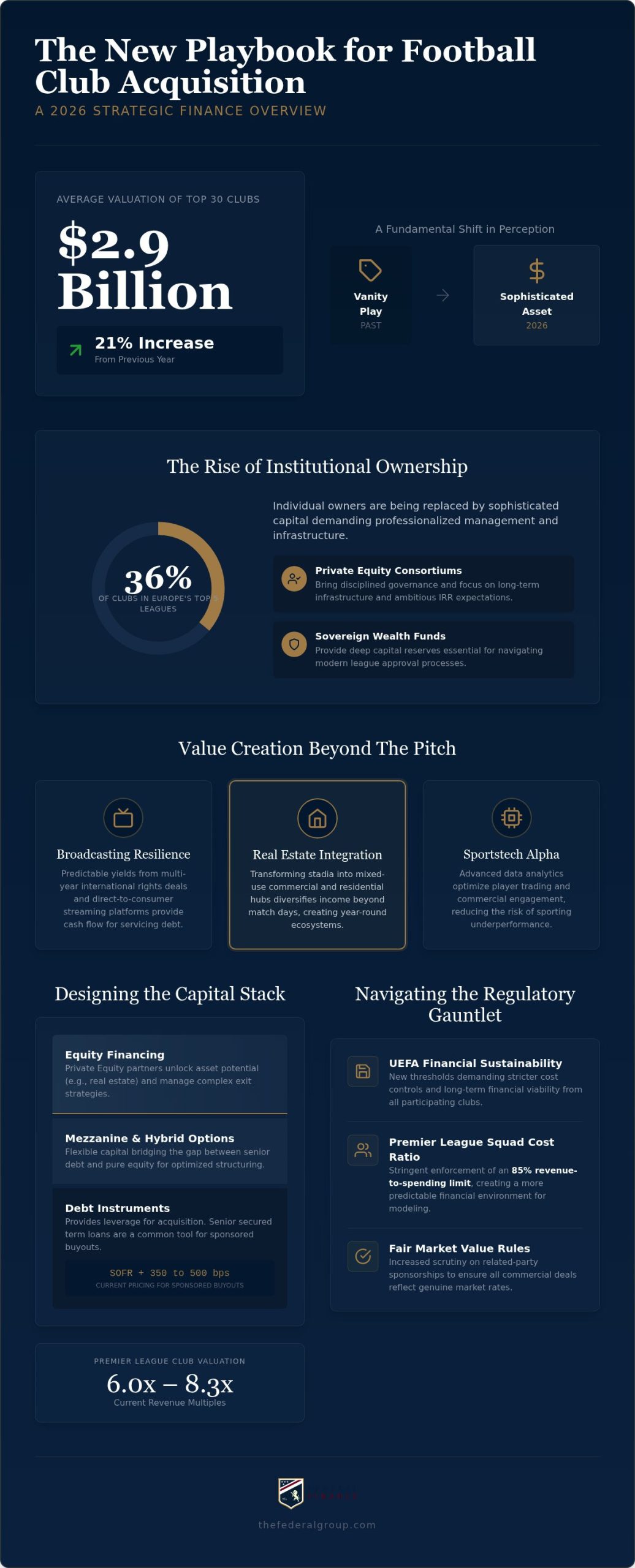
11 August 2026In 2026, football club acquisition is no longer a vanity play; it’s a sophisticated asset-class maneuver that requires integrated private equity and debt structuring. While the average valuation of the top 30 clubs has climbed to $2.9 billion, securing the necessary football club acquisition finance has become a complex gauntlet. Traditional lending models often struggle to align with the latest UEFA squad cost rules and the 85% revenue-to-spending limits now enforced by the Premier League.
You likely recognize that the window for entry is narrowing as institutional competition intensifies and valuations reach record multiples. This guide provides the strategic framework you need to master these financial complexities and secure the capital required for high-stakes takeovers. We’ll explore the transition from individual assets to multi-club ownership ecosystems, compare current debt and equity structures in a high-interest environment, and outline a roadmap for mitigating the regulatory risks that can derail even the most ambitious acquisitions.
Key Takeaways
- Understand the transition of professional football clubs into high-yield institutional assets and how this shift demands professionalized management and infrastructure.
- Learn to design a sophisticated capital stack that balances senior debt, private equity, and mezzanine options to optimize your football club acquisition finance strategy.
- Master valuation frameworks that move beyond basic revenue multiples to incorporate Discounted Cash Flow models and the quantification of “Sporting Alpha.”
- Navigate the 2026 regulatory landscape, specifically the new UEFA Financial Sustainability thresholds and the stringent “Fair Market Value” rules for related-party sponsorships.
- Identify the operational advantages of an integrated investment approach that combines sports multi-club ownership with industrial-scale property development.
The Landscape of Football Club Acquisition Finance in 2026
The professional football sector has undergone a fundamental transformation. What were once locally owned community assets have evolved into high-yield alternative investments that attract the world’s most sophisticated capital. By mid-2026, the average valuation of the top 30 global clubs reached $2.9 billion, representing a 21% increase from the previous year. This surge is driven by a shift toward institutional rigor and the integration of diverse revenue streams. Investors now view football club acquisition finance as a gateway to an ecosystem comprising global intellectual property, premium broadcasting rights, and industrial-scale real estate.
The Shift Toward Institutional Ownership
Individual owners are increasingly being replaced by private equity consortiums and sovereign wealth funds. As of the 2025-26 season, over 36% of clubs in Europe’s top five leagues secured financial backing from private debt or equity firms. This institutionalization is not merely a trend; it’s a regulatory requirement. Modern league approval processes now demand the level of transparency and capital depth that only professionalized finance can provide. Understanding the underlying football economics is essential for navigating these high-stakes entries. These investors bring disciplined governance and a focus on long-term infrastructure, moving away from the volatile, sentiment-driven spending of previous decades.
Key Market Drivers for 2026 Acquisitions
Several factors make 2026 a pivotal year for cross-border investment. Global broadcasting and digital streaming revenues continue to show resilience, providing the predictable cash flows necessary for servicing debt. However, the true value driver is often stadium-anchored development. Effective football club acquisition finance strategies must now account for these real estate ecosystems to ensure long-term viability. Modern acquisitions frequently prioritize the “stadium ecosystem,” where clubs leverage their physical assets to create year-round commercial hubs.
- Broadcasting Resilience: Predictable yields from multi-year international rights deals and direct-to-consumer streaming platforms.
- Real Estate Integration: Transforming stadia into mixed-use commercial and residential zones to diversify income beyond match days.
- Sportstech Alpha: Utilizing advanced data analytics to optimize player trading and commercial engagement, reducing the risk of sporting underperformance.
The introduction of the Premier League’s Squad Cost Ratio for the 2026/27 season has created a more predictable financial environment. This stability allows for more precise modeling of acquisition premiums. Successful takeovers now depend on a firm’s ability to integrate these disparate asset classes into a single, cohesive investment strategy that satisfies both financial stakeholders and sporting regulators.
Strategic Capital Structures: Debt, Equity, and Hybrid Solutions
Designing the optimal capital stack for a professional sports takeover requires more than just deep pockets. It demands a sophisticated blend of instruments that align with the club’s long-term growth trajectory and immediate operational needs. In a market where top-tier Premier League clubs trade at revenue multiples between 6.0x and 8.3x, football club acquisition finance must be as agile as it is robust. An integrated approach balances the permanence of equity with the structured leverage of debt to maximize shareholder value while maintaining regulatory compliance.
Equity Financing and Private Equity Partners
Institutional investors often choose between minority stakes for market entry or majority control for radical operational overhaul. A real estate private equity partner adds significant value by unlocking the development potential of stadium-anchored assets and adjacent commercial land. These partners bring the technical precision required to manage complex exit strategies and meet ambitious IRR expectations. Navigating these varied Equity Finance and Ownership Models allows investors to choose a structure that matches their specific risk appetite and vision for the club’s commercial ecosystem.
Debt Instruments and Bridging Finance
Senior secured term loans for sponsored buyouts currently price at SOFR plus 350 to 500 basis points, reflecting the high-stakes nature of these assets. Manchester United’s 2026 bond refinancing at 5.36% illustrates the pricing benchmarks for marquee entities in the current environment. Beyond senior debt, mezzanine finance often fills the gap, providing higher leverage without immediate equity dilution. When opportunities for rapid asset acquisition arise, such as securing land for training ground expansions or stadium footprint increases, bridging finance for land acquisition serves as a vital tactical tool. These short-term solutions allow clubs to move quickly before transitioning to long-term development finance.
Lenders in this space prioritize asset-backed structures, often securing loans against the stadium or future broadcasting receivables. However, the seasonal nature of football revenue creates unique challenges for covenant management. Cash flow peaks during transfer windows and season ticket cycles, requiring debt structures that are flexible enough to withstand these fluctuations. If you’re planning a complex takeover, consulting with an integrated sports financier can help you secure a capital stack that supports both sporting ambition and financial stability.
Valuation Frameworks and Financial Due Diligence
Accurate valuation in the professional sports sector requires looking past the simplistic revenue multiples often cited in media reports. While marquee Premier League clubs trade at 6.0 to 8.3 times their trailing-year revenue, other clubs in the same league often settle below a 4x multiple. Sophisticated investors utilize Discounted Cash Flow models that incorporate “Sporting Alpha,” which quantifies the projected financial upside of league promotion or consistent European qualification. This transition to predictive modeling is essential for securing competitive football club acquisition finance, as lenders require rigorous proof of debt-service coverage under various performance scenarios.
Financial due diligence must scrutinize more than just the balance sheet. Contingent liabilities, such as deferred player transfer debt and complex agent commission structures, can quietly erode an acquisition’s value. Pension deficits and long-term maintenance requirements for aging stadiums also represent significant capital outlays. Investors should prioritize clubs with substantial real estate holdings, including training grounds and development land, as these tangible assets provide the security needed for high-leverage financing structures.
The Multi-Club Valuation Premium
The rise of the sports multi-club ownership model has introduced a new valuation premium based on operational synergy. As of early 2026, approximately 380 clubs worldwide are part of an MCO structure, with 48% of clubs in Europe’s “Big Five” leagues participating in these networks. This model creates value through centralized scouting, shared administrative costs, and optimized player development pathways. When valuing a club within an MCO, investors must account for the cross-border portfolio benefits that traditional single-club models cannot replicate.
Risk Assessment in Sporting Assets
Mitigating the financial impact of poor sporting performance is a core component of the due diligence process. The loss of broadcasting income following relegation remains the most significant threat to club stability, as parachute payments rarely cover the full shortfall in operating revenue. A comprehensive risk assessment should evaluate:
- Sponsorship Stability: The resilience of kit manufacturing and shirt sponsorship deals, particularly under the latest “Fair Market Value” regulations.
- Infrastructure Capex: The long-term costs associated with modernizing sporting facilities to meet 2026 digital and hospitality standards.
- Squad Cost Ratios: Compliance with the 85% spending limit on football-related revenue to avoid financial penalties or points deductions.
Securing football club acquisition finance in this climate requires a proactive approach to risk management. Investors who can demonstrate a clear plan for diversifying revenue beyond match-day income are far better positioned to negotiate favorable terms with institutional lenders and private equity partners.
Navigating Regulatory Compliance and Multi-Club Models
The regulatory gauntlet for professional sports has shifted from monitoring historical losses to enforcing real-time cost controls. As of 2026, UEFA’s Financial Sustainability Regulations and the Premier League’s new Squad Cost Ratio (SCR) have redefined the parameters of viable football club acquisition finance. Investors must now operate within a framework where on-pitch spending is capped at 85% of football-related revenue and net player sales. This shift places a premium on “Fair Market Value” (FMV) assessments, particularly for related-party sponsorships. Regulators now utilize independent benchmarks to ensure that commercial deals aren’t used to artificially bypass spending caps, making transparent financial modeling a prerequisite for any successful takeover.
Regulatory Steps for MCO Implementation
Managing a portfolio of clubs requires strict adherence to UEFA Article 5, which was updated in March 2026. These rules prohibit clubs under the same “decisive influence”-defined by a 30% shareholding or revenue contribution threshold-from competing in the same UEFA tournament. Establishing robust corporate firewalls is essential to satisfy integrity regulations. This includes independent board structures and transparent reporting for cross-club player transfers, which are now scrutinized to prevent “hidden” subsidies. Navigating these requirements is a core component of professional football club investment strategies in the modern era.
Cross-Border Legal and Tax Structuring
Selecting the right jurisdiction for a club’s holding company is a critical part of football club acquisition finance planning. Luxembourg remains a preferred hub for European ventures due to its sophisticated legal framework, while US-based vehicles are increasingly common for North American consortiums targeting the UK market. Investors must account for the tax implications of international broadcasting distributions and commercial royalties. Implementing efficient withholding tax strategies is vital for global portfolios where revenue is generated across multiple tax regimes. These structures must also withstand the scrutiny of the Owners’ and Directors’ Test (OADT), which now includes enhanced due diligence on the source of capital and long-term sustainability plans.
If you require a partner to navigate these multi-layered compliance hurdles, contact The Federal Group’s Sports Division for a consultation on integrated capital and regulatory solutions.
Securing Institutional Funding with The Federal Group
Success in the 2026 sports market demands more than isolated financial advice; it requires an integrated partner capable of managing the entire investment lifecycle. The Federal Group provides a unique synthesis of private equity, development finance, and specialized sports expertise. We understand that a club’s value is intrinsically linked to its physical and commercial ecosystem. By providing comprehensive football club acquisition finance, we empower investors to look beyond the pitch and unlock the latent value in stadium-anchored real estate and global multi-club networks.
Our Sports Division acts as a strategic architect for international takeovers. We facilitate complex cross-border acquisitions by providing access to bespoke debt structures and institutional capital pools. From the initial due diligence phase to long-term asset management, we ensure that every financial decision aligns with the stringent 2026 regulatory environment. This proactive approach minimizes the risk of points deductions or transfer bans that can devalue an asset overnight, ensuring your investment remains both compliant and competitive.
Our Integrated Design and Build Advantage
Modernizing a club’s infrastructure is a capital-intensive necessity that often creates friction between lenders and developers. Working with an integrated design and build developer allows investors to streamline stadium expansions and training ground upgrades. This approach maximizes match-day revenue by creating high-value hospitality and commercial zones while significantly reducing project risk through full lifecycle management. By controlling both the finance and the delivery, we eliminate the typical delays associated with third-party architectural consulting and construction tenders.
Partnering for Global Sports Growth
The transition to a multi-club model requires precise fiscal engineering and a deep understanding of international tax jurisdictions. We offer specialized expertise in financial structuring for multi-club ownership, ensuring that capital is deployed efficiently across diverse leagues. Our team manages the complexities of cross-border player trading and administrative cost-sharing, which are vital for achieving the “Sporting Alpha” discussed earlier in this guide.
- Bespoke Debt Structuring: Accessing senior and mezzanine finance tailored to sports-specific cash flow cycles.
- Tactical Bridging: Providing rapid capital for land acquisition and stadium footprint expansion.
- Regulatory Alignment: Ensuring every acquisition structure complies with the latest UEFA and league-specific spending caps.
We invite institutional investors and private equity consortiums to leverage our global reach and technical depth. Our commitment to stability and ambition ensures that your capital is not just deployed, but strategically positioned for sustained growth in a competitive international market. Consult with our Sports Division for your next acquisition to secure a partner that understands the high-stakes reality of football club acquisition finance.
Strategizing for Long-Term Value in Global Football
The landscape of professional sports has transformed into a high-stakes institutional asset class where success depends on more than match-day results. Navigating the complexities of football club acquisition finance in 2026 requires a disciplined approach to capital structuring and an intimate understanding of evolving UEFA and league-specific regulations. By moving beyond simple revenue multiples and embracing sophisticated multi-club ownership models, investors can unlock significant “Sporting Alpha” and sustainable commercial growth.
The Federal Group stands ready as your strategic partner in this journey. Our dedicated Global Sports Division specializes in multi-club ownership strategies, while our integrated property and finance expertise ensures every facet of your acquisition is optimized for value. We focus on delivering specialist, high-value international capital solutions that manage the entire lifecycle of your investment. It’s time to move beyond traditional models and embrace a holistic approach to sports ventures that prioritizes long-term stability and visionary growth.
Partner with The Federal Group for Strategic Sports Acquisition and secure your position in the future of the global game.
Frequently Asked Questions
What is the typical debt-to-equity ratio in a football club acquisition?
Typical debt-to-equity ratios for professional club acquisitions generally range between 30/70 and 50/50. While some high-profile leveraged buyouts have historically pushed these boundaries, modern institutional lenders and league regulators prefer more conservative, equity-heavy structures. Higher leverage is usually only achievable when the financing is secured against tangible assets like the stadium or guaranteed future broadcasting receivables.
How do UEFA Financial Sustainability Regulations affect acquisition finance?
UEFA regulations now limit a club’s squad costs to a specific percentage of its total football-related revenue and net profit from player sales. This “squad cost rule” forces investors to align their football club acquisition finance strategy with long-term revenue growth rather than unsustainable debt-funded spending. Clubs exceeding these limits face severe financial penalties or exclusion from European competitions, making compliance a primary concern for lenders.
Can bridging loans be used for professional sports club takeovers?
Bridging loans serve as a vital tactical tool for rapid asset acquisition or securing land during a takeover process. These short-term facilities allow investors to move quickly when a competitive opportunity arises before transitioning to long-term development finance or private equity. They’re particularly effective for clubs needing immediate capital to modernize facilities or expand their real estate footprint to meet 2026 digital standards.
What are the primary risks associated with multi-club ownership (MCO)?
The primary risks of multi-club ownership involve regulatory restrictions on participating in the same UEFA competitions. Under the March 2026 updates, clubs with the same “decisive influence,” defined by a 30% threshold, can’t compete against each other in Europe. Managing these firewalls requires complex legal structuring and independent board governance to avoid integrity challenges and maintain the portfolio’s overall valuation premium.
How is the valuation of a football club determined in 2026?
Club valuations in 2026 are determined through a mix of trailing-year revenue multiples and sophisticated Discounted Cash Flow models. While top-tier Premier League clubs often trade at multiples between 6.0x and 8.3x, marquee Italian clubs typically trade lower at 3x to 4x. Investors also quantify “Sporting Alpha,” which accounts for the projected financial upside of European qualification or optimized player trading pathways.
What is the role of real estate in football club acquisition finance?
Real estate provides the tangible security required for high-leverage football club acquisition finance. Stadia, training grounds, and development land offer a stable asset base that is less volatile than on-pitch performance. By developing stadium-anchored commercial hubs, clubs can diversify their revenue streams beyond match-day income, creating a year-round ecosystem that is highly attractive to institutional lenders and private equity partners.
How do investors navigate the Owners and Directors Test?
Navigating the Owners’ and Directors’ Test requires transparent disclosure of the source of capital and long-term sustainability plans. Leagues have enhanced these tests to include rigorous background checks and a sustainability rule that ensures new owners have the capital depth to fund the club for several years. Successful candidates often work with integrated financial partners to provide the level of institutional rigor required by modern regulators.
What are the benefits of a private equity partnership in professional sports?
Private equity partnerships bring disciplined governance and the capital depth required for large-scale infrastructure projects. These partners help professionalize club management and unlock commercial value through their global networks and exit strategy expertise. In a market where over 36% of top European clubs have financial backing from private firms, these partnerships are essential for competing at the highest levels of the game.