Professional Football Club Investment: The 2026 Strategic Explainer
10 August 2026Why would the most calculated institutional investors in the world compete for assets that were once dismissed as expensive vanity projects? The paradigm of professional football club investment has shifted from emotional philanthropy to a rigorous, data-driven discipline. While the sport was previously defined by unpredictable balance sheets and opaque regulatory shifts, it’s matured into a sophisticated global asset class. You likely recognize the historical risks associated with European football, particularly the volatility of promotion and relegation or the shifting mandates of FIFA and UEFA.
We understand that the complexity of cross-border acquisitions and the reputation for loss-making ventures can be a significant barrier to entry. This strategic explainer identifies how institutional private equity and the Multi-Club Ownership (MCO) model have de-risked the sector. You’ll discover the modern revenue drivers that sustain valuation growth and learn how to evaluate the operational synergies of a diversified sports portfolio. We explore the structural evolution of the industry and provide a clear framework for identifying the capital partners required to navigate this high-stakes environment in 2026.
Key Takeaways
- Understand the transition from individual patronage to institutional private equity, ensuring clubs operate with professional management and data-led recruitment strategies.
- Identify the core revenue drivers including global broadcasting rights and commercial partnerships that underpin the stability of elite football assets.
- Evaluate the Multi-Club Ownership (MCO) model to leverage economies of scale across scouting, medical, and commercial operations.
- Navigate the complexities of professional football club investment by utilizing sophisticated valuation methodologies and strategic bridging finance.
- Recognize the critical link between integrated infrastructure development, such as stadiums and academies, and the overall appreciation of sports asset value.
The Evolution of Professional Football Club Investment in 2026
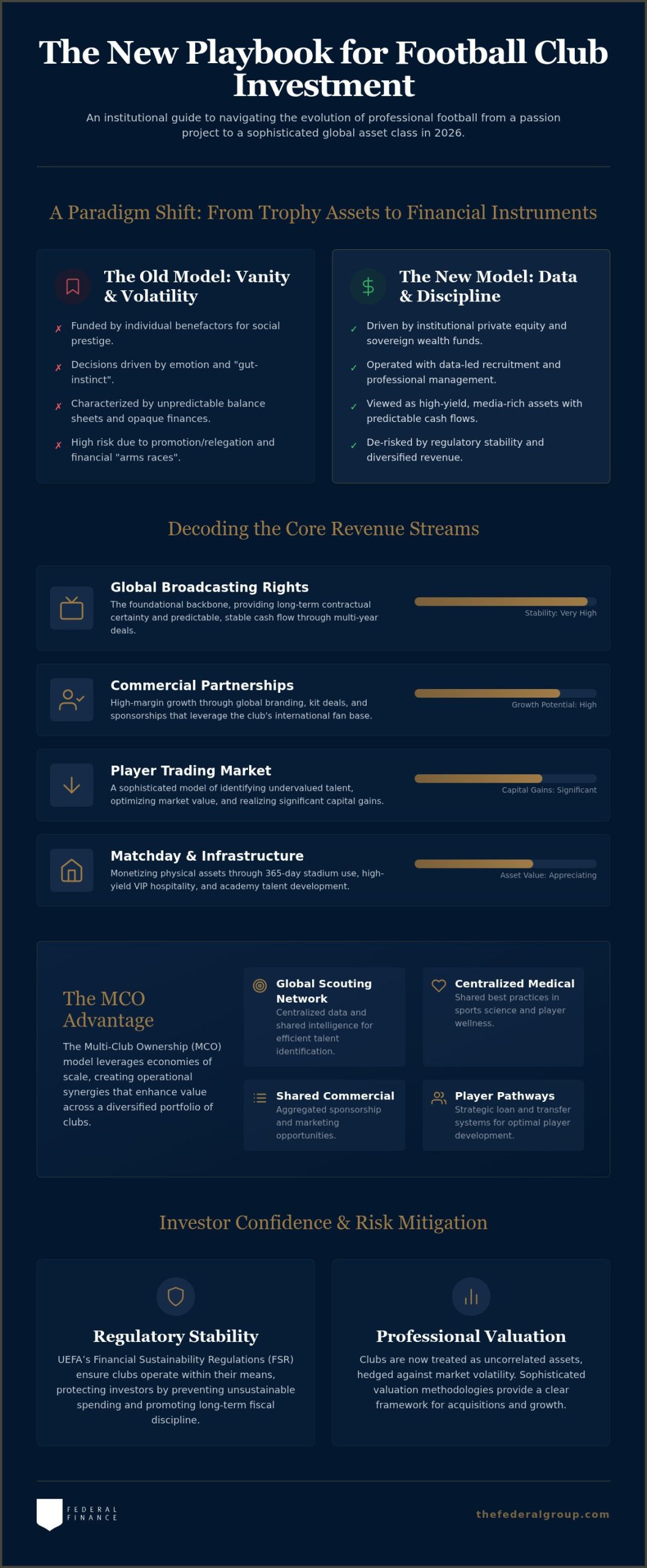
The era of individual benefactors funding clubs for social prestige has largely concluded. In its place, a sophisticated framework of professional football club investment has emerged, driven by institutional private equity and sovereign wealth funds. These entities don’t view clubs as vanity projects; they view them as high-yield, media-rich enterprises with predictable cash flows. By 2026, the professionalization of club management has reached its zenith, with data-led recruitment and algorithmic scouting replacing the traditional, gut-instinct approach of years past. This year represents a watershed moment as global sports valuations are no longer tied purely to on-pitch results, but to the underlying value of content, real estate, and global fan data.
From Trophy Assets to Financial Assets
Football clubs have successfully transitioned into uncorrelated assets, offering a hedge against traditional market volatility within diversified portfolios. The Evolution of Professional Football Club Investment demonstrates that the financial architecture of the sport now mirrors that of high-end real estate or infrastructure projects. The institutionalization of sports capital in 2026 is the systematic conversion of fan-driven passion into scalable, data-verified revenue streams managed by professional fiduciaries. Sovereign wealth funds and private equity firms have injected billions into the ecosystem, driving valuations to record heights while demanding rigorous fiscal discipline. This capital isn’t just targeting the elite tiers. It’s increasingly flowing into mid-tier European competitions where growth potential remains high and entry costs are more accessible, providing these leagues with unprecedented financial stability.
The Impact of Regulatory Stability
Investor confidence has been bolstered by the maturation of UEFA’s Financial Sustainability Regulations (FSR). These rules don’t just limit spending; they protect the investor by ensuring that clubs operate within their means, preventing the ruinous arms races that characterized previous decades. League-wide collective bargaining for broadcasting rights provides a level of revenue certainty that was previously unthinkable in such a competitive market. Modern owners must now adhere to strict transparency requirements, which has cleared the opaque reputation that once deterred institutional players. This regulatory framework transforms a historically volatile venture into a secure, long-term play. It’s no longer about winning at any cost. It’s about sustainable growth through integrated management and strategic capital allocation.
Decoding the Revenue Streams of Elite Football Assets
Understanding the financial viability of professional football club investment requires a granular look at the diversified revenue pillars that sustain modern valuations. Broadcasting rights remain the foundational backbone, offering long-term contractual certainty through multi-year deals with global media conglomerates. These agreements provide a stable floor for annual turnover, shielding clubs from the immediate impact of short-term performance dips. Beyond the pitch, commercial partnerships provide high-margin growth through global branding, sleeve sponsorships, and technical kit deals that leverage a club’s international reach.
The transfer market has evolved into a sophisticated player trading model where clubs operate as talent incubators to realize significant capital gains. This isn’t merely about selling star players; it’s a strategic cycle of identifying undervalued talent and optimizing their market value. Meanwhile, matchday revenue has shifted from simple ticket sales to high-yield hospitality and VIP experiences. These premium services cater to a corporate demographic that values exclusivity, ensuring that matchday turnover isn’t solely dependent on local attendance or general admission prices.
Real Estate and Infrastructure Monetisation
Modern stadium assets are now designed for 365-day-a-year utilization to maximize the ROI of the club’s physical footprint. By hosting concerts, corporate events, and non-football sporting fixtures, clubs transform their infrastructure into a constant revenue generator. Elite academies also play a dual role. They produce homegrown talent that bolsters the first team while serving as a significant financial asset on the balance sheet. Success in these complex infrastructure projects often requires integrating integrated design and build developer expertise to ensure stadium upgrades meet both aesthetic standards and commercial requirements for 2026 and beyond.
The Digital and Global Frontier
The digital transformation allows clubs to bypass traditional gatekeepers and monetize global fanbases directly through Over-The-Top (OTT) platforms and exclusive digital memberships. This strategy is particularly vital for expansion into the US and Asian markets, where the appetite for European football brands continues to surge. In 2026, sophisticated data analytics drive commercial ROI by mapping fan behavior to personalized sponsorship activations, ensuring every digital interaction is a potential revenue event. This level of precision allows sponsors to justify higher spends based on verifiable engagement data.
Aligning these diverse revenue streams requires a partner who understands the financial and physical requirements of the asset. The Federal Group provides the strategic capital and development oversight necessary to unlock these complex revenue opportunities within the global sports ecosystem.
The Rise of the Sports Multi-Club Ownership Model
Multi-Club Ownership (MCO) has evolved from an experimental structure into the dominant strategy for 2026. It represents a fundamental shift in how professional football club investment is executed. By aggregating assets under a single corporate umbrella, investors can mitigate the inherent volatility of a single-team model. This approach allows for the implementation of shared intellectual property across multiple jurisdictions. It ensures that scouting, medical protocols, and commercial strategies are standardized, creating a cohesive brand identity that transcends individual leagues. Geographic spread allows an ownership group to hedge against local economic downturns or changes in broadcasting valuations within a specific nation, providing a level of security that single-club owners can’t achieve.
The financial logic is compelling. Centralizing high-cost departments like data analytics and global scouting networks reduces per-club operational expenditure while increasing the quality of output. A group with clubs in three different countries can deploy a single, elite medical team or commercial sales force to service the entire portfolio. This scale enables the group to negotiate more lucrative sponsorship deals by offering brands exposure across multiple markets and fan demographics simultaneously. Centralizing back-office functions like HR, finance, and legal services doesn’t just cut costs; it improves EBITDA margins across the entire group, making the portfolio more attractive for future exit events or refinancing.
Synergies of the Multi-Club Framework
Within this ecosystem, the flagship club acts as the pinnacle of a managed player pathway. Feeder clubs in lower-tier or secondary European leagues provide a controlled environment for talent development, ensuring that high-potential assets gain necessary match experience without leaving the group’s oversight. You can explore this further in our guide to analyzing the sports multi-club ownership model. This vertical integration protects the group’s capital by reducing the need for expensive external transfers, as the primary club can draw from a pre-vetted internal talent pool. It transforms the traditional transfer market risk into a predictable internal supply chain.
Navigating the “Multi-Club” Regulatory Landscape
As the model proliferates, regulatory scrutiny from bodies like UEFA has intensified. Current rules focus on protecting competitive integrity, particularly when two clubs under the same ownership qualify for the same continental competition. Structuring these groups requires precise legal and financial engineering to ensure compliance while maintaining operational efficiency. Investors must stay abreast of sports club private equity trends to understand how ownership stakes are being partitioned to meet these evolving standards. Successfully navigating these hurdles is essential for any long-term professional football club investment strategy that aims for global scale and regulatory resilience.
Navigating Risks and Capital Structuring in Sports Acquisitions
Valuing a sports entity requires moving beyond the traditional Price-to-Earnings (P/E) ratios used in standard corporate finance. In the world of professional football club investment, valuations are typically driven by revenue multiples, squad market value, and the scarcity of elite assets. This unique financial profile means that due diligence must be exceptionally rigorous. Investors need to look past the surface-level turnover to identify hidden liabilities. These often include deferred transfer payables, contingent agent fees, or complex tax obligations tied to international player image rights. Failing to uncover these “off-balance-sheet” commitments can significantly erode the expected ROI post-acquisition. A comprehensive understanding of football club acquisition finance is essential for structuring deals that account for these complexities while satisfying the latest UEFA squad cost rules and league-mandated spending limits.
Mitigating the risk of relegation is the most critical component of capital protection in European markets. Sophisticated owners utilize financial hedging and “downward-flex” contract clauses to ensure that the club’s wage bill automatically scales down if the team drops a division. This structural flexibility prevents a temporary sporting setback from becoming a permanent financial catastrophe. By integrating these safeguards into the initial acquisition framework, institutional partners can maintain stability even in volatile seasons.
Bridging Finance and Capital Solutions
Speed is often the deciding factor in successful sports M&A. When a club becomes available, the window for negotiation is narrow, requiring immediate access to liquidity. Many investors utilize short-term capital to secure the asset before transitioning to a long-term refinancing plan. The principles of strategic bridging finance for land are highly relevant here, particularly when the acquisition involves significant stadium-adjacent development. The Federal Group provides the necessary liquidity and expertise to facilitate these rapid transactions, acting as the institutional bridge between capital and opportunity.
Private Equity Partnership Models
Choosing between a minority and majority stake is a strategic decision based on the investor’s desired level of control. While majority ownership allows for total operational transformation, minority stakes offer High-Net-Worth (HNW) investors exposure to the asset class without the burden of day-to-day management. Joint Venture (JV) structures are frequently used for large-scale infrastructure projects, such as academy expansions or stadium redevelopments. These JVs ensure that the financial partners and sporting directors remain aligned on the long-term vision. To discuss how to structure your next professional football club investment, you should contact The Federal Group’s sports division for a confidential consultation.
Strategic Partnerships for Global Football Ventures
Executing a successful professional football club investment in the 2026 market requires more than just capital. It demands a multi-disciplinary approach that synchronizes institutional finance with operational sports expertise and large-scale infrastructure development. Unlike traditional private equity plays, sports assets are deeply intertwined with their physical footprint and local regulatory ecosystems. An international real estate finance partner provides the necessary structural oversight to ensure that the club’s stadium and training facilities aren’t just costs, but appreciation-driving assets. This integrated perspective separates high-performing portfolios from those that struggle with the complexity of cross-border sports acquisitions.
The Federal Group acts as a global gateway for institutional capital, providing a secure bridge into the elite tiers of the sport. We manage the entire lifecycle of the investment, from initial due diligence to long-term asset management. Our Sports Division is specifically designed to handle the high-stakes environment of modern football, where timing and discretion are paramount. Moving from interest to execution requires a partner who can navigate the nuanced requirements of FIFA, UEFA, and national governing bodies while maintaining a focus on the investor’s bottom line.
The Federal Group Advantage
Our competitive edge lies in a unique blend of private equity, property development, and specialized sports management. We don’t just facilitate loans; we provide a holistic ecosystem for asset growth. Our extensive background in international property development finance allows us to de-risk stadium and academy projects by applying rigorous industrial standards to sports infrastructure. This specialized knowledge ensures that development projects are completed on time and within budget, protecting the club’s valuation. Our global network also provides our partners with exclusive access to off-market opportunities that never reach the public domain, offering a first-mover advantage in high-growth leagues.
Initiating Your Sports Investment Strategy
The first step in any successful venture is defining a clear investment mandate. You must decide if you’re targeting stable, long-term yield through established top-tier clubs or seeking aggressive capital growth via mid-tier assets and Multi-Club Ownership models. A comprehensive “Sporting Audit” is essential, running parallel to financial due diligence to assess the quality of the club’s technical staff, recruitment algorithms, and youth pipeline. This dual-track approach ensures that the sporting project is as robust as the financial projections. When you’re ready to explore professional football club investment opportunities, contact our Sports Division for a confidential strategic consultation to align your capital with the world’s most dynamic asset class.
Capitalizing on the Future of Global Sports Assets
The landscape of 2026 demands a fundamental shift from passive ownership to active, integrated asset management. Professional football club investment has matured into a resilient and sophisticated asset class where value is extracted through infrastructure development, data monetization, and multi-club synergies. Success in this sector is no longer defined by matchday results alone. It’s defined by the ability to transform a sporting brand into a global media and real estate powerhouse that operates with institutional discipline.
As the strategic bridge between capital and opportunity, The Federal Group offers a specialized Sports Division with deep expertise in private equity and property development across major football markets. We provide the global footprint and technical insight necessary to navigate complex cross-border acquisitions and shifting regulatory environments. Our integrated approach ensures that every stadium project or talent academy is optimized for long-term capital growth and operational efficiency.
Partner with The Federal Group for your global sports investment strategy to unlock high-yield opportunities in this dynamic market. The window for strategic entry is open for those ready to execute with precision and institutional weight. We look forward to helping you build a legacy in the world’s most popular sport.
Frequently Asked Questions
Is professional football club investment actually profitable in 2026?
Profitability in 2026 is driven by the shift from patronage to data-led management. While top-tier clubs generate significant broadcasting and commercial revenue, mid-tier assets offer growth through player trading and infrastructure monetization. Investors who treat clubs as media and real estate platforms, rather than vanity projects, see consistent returns. This disciplined approach ensures that financial health isn’t solely dependent on on-pitch results.
What is the minimum capital required for professional football investment?
Minimum capital requirements depend on the target league and club stature. Entry into a secondary European league might require $10M to $50M for a controlling stake. However, professional football club investment at the elite level, such as the Premier League or La Liga, typically demands hundreds of millions in initial capital plus operational reserves. Minority stakes in mid-market clubs offer a more accessible entry point for institutional investors.
How does the Multi-Club Ownership model reduce investment risk?
The Multi-Club Ownership (MCO) model reduces risk by spreading exposure across multiple jurisdictions and leagues. If one club faces a downturn, the others provide stability. It also lowers costs through shared scouting, medical, and commercial departments. This framework turns the unpredictable nature of sports into a more manageable, diversified corporate portfolio. It creates a controlled player pathway that reduces the need for expensive external transfers.
Can I invest in a football club through private equity?
Private equity has become the dominant structure for modern sports acquisitions. You can invest through specialized funds that aggregate capital for multi-club strategies or through direct equity stakes. This institutional approach brings rigorous fiscal discipline and long-term strategic planning to the industry. It’s a model that prioritizes EBITDA growth and asset appreciation over the short-term emotional spending that characterized the sport’s earlier eras.
What are the main risks of investing in a lower-tier football club?
Lower-tier clubs carry higher volatility, primarily due to the financial cliff associated with relegation. These assets often have underdeveloped infrastructure and less transparent financial records. Investors must perform deep due diligence to uncover hidden liabilities, such as outstanding transfer payments or unfavorable stadium leases. Without a clear plan for promotion or player development, these clubs can become capital-intensive ventures with limited liquidity options.
How do UEFA Financial Sustainability Regulations affect new investors?
UEFA’s Financial Sustainability Regulations (FSR) protect investors by enforcing fiscal discipline across European football. These rules limit spending on wages and transfers relative to revenue, preventing unsustainable spending wars. For new investors, FSR provides a more predictable competitive environment. It ensures that club valuations are based on actual financial health rather than artificial spending, making the asset class more attractive to institutional capital.
What role does stadium real estate play in club valuation?
Stadium real estate is a critical pillar of professional football club investment valuation. A modern, club-owned stadium provides a constant revenue stream through non-matchday events and premium hospitality. It also serves as high-quality collateral for securing development finance or bridging loans. Clubs that own their infrastructure are valued significantly higher than those with leasehold arrangements, as they control their primary revenue-generating asset.
How do I start the process of acquiring a professional football club?
The process starts with defining your investment mandate, focusing on either long-term yield or aggressive capital growth. You should then engage a specialized partner to perform a comprehensive sporting and financial audit. Accessing off-market opportunities through a global network is usually more effective than pursuing public listings. This allows for more favorable negotiation terms and ensures the acquisition aligns with your broader portfolio strategy.