Global Sports Investment Group: The 2026 Strategic Evolution of Sports as an Asset Class
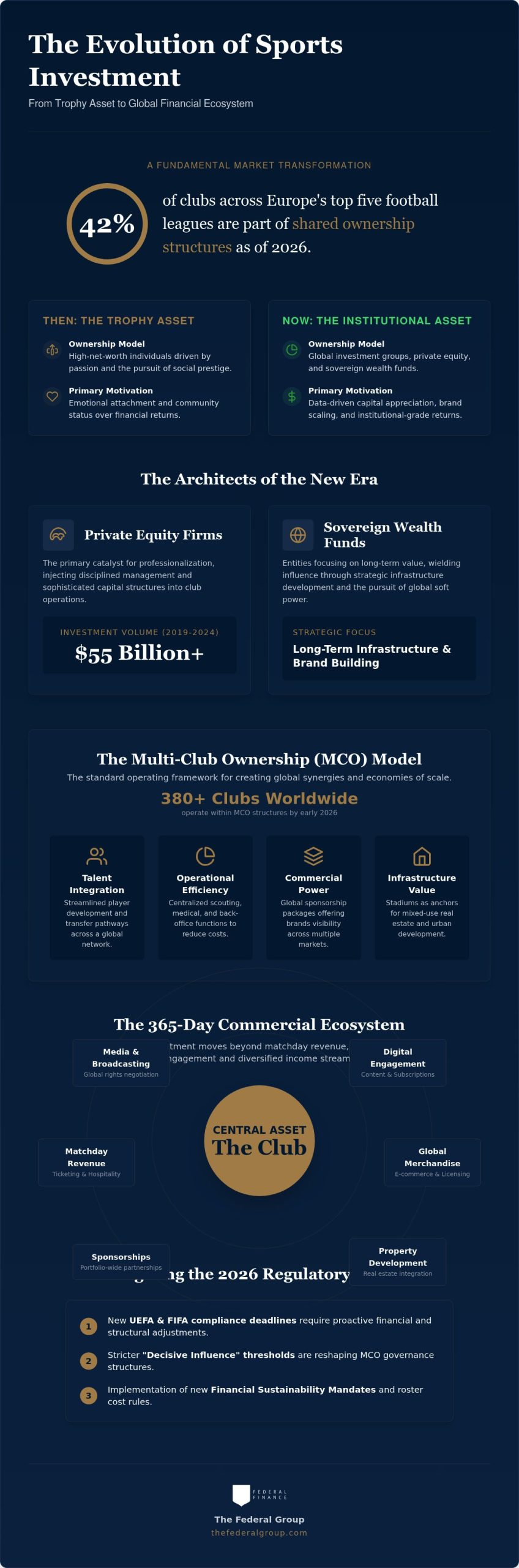
13 August 2026By the start of 2026, nearly 42% of clubs across Europe’s top five football leagues have entered shared ownership structures, signaling a permanent shift in how professional athletics are valued. The era of the “trophy asset” has been replaced by a rigorous, data-driven approach led by the professional global sports investment group. You likely recognize that the entry barriers to this sector have never been higher, particularly as cross-border regulations and the complexity of valuing brand equity create significant friction for new capital. It’s no longer enough to simply buy a team; you must now manage an integrated ecosystem of talent, media rights, and infrastructure.
This article explores how institutional players are transforming sports into a sophisticated, multi-billion dollar asset class. You’ll learn how to navigate the March 2026 UEFA compliance deadlines and the new roster cost rules while identifying revenue synergies across global portfolios. We’ll also examine the multi-club ownership model and the specific capital structures required for high-value acquisitions in this evolving landscape.
Key Takeaways
- Understand the transition from individual vanity ownership to a model where a global sports investment group prioritizes institutional-grade capital appreciation and global brand scaling.
- Identify the strategic benefits of multi-club ownership, including streamlined player development pathways and cross-border operational synergies.
- Navigate the 2026 UEFA and FIFA regulatory shifts, focusing on new “decisive influence” thresholds and financial sustainability mandates.
- Learn how to integrate sports infrastructure with mixed-use property development to generate diverse revenue from retail, residential, and hospitality sectors.
- Gain insights into structuring capital for sports acquisitions through specialized private equity and bridging loan solutions.
Defining the Modern Global Sports Investment Group
A global sports investment group is a multi-asset entity managing diverse sports interests. For decades, professional sports ownership was defined by high-net-worth individuals seeking social prestige, often referred to as “vanity” assets. By 2026, this landscape has fundamentally shifted. Institutional investment groups now dominate, applying the same rigor found in Sports economics to professional athletics. These groups prioritize capital appreciation, media rights monetization, and global brand scaling over emotional attachment.
Private equity has been the primary catalyst for this professionalization. By injecting disciplined management and sophisticated capital structures, these firms have turned clubs into high-performing businesses. The focus is no longer just on winning trophies; it’s about building a sustainable, scalable enterprise that generates institutional-grade returns. The entry of professional capital has forced a total modernization of front-office operations and commercial strategies.
The Shift from Club to Ecosystem
The 2026 era marks the definitive rise of the “Sports Holding Company.” Modern owners view a club not as a standalone unit but as a central node in a broader commercial ecosystem. This transition moves the business model beyond traditional matchday revenue toward 365-day commercial cycles. Revenue is now generated through digital engagement, year-round hospitality, and global merchandise long after the final whistle. Technology and data analytics are essential tools in this portfolio management. A global sports investment group uses advanced metrics to optimize player trading, enhance fan engagement, and drive operational efficiency across its entire holdings.
Key Players in the Global Market
The market is currently split between sovereign wealth funds and private equity firms, each bringing different strategic advantages. Sovereign wealth funds often focus on long-term soft power and infrastructure. In contrast, private equity firms seek specific exit horizons and aggressive growth. Between 2019 and 2024, private equity firms invested over $55 billion in sports-related assets, a trend that has only accelerated into 2026. Specialized sports investment vehicles have emerged to bridge the gap between niche expertise and institutional scale.
These groups wield immense influence over global transfer markets and media rights negotiations. By aggregating multiple assets, they create a level of bargaining power that individual clubs could never achieve alone. This collective strength allows them to dictate terms in broadcasting deals and sponsorship agreements, ensuring the entire portfolio benefits from the group’s global reach. It’s a model that prioritizes stability and long-term value creation in an increasingly volatile market.
The Multi-Club Ownership (MCO) Model and Global Synergies
The Multi-Club Ownership (MCO) framework has evolved into the standard operating model for any institutional global sports investment group. By early 2026, approximately 380 clubs worldwide operate within these structures. This model involves acquiring clubs across different tiers or continents to create a vertical integration of talent and commercial power. It’s a strategy that allows for significant cost sharing in back-office operations, medical departments, and scouting networks. By centralizing these functions, groups can achieve economies of scale that are impossible for standalone clubs to replicate.
Commercial advantages are equally compelling. A group can offer global sponsorship packages that provide brands visibility across multiple markets simultaneously. This scale attracts blue-chip partners seeking broad market penetration through a single point of contact. These groups also frequently integrate property development into their portfolios, using stadium footprints as anchors for broader urban regeneration projects. This connection between sports infrastructure and high-value real estate development provides a secondary, stable revenue stream that buffers against the volatility of on-pitch results.
Financial Structuring for Multi-Club Ownership
Managing a portfolio of clubs requires sophisticated financial structuring for multi-club ownership. Investment groups must navigate complex cross-border capital flows while maintaining tax efficiencies across different jurisdictions. Centralized corporate governance is non-negotiable; it ensures that the parent entity maintains control over strategic direction while allowing individual clubs to maintain local cultural relevance. Groups often utilize the UEFA multi-club ownership regulations as a roadmap to ensure compliance and maintain competition integrity, particularly when multiple clubs in a portfolio qualify for international tournaments.
Player Trading as a Revenue Stream
Player trading has become a primary revenue driver for modern MCOs. By moving talent through internal club pathways, a global sports investment group can optimize a player’s market value before a high-fee external sale. This reduces external transfer spend while maximizing sell-on fees for the group. FIFA’s latest clearing house regulations have brought increased transparency to these global trades, requiring groups to be even more precise in their valuations. Successful groups in 2026, such as those supported by The Federal Group’s Sports Division, leverage these internal markets to ensure financial stability even when broadcasting revenues fluctuate. This disciplined approach to talent management differentiates institutional owners from the speculative investors of the past.
Navigating Regulatory Frameworks and Financial Fair Play
The regulatory environment for a global sports investment group has reached a critical inflection point in 2026. UEFA and FIFA have intensified their focus on competition integrity, specifically targeting the “decisive influence” found in multi-club structures. As of March 1, 2026, any ownership group must prove it doesn’t exercise control over multiple clubs in the same competition if they hold more than 30% of a club’s shares or provide more than 30% of its total revenue. This threshold represents a significant tightening of previous standards, forcing many portfolios to restructure their equity positions to remain compliant.
Parallel to ownership rules, the Financial Sustainability Regulations (FSR) now impose a permanent 70% cap on total revenue for spending on player salaries and agent commissions. This “Roster Cost Rule” demands a level of fiscal discipline that was previously optional for many clubs. Managing related-party transactions has also become more complex, as regulators now use sophisticated fair-value assessments to ensure commercial sponsorships aren’t being used to circumvent these caps. Investors must now justify every internal revenue stream against market benchmarks.
Investors face three primary regulatory hurdles in this new era:
- Decisive Influence Compliance: Navigating the 30% ownership or revenue threshold to maintain multi-club eligibility in elite competitions.
- FSR Cost Management: Adhering to the 70% revenue-to-squad-cost ratio while remaining competitive in the transfer market.
- Related-Party Scrutiny: Defending the commercial validity of sponsorship deals originating from within the parent group’s ecosystem.
Cross-Border Legal Complexity
Acquiring sports assets requires a deep understanding of differing ownership laws across the UK, EU, and US. While the NFL now permits private equity funds to take minority stakes up to 10%, European leagues maintain stricter fit-and-proper-person tests. Successfully structuring these acquisitions often requires the expertise of an international real estate finance partner to manage the complex interplay between property law and sports regulations. This is particularly vital when acquisitions involve large-scale stadium redevelopments that must comply with national security and local zoning requirements.
Transparency and Institutional Reporting
A global sports investment group must now operate with the transparency of a publicly traded firm. ESG standards have moved from the periphery to the core of institutional reporting, as stakeholders demand accountability regarding social impact and governance. This shift has professionalized club accounting, moving away from opaque ledger systems toward integrated financial reporting. Additionally, the rise of fan-led review legislation in several European markets has introduced new layers of oversight, requiring owners to balance institutional growth with community-focused governance structures.
The Intersection of Sports Investment and Property Development
Modern sports investment has transcended the boundaries of the field of play. A global sports investment group now views the stadium not merely as a venue for matches but as the primary anchor for large-scale mixed-use property development. This “District” model transforms sports venues into 24/7 urban destinations, generating consistent non-sporting revenue through high-density retail, residential, and hospitality assets. By diversifying income streams, investment groups can insulate themselves from the inherent volatility of athletic performance and broadcasting cycles.
Securing the necessary property finance for high-value projects is the cornerstone of this evolution. Institutional investors recognize that the real estate value surrounding a stadium often rivals the valuation of the sports franchise itself. This integrated approach allows for a holistic valuation of the asset class, where the physical footprint and the brand equity work in tandem to drive long-term alpha. It’s a shift from temporary matchday spikes to a permanent commercial ecosystem.
Real Estate Synergies in Sports Portfolios
Strategic land acquisition adjacent to existing infrastructure is a primary driver of portfolio growth. Groups utilize specialized property development loans to fund the construction of world-class training facilities and elite academies. These assets do more than develop talent; they increase the underlying land value and attract further investment into the surrounding area. Mastering the capital stack for property development is essential here, as it allows groups to layer senior debt with mezzanine financing and private equity to optimize their leverage and returns.
Integrated Design and Build for Sports
The integrated developer model is becoming the preferred vehicle for complex stadium projects because it significantly reduces execution risk. By managing the entire lifecycle from design to delivery, a global sports investment group ensures that new builds meet 2026 sustainability and technology standards. Modernizing legacy assets is equally critical. Integrating smart-stadium technology, such as high-density connectivity and automated hospitality systems, directly increases long-term property valuation. These technological upgrades turn aging infrastructure into high-performing, data-rich assets that appeal to institutional stakeholders.
To explore how your portfolio can benefit from integrated sports and real estate strategies, contact The Federal Group’s dedicated Sports Division to discuss our design and build development capabilities.
Capital Solutions and Private Equity with The Federal Group
The Federal Group operates as a specialized bridge between institutional finance and professional athletics. Our dedicated Sports Division focuses on identifying high-potential global acquisitions that align with broader property development goals. We provide the capital solutions necessary to transform a club from a local competitor into a central asset within a global sports investment group. This integrated approach combines Private Equity expertise with Design & Build Development capabilities, ensuring every acquisition is structured for long-term scalability. By managing the intersection of finance and infrastructure, we help partners navigate the high entry barriers of professional sports.
Our methodology prioritizes stability and ambitious growth. We recognize that modern sports ownership requires more than just capital; it requires a proactive, integrated strategy that manages every stage of a project’s lifecycle. We position ourselves as a heavyweight partner, offering the scale of a large corporation paired with the focused insight of a niche consultancy. This allows our stakeholders to feel secure in their high-value investments while remaining ready for complex, international challenges.
Bridging Finance for Sports Acquisitions
Liquidity management is a primary challenge during intense transfer windows and complex acquisition negotiations. We utilize short-term Bridging Loans to help investors secure time-sensitive sporting assets before competitors can mobilize. These facilities provide the necessary agility to navigate the high-stakes environment of international football and other professional leagues. Our track record in international property and sports finance allows us to move with the speed the market demands. By securing assets quickly, our partners can focus on the operational and strategic transitions required for successful Sports Multi-Club Ownership.
Partnering for Global Scale
Institutional partners leverage our Sports Division expertise to navigate the complexities of global portfolios. We facilitate strategic joint ventures that allow for shared risk and pooled resources across diverse geographies. Whether you’re looking to acquire a minority stake under the latest private equity regulations or build an integrated ecosystem in Europe, we provide bespoke sports investment opportunities. Our model manages the entire lifecycle of an asset, from the initial capital injection to the final design and build phase of stadium infrastructure. This ensures that every global sports investment group we support has the structural foundation to achieve institutional-grade returns.
Contact The Federal Group to discuss how our Private Equity solutions and specialized sports finance can accelerate your portfolio’s growth and secure your position in this evolving asset class.
Securing Your Position in the 2026 Sports Economy
The 2026 sports landscape demands a definitive shift from passive ownership to integrated ecosystem management. Success in this high-stakes environment requires a deep understanding of multi-club synergies and the ability to navigate a tightening regulatory framework. By aligning sports acquisitions with large-scale property development, investors can secure stable revenue streams that protect against on-pitch volatility. This holistic approach ensures that athletic assets function as high-performing components of a broader institutional portfolio.
The Federal Group serves as a strategic partner for any global sports investment group seeking institutional-grade alpha. Our Integrated Sports Division and global property finance expertise provide the foundation for high-value capital structuring in this complex market. We bridge the gap between niche sports insight and industrial-scale development finance. This specialized expertise allows our partners to manage every stage of a project’s lifecycle with total confidence.
Explore Bespoke Sports Investment Solutions with The Federal Group and discover how our specialized capital solutions can transform your portfolio. The era of professionalized sports investment is here; it’s time to build your legacy with a partner who understands the global scale of modern development.
Frequently Asked Questions
What is a global sports investment group?
A global sports investment group is an institutional entity that manages a portfolio of sports-related assets to drive capital appreciation and commercial growth. These groups move beyond individual team ownership to create integrated ecosystems involving media rights, digital intellectual property, and real estate. By 2026, they’ve professionalized sports management, replacing traditional high-net-worth individual owners with data-driven institutional capital and rigorous corporate governance standards.
How does the multi-club ownership model benefit investors?
Multi-club ownership (MCO) provides economies of scale through centralized scouting, medical, and back-office operations. It creates internal player development pathways that optimize transfer value and reduce external spending. By owning approximately 380 clubs worldwide in 2026, MCOs also offer sponsors global reach across multiple markets. This structure mitigates risk by diversifying revenue streams across different leagues and geographic regions, ensuring stability even if one club underperforms.
Can private equity firms own professional football clubs?
Yes, private equity firms are now major players in professional sports, having invested over $55 billion between 2019 and 2024. In 2026, they provide the liquidity necessary for stadium redevelopments and club modernization. While North American leagues like the NFL cap private equity stakes at 10%, European football allows for significant control. These firms prioritize operational efficiency and commercial scaling to deliver institutional-grade returns for their limited partners.
What are the main risks of investing in professional sports?
The primary risks include high entry barriers, regulatory volatility, and the difficulty of valuing intangible assets like fan loyalty. Changes to UEFA’s “decisive influence” rules in 2026 can force sudden portfolio restructuring. Performance-based revenue, such as broadcasting rights dependent on league standing, also introduces financial unpredictability. Successful investors mitigate these risks by integrating real estate and non-sporting assets into their portfolios to create stable, year-round income.
How do sports investment groups value a football club?
Valuation has shifted from simple revenue multiples to complex models based on intellectual property, media reach, and real estate potential. A global sports investment group assesses a club’s brand equity, digital engagement data, and the replacement cost of its infrastructure. They also factor in the synergy value a club adds to an existing multi-club portfolio. This sophisticated approach ensures that the purchase price reflects long-term commercial potential rather than just matchday income.
What is the role of real estate in sports investment?
Real estate serves as a stabilizing anchor that generates 365-day revenue through mixed-use developments. Stadiums are now central to “District” models that include retail, residential, and hospitality assets. By developing land adjacent to sports infrastructure, investors can capture property value appreciation that is independent of on-pitch results. This integrated strategy turns a seasonal sports venue into a permanent commercial destination, significantly increasing the overall valuation of the investment portfolio.
How are 2026 Financial Fair Play rules affecting global investors?
The 2026 Financial Sustainability Regulations (FSR) impose a strict 70% cap on revenue spent on squad costs, including salaries and agent fees. This requires investors to focus aggressively on increasing commercial revenue to maintain competitive spending levels. Additionally, new UEFA rules regarding related-party transactions prevent owners from using internal sponsorships to bypass these limits. These regulations have forced a move toward more transparent, professionalized accounting and sustainable business models across global sports.
Why is the “global” aspect important for sports investment groups?
Global scale is essential for a global sports investment group to maximize media rights and sponsorship value. It allows for the cross-pollination of talent and commercial strategies between different continents and time zones. By operating internationally, groups can access emerging markets where fan bases are growing rapidly but infrastructure remains undeveloped. This geographic breadth provides the necessary reach to attract blue-chip global partners and maintain a competitive edge in the international transfer market.