Private Equity for Global Property: 2026 Strategic Guide
26 August 2026The most resilient international developments in 2026 are no longer defined by the size of their capital injection, but by the operational intelligence behind it. While many developers struggle to bridge the gap between financial spreadsheets and physical construction, a new class of integrated partner is emerging. Securing private equity for international property development now requires more than just a high IRR. It demands a sophisticated understanding of cross-border capital structures and the ability to navigate a fragmented regulatory landscape where state-level restrictions and federal tax shifts, such as the 100% bonus depreciation rules, have rewritten the playbook for success.
You likely recognize that traditional lending often falls short when faced with currency volatility or complex repatriation hurdles. Finding a partner who speaks the language of both the boardroom and the building site is your highest priority for scaling a global portfolio without over-leveraging. This strategic guide promises to reveal how you can leverage integrated private equity to de-risk high-value projects and secure reliable capital for the full project lifecycle. We will examine the mechanics of cross-border structures, the impact of the 2026 tax landscape, and the advantages of a unified design and build approach.
Key Takeaways
- Navigate the 2026 shift toward cross-border capital deployment by understanding the evolving regulatory landscape in both emerging and established markets.
- Identify the most effective private equity for international property development strategies, specifically how opportunistic models drive maximum returns for high-value projects.
- Eliminate project friction by adopting an integrated design-and-build model that aligns financial objectives with operational execution.
- Master the nuances of structuring joint venture partnerships, including the critical balance of GP and LP roles within a global development context.
- Discover how to scale a global portfolio by partnering with integrated specialists who provide bridging finance and long-term equity.
The Landscape of Private Equity for International Property Development
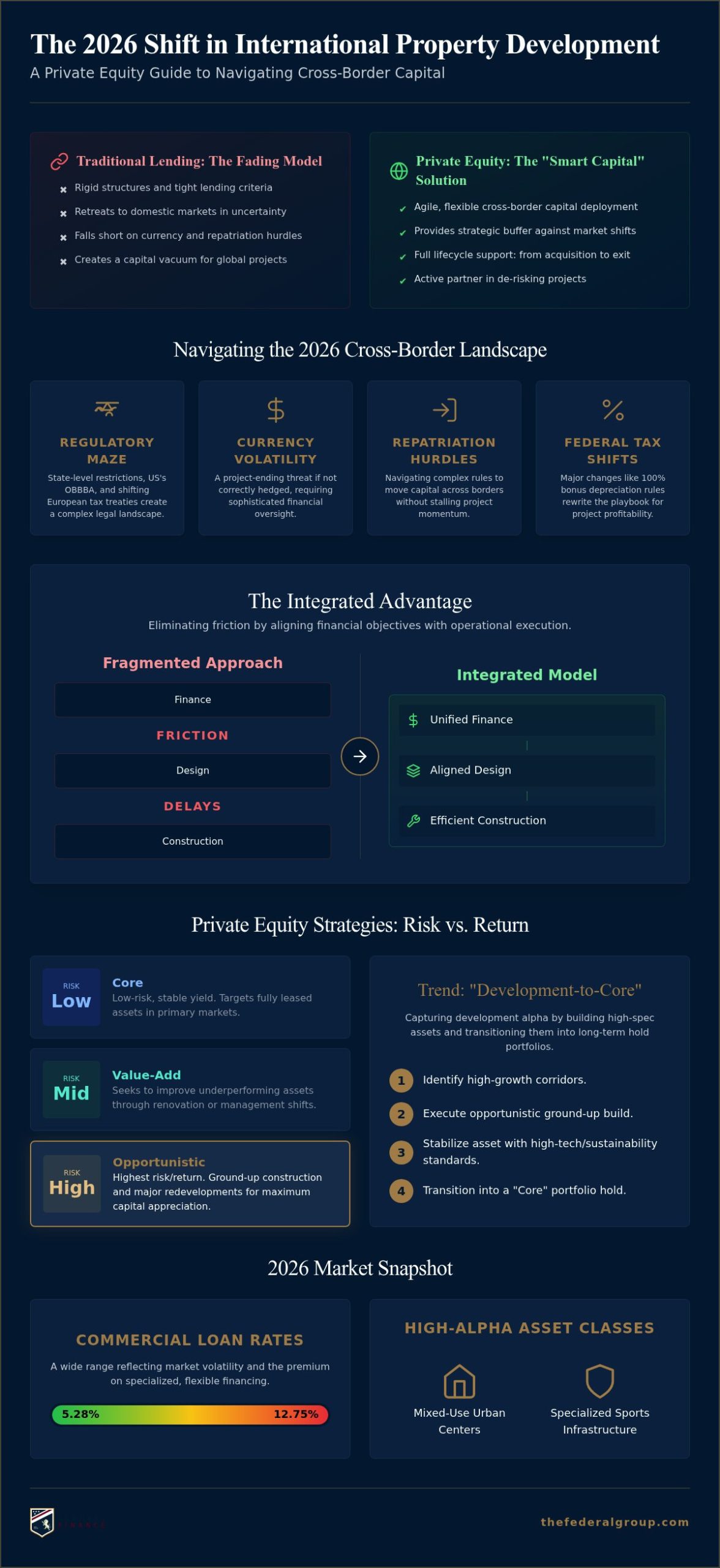
International real estate private equity serves as the high-velocity engine for global infrastructure and high-value property development. In 2026, the sector has moved beyond simple asset acquisition toward a sophisticated model of cross-border capital deployment. This transition is fueled by a volatile economic environment where agility outweighs the rigid structures of traditional retail banking. Developers now prioritize Private Equity Real Estate partners who provide more than just liquidity; they offer a strategic buffer against global market shifts.
Traditional banks have tightened their lending criteria, often retreating to domestic markets during periods of uncertainty. This has created a vacuum filled by “smart capital.” These equity partners understand the nuances of the full development lifecycle, from site acquisition to eventual exit. For developers scaling across borders, private equity for international property development offers the flexibility required to execute complex projects in both established European hubs and emerging markets. This smart money isn’t just passive; it’s an active participant in de-risking the project from day one.
Why Cross-Border Development Requires Specialized Equity
Managing a project across multiple jurisdictions involves more than just architectural design. In 2026, the implementation of the “One Big Beautiful Bill Act” (OBBBA) in the U.S. and shifting European tax treaties have made specialized oversight mandatory. Currency risk isn’t just a spreadsheet line item. It’s a project-ending threat if not hedged correctly. Experienced international real estate finance partners bridge the gap by integrating global capital access with granular local knowledge. This ensures that capital repatriation hurdles and differing regulatory environments don’t stall momentum. Success depends on a partner’s ability to balance global financial scale with the specific legal requirements of each local municipality.
The 2026 Shift: From Passive Investing to Active Development
Institutional investors have largely abandoned the safety of stabilized, low-yield assets in favor of ground-up development. This shift reflects a desire for higher alpha in an era where commercial loan rates range from 5.28% to 12.75%. We’re seeing a surge in niche asset classes, including mixed-use urban centers and specialized sports infrastructure. The Federal Group operates at the center of this evolution. By serving as an integrated partner, the group manages the friction between finance and construction. This allows stakeholders to capture the value of development without the typical operational fragmentation that plagues international portfolios. The focus has moved from merely owning property to actively creating it.
Core Private Equity Strategies for Global Real Estate
Institutional capital typically flows through four distinct risk-return channels. Core and Core-Plus strategies prioritize stability and immediate yield, often targeting fully leased assets in primary markets. Value-Add strategies seek to improve underperforming properties through renovation or management shifts. However, in the context of private equity for international property development, Opportunistic strategies represent the most aggressive and high-potential path. These involve ground-up construction or major redevelopments where the risk is highest, but the potential for capital appreciation is greatest.
A significant 2026 trend is the ‘Development-to-Core’ model. This allows institutional investors to capture the development alpha by building to high specifications and then transitioning the asset into a long-term hold portfolio. Data from Private Equity International indicates that this movement toward active creation is a response to compressed yields in the secondary market. By controlling the entire lifecycle, developers can bake in sustainability and technological standards that older assets simply can’t match.
Opportunistic Development in International Markets
Success in international ground-up builds depends on identifying high-growth corridors where demand outstrips supply. Risk mitigation remains the primary hurdle. Developers must balance aggressive growth with rigorous downside protection, such as fixed-price contracts and sophisticated currency hedging. Maximizing returns in these scenarios often requires a deep understanding of international property development finance to ensure the capital stack is optimized for both construction and long-term equity. If you’re looking to structure a complex international deal, consulting with a strategic partner can provide the necessary global perspective.
Alternative Assets: The Sports Multi-Club Model
Professional sports infrastructure has emerged as a powerhouse property-adjacent asset class. The intersection of professional football club investment and commercial real estate creates unique synergies. Stadiums are no longer isolated venues; they act as anchors for massive mixed-use developments, including hospitality, retail, and residential hubs. This ecosystem approach diversifies revenue streams beyond match-day tickets. The Multi-Club Strategy serves as a vehicle for global commercial and athletic synergy, transforming traditional sporting venues into diversified, year-round revenue engines. This model allows for the scaling of a global portfolio that benefits from both athletic performance and industrial-scale property appreciation.
The Integrated Advantage: Why Capital Alone Isn’t Enough
Capital is a commodity in the current market. In high-stakes private equity for international property development, the real value lies in the precision of execution. Most projects suffer from a fundamental disconnect between the entity providing the funds and the entity laying the bricks. This friction leads to delays, cost overruns, and misaligned incentives that erode margins. When a financier only understands spreadsheets and a builder only understands site conditions, the project’s profitability is often lost in translation. Successful developers in 2026 recognize that capital is merely the entry fee; the real profit is found in the integration of finance and construction.
The solution is the ‘Integrated Design & Build’ model. By merging financial oversight with physical construction, developers eliminate the traditional friction points that stall large-scale builds. Federal Holdings manages the entire lifecycle, from initial architectural concepts to final structural completion. This ecosystem approach significantly reduces ‘soft costs’ such as third-party consultancy fees and legal disputes between separate contractors. It ensures that every design choice is financially viable from the start, allowing for faster decision-making when global market conditions shift. This synergy transforms the developer from a passive manager into an active creator of value.
De-risking Projects through Design-and-Build Integration
Integrated developers maintain strict budget discipline, which is vital when commercial loan rates remain volatile. Full lifecycle management directly impacts the investor’s IRR by shortening the time between land purchase and tenant occupancy. By controlling the supply chain and labor directly, an integrated partner buffers the project against the inflationary spikes that can derail a budget. You can explore the efficiency of the integrated design and build developer to understand how this synergy eliminates common project bottlenecks that typically plague fragmented teams. This model ensures that the architecture serves the financial goals, not the other way around.
Bridging the Gap: From Land Acquisition to Final Build
Securing the right site is the first hurdle in any global portfolio expansion. Utilizing bridging finance for land acquisition allows developers to move quickly on prime opportunities before the window of opportunity closes. The real advantage comes from transitioning this short-term debt into a permanent equity partnership without switching institutions. This seamless flow of capital is the ultimate ‘alpha’. It provides a level of stability that fragmented teams can’t replicate, ensuring that the strategic vision established at the acquisition stage survives the logistical rigors of the international build. This continuity of partnership is what allows a global portfolio to scale without the risk of over-leveraging.
Structuring Cross-Border Equity Partnerships in 2026
Structuring a Joint Venture (JV) for private equity for international property development demands a surgical approach to interest alignment. In 2026, the standard 2/20 fee structure has given way to more complex, performance-indexed models. The General Partner (GP) typically provides the operational expertise and local site control, while the Limited Partner (LP) provides the bulk of the institutional capital. Success hinges on a clear “Waterfall” distribution schedule. This mechanism ensures that LPs receive their preferred return before the GP captures carried interest, creating a disciplined environment where the developer is incentivized to exceed baseline projections while protecting the initial capital injection.
Institutional capital in 2026 is strictly tied to ESG and sustainability benchmarks. Financial partners now require granular data on carbon footprints and social impact before committing to a development. Projects that fail to meet these international standards often face a higher cost of capital or a limited pool of exit buyers. For developers, this means that the capital stack isn’t just about debt and equity; it’s about demonstrating long-term asset resilience through high-performance building standards.
Step 1: Financial Modeling and Feasibility
The optimal debt-to-equity ratio for international builds in 2026 often hovers around 60:40, reflecting a cautious approach to higher global interest rates. Modeling must account for regional construction costs that can fluctuate based on localized supply chain pressures. Feasibility is a blend of market demand and regulatory clearance. Developers must also factor in localized exit cap rates to ensure the terminal value of the asset justifies the development risk. Precise modeling allows the partnership to withstand the market volatility that often accompanies large-scale, multi-year builds.
Step 2: Legal and Tax Structuring
Special Purpose Vehicles (SPVs) are the industry standard for isolating risk in cross-border developments. These entities protect the parent company from project-specific liabilities while facilitating a cleaner exit. Navigating withholding taxes and capital repatriation requires a deep understanding of bilateral tax treaties, especially following the 2026 shifts in international accounting standards. Transparent reporting is mandatory to maintain trust between the GP and LP. If you are ready to scale your portfolio with a partner who understands these complexities, contact The Federal Group today to discuss your next high-value project.
Strategic Partnerships: Scaling Global Portfolios with The Federal Group
High-value international development in 2026 requires a partner who operates beyond the constraints of traditional institutional bureaucracy. While conventional lenders have become increasingly reactive, retreating into conservative domestic shells, The Federal Group has expanded its role as a proactive strategic partner. We don’t just provide liquidity; we provide a comprehensive capital engine designed for the complexities of industrial-scale property. By merging institutional-grade finance with a visionary developer mindset, we allow our partners to scale global portfolios with a level of agility that traditional banking simply can’t match.
Our firm occupies a unique position at the intersection of global finance, professional sports infrastructure, and integrated construction management. This ecosystem approach is vital for developers who need to move quickly on high-potential opportunities without sacrificing structural security. We offer a unified solution that covers the entire project lifecycle. Whether you are navigating the nuances of private equity for international property development or seeking to capitalize on property-adjacent alternative assets, our model ensures your financial objectives are perfectly aligned with physical execution.
A Track Record of Integration
The Federal Group’s strength lies in our ability to provide seamless capital transitions. We specialize in moving projects from the high-speed land acquisition phase into long-term equity partnerships. This continuity eliminates the friction of re-financing with multiple institutions and ensures the strategic vision remains intact from day one. Our Elite Development Finance Lender case study serves as a definitive proof of concept, demonstrating how integrated oversight leads to superior IRR and reduced project risk. Furthermore, our global network in professional sports allows us to unlock unique development opportunities in stadium-anchored mixed-use hubs that are often invisible to traditional real estate investors.
Securing Your Future Development Finance
The 2026 economic landscape rewards those who pivot away from fragmented funding models toward integrated equity partnerships. As regulatory environments become more complex and construction costs remain sensitive to global inflation, the value of a ‘smart money’ partner has never been higher. We invite developers and institutional stakeholders to explore how our integrated capital solutions can de-risk their next major build. Beginning a consultation with us is the first step toward securing a reliable, long-term capital stack that supports your ambition without over-leveraging your assets. It’s time to move beyond the limitations of reactive banking and embrace a partnership built for the scale of tomorrow. Partner with The Federal Group for your next international development.
Capitalizing on the Future of Global Development
The 2026 property market demands a shift from fragmented lending to integrated strategic partnerships. Success in this high-stakes environment depends on your ability to merge capital deployment with operational precision. By utilizing private equity for international property development, you can navigate the complex regulatory shifts and currency risks that often stall traditional projects. The most resilient portfolios are those that leverage an ecosystem approach; here, bridging finance seamlessly transitions into long-term equity within a unified design and build framework.
The Federal Group provides the stable foundation required for industrial scale ambition. Through Federal Holdings, we integrate professional sports multi-club ownership synergy with world class development finance to ensure your projects achieve maximum IRR. It’s time to move beyond reactive banking and align with a partner who understands the physical reality of construction as well as the financial gravity of the boardroom. Stability and vision are no longer mutually exclusive; they are the dual requirements for global expansion.
Secure Strategic Private Equity for Your International Development and begin scaling your global footprint with confidence today.
Frequently Asked Questions
What is the difference between private equity and traditional development finance?
Private equity focuses on equity participation and profit-sharing, whereas traditional finance is primarily debt-based with fixed interest payments. Private equity partners often take an active role in the project lifecycle, providing strategic oversight. In 2026, many developers choose private equity for international property development to bypass the rigid lending caps and conservative risk profiles of retail banks. This allows for higher leverage and more flexible capital structures that adapt to the specific needs of a complex build.
How do international tax treaties affect cross-border property private equity?
Tax treaties determine the withholding rates on dividends, interest, and capital gains repatriated from a foreign jurisdiction. These agreements prevent double taxation and provide a legal framework for capital movement. In 2026, navigating these treaties is essential to protect the project’s bottom line. Strategic use of Special Purpose Vehicles (SPVs) in treaty-favorable jurisdictions can optimize the tax efficiency of a cross-border equity partnership while ensuring full compliance with international reporting standards and transparency requirements.
What are the typical IRR expectations for international property development in 2026?
Typical IRR expectations for opportunistic international developments in 2026 range between 18% and 25%. These targets reflect the higher risk profile of ground-up construction in a volatile global economy. Investors prioritize projects that demonstrate robust downside protection and clear exit strategies. While core assets may offer lower yields, the development alpha captured through integrated construction and strategic market positioning remains the primary driver for institutional private equity allocations in the property sector this year.
Can private equity be used for land acquisition through bridging loans?
Private equity can facilitate land acquisition through bridging loans, often serving as a precursor to a long-term equity partnership. This structure allows developers to secure prime sites quickly before transitioning into a full development capital stack. The Federal Group specializes in this seamless transition, providing the initial liquidity required to lock in a site and then rolling that debt into a strategic equity position as the project enters the construction phase. It’s a powerful tool for maintaining project momentum.
How does the ‘Integrated Design & Build’ model reduce investment risk?
The ‘Integrated Design & Build’ model reduces risk by eliminating the operational friction between the financier and the contractor. By housing architecture, engineering, and construction management under one roof, the developer maintains total control over the budget and timeline. This unity prevents the cost overruns and legal disputes that commonly plague fragmented teams. It ensures that every design decision is financially vetted, providing investors with greater security and a more predictable path to completion without third-party delays.
Is private equity suitable for sports-related property developments?
Private equity is increasingly targeting sports-related property developments, particularly stadium-anchored mixed-use hubs. These projects offer diversified revenue streams that combine athletic performance with commercial real estate appreciation. Utilizing private equity for international property development in the sports sector allows for the creation of year-round destinations. These ecosystems include hospitality, retail, and residential components, making them highly attractive to institutional investors seeking alternative assets with strong community synergy and high-potential commercial returns.
What are the requirements for a developer to secure a private equity partner?
Securing a private equity partner requires a proven track record, a robust financial model, and a clear exit strategy. Developers must demonstrate site control and provide detailed feasibility studies that account for localized construction costs and regulatory hurdles. In 2026, a strong emphasis is also placed on ESG compliance and sustainability data. Partners look for transparency, professional management teams, and a project vision that aligns with their specific risk-return profile and global investment mandate for the upcoming cycle.