Real Estate Development Partnerships: 2026 Strategic Guide
29 August 2026Nearly $1.8 trillion in commercial loans will mature by the end of 2026, creating a high-stakes environment where traditional joint ventures often buckle under the weight of market volatility. You likely recognize that the friction between capital providers and development expertise isn’t just an operational nuisance; it’s a structural risk that erodes long-term returns. In a landscape defined by a 4.64% 10-Year Treasury and shifting tax incentives, success depends on structuring real estate development partnerships that move beyond simple equity splits toward integrated ecosystems of expertise and capital.
This guide provides the strategic framework required to master institutional-grade structures, ensuring you can align complex capital stacks, mitigate multi-jurisdictional risks, and maximize development ROI. By moving from reactive management to proactive alignment, you can secure scalable capital access and clear governance. We will examine the mechanics of “Expertise-Equity” models, the hierarchy of the modern capital stack, and the sophisticated exit frameworks necessary to thrive in the 2026 global market.
Key Takeaways
- Understand why the 2026 market landscape requires a shift from basic joint ventures to integrated expertise-equity models for high-value projects.
- Master the technical nuances of structuring real estate development partnerships by choosing the right GP/LP hierarchy to align interests and secure institutional capital.
- Maximize risk-adjusted returns by aligning your capital stack with performance milestones through sophisticated waterfall distribution frameworks.
- Mitigate operational friction with clear governance protocols that define major decision rights and asset disposition strategies from the outset.
- Leverage an integrated design and build model to bridge the gap between architectural vision and financial feasibility across the entire development lifecycle.
The Evolution of Real Estate Development Partnerships in 2026
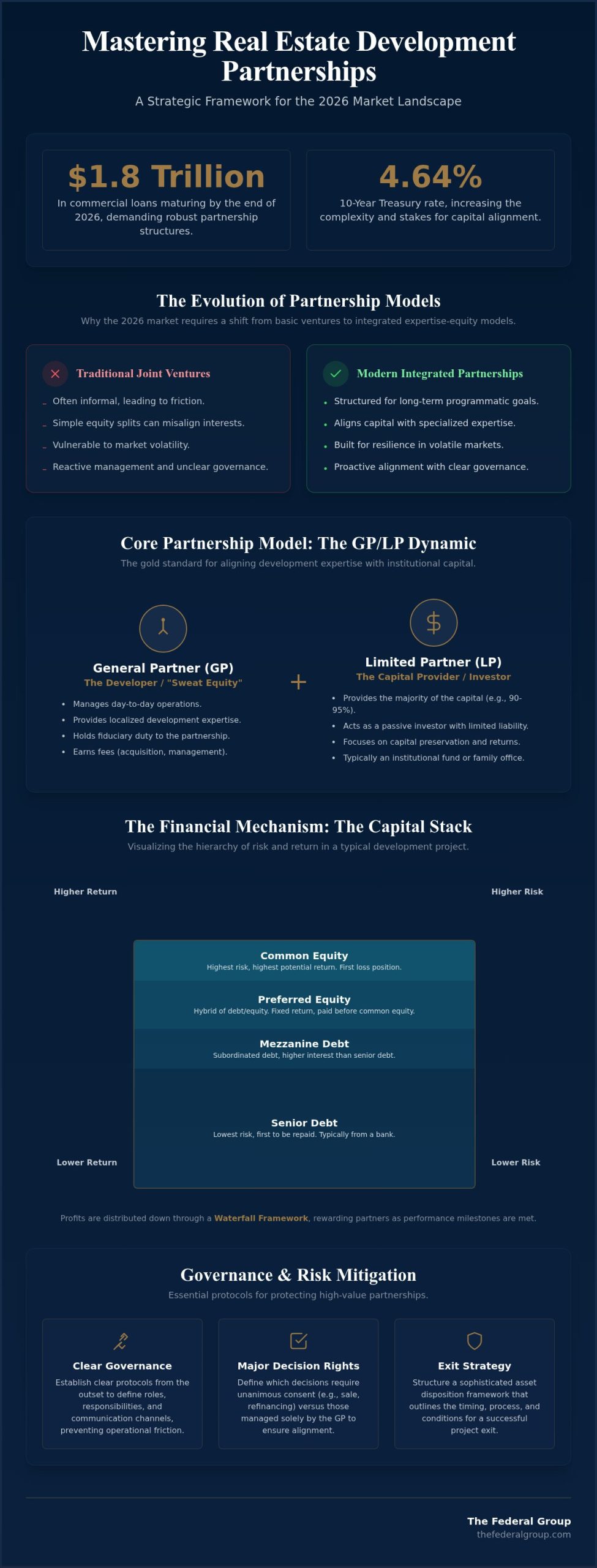
The 2026 real estate market represents a fundamental shift in how value is created and protected. Structuring real estate development partnerships has evolved from a simple cost-sharing exercise into a high-stakes alignment of global capital and specialized expertise. A modern partnership is defined as a strategic alliance where the Developer provides localized operational mastery and the Equity Partner provides institutional-grade liquidity. The $1.8 trillion in commercial loans maturing this year has forced a departure from the informal joint ventures of the past. High-value projects now require robust structures that can withstand a 4.64% 10-Year Treasury and the complexities of international tax compliance.
We’re seeing a decisive movement away from project-by-project deals toward long-term programmatic partnerships. These financial ecosystems allow for predictable capital deployment across multiple assets, reducing the friction of repeated fundraising. Success in this environment often hinges on the involvement of an international real estate finance partner. Such partners facilitate cross-border growth and bridge the gap between regional development opportunities and global liquidity pools.
Drivers of Modern Institutional Alignment
The scale of mixed-use developments in 2026 demands capital pools that exceed the capacity of most independent firms. Beyond simple funding, the rising complexity of global ESG frameworks and multi-jurisdictional regulations requires a partner with deep analytical resources. Aligning with a real estate private equity partner provides the institutional weight necessary to navigate these hurdles while maintaining the momentum of large-scale construction. This alignment ensures that every project meets the stringent compliance standards required by global investors.
Solo Development vs. Strategic Partnerships
The choice between solo development and a strategic partnership is ultimately a trade-off between 100% ownership and 100% risk. While total control is appealing, it often leads to over-leveraging and limited scalability in a volatile market. Partnerships allow developers to diversify their portfolios and access specialized expertise in design and construction management. Mastering the Real estate development process now requires an integrated approach. By structuring real estate development partnerships effectively, firms can leverage the synergy between private equity and high-level construction management to achieve superior risk-adjusted returns without compromising their balance sheets.
Core Partnership Models: JV, GP/LP, and Co-Investments
Selecting the appropriate legal and financial vehicle is the first critical step in structuring real estate development partnerships. In the 2026 market, where the 10-Year Treasury sits at 4.64%, the choice of model dictates how risk is distributed and how capital is recycled. While many developers default to familiar arrangements, high-stakes international projects require a more nuanced approach to entity selection. The decision typically rests on a trade-off between operational autonomy and the scale of institutional backing required for the asset class.
The GP/LP Dynamic: Expertise Meets Capital
The General Partner (GP) and Limited Partner (LP) hierarchy remains the gold standard for private equity alignment. In this structure, the GP acts as the manager, providing the “sweat equity” and localized development expertise. Conversely, the LP serves as the passive capital provider, often an institutional fund or family office. Success in Structuring Real Estate Partnerships under this model depends on transparent fee arrangements. Standard structures include acquisition fees for sourcing the deal, ongoing management fees for project oversight, and disposition fees upon a successful exit. This model effectively balances the GP’s fiduciary duty with the LP’s need for capital preservation.
Joint Ventures for Large-Scale Projects
Joint Ventures (JVs) are frequently utilized for single-asset, high-value developments where both parties seek active involvement. When securing development finance for mixed-use projects, a JV allows for a 50/50 or majority/minority split that can be tailored to the specific strengths of each partner. These agreements must contain precise clauses to prevent operational paralysis. Deadlock provisions, buy-sell triggers, and rights of first refusal are essential for maintaining momentum during market volatility. For developers seeking to scale without the constraints of a traditional fund, exploring bespoke private equity solutions can provide the necessary flexibility to execute complex builds.
Co-investment vehicles have also seen a rise in 2026 as institutional LPs seek more direct exposure to specific projects alongside the GP. This model reduces the “blind pool” risk associated with large funds and allows for more granular control over asset selection. Whether you’re managing a workforce housing project in the Midwest or a logistics hub, the model you choose must align with the project’s duration. Short-term bridging needs might favor a lean JV, while decade-long mixed-use masterplans demand the robust governance of a GP/LP framework. Structuring real estate development partnerships with this level of foresight ensures that the capital stack remains resilient through every phase of the project lifecycle.
The Financial Mechanism: Capital Stacks and Waterfall Distributions
The financial architecture of a deal is where the vision of a project meets the reality of institutional discipline. In the current 2026 environment, with the Secured Overnight Financing Rate (SOFR) at 3.65%, the anatomy of the capital stack has become increasingly sophisticated. Senior debt remains the foundation, typically covering 60% to 65% of the loan-to-cost (LTC). However, the gap between senior debt and common equity is now frequently filled by mezzanine finance and preferred equity. Success in structuring real estate development partnerships requires a precise understanding of how these layers interact to protect the principal while incentivizing performance.
Profit distributions are governed by the “waterfall,” a hierarchical mechanism that dictates the order and magnitude of cash flow payments. These distributions are rarely linear. They rely on performance milestones, often triggered by the Internal Rate of Return (IRR). Once the Limited Partner (LP) achieves a specified return, the distribution shifts to favor the General Partner (GP) through “carried interest” or a “promote.” This alignment ensures the developer is rewarded for outperformance, creating a high-stakes synergy between capital and execution.
Navigating the Waterfall: Hurdles and Catch-ups
Hurdle rates serve as the gatekeepers of the waterfall. A standard 2026 institutional structure might set an initial hurdle at an 8% to 10% preferred return. Until this threshold is met, the LP receives 100% of the distributable cash flow. Once the hurdle is cleared, a “catch-up” clause often activates. This provision allows the GP to receive a concentrated share of profits until their total distribution matches their agreed promote percentage. Tiered models further refine this by increasing the GP’s share as higher IRR targets, such as 15% or 20%, are achieved. This tiered approach protects the LP’s downside while providing the GP with significant upside for exceptional delivery.
Equity vs. Debt in the Partnership
The distinction between debt-like and equity-like instruments is critical when establishing leverage ratios. Many developers utilize bridging finance for land acquisition to secure prime sites before the full partnership capital is called. Preferred equity often acts as the “bridge” between mezzanine debt and common equity, offering a fixed return with some upside potential but without the voting rights of common shares. In a market where bank construction loans range from 6.5% to 9.5%, balancing these layers is essential. Structuring real estate development partnerships with a resilient capital stack allows the project to absorb interest rate fluctuations without compromising the project’s viability or the partners’ fiduciary obligations.
Governance and Risk Mitigation for High-Value Partnerships
Governance frameworks act as the operational guardrails for high-stakes projects, ensuring that the developer’s execution remains aligned with the investor’s risk appetite. In 2026, the complexity of international project management has made vague agreements a significant liability. Structuring real estate development partnerships now requires granular definitions of “Major Decisions” that fall outside the developer’s day-to-day autonomy. These typically include budget variances exceeding 5%, the selection of senior lenders, and the timing of asset disposition. By codifying these triggers, partners prevent the operational paralysis that often occurs during market shifts.
Risk mitigation extends beyond decision rights into the realm of personal and corporate accountability. “Bad Boy” guarantees are now standard, protecting the capital partner against “above-the-line” risks like fraud, gross negligence, or unauthorized debt. Performance bonds further insulate the project from contractor insolvency, a critical consideration as the $1.8 trillion “Wall of Maturities” puts pressure on construction firms. A well-structured partnership also anticipates its own end. Whether through a clean dissolution or a recapitalization event, exit strategies must be defined before the first stone is laid.
Institutional Governance Triggers
Institutional partners demand a level of transparency that matches their fiduciary obligations. This includes unanimous consent for any changes to the capital stack or fundamental shifts in the project’s use case. Reporting standards must be rigorous, providing real-time data on construction progress and budget burn rates. When disputes arise, mechanisms like “Texas Shootout” clauses or mandatory arbitration in stable jurisdictions ensure that conflicts don’t stall the development lifecycle. This structured approach provides the security required by global equity providers.
De-risking through Operational Transparency
Transparency is the ultimate de-risking tool in cross-border development. Utilizing third-party audits and independent construction monitoring provides an objective layer of oversight that satisfies institutional LPs. Managing cross-border risks also involves sophisticated currency hedging and a clear understanding of international legal jurisdictions. Partnering with an integrated development finance lender ensures that your project benefits from global oversight and institutional-grade reporting. If you are ready to scale your portfolio with a partner that prioritizes stability and precision, consider our bespoke capital solutions.
The Integrated Advantage: Partnering for Full Lifecycle Success
In the fragmented landscape of 2026, the greatest risk to a partnership is the disconnect between the drawing board and the balance sheet. Traditional models often suffer from a “feasibility gap” where architectural ambitions collide with the realities of high-interest construction debt. By structuring real estate development partnerships through an integrated lens, stakeholders can unify these disparate phases into a single, cohesive operation. This approach moves beyond simple capital provision, transforming the relationship into a full lifecycle ecosystem that prioritizes speed to market and capital efficiency.
The integrated design and build developer model serves as the ultimate friction-reducer. It ensures that every design choice is vetted against current market variables, such as the 6.75% WSJ Prime Rate, before a single permit is filed. The Federal Group embodies this philosophy by pairing its Private Equity arm with the specialized build expertise of Federal Holdings. This synergy allows for a “full lifecycle” approach that eliminates the costly delays typical of third-party architectural consulting, focusing instead on internal execution and financial precision. Case study data from recent mixed-use projects shows that this integration can reduce construction timelines by up to 15% compared to traditional siloed models.
Synergy Between Finance and Build
Early-stage design integration is the most effective defense against the cost overruns that plague large-scale projects. When the build team and the finance partner operate under the same umbrella, equity partners gain unprecedented visibility into the project’s health. This transparency is particularly vital in specialized sectors. For instance, The Federal Group’s Sports Division leverages this niche expertise to manage complex stadium and multi-club developments. In these projects, specialized infrastructure must align perfectly with revenue-generating capital structures to ensure long-term viability and operational success.
Building Long-Term Developer-Capital Relationships
The goal of structuring real estate development partnerships in today’s high-stakes market is to move from transactional deals to “partner of choice” status. This evolution requires a commitment to the entire asset lifecycle, from the initial bridging loan for land acquisition to the final disposition of the stabilized asset. The Federal Group supports developers through this progression, providing the stability of a seasoned financier with the visionary energy of an integrated builder. Initiating a partnership for your next high-value project begins with a strategic alignment of goals and an uncompromising focus on risk-adjusted returns. Taking the next step toward a partnership ensures your development has the institutional weight required to thrive in a volatile global market.
Securing Your Development Legacy in a Global Market
The 2026 real estate landscape demands a departure from legacy joint venture models toward sophisticated, institutional-grade alignment. Success depends on your ability to harmonize complex capital stacks with transparent governance and performance-based waterfall distributions. By mastering the nuances of structuring real estate development partnerships, you position your portfolio to absorb market volatility while securing the scalable capital necessary for international growth.
The Federal Group provides the stable, authoritative foundation required for these high-stakes challenges. As specialists in international property finance and private equity, we offer a unique competitive advantage through Federal Holdings, our fully integrated Design and Build division. This lifecycle approach eliminates the friction between financial feasibility and architectural vision, particularly in specialized asset classes like global sports infrastructure and high-value property.
Partner with The Federal Group for your next high-value development project to leverage our global expertise and integrated construction management. The right partnership doesn’t just fund a project; it transforms a visionary concept into a resilient, high-yield asset. We are ready to help you navigate the complexities of the global market with confidence and precision.
Strategic Partnership Frequently Asked Questions
What is the most common legal structure for real estate development partnerships?
Limited Liability Companies (LLCs) and Limited Partnerships (LPs) remain the most common legal structures in 2026. These entities provide essential liability protection while allowing for pass-through taxation. In complex international deals, these structures facilitate the clear separation of management duties and capital contributions. Choosing the right entity is a foundational step in structuring real estate development partnerships to ensure long-term stability and tax efficiency across different jurisdictions.
How do waterfall distributions work in property development?
Waterfall distributions are hierarchical profit-sharing models that dictate the order in which cash flow is split between partners. They typically begin with a preferred return to the Limited Partner (LP) until a specific hurdle rate is reached. Once achieved, the General Partner (GP) receives a “promote” or “carried interest” as an incentive for outperformance. This mechanism ensures that the developer’s interests are perfectly aligned with the financial success of the institutional capital provider.
What is a ‘Bad Boy’ guarantee in a real estate partnership?
A ‘Bad Boy’ guarantee is a legal provision that converts a non-recourse loan into a recourse loan if the borrower commits specific “bad acts.” These acts usually include fraud, gross negligence, or unauthorized debt. While the partnership itself typically limits liability, these guarantees ensure that individual stakeholders remain personally accountable for actions that could jeopardize the project’s integrity. It provides an essential layer of security for institutional equity partners.
How does a GP/LP structure differ from a Joint Venture?
The primary difference lies in the level of operational involvement and liability. In a GP/LP structure, the Limited Partner is a passive investor with limited liability, while the General Partner manages the project. A Joint Venture often involves more active participation from both parties and is frequently used for single-asset developments. JVs often involve a more equal distribution of decision-making power compared to the manager-led GP/LP model.
What role does private equity play in property development partnerships?
Private equity provides the high-octane capital and strategic oversight necessary for industrial-scale projects. Beyond simple funding, private equity partners bring global market insights and rigorous compliance standards to the table. The Federal Group leverages this capital to fuel high-potential developments, ensuring that projects have the liquidity needed to navigate the $1.8 trillion in loan maturities scheduled for 2026. This partnership model transforms regional opportunities into institutional-grade assets.
How can I maintain control of my project while taking on institutional equity?
You can maintain operational control by clearly defining “Major Decisions” within the partnership agreement. Structuring real estate development partnerships with specific governance triggers allows you to retain day-to-day management while giving institutional partners consent rights over high-stakes events like refinancing or asset sales. This balance ensures that you benefit from institutional capital without sacrificing the localized expertise that drives project value. Clear reporting and transparency further reinforce this trust.
What are the common exit strategies for a real estate development partnership?
Exit strategies typically involve a stabilized asset sale, a recapitalization, or a partner buyout. In 2026, many partnerships target a sale to institutional buyers or REITs once the project achieves specific occupancy milestones. Alternatively, a “buy-sell” provision allows one partner to acquire the other’s interest under defined conditions. Establishing these exit frameworks early in the development lifecycle ensures a clean dissolution and protects the risk-adjusted returns for all stakeholders.
How does integrated design and build affect partnership risk?
An integrated design and build model significantly reduces partnership risk by eliminating the disconnect between architectural vision and financial feasibility. Through divisions like Federal Holdings, developers can vet construction costs against real-time market data during the design phase. This synergy prevents the budget overruns that often cause friction in traditional partnerships. By managing the full project lifecycle, integrated developers provide a higher degree of cost certainty and timeline reliability for their equity partners.